
Over the past few months, we’ve extensively talked about the NFL Draft and the players selected by each team – most recently as part of my month-long divisional draft and roster review video series – to go with some thoughts on free agency. At this point of the calendar, we’ve largely reached the end of the roster acquisition period, and it’s time to make some overarching statements.
The purpose of this exercise is to draw conclusions one more time, but from more of a large-scale view, and outline the position groups that were improved the most through all these different avenues, also including trades. This is based on what each roster looked like following week 18, not taking injuries into account, whether those affected who were actually available at that time or those who may linger into this upcoming season.
Once again, the idea here is to talk about these units in a more comprehensive sense, rather than simply pointing at a singular player who might change the feel of those.
This is what I came up with:
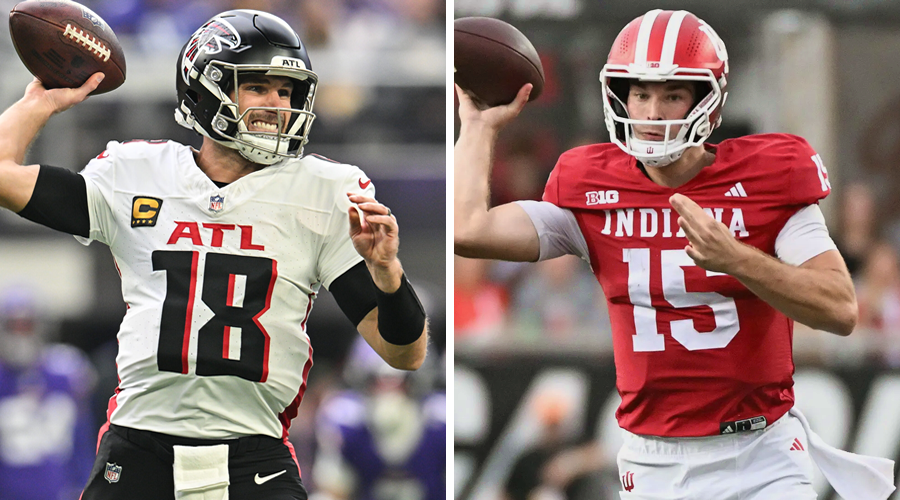
Quarterbacks – Las Vegas Raiders
Additions: Kirk Cousins & Fernando Mendoza
Departures: Geno Smith & Kenny Pickett
Since I’m trying to reflect on all my thoughts and previous iterations of articles like this, I will start off by saying that I had the Raiders in this spot a year ago already, when the bar was pretty easy to clear, as Geno Smith and a couple of late-round picks simply had to outclass Gardner Minshew and Desmond Ridder as departures. And even though we can argue about what Geno presented for them, it certainly wouldn’t be sincere of me to claim there was any substantial improvement. I believe that changes this year. If we were talking about one of the most courageous passers in the sport, with the Seattle version of Geno, that would be a different story. But this past season, he allowed bad circumstances to drag his level of play down, with no support from the run game, and very limited receiving options, particularly when Brock Bowers was either out or banged up, while just not operating in a more fast-paced way that might mitigate crumbling pockets. So above everything else, how quarterbacks are asked to function in this Klint Kubiak offense, should create an easier environment for these Raiders signal-callers, where they move the launch-point frequently and incorporate a heavy dose of true dropbacks from under center, which don’t typically allow defensive lines to fly off the ball. Even if you ignore the QBR of 3.4 Pickett posted in his two starts, all you’re hoping for is that someone (in 15 games) doesn’t compound their issues to the tune of leading the league in interceptions (17) and sacks (55).
Although I view that three-year stretch as a starter with the Seahawks for Geno of higher quality than anything Cousins has done in his career in that same time frame, his overall track record in the league offers a steadier floor. 2024 was a catastrophe for the Falcons, drafting Michael Penix Jr. eighth overall shortly after handing the veteran a substantial, fully guaranteed contract, only to be repaid with an almost equal number of touchdowns as interceptions (18-to-16) while going 7-7 as a starter. If you take out that season, here are Kirk’s 17-game averages – 67.3% completion rate, 4505 passing yards and 31 touchdowns vs. 11(.3) interceptions, with a 79-63-2 record. Moreover, he’s very familiar with this Kubiak-Kevin O’Connell world of offenses and what’s expected from the quarterback. He regularly flirted with the top-ten line during his time in Minnesota, delivering a bunch of high-level anticipation throws in the deep and intermediate area, while being willing to hang in the pocket.
Yet, even if we were to concede that Geno-to-Kirk is about an even trade-off, we’re basically looking at a player in Pickett, who I clearly didn’t consider first-round caliber, and never lived up to that pedigree, by someone that pretty much everyone agreed was worthy of going first overall. Mendoza was pretty much locked into that selection since the day he beat Ohio State in a battle of then-undefeated teams in the Big Ten Championship, followed by winning the Heisman Trophy, and bringing the Hoosiers their first-ever national title. At times compared to Cousins due to their sort of lanky builds and corny personalities, there are some similar qualities in terms of toughness and how they throw the football, but the rookie clearly offers better mobility to pick up key yardage with his legs, and more mustard behind the ball, particularly at this stage of Kirk’s career, when you compare it to Mendoza driving the ball on a line from one hash to the opposite sideline, even with hoe much longer that distance even is on a college field. I’ve discussed the learning curve he may face coming from this RPO-heavy Indiana system in the AFC West review, and therefore, there are some moments he appears panicky inside the pocket when the picture does change post-snap on true dropbacks. However, what I really appreciate is how he communicates to his targets with the placement of the ball, and how he’s able to defeat tight coverage that way.
Honorable mention: New York Jets
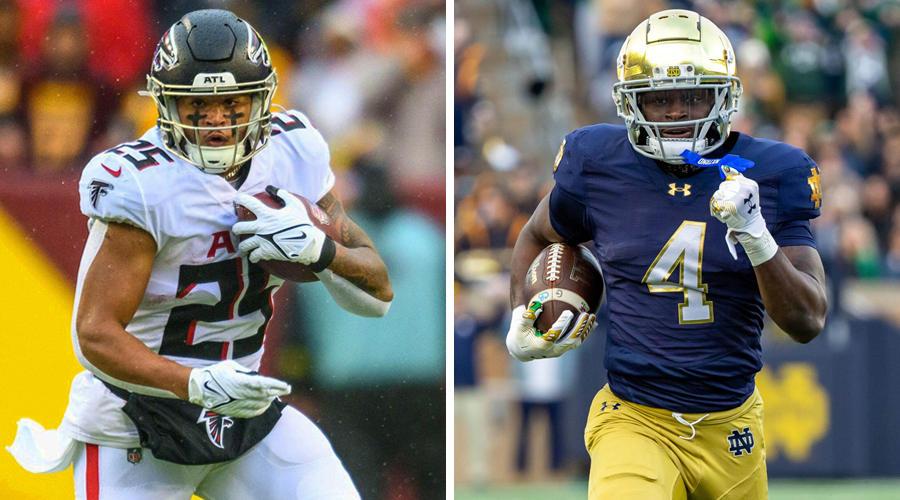
Running backs – Arizona Cardinals
Additions: Tyler Allgeier & Jeremiyah Love
Departures: Emari Demercado & Michael Carter
Similar to quarterbacks, obviously the addition of the third overall pick in the draft is the main difference for the ceiling of this group, but yet another steady veteran should lift the floor for them collectively. As I already mentioned in the intro, pre-existing injuries are not considered as part of this exercise, which would make the James Conner situation complicated, as he’s still recovering from a gruesome leg injury suffered in week three of this past season. Putting him and a mid-day selection from the 2024 draft in Trey Benson aside, who appeared bound to break out in the veteran’s absence, only to suffer a meniscus injury just a week later that knocked him out for the rest of the year, the two running backs actually off the roster now will combine for just 2.5 million dollars on their respective one-year deals buries on the depth chart elsewhere. Emari Demercado certainly was the more efficient of the duo on a per-touch basis, but his season-long 71-yard run ended with him dropping the ball just short of the goal-line and starting the gears on a Titans comeback, when it should’ve been the dagger. And then he only had one game with more than five carries all year. Meanwhile, Michael Carter’s 333 rushing yards led the team overall, but he so on half the yards-per-carry average (3.6 YPC), and has been a third-down-oriented RB3 throughout his career.
For people in the fantasy space, hearing/reading the name of Tyler Allgeier can send a shiver down their spine, if they owned Falcons superstar Bijan Robinson over the last few years, but considering how much two different coaching staffs leaned on him being a major piece of the rotation, he’s continued to earn his opportunities to be on the field. That’s particularly been the case near the goal-line, as he’s reached the end zone 20 times across 737 career touches so far. Having been such a short-yardage specialist throughout his time in Atlanta has pushed Allgeier’s averages down, but since entering the league in 2022, his rushing success rate of 41.6% ranks 11th among 34 players with 500+ carries (676 for Allgeier). This is one of the most hard-nosed runners in the league, constantly plowing through angled tackles and churning out yards after contact, with his 3.27 career average consistently flirting with the top ten for the position. He’s always been at his best in a (wide) zone-based rushing attack, where he can transfer his momentum downhill after stretching the defense horizontally, like he will in again with new Cardinals head coach Mike LaFleur, and he’s never allowed a QB sack across 151 total pass-blocking snaps (six pressures).
The crown jewel here, of course, is Jeremiyah Love however, coming off a season in which he won the Doak Walk Award – handed to the top running back in college football – and finished on the podium for the Heisman Trophy. He averaged exactly 6.9 yards per carry each of the past two years, with just over 3000 yards and 40 touchdowns total from scrimmage. As I’ve described in detail before, he offers an interesting build, where he somewhat deceptively packs around 215 pounds across his fairly narrow frame, which allows him to slice through narrow creases. He runs with tremendous contact balance and determination to get himself out of muddy situations, yet when he’s given a lane to accelerate, he has that final gear to pull away for homeruns, even if he has to hurdle over a diving tackling attempt along the way. Along with what he does on the ground, Love has continuously showcased improvements as a pass-protector, and just watching him go through his on-field workout at the combine (to go with his 55 catches over the last two years), he’s incredibly natural as a route-runner and when adjusting to passes. To the point where the often-overused adage of “he’s an extra receiver on the field” does apply, because he can legitimately line up in any eligible spot. Exposing Love to less of a beating between the tackles on early downs with Allgeier’s presence, so the rookie is fresh enough to do damage in space, should be a positive long-term.
Honorable mention(s): Kansas City Chiefs
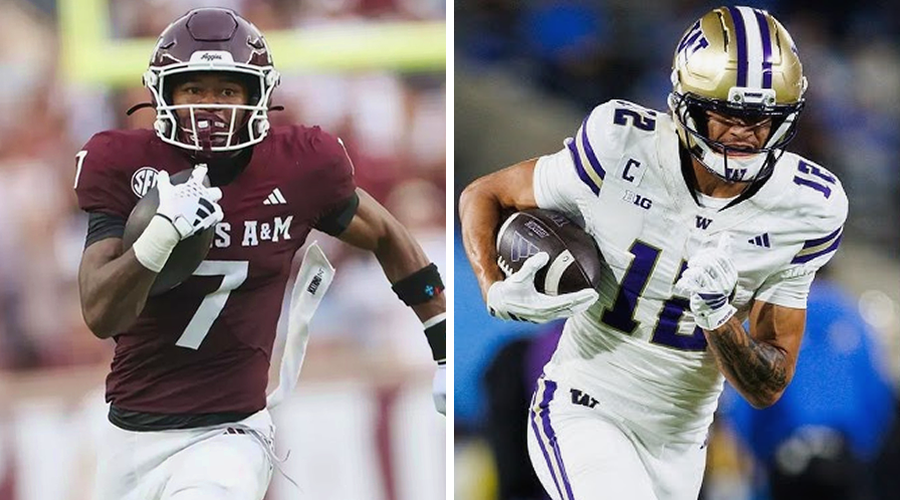
Receiving corp – Cleveland Browns
Additions: K.C. Concepcion, Denzel Boston, Tylan Wallace, Joe Royer & Carsen Ryan
Departures: Malachi Corley, Jamari Thrash, David Njoku & Brenden Bates
Although this marks the third straight position group, where the biggest influx of talent comes via the draft, I do believe two top-40 picks make it quite meaningful. More important however is the contrast to the actual departures. Coming off arguably his least productive season of extended action further helps with David Njoku moving on in free agency, as they’re betting on youth at tight-end, particularly with what Harold Fannin Jr. showed in his rookie season. Not having both guys to give them a really fun 12 personnel grouping on obvious passing downs I do consider as a loss, but it was also difficult to actually get them out on the field together, because neither one has ever been particularly comfortable as a true hand-in-the-dirt, on-the-ball “Y”. Yet, while Njoku came close to 300 receiving yards across 12 games played, these other three names above combined for just 211 yards through the air. Malachi Corley in particular did receive some opportunities as part of end-around/fly sweep game, along with returning kicks for Cleveland, but he was part of final roster cuts for the Jets only 16 months after he was the 65th overall pick in the draft for them, and he has yet to reach the end zone in the pros – as another guy who entered the dog house in New York after dropping the ball at the one-yard line.
Again, the main selling point around the improvements of this receiving point, in combination with there not being multiple truly substantial losses, is this duo of highly drafted rookies. K.C. Concepcion and Denzel Boston basically posted 1000 and 900 scrimmage yards respectively, both with double-digit touchdowns. More so than their previous accolades, it’s the skill sets they bring to the table that are really intriguing. I have my concerns with how Concepcion approaches the football, and that drops may follow him to the NFL level. Still, he was a dynamic gadget player at N.C. State, who can handle an assortment of touches and individually create yardage (averaging nearly a missed tackle every fourth catch of his career), before turning into one of the elite separators in college football last season at Texas A&M, when much more was put on his plate from a route-running perspective. Plus, he was a consensus All-American all-purpose player, also averaging 18.2 yards per punt return and taking two of those the distance. Boston, meanwhile, is much more of your prototypical big-bodied X receiver, who can battle through contact during the route and win contested catches, going 10-of-13 in that regard last season. Yet, he’s more deceptive in his early set-ups, makes sure to attack the blind spots of defenders, and can reduce that 6’4” frame at the break-point. Plus, he consistently runs through the catch and is highly competitive once the ball is in his hands.
Veteran Tylan Wallace only had one season of any real note in terms of receiving production, as he hauled in all but one of his 12 targets for just under 200 yards two years ago, with 112 combined over the other four. However, the reason Baltimore kept him around for that long is two-fold – he had a game-winning overtime return touchdown in 2023 as one of his 1000 career special teams snaps in five years, and he’s largely been a quality blocker when used on offense. As for the two day-three tight-ends, Joe Royer posted 79 catches for 937 yards and seven touchdowns in two years at Cincinnati. His ability to play above the rim is a big bonus (10-of-17 in contested situations), he runs angry with the ball (14 missed tackles forced across that time), and had a perfect passer rating when targeted in 2025 (158.3). Carsen Ryan, meanwhile, brings the size (6’3”, 255 pounds) and mindset to contribute in-line and as a utility player, who’s urgent out of his stance, fundamentally sound with connecting his hands and centering his blocks. Along with that, he did a lot of work on leverage throws and replacing zone defenders at BYU, before becoming a tough guy to wrestle to the ground, averaging 7.5 yards after the catch this past season. This isn’t a very proven group at this point, but they slot into more substantial roles.
Honorable mention(s): New England Patriots, New Orleans Saints & Tennessee Titans
Offensive line – Houston Texans
Additions: Braden Smith, Wyatt Teller, Evan Brown, Keylan Rutledge & Febechi Nwaiwu
Departures: Tytus Howard, Laken Tomlinson & Juice Scruggs
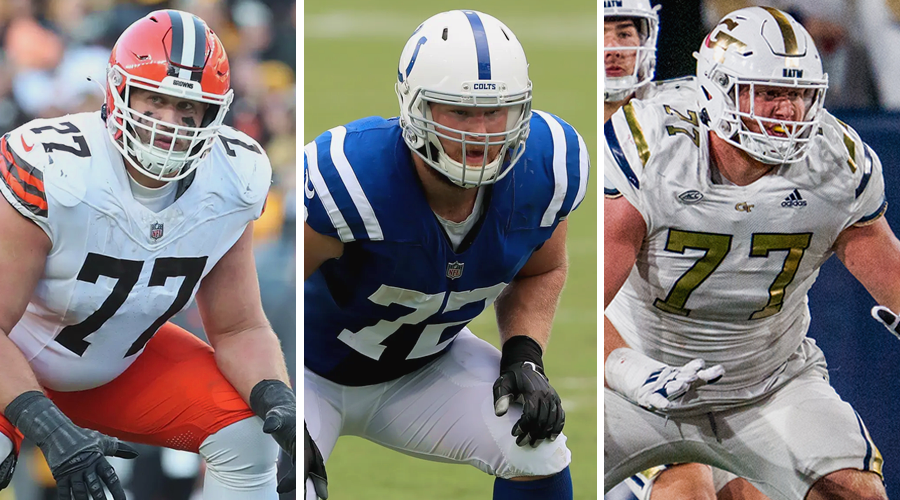
Funnily enough, the Browns were in contention here, based on them moving on from several aging veterans, only bringing back one primary starter from their previous five, of which one ended up in Houston. However, after they were in horrendous shape two years ago, culminating in C.J. Stroud getting sacked eight times in the 2024/25 Divisional Round at Kansas City, you can definitely see a plan for the Texans, and they could be a legitimate “plus unit” this upcoming season. The one move I questioned at the time was trading Tytus Howard to Cleveland for a fifth-round pick, who’s been a solid starter for them at left guard and right tackle as a former first-rounder. Having turned 30 recently, and in correlation with some of the decisions they made, I can get on board with it however. Juice Scruggs was the other player involved in a trade, who has been an underwhelming spot starter, as they packaged him with a fourth- and seventh-rounder respectively for former Lions running back David Montgomery – who should also help fortify their protections as one of the better pass-blockers at the position. Otherwise, Laken Tomlinson is a familiar name, but was limited to just seven games last season, prior to being inactive for a while and then getting waived at the start of December. So he doesn’t even fully qualify here, but I did decide to bring him up as someone in the twilight of his career, in pretty steady decline since leaving San Francisco four years ago.
As for the additions, Braden Smith presents the opposite of Trent Brown out on the edge, as an uber-reliant presence for the Colts, who’s regularly flirted with Pro Bowl level of play. He has missed meaningful time each of the past three seasons, but he has played double-digit starts in all eight with Indy. All but 107 of his 6917 career snaps have been at right tackle, where basically every year he’s posted a PFF pass-blocking grade around 70, although his run-blocking has unfortunately declined a little bit recently. Nonetheless, you rarely see any missed assignments, and he typically “dies slowly” if he does eventually lose in pass-pro, rather than a lot of quick pressures that have haunted Houston’s offense at times. Meanwhile, Wyatt Teller presents one of those rare cases, where a team traded a player just a year after drafting him, returning the fifth-round pick the Bills originally used on him, to go with a sixth-rounder, while putting a seventh into the package themselves. Since then, he was a fixture at right guard for seven years in Cleveland. This past season was his worst in terms of pass-blocking efficiency, but he’s still one of the most physical guys when it comes to creating vertical displacement on combo-blocks and kicking edge defenders out of the club as a puller. He’s a perfect fit for their recent transition to a more gap-scheme-oriented approach. The third veteran, Evan Brown, has weirdly been able to hang around as a starter a lot more than you might expect, logging over 4300 total snaps split between the three interior spots on the O-line, for three different teams. He should at least provide quality depth and versatility.
With that in mind, their commitment to bolstering that unit continued during the draft. Firstly, they actually traded up a couple of spots for pick 26 to select Georgia Tech’s Keylan Rutledge. The interesting piece with his projection to the pros, of course, is that he spent all but two of 1776 offensive snaps in his two years with the Yellow Jackets at right guard, following his transfer from Middle Tennessee State. However, the Texans immediately talked about him moving to center, which makes sense on paper, based on previously signing guard Ed Ingram to a three-year, 37.5-million-dollar contract extension. On basically half of those spent in pass-protection, Rutledge only allowed one sack and 12 total QB pressures. However, I would say he’s actually a significantly better road-grader in the run game, who was constantly tasked with pulling duties, kicking out, wrapping around to lead up on backers, or getting out to the corner. Houston came back to start day three and selected guard Febechi Nwaiwu. He turned himself into a standout performer in his second season at Oklahoma, following his transfer from North Texas. Across 505 pass-blocking snaps in 2025, he didn’t surrender a single sack or hit on his quarterback (two hurries), and he was only penalized once all year. His body control to adjust to targets on the fly is more questionable, but he’s a densely built player with 34.5-inch arms, who can drop a heavy shoulder and ride D-tackles off their landmarks. So this further cements them wanting to lean on attacking downhill on the ground and creating firm interior of the pocket for C.J. Stroud, so his worst tendencies aren’t highlighted as much, where he can start to see ghosts at times.
Honorable mention(s): Cleveland Browns
Defensive line – Cincinnati Bengals
Additions: Dexter Lawrence, Jonathan Allen, Boye Mafe & Cashius Howell
Departures: Trey Hendrickson, B.J. Hill & Joseph Ossai
The divorce between Hendrickson has basically lasted three years now, as he’s been seeking a long-term contract with the Bengals, but was basically franchise-tagged each of the last two offseasons, with altered one-year contracts respectively. For both of those, they were coming off consecutive 17.5-sack campaigns, leading the league in that category for the latter. Finally, in 2025, he suffered a core muscle injury midway through the season, which required surgery, from which he likely wasn’t going to rush back without financial security. So there’s no debate that Hendrickson is the most proven pure pass-rusher among all these names, but he will also turn 32 this season, and is looking to rebound from a quiet year. Secondly, a promising rookie season as a rotational player for Joseph Ossai unfortunately ended with an immature moment of tackling Patrick Mahomes out of bounds and drawing a deadly flag, which potentially cost the Bengals a chance to go to back-to-back Super Bowls. His snap total the following year was cut in half, but then it ticked back up significantly these last two years, somewhat out of necessity, combining for 74 QB pressures.
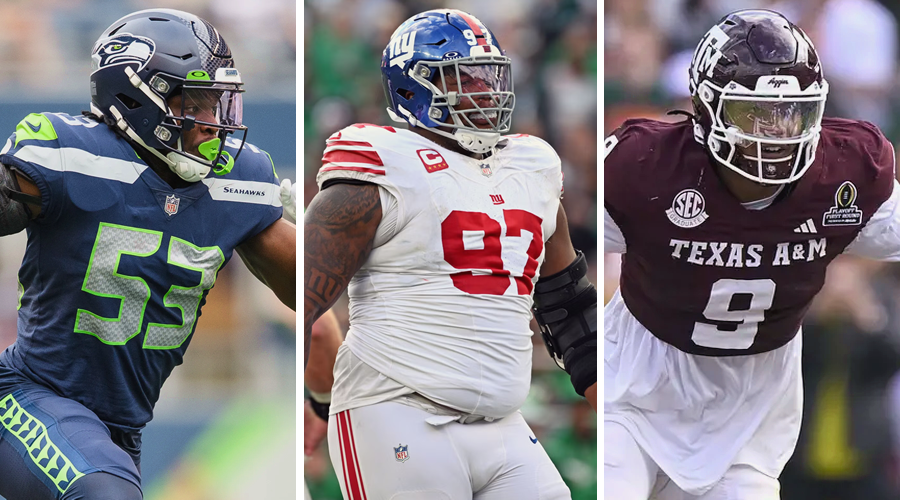
With all that in mind, where this trio of D-linemen led them – even though their safety and linebacker play were even bigger issues in that order – is finishing 27th or worse in each of the past three seasons in defensive EPA. Not saying that the player they traded the tenth overall pick in the draft for has single-handedly been able to lift the Giants’ fortunes, but he’s universally accepted as one of the elite players at his position, even if he’s coming off a down 2025 season, where his performance was likely impacted by lingering issues due to an elbow injury. Over the previous three years, he racked up 171 QB pressures across 1355 pass-rush snaps, despite primarily lining up between the A-gaps and drawing numerous double-teams, and was one of the premier run-defenders from that spot as well. The other D-tackle, Jonathan Allen, has unfortunately declined in his final season with Washington and then his one-year stint in Minnesota, particularly in run defense. However, he had previously posted at least 47 QB pressures in four straight seasons, and is still highly capable of creating vertical displacement as a pocket-pusher type. And he has only missed more than one game in one of eight years as a pro. Running a lot of Over fronts (with their DTs in 3- and 1-/2i-alignments) makes sense for DC Al Golden.
For Bengals fans who didn’t really track the Seahawks over the last three years, handing Boye Mafe 60 million dollars over the next three years may sound like a steep price, after only recording two sacks across 20 games during Seattle’s dominant defensive run to a Lombardi Trophy. Yet, over the course of that time, he’s been a quality edge setter in the run game and logged 149 QB pressures across less than 1200 pass-rush snaps. As for the top selection they did still own in the draft, following the trade for Big Dex, the Bengals picked Texas A&M’s Cashius Howell 41st overall. I don’t believe the 253 pounds he weighed in at the combine is truly representative of what he played at with the Aggies, and the major issue with his profile, of course, are those 30-and-¼-inch arms, with the consistent disadvantage that creates for him dealing with tackles. However, he plays above his weight class in run defense and has been one of the toughest guys to stay in front of rushing the passer these last three years, earning elite PFF grades in that regard and posting between 34 and 44 pressures on 760 combined opportunities. Both these guys bring a slipperiness to elude sift blocks by tight-ends on the backside of split zone concepts and slip off contact and create angles to the ball-carrier as they’re dealing with pulling linemen. Mafe offers more of a speed-to-power element, and uses his hands as weapons to free himself from stalemates, while Howell’s bend and suddenness to threaten the edges of pass-protectors are tremendous. Having these guys flying up the arc with how their interior rushers can take away space to step up should mesh very well.
Honorable mention(s): New York Jets & Kansas City Chiefs
Linebackers – New York Giants
Additions: Tremaine Edmunds, Arvell Reese & Jack Kelly
Departures: Bobby Okereke & Demetrius Flannigan-Fowles
I wouldn’t say that the second level of the Giants defense was a major problem area in previous years, but in 2025, that and their (banged-up) cornerback group really limited what their talented D-line might set the table for. Veteran Bobby Okereke was a solution for them to stabilize their linebacker play actually, when they signed him as a free agent in 2023. In his two 17-game seasons each as a starter with the Colts and Giants (being limited to 12 games in 2024), he’s posted at least 132 tackles in each of them. He also recorded nine forced fumbles, six interceptions and 28 pass break-ups across that time. His missed-tackle rate across that time has been right around 10%. However, this past season was his worst when you watch him operate on a snap-to-snap basis, in terms of reading and reacting to plays, putting himself in advantageous positions, which is backed up by PFF’s overall grading. Meanwhile, Demetrius Flannigan-Fowles has never started more than three games in any of his six seasons as a pro, of which he spent the first five with the 49ers. Just nine of his 129 career tackles have resulted in a loss for the offense, to go with only posting four PBUs, and no fumbles forced or recovered. Also, he only received a PFF grade of 60 or higher once in his career.
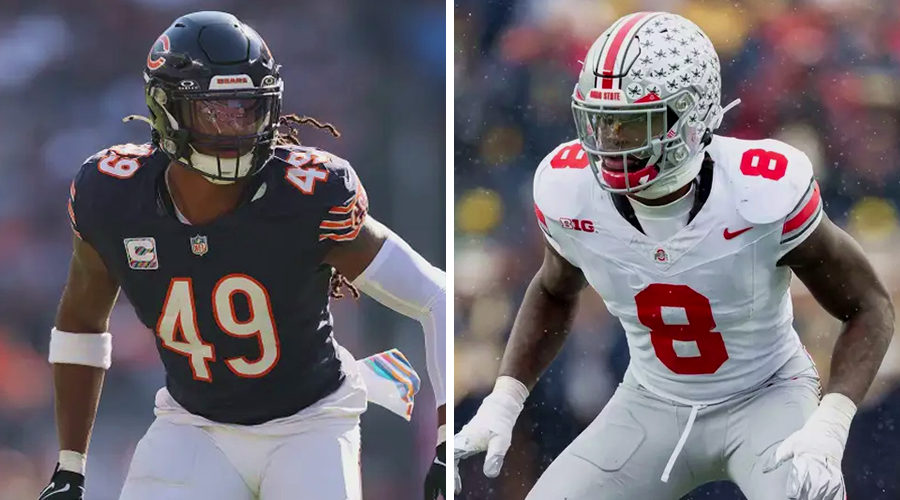
As we switch over to the additions, Tremaine Edmunds definitely isn’t a perfect player. He has never quite lived up to his billing as the 16th overall pick for the Bills in 2018, who came in with a highly intriguing physical profile, with a wingspan just short of seven feet, and only turned 20 years old days after he was actually drafted. Yet, although his mental processing skills never quite caught up to his athletic capability, he has literally started all 119 games he’s been available for (out of 133 possible). Edmunds has literally posted triple-digit tacklers all eight seasons as a pro (five with Buffalo, three with Chicago), intercepting 14 interceptions and breaking up another 59. The underlying coverage numbers have never been as good, but over the past five seasons, he’s posted a missed-tackle rate of just 8.5%. For Chicago to part ways this offseason was more so based on clearing 15 million dollars off their books. The biggest overall commitment the G-Men made this offseason, however, was using the fifth overall pick in the draft on Ohio State’s Arvell Reese. This guy emerged from a rotational player previously to a unanimous first-team All-American in 2025, playing this hybrid on-/off-ball role for the Buckeyes. He was already very productive in that season, posting 34 “defensive stops” and 27 QB pressures on 119 pass-rush snaps this past season. However, by his own admission, he didn’t really have much of a plan for getting after quarterbacks at that point, despite his 1.58 ten-yard split being tops among EDGE defenders. Reese brings a tremendous combination of violence and body control to the table, when you watch him take on and discard blockers on the move, come to balance to finish tackles in space. His instincts in coverage are still being developed, but there are no restrictions in his movements.
How these two athletes work in tandem will be fascinating to watch. Allowing Edmunds’ range in coverage to shine, while Reese is more frequently deployed as a pressure player, is logical. Moreover, it makes their pressure packages that much tougher to figure out, because they can mug both of them, line Reese up as a legit edge rusher, possibly to the same side, where offense don’t know who’s going to peel off – and then potentially still act as a QB spy. That’s especially true in combination with Abdul Carter, who didn’t transition from his off-ball LB role until his final season at Penn State, and can stand up over interior blockers. To go with that, they also selected Jack Kelly from BYU, who was a two-time team captain, earned first-team All-Big 12 honors in 2025, and had a relative athletic score of 9.83. He posted 30+ defensive stops in both seasons with the Cougars, and the former Weber State edge defender was insanely effective as a pass-rusher during his career, with 57 total QB pressures across 217 such snaps over that time, to go with only surrendering one touchdown on 32 targets (and nearly 300 coverage snaps) last year. He can also be a valuable spy or add-on rusher, with the way he tracks quarterbacks and the quick burst to erase escape angles.
Honorable mention(s): Las Vegas Raiders & Washington Commanders
Secondary – New York Jets
Additions: Minkah Fitzpatrick, Dane Belton, Nahshon Wright, D’Angelo Ponds & V.J. Payne
Departures: Tony Adams, Isaiah Oliver & Ja’Sir Taylor
Finally, we switch to the other New York team, whose defense last season was even more disappointing, even if you take into account that they traded their two best players (cornerback Sauce Gardner and defensive tackle Quinnen Williams) around the deadline. Nothing speaks more to that than the fact that they became the first team in the Super Bowl to go a full year without intercepting a pass. So as we get to the first players no longer on the roster, I won’t act as if Tony Adams isn’t a capable starting safety in this league. He’s posted PFF coverage grades above 65 in each of the last three years. However, he also had a missed-tackle rate just below 15% across that time, and outside of his three interceptions in 2023, he has only been involved in one takeaway of course of the rest of his rookie contract with the Jets. The next-biggest personnel loss was Isaiah Oliver. Two years into being a second-round pick for the Falcons, he started to transition to a primary nickel role, where he became a quality contributor across his final two of five seasons in Atlanta, along with a year with the 49ers and Jets. However, after being in the lineup for about half the games of his career previously, Oliver officially only logged two starts across all 17 weeks last season, and earned career lows in PFF coverage, run defense and tackling grades. Lastly, Ja’Sir Taylor did receive solid playing time in his second and third seasons with the Chargers as a former sixth-rounder at outside corner. However, at the deadline last season, they traded him to New York for basically the lowest draft pick possible (a 2028 seventh-rounder). And yet, 75 of his 138 snaps defensively came in a meaningless week 18 contest. These latter two have combined for just four picks on about 3300 coverage snaps, while Taylor has posted a 19.8% missed-tackle rate throughout his short career.
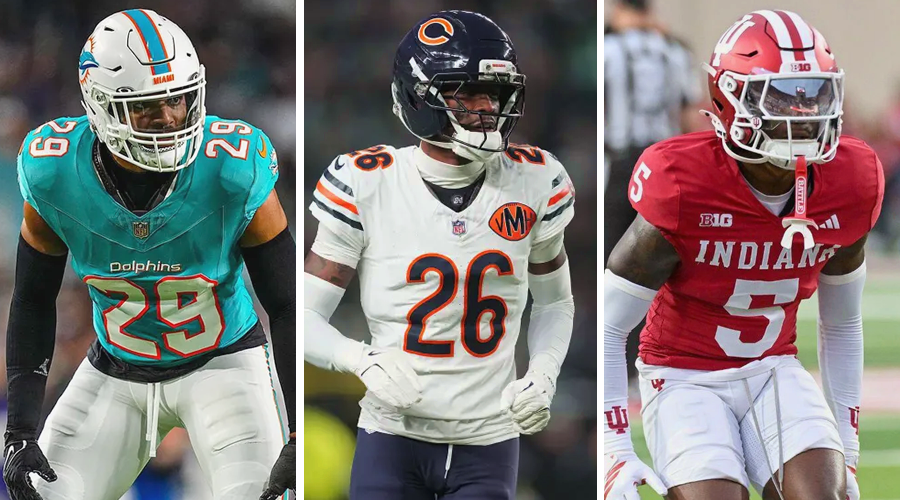
Trading a seventh-rounder for Minkah Fitzpatrick, who book-ended his previous time as a pro with a season in Miami each, to go with an impressive six-year stretch in Pittsburgh in between, may not change takeaway fortunes significantly. His ball-production saw a massive drop in 2023, as over these past three seasons, of which he’s also missed 20 of 51 possible games, he’s only combined for two picks and 13 pass break-ups. Previously, he had posted 19 total INTs and 47 PBUs across his first five years in the league. His run defense and tackling have remained of high quality, however, as someone should be deployed closer to the ball, missing barely over 10% of his attempts over that stretch. Dane Belton, on the other hand, had a poor start to his NFL career, but has cut his missed-tackle rate in half these last two years, respectively, down to 4.1% in 2025, with a lot more of those stops constituting an actual positive play for the defense in relation to down-and-distance. He has also collected six picks and 16 PBUs across his rookie deal with the Giants, as someone who can split snaps between attacking routes in front of him in quarters principles and dropping down into the box, including matching up with tight-ends. The third safety to bring up here is seventh-round pick V.J. Payne (Kansas State), who offers an elite height/weight/speed profile, at 6’3”, 210 pounds, with nearly 34-inch arms and 4.4 speed. He’s still developing that eye balance to track both the quarterback and nearby targets, but this past season, he was only charged with 158 yards across 38 targets as the next-closest defender, as a versatile piece on the back-end and team captain.
At the corner position, Nahshon Wright comes over from Chicago following a breakout season. After only starting three games across his first four seasons between the Cowboys and Vikings, he was a fixture in the lineup for the Bears in all but one of 19 total games (including the playoffs), thanks in part to injuries. Wright’s stats exploded, being involved in ten(!) total takeaways, to go with 11 PBUs. So I was very surprised to see the Jets were able to lock him down for a year at just 3.5 million dollars. To go with that, D’Angelo Ponds made it to pick 50 in the draft, despite making back-to-back first-team All-Big Ten and being named Defensive Player of the Game in two of Indiana’s CFP contests, because he’s only 5’9”, 180 pounds. Nobody’s ever told him that though, when you watch him set the tone at the line of scrimmage and compete at the catch-point, where a 43.5-inch vertical (the top mark among this year’s CB group) certainly helps. Along with showcasing some of the best film-studying habits and route anticipation you’re going to see from a college corner, he massively cut down his penalty count across nearly 500 coverage snaps (from seven to just one), and he’s a physical face, with a miss rate of just 3% last season. If nothing else, all these guys in the secondary should operate with a lot more decisiveness, as we see how Aaron Glenn actually meshes them together.
Honorable mention(s): Las Vegas Raiders & Los Angeles Rams

