
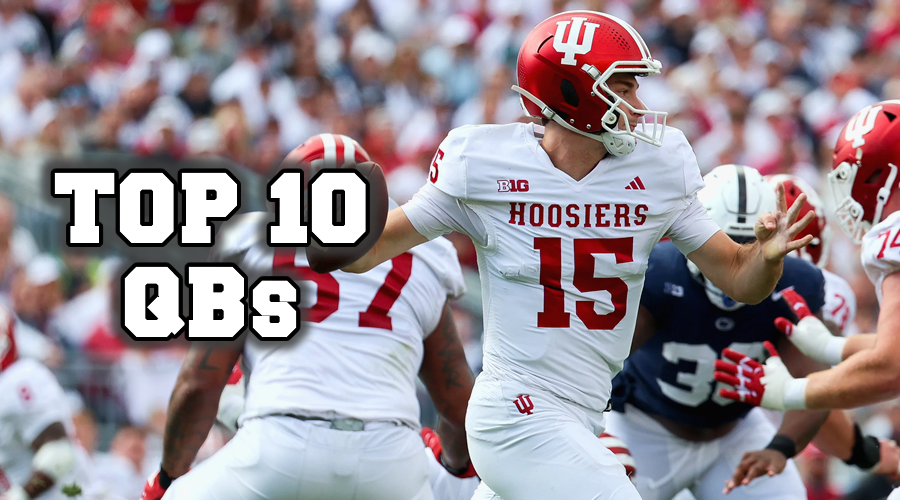
We’ve reached the final piece of my annual positional draft rankings series, and of course it’s the one that gets discussed the most – quarterbacks. Unfortunately, I can’t say that we’ve saved the best for last here, as this group certainly doesn’t match up to 2024 or really even last year – in large part because so many young passers we expected to come out actually decided to go back to college – but there are some interesting discussions to be had.
I believe we have one quarterback that is worthy of being the first guy off the board in many drafts. Then I personally have a two-man tier in the second round, before we get to a pretty substantial drop-off. There may only be two or three other names that ultimately make it inside my personal top 100, and then, I ended up with a couple of likely surprises to close out this list.
Let’s get into it one more time:
1. Fernando Mendoza, Indiana
6’5”, 235 pounds; RS JR
Just a two-star recruit in 2022 for Cal, Mendoza initially redshirted before starting the final 19 games of his time with the Bears, completing 66.5% of his passes for just over 4700 yards and 30 touchdowns compared to 16 interceptions, along with four scores as a rusher. He transferred to Indiana for 2025 and not only won the Heisman trophy but also led the Hoosiers to an undefeated national championship, with a completion of 72.0%, over 3500 yards, 41 TDs vs. six INTs, along with nearly 300 more yards and seven TDs on the ground.
This is a tall old-school pocket passer. Mendoza consistently delivers a tight spiral with a pretty snappy motion despite those long levers, and he doesn’t need a whole lot of space to create velocity on the ball. Pretty much all throws on the field are available to him. You see deep posts fly over 50 yards through the air, cross-country routes after initially rolling the opposite way, but also despite those wide hashes in college football, him deliver corner routes or drive blaze outs towards the opposite sideline. He strokes passes over the middle that require plenty of mustard and to where his receivers can run away from the defender shaded outside of them. Mendoza takes advantage of his height and can raise the launch-point in order to get it order a pass-rusher closing in on him, but he also quickly aligns himself to the quarter on RPOs, in order to teleport the ball to his receivers immediately when that’s what the read dictates. His throwing power and accuracy don’t really suffer when near a full sprint off bootlegs or moved pockets, where he can sling his arm back and hit throws slightly against his momentum. Mendoza does allow his off-arm to get too far away from his body during the rotation or not fully follow through – and his accuracy suffers in the process. He weirdly left some (slot) fades short and/or inside when his receivers were able to detach.
Trying to evaluate his decision-making is somewhat challenging because the Hoosier offense was so RPO-centric and he constantly had to just read one conflict defender. So there’ll be a certain learning curve going under center and responding to changing picture. However, you certainly see an understanding for where defenses are vulnerable based on pre-snap looks on true dropbacks. Mendoza wants to release the ball with anticipation, he tries to exhaust progressions when put in those spots, and even on some largely pre-determined throws, you see him stop receivers before they run themselves into a driving defender. Most importantly, Fernando trusts the play design and the defenders being cleared out to create space for routes, where he’ll let the ball go well before his man arrives there. He correctly identifies and places the ball to the according shoulder based on the positioning of defenders on go balls, eating on those back-shoulder balls (and converted stop routes) to Elijah Sarratt especially. He displays impressive awareness for where the sticks are on third downs and how to manage certain game situations, but also the wherewithal to chuck it out of bounds when necessary. Last year, he posted passer ratings of 120+ last season on throws to all three levels (0-9, 10-19 and 20+ yards), while consistently raising his level of play in big games and when his team needed him most late.
The biggest blemish on Mendoza’s profile is that he simply isn’t a very creative player out of structure. He can get panicky inside the pocket if something isn’t there that he initially saw and especially on broken plays, reverts to being a runner. With that being said, you do see him manipulate rush angles with abrupt, yet balanced movements, where he can really drop that throwing shoulder and hurl up a couple of yards if required, and seemingly has eyes in his back of his head at times, to leave someone screaming off the edge empty-handed. Mendoza is fearless with following through on throws in the face of pressure, especially when the D-end is left unblocked and he needs to loft it over that guy. Outside the pocket, both hands remain connected to the football, and if there’s some green grass in front of him, he can eat up plenty of it with those elongated strides. He had plenty of key runs getting out to the sideline on keepers or punishing defenses for leaving the middle open on QB draws. And although he offers as a large surface area for tacklers as more of a linear athlete, he’s incredible tough to take and get up from wicked shots as a runner, including getting flipped mid-air.
Grade: Top ten
2. Ty Simpson, Alabama
6’2”, 210 pounds; RS JR
A coach’s son, Simpson came to Alabama as a five-star recruit in 2022, who patiently waited three years behind Bryce Young and Jalen Milroe, before finally getting and taking advantage of his chance in 2025 (50 pass attempts previously). In that season, he was named second-team All-SEC alongside Ole Miss’ Trinidad Chambliss, throwing for 3567 yards and 28 touchdowns compared to five interceptions, plus a pair of TDs on the ground. The main questions with him are based around how much deal with gastritis and some bruises affected him over the second half of last season, and the fact he only logged 15 carries starts. However, immediately being named a team captain speaks to his football character.
Simpsons is clean in his drops and general throwing mechanics. His release is consistent and compact, with little wobble to the football. He was asked to “punch-and-plant” a lot in Bama’s quick game, getting the ball out in a hurry. You see him hit a bunch of stop/curl routes at either sideline when facing off corners. Simpson delivers plenty of passes that lead his receivers to come open against tight coverage, requiring high-level placement. In particular, some of these lofts on double-moves are put to a spot where you couldn’t hand the ball off any better. He actively takes speed of the ball to make it easy to catch on these short throws on slide routes and crossers on pocket movement, yet he also shows the core strength and flexibility to get his shoulders turned at a near dead-sprint out to his left and get pace behind the ball to hit guys at the sideline. He is on the smaller end of the spectrum with more so average arm strength for NFL standards, where his range is capped if there’s no space to step into throws, and he doesn’t quite bring the velocity to drive the ball on a line from one hash to the opposite sideline consistently. But he was also let down by the second-most drops for any Power Four QB last season (30).
People around the Alabama program have described Simpson as a football and it shows in his command at the line of scrimmage. He wins with great anticipation and accuracy, regularly letting the ball go before his targets have gotten out of their breaks as they’re just clearing someone on the second level. Kalen DeBoer and Ryan Grubb heavily leaned on pure progressions, where the quarterback’s processing speed to cycle through at the pace at which he does is pretty remarkable for a first-year starter. Simpsons sees the corner playing a hard flat and rips those hole-shots in cover-two against it with no fat to his drop, and he absolutely rifles in skinny post routes against cover-three, when he feels like the corner is shaded too far outside or they create leverage through motion. This guy is very willing to attack the intermediate middle of the field, including getting to those backside digs after initially reading concepts to the open side of the formation. He recognizes when defenses there’s space underneath as defenses drop out of heavy pressures, but generally he’s a little to willing to revert to his checkdowns. I appreciate how he actively forces receivers to stop off their route in front of the safety or as they’re approaching ancillary zone defenders.
Ty prides himself on being tough and deliver big throws under pressure. He displays a good feel for one side of the rush taking these wider angles up the feel and he needs to step up or take off up the middle. You see him drops his hips in a way that allows him to evade multiple points of pressure with integrated, sudden movements, and he’s fundamentally sound with keeping both hands glued to the ball as he moves in and out of the pocket. He would benefit from being a little more subtle in how he navigates pressure, and if nothing is there 2.5+ seconds into the down, Simpson needs to find ways to get rid of the ball. He features a compact spin through his throwing shoulder if there’s a free rusher flashing in his face, with good speed, and curls back up after getting wide to deliver passes with solid velocity and accuracy on the run. When scrambling out to his right especially, his willingness to throw across his body and put the ball at risk is worrisome. Nonetheless, he has some elusiveness and fluidity to him as a runner, with effective cuts to change course.
Grade: Early second round
3. Garrett Nussmeier, LSU
6’2”, 205 pounds; RS SR
One of the nation’s 100 highest-ranked recruits in 2021, Nussmeier saw action in four games as a true freshman but was granted a redshirt. Over the next two years, he had to wait his turn behind eventual Heisman trophy winner Jayden Daniels, only getting to start (and win) the final two contests of those respective seasons. In 2024, he finally got his chance to be “the guy” and he cashed in, throwing for over 4000 yards and 29 TDs vs. 12 INTs, along with three more scores on the ground. Unfortunately, his play dropped off last year, along with the LSU program altogether, and he missed the final month with abdominal strain.
You can tell Nussmeier has been raised to be a quarterback with how clean his drops are and how smooth he is mechanically. He gets his cleats in the ground, steps into and drives the ball with conviction to either sideline. Although he tapers off above 50 yards, he provides the requisite arm talent to deliver far-hash downfield throws. The slot fade remained a prominent feature of Tiger offense when he took over, thanks to his ability to lay out the ball to a spot where his receivers can track and run under it effectively. And he excels at laying the ball up to the top shelf for his tall targets. Nussmeier understands when to take pace off the ball as he just flips to someone short, and he can drop down the arm angle to get it quicker to one of his guys leaking into the flats or when he’s throwing a hitch route after climbing up and looking downfield. However, he allows his base to get pretty wide, especially when opening up for horizontal throws, and his accuracy suffers to some degree. And I did see him sail a few “sail” routes, to where a clouding safety or corner passing off the vertical route could get hands on the ball.
When Nussmeier took over the Tigers offense in 2024, his experience and comfort within was palpable when you watched him operate, making pre-snap checks and understanding the purpose of concepts. You see the mental fortitude to read two conflict defenders to the field and still come back to his backside matchup throughout his tape. He displays high-level anticipation for windows over the middle of the field and regularly widens safeties in two-high hooks in order to rip seam shots. Nussmeier is patient with allowing his targets to clear ancillary zone defenders, without flat-out staring them down. He recognizes when he needs to push his targets a little steeper if someone could sink underneath those, or pull his guys back down once they’re entering a window, so the safety can’t close on it from depth. Nussmeier delivers some big-time honey-hole shots as the defense rotates coverage, where he doesn’t actually need to hitch and re-set necessarily, by which time he might be late already, and he understands when defenses won’t be able to bail out of pressure looks quickly enough, so he can throw over their heads. Although, he does pre-determine some shots and doesn’t come off them even as he sees someone play way over the top. Plus, while you generally like the aggressive decision-making, he turns down some lay-ups on advantage throws or when there’s excess space underneath for a shallow cross.
Nussmeier displays high-level pocket presence to set up clean platforms for himself to release from. He hitches up and reduces his throwing shoulder effectively to elude swinging arms by guys coming around the corner, and I love seeing him not immediately fade away as bodies are pushed into his lap. He’s able to create torque and still put some pepper behind the ball on throws between the second and third level after running up to the line of scrimmage, and when he’s scrambling out to the sideline, he shows good peripheral vision to find his receivers drifting back inside on secondary-reaction plays. I also thought his ability to whip his hips around running left and disconnect his upper and lower half to a certain degree on those stood out. Nuss simply overestimates his mobility to beat defenders in pursuit, he only forced two missed tackles across 70 career carries, and throwing across his body as much as he does, rolling right, will only bite him in the ass more at the NFL level.
Grade: Late second round
4. Carson Beck, Miami
6’5”, 230 pounds; RS SR*
A four-star recruit back in 2020, Beck initially took a redshirt and then didn’t see the field his first two active seasons at Georgia outside of mop-up duty. He took over the starting gig from Stetson Bennett 2023 and looked even better than the guy who had led the Bulldogs to back-to-back national championships. Unfortunately, after deciding to return to school when he was viewed as a potential top-ten pick, his play dropped off the following offseason and he needed UCL surgery on his throwing elbow. He decided to transfer to Miami, who he led to a national championship game appearance. Across those three seasons as a starter, he threw for well over 11.000 yards and 88 touchdowns vs. 32 interceptions, went 37-6 and played in a lot of big games.
On the surface, you see a calm base and smooth delivery with very repeatable mechanics with Beck. He’s an effortless thrower with the way he flips the ball out to his backs or delivers screen passes on a very compact release and not forcing his targets to slow down at all. He creates easy velocity on the ball and throws a beautiful spiral, even when letting it fly 40+ yards downfield and pulling his targets further up the field at steep angles. Beck is capable of dropping balls into the bucket of receivers on looping throws towards the opposite sideline, and he delivers some pretty balls to his targets on the move between the second and third level of the defense, layering passes over sinking players on deep crossers. On under-center bootlegs, he consistently seems to provides very catchable pass after making that quick decision if he goes to the corner or the flats, making Miami very effective near the goal-line. Beck does tend to guide some throws, rather than letting it rip when he should, and last I thought his arm didn’t look the same on vertical shots outside the numbers, which regularly landed way out of bounds.
Beck generally operates well on time and has been near the bottom/top of the list among FBs quarterbacks in time to throw (2.44 seconds for his career). He consistently makes the correct on spacing or levels-based concepts and identifying how defenses respond to bunch sets. Routinely he’ll let the ball go before receivers get out of their breaks, including when he has to drive the ball on curl routes against bailing corners from the opposite hash. If the deep middle safety steps down and provides a one-on-one with the corner on a post route, Beck sees that as an invitation to go for the homerun. He confidently flips over to the backside dig if the read to the open side is muddy, and he’s not afraid of attacking tight windows if that’s what’s dictated. Yet, when those close, he’s so quick to re-set his feet and align himself to check the ball down after maintaining a vertical posture. Where he can still be vulnerable is not paying attention to hanging corners or backside safeties poaching over on deep balls across the field.
You see Beck pedal or slide away from oncoming rushers just enough to be able to launch down the field or allow his receivers to work back down towards him with regularity. You see some pretty sudden movement inside the pocket to navigate around pressure points, without having to compromise his throwing posture. The way he gets that throwing shoulder turned vertical and away from rushers promptly, to slither through creases and take what he can as a runner is something you wouldn’t think he has in his bag. Although he’s not the most creative player out of structure, he understands which route become “live” based on how he’s forced to not, and spots receivers taking off vertically, with the defense losing them. He’s generally smart about protecting his body, but will also give up it up and fight for first downs late in games. Now, he may be slippery, but then doesn’t have that extra gear to actually create big runs when he escapes the pocket. And all his numbers have vastly dropped off when under pressure throughout his career, when too often his poise seemed to evaporate and he’d toss the ball into crowded windows.
Grade: Top 100
5. Cole Payton, North Dakota State
6’3”, 235 pounds; RS SR
A two-star prospect in the 2021 class, Payton basically didn’t see the field in his first two seasons, before emerging as a key red-zone weapon, rushing for 13(!) touchdowns and over 600 yards. His usage decreased heavily behind starter Cam Miller in 2024, who could take on a lot of the rushing responsibilities, before finally taking the reins this past season. Then he threw for over 2700 yards and rushed for nearly another 800, with 29 total TDs, averaging 12.1 yards per pass attempt and 5.7 yards per carry, while leading the Bison to a 12-1 record and receiving FCS All-American accolades.
There are a lot of easy ways an NFL team might talk themselves out of Payton. – He’s only a one-year FCS starter and a lefty, who’ll turn 24 early in his rookie season, with plenty of work to do. Having said that, there’s also a lot to get excited about with his physical profile. This is a big, strong quarterback with NFL-level arm talent and athleticism. He controls the ball with those 10-and-¼-inch hands and fires from a wide, powerful base. Payton routinely puts enough air on vertical shots that allow his receivers to adjust and create that late separation, and I’ve seen him hit multiple 50-yard post routes on his tape that hit his guys right in the hands. NDSU would put his top WR Bryce Lance as the single receiver to the far side of the field and run double-moves with him, which were dropped optimally into the bucket. Payton is efficient in how he gets out for bootlegs and can deliver from various platforms, and he’s an easy thrower especially rolling to his left. His elongated release and some inconsistencies in his delivery invite more variance and some fairly easy misses though.
Payton hits receivers out of their breaks on timing-based routes on the perimeter. He can either dispose of options quickly to advance in his progressions, or bleed out longer-developing concepts before getting to his checkdown if they don’t open up. Payton zips the ball through narrow openings between linebackers with conviction, yet also lofts plenty of passes over the outstretched arms of someone underneath. I’ve seen him force the post defender to open one way and then chuck the ball to someone on a crossing route behind the other safety stepping down. I also liked seeing him put the ball over the heads of corners when he has a wideout with a size advantage, with enough pace that the safety couldn’t range out there from the hash in time. In his one season as a starter, Payton posted 26 big-time throws compared to six turnover-worthy plays (226 pass attempts). At this point, he largely needs to see the open target rather than letting the ball go early with anticipation. Plus, he’ll occasionally double-clutches, yet try to rip throws anyway, either inviting underneath defenders to drift that way or lobbing it up for grabs.
You see Payton stand strong in the face of pressure and his accuracy to suffer significantly with contact being imminent. He explosively hitches up into the pocket to eliminate the angles for guys rushing off the edge, and is strong enough to pull out of would-be-sacks. Payton sees his receivers convert their routes to get behind the defense as he gets outside the pocket and lobs these moonballs for them to run underneath of. Having said that, he benefitted from outstanding protection and just being a better athlete than the guys trying to chase after him in the FCS, finishing with a massive 3.33 seconds time-to-throw. He won’t be able to escape the pocket nearly as frequently against NFL speed, but that instant acceleration showed up regularly, including as he captured the edge when pulling the ball on designed plays. Payton does well to press one shoulder of lead-blockers and slide the opposite way once he gets defenders leaning. He covers plenty of ground with those long strides when given room to roam (4.56 at the combine), he frequently shakes off defenders trying to wrap up his legs, and even as it looks like he’s losing his balance, he finds a way to stay alive. There also seemed to be one big-time hurdle in every game.
Grade: Early fourth round
6. Taylen Green, Arkansas
6’6”, 225 pounds; RS SR
A three-star recruit in 2021, Green appeared in two games and took an initial redshirt before bursting onto the scene as the Mountain West Freshman of the Year in 2022. The year after he led the Broncos to a conference championship before transferring to Arkansas. In two years with the Razorbacks, he completed 60.5% of his passes for 5868 yards and 34 touchdowns compared to 20 interceptions, along with another 1379 yards and 16 TDs on the ground. He was voted captain in the latter of those.
No quarterback in this draft class is more tantalizing than this guy. Green freak athlete, who carries 225-230 pounds like it’s nothing, throws a tight spiral and can access all areas on the field. He has the Howitzer to pin deep crossing routes onto his receivers to defeat tight coverage and not allow someone to close in time. And you see what I label the gold standard for pass quality, where he can layer the ball over the top of a trailing defender up the pole, but with enough pace to get it down in front of the converging safeties. Yet, there’s also the elasticity in his arm to make various challenging throws on the run or not having his feet properly aligned to the target. I love how he can whip his hips around as he’s scrambling out wide, to create a solid platform to zip passes from. His throwing motion can definitely be a little elbow-y with that lankier build, which leads more volatility in where the ball ends up, and you especially see that show up when he’s sailing throws over the middle of the field.
This is an aggressive vertical passer. Your safeties in two-high looks better not play flat-footed, because this guy will throw post routes over their head. When they rotate into single-high, he will sort of replace the guy going to the high post by ripping the seam behind him. Because he threatens that area of the field to such a capacity, it opens up a lot of space underneath and he lasers over a ton of quick hitches. Green whistles glances/bang-eights past the ear-hole of defenders closing out to the flats, and he’ll take that extra hitch and place the ball slightly in front of his receivers as they’re about to clear a second-level defenders breaking towards the middle of the field. You also routinely see him hit one of his targets after he’s cleared through near the opposite sideline when that space has opened up after he’s looked down the field until the last moment. With that being said, he also tips off the defense with his eyes when he knows where he wants to go pre-snap, allowing underneath bodies to drift into those passing lanes. And he completely misses some defenders sinking underneath these throws on the move where he’s floating the ball to someone working across the field, while being way too risky with his decisions outside the pocket. He had double the turnover-worthy plays (22) as big-time throws (11) last season.
You like the fact that Green has adopted more incremental movements to manage the pocket, hitching and sliding away from single pressure points while keeping his feet underneath himself. That’s definitely where he needs to make the most progress still, as way too often, he’ll bail on the play and starts to run backwards, as soon as the pocket feels kind of muddy. Yet, he’s off course a threat to rip off chunk plays if the defense presents a voided rush lane to him and he gets to show off that 4.36 speed. He truly runs like a gazelle, making subtle adjustments to his path and burning pursuit angles with ease. Green is incredibly tough for tacklers to get a straight shot at, with an innate feel for reducing his shoulder, nonchalantly hitting a subtle juke without even breaking stride or hitting those one-two crossover moves to make defenders fly by in the open field. He forced 70(!) missed tackles across 295 carries with the Razorbacks. Plus, he’ll stretch his long body forward for additional yardage. Now, although he rides the handoff until the last possible moment to have clear lanes as he pulls the ball, he does still make the wrong decision on plenty of option-style plays.
Grade: Fourth round
7. Sawyer Robertson, Baylor
6’4”, 220 pounds; RS SR
The cousin of Jarrett Stidham and son of a first-round pick in the MLB draft (Stan), Sawyer Robertson was a four-star recruit for Mississippi State in 2021. After redshirting initially, only attempting 11 passes in year two and then his head coach Mike Leach passing away, he transferred to Baylor. There he started four games in that first season and then took over the full-time job in week three of 2024, finishing his career with 23 straight starts. Across those, he completed 61.1% of his passes for 6752 yards, 59 touchdowns compared to 20 interceptions, along with another seven scores on the ground.
Robertson presents a dense frame and strong arm, and size is a skill when it comes to seeing over his offensive line and making big-boy throws from the pocket. He gets enough mustard on the ball to be a tad late throwing out routes with someone sitting in the flats or a curl. Yet, he regularly uses three-quarter deliveries to put it on his guys in the quick screen game and let them go to work. At Baylor, he frequently put the ball in favorable spots for his basketball-like receiving corp (with Josh Cameron and Michael Trigg), allowing them to make plays down the field. Robertson is capable of suddenly opening up his front-shoulder and slightly throw across his body if required, and can change up arm angles to deliver on the move. He does have a wide kickout with his back-leg and his throwing motion gets pretty long with a substantial wind-back of the arm, making himself vulnerable to getting passes batted at the line (10 in 2025) and stripped more regularly by pros. Plus, his accuracy outside the numbers is more so generally accurate I’d say, where it can feel like he’s guiding the ball when trying to put extra arc on it.
From a coaching perspective, you appreciate that Sawyer trusts the design of pass concepts, letting the ball go early in-between zone defenders still expanding. He zips in quick slants and drags if the nickel isn’t playing with inside leverage or offers an extensive cushion, and he punishes defenses being late in their rotations or someone not bumping out immediately. He’s capable of progressing to number three across the field and is willing to take an extra hitch/slide step to allow his receivers to clear zone defenders to get reach secondary windows. Robertson cashes in on plenty of tight-window throws over the middle of the field, whistling passes past the ear-hole of linebackers. Even though he misses some ancillary zone defenders, drifting underneath routes later into the progression, he does show enough maturity when the vision is cloudy or there’s someone sitting in the passing lanes, to flip it out to his checkdown. He makes sure to look off single-high safeties when he determines pre-snap that he’ll take a vertical shot, and he hits a bunch of back-shoulder fades if the corner plays heavy stack technique. This past season, he had 25 big-time throws, but also 21 turnover-worthy plays.
Robertson bounds up into open lanes within the pocket and fires the ball to guys finding space late. He features a pretty tight spin to his blindside for such a big guy, to get out on the edge, and curls back up towards the line of scrimmage to laser some passes to his guys on secondary routes. You see the strength as someone’s trying to drag him down, to still flip the ball at the feet of his checkdown and avoid negative plays, and he’s lowered his pressure-to-sack conversion rate every year, down to 15.0% last season. I will say that there’s a lot of bouncing in the pocket, which delays his ability to react to and navigate around singular points of pressure, and he can get himself into trouble by drifting too deep or spinning away from one rusher into someone else. Watching him take off as a runner, Robertson does look a little clunky in his movements, but once he does get rolling, he can hit some surprising top speed (4.64 at the combine), and he’s a tough runner, who tightly wraps the ball – averaged 3.22 yards after contact and only fumbled five times for his career.
Grade: Early fifth round
8. Cade Klubnik, Clemson
6’2”, 205 pounds; SR
The number one quarterback recruit of the 2022 class, Klubnik started his true freshman season behind another former five-star in D.J. Uiagelei, but saw some spot duty at the end of the year. That had earned him the starting gig, which he held for all but one of 40 possible games, which he missed due to injury. Across the latter two seasons, he completed 64.4% of his passes for 6582 yards and 52 touchdowns vs. 12 interceptions, along with 557 more yards and 11 TDs on the ground.
Right off the bat, I would say Klubnik presents doesn’t present any overwhelming physical traits, but there’s enough of everything that he should be able hang around the league, considering his pedigree and how he carried himself as a tough leader for a Clemson program in decline. He features a tight over-the-top release, where he keeps his off-arm pinned to his rib-cage. You see some of the better accuracy in the class, including leading his receivers away from leverage and allowing them to maximize YAC. He absolutely rifles curl routes to his boundary receiver, before the corner can redirect forward, and has enough zip on the ball to hit speed outs to the far sideline if that defender bails out. Klubnik is capable of putting a ton of arc on the deep ball without those dying out at the end, but also drive corner routes in front of the safety in two-deep coverages. He’s slick ball-handler in the RPO game, who rapidly snaps his hips around or aborts the run fake altogether and doesn’t need to re-set. Plus, he creates easy velocity on the ball whilst on the run, where his arm can be a somewhat independent contractor (in a positive sense). He does watch plenty of slants go off the hands of his receivers, because he prioritizes heat over accuracy.
Klubnik looks comfortable spreading out the formation and attacking space in the quick game. He’s happy to just chip away with free access throws on the outside or against safeties providing access cushion. He displays quality general field vision, routinely finding crossing routes or someone in the flats with room to run. He’s confident with attacking those passing lanes between linebackers and either puts the ball on the numbers of his targets settling down between those or to where it communicates to them that they should drift away from closing coverage. Klubnik is disciplined with his posture to make deep post safeties open the wrong way before coming back to routes breaking in front of them, and he throws in subtle shoulder-fakes to corners to jump up into the flats and open up opportunities to go over their head. However, while he can pause an extra beat and not lose mustard, he does get stuck on his first read too much (in an offense that didn’t ask to go through any full-field progressions) and doesn’t quite have the arm to put the ball on a line to fit it later than expected.
Most promising about his profile, Klubnik has graded out as one of the best FBS quarterbacks under pressure, with 22 big-time throws compared to only nine turnover-worthy plays since 2024. He has the core strength to deliver passes with his feet cock-eyed and rear it off his back-hip, but also features a a quick initial burst to get away from a free rusher. When he’s out of the pocket, Klubnik uses hesitation and sudden bursts in manipulative ways, he spots receivers getting lost by the defense and gives them opportunities for explosive plays by putting the ball to where they can run underneath them down the field. He would certainly benefit from calming down his pocket movement, becoming more subtle in the way he shuffles up or slide away from pressure points, while maintaining a throw-ready posture. And he shows anxious feet against a quality pass rush, with a bad tendency of taking negative plays or not getting rid of the ball in favor of trying to keep plays alive. Nevertheless, he understands how to execute run concepts with appropriate pacing and get defenders blocked, with a knack for navigating around bodies and finding daylight. He has solid speed and pretty good wiggle to side-step linebackers (51 career missed tackles forced).
Grade: Fifth round
9. Jalon Daniels, Kansas
6’0”, 220 pounds; RS SR*
Just a three-star recruit in 2020, Daniels flashed in a couple of games early in his career before helping the Jayhawks reach new height in the history of their football program. Individually, he was the first-team All-Big 12 QB as a redshirt sophomore despite only playing in nine games. After being just limited to just three games in 2023, he was a team captain in each of the final two seasons, yet despite some late rallies in upset wins, Kansas went 5-7 in both respectively. Over that four-stretch, Daniels completed 62.5% of his passes for 7704 yards and 59 touchdowns compared to 24 interceptions, along with 1342 yards and 17 TDs as a runner.
Right off the bat, Daniels having been on my radar for such a long time, his feet have become a lot calmer and he’s comfortable operating from within the pocket. He has a whippy arm that doesn’t necessitate a whole lot of space to release from, while being very clean with pulling the ball and putting it on the numbers of his guys on RPOs without any wasted movement. You see plenty of big-time throws on sail routes and fades from the opposite hash 50+ yards from the launch point. Daniels does a good job of allowing his receivers to maximize YAC by hitting them in stride. His touch and accuracy throwing the ball on the move are pretty impressive, but more notably, he can jog up to the line of scrimmage and absolutely whistle in throws between zone defenders. He’s crafty with slight of hand stuff, and has the snappy hips to quickly flip around off backfield action, or to dump it off to his outlets if the defense dictates that. He does have an elongated throwing motion, which invites more variance in the way the ball comes out, and he excessively kicks out his back leg, affecting the results of where it ends up. He also unnecessarily turns his body or fades away on some passes he gets out there without pressure, which end up sailing on him.
Daniels is capable of exhausting full-field progressions and come back to backside in-cuts after opening to the field initially. That includes the peripheral vision to read out mesh concept, where he regularly hits the button-hook sitting down between the two crossers, as the linebackers expand. He happily chips away with free-access throws vs. sinking off-corners, yet if there’s just one moment of pause, he’ll drill his receivers at the sideline on honey-hole shots before the clouding safety can close out that way. Daniels constantly hits the right guy when they push multiple vertical routes at one deep defender, and he absolutely fires those deep hook routes over the middle of the field against soft zone looks, after forcing horizontally-stretched bodies in that area to commit with his eyes. He does need to give his wideouts more of a shot by keeping the ball in the field of play when he decides to go there late however, and he did throw some bad picks against trap coverage.
For as dangerous as he is outside the pocket, Daniels excels at sliding sideways and hanging back there behind the big guys. He’s highly elusive, making rushers look silly, falling to the turf as he jukes them out, and showcases a great deal of creativity when it comes to secondary play opportunities. Daniels is very sudden and slippery when he decides to tuck the ball and get what he can with his legs. Whether he’s gaining ground on chasing D-ends or puts the defense in catch-up mode when keeping the ball on option plays, his acceleration stands out. He brings the wiggle combined with crafty head-fakes to badly cross over opponents in the open field, with the balance to stay on his feet if he stumbles momentarily. He can get low and navigate around blockers with great start-stop quickness on designed carries, and really plays around with the read-man on speed option. Now, there’s still plenty of room to refine his pocket movement with more subtleness and not bailing due to one point of pressure, and he just can’t be superman all the time, trying to spin away from rushers and wildly swing the ball around – he fumbled 18(!) times over the past two seasons combined.
Grade: Early sixth round
10. Athan Kaliakmanis, Rutgers
6’2”, 215 pounds; RS SR
In a quarterback class with a meaningful drop from the top name and then arguably a cascade after the next two, Kaliakmanis is someone who shouldn’t just be completely ignored. After redshirting his first year at Minnesota as a four-star recruit in 2021, he started his final one-and-a-half seasons there, and then all 12 games both years at Rutgers. There, he only 57.9% of his passes, but for 5820 yards and 38 touchdowns compared to 14 interceptions, along with another 224 yards and seven TDs on the ground.
Kaliakmanis has the arm strength to challenge all areas of the field. You see plenty of true vertical shots and him driving the ball to either sideline, as he’s continued to work on his throwing mechanics – completed 28 passes of 20+ air yards last season. He beautifully drops in slot fades and rail routes to the outside shoulder of his receivers. When running up into the pocket, he doesn’t necessarily need to create opposites, as his shoulder are parallel to the line of scrimmage, and he can lay the ball up with a ton of arc as he’s running towards his right, giving his receivers jump-ball opportunities. Kaliakmanis flips very catchable passes to his underneath targets when the offense moves his launch-point, and he has enough flexibility in his arm to wrap the ball around a closing defender. You see him shoot from the hip a lot on throws in the five-yard range and can end up a little off, such as forcing his receivers on quick outs to turn through the inside shoulders, and on vertical shots outside the numbers in rhythm, there’s room to add more loft to passes when they’re tightly covered, to win the ball in the air.
This guy’s very willing to attempt and has the arm talent to hit on big-boy throws into windows with defenders converging from multiple angles. He trusts that his receivers will be at the right spot and rips passes with anticipation as they come in behind zone defenders, as well as constantly looking in sync with them adjusting their routes based on coverage/technique defenders apply. He makes defenses respect the deep option on high-low concepts, dropping some corner routes into the perfect spot on smash concepts, yet patient enough to chip away with free-access throws. And he always seems to capitalize on busted coverages and doesn’t “too safe” with his ball-placement as he has someone streaking freely downfield. Kaliakmanis posted career-bests in both big-time throw rate (6.6%) and turnover-worthy play percentage (2.4%) last season. Unfortunately, against his two toughest opponents – Oregon and Ohio State – he sent 18-of-46 for 160 yards, no touchdowns and two picks, never looking comfortable throughout those days and tried to more so guide throws.
He’s certainly willing to hang at the top of his drop or the mesh point on RPOs and not allow his throwing motion to be significantly affected as someone’s closing in on him with bad intentions. Kaliakmanis can really right that back-shoulder away from pass-rushers at the last possible moment, as they corner towards him, to run up into the pocket. Unfortunately, his accuracy takes a significant hit when he’s forced to move off the spot and find a new platform to release from. And his pressure-to-sack conversion rate from 2024 more than doubled this past year, up to a massive 29.2%, missing some opportunities to slip through creases and throw the ball at the feet of a nearby target as time’s running out. He has been sneaky effective pulling the ball on zone read throughout his career, with long strides as he turns those upfield, nifty in the way he pulls his legs away from low tackling attempts and doesn’t shy away from taking on multiple defenders and fighting for crucial yardage though.
Grade: Sixth round
The next few names:
Joey Aguilar (Tennessee), Drew Allar (Penn State) Joe Fagnano (UConn), Luke Altmyer (Illinois) & Behren Morten (Texas Tech)

