
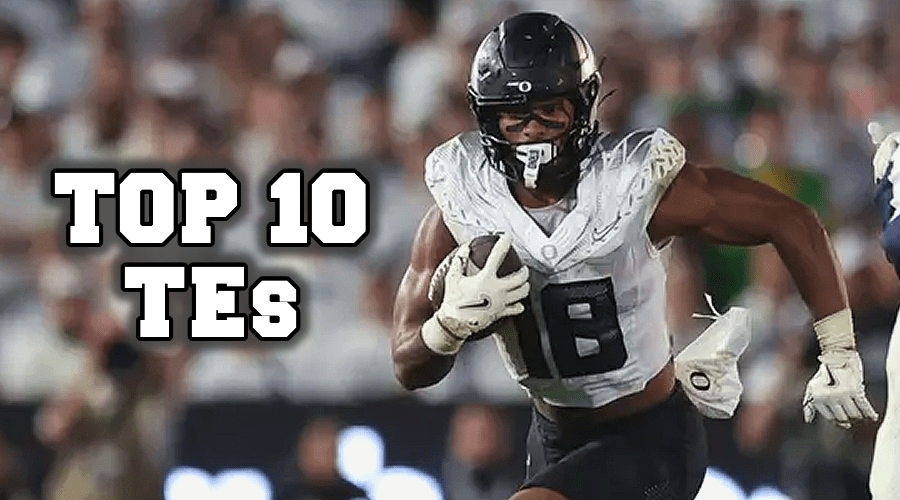
We’ve already discussed running backs and wide receivers. Now it’s time to complete our skill-position group with the tight-ends. This is a position that continuously morphs as the demands of them change over time. Generally, you differentiate between the more traditional “Y”, attached to the hip of the offensive tackle and heavily involved in your run-blocking schemes, and the more movement-based “F”, who often times is more like an oversized wide receiver. I will talk about which roles these guys are capable of filing and where they may not still grow at the next level.
Although we don’t quite have a duo at the top like last year with Colston Loveland and Tyler Warren, who already look like two of the best tight-ends in the NFL, my number one is just one notch down from those guys. After that, I don’t believe there’s another player I’d consider until the middle of day two, but then we get to a pretty strong cluster of names after that, to where my entire top ten is worthy of being selected within the first four rounds, and there’s enough depth to where we should likely beat last year’s total number of guys drafted altogether (16).
This is how they stack up for me:
1. Kenyon Sadiq, Oregon
6’3”, 245 pounds; JR
A four-star recruit in 2023, Sadiq only caught five passes as a true freshman, before bulking up the following offseason and flashing big-time potential as a rotational player, who led all tight-ends with 20+ catches with 10.1 yards after the catch. This past season, I thought he actually looked a little leaner again, but became one of the premier weapons at the position, hauling in 51 passes for 560 yards and eight touchdowns, earning second-team All-American recognition.
Although, he’s on the smaller end for a tight-end, Sadiq has a well-defined frame with powerful arms. Those only not being 31.5 inches long isn’t optimal, and because he’ll often be in a three-point stance that looks more like a defensive linemen’s, which he comes out of with that much forward lean, you see him get arm-overed or swiped by a couple of times per game. I’d say he still has plenty of room to refine his hand-placement around the line of scrimmage, too often grabbing the outside of defenders’ shoulder-pads. However, he did show growth in that area in 2025. Sadiq operates with good sink and a wide base as a run-blocker. He displays good timing for when to peel off combination blocks and shows no hesitating when asked to cut up through gaps and throw his body into linebackers as a lead-blocker from wing/H-back alignments. The burst out of his stance allows Sadiq to reach extended landmarks and sift or pull all the way across the formation on different run concepts. To me however, he’s at his best when asked to pin linebackers/box safeties inside or takes care of a DB on inside handoffs when lined up as the tip-man of (tight) bunches, where he does a great job of positioning himself, activating his hips and glutes to shield them. He also identifies early when assignments change from detached alignments, and regularly does just enough to stay attached and turn defenders as they try to shoot past him more aggressively.
Obviously, we’re talking about an athletic freak here. His 4.39 in the 40 was right there with Vernon Davis for the top mark ever for a tight-end, and his jumps are both in the 98th percentile. With his instant acceleration, Sadiq can rapidly punish the defense when railing up the boundary, and he was a seam-running demon last season, who’d clear the second level in a hurry. He shows a good understanding generally for widening his initial track in order to creating a bigger window for himself, and he gains velocity through curvilinear movement, such as on crossing routes. Although, he’s still refining how he stems his routes, he adopted more change of tempo and a well-timed swipe down last season, to not get disrupted as he clears ancillary zone defenders. He did run a fairly limited route-tree, where he hasn’t shown much savvy early or near the top, before actually making sharp cuts. Slightly clapping at the ball with small separation between his hands led to a 10.5% drop rate last year, but he’s largely able to decelerate fastballs with those soft 10-inch mitts. Sadiq displays natural skills to contort his body mid-air and had several impressive over-the-shoulder- and high-point grabs while charging up the hash/sideline. His speed also enables him to create big yardage after the catch, where you see agility feet, him calculating and tilting away from angled tackles, clearing arm-tackles with how low he runs, but also impressive hurdling over diving attempts.
Grade: Top 20
2. Max Klare, Ohio State
6’4”, 245 pounds; RS JR
Klare was my TE1 coming into this past college football season, after he was the focal point of Purdue’s pass game, with a team-leading 685 receiving yards. His production decreased after transferring to Ohio State (43-448-two) due to having likely a top-15 pick this year and a top-five selection in 2027. However, he was named first-team All-Big Ten, and all of the things that previously got me excited are still there on tape.
While his receiving totals decreased to some degree, Klare improved as a run-blocker in 2025, especially on zone schemes. He doesn’t consistently roll his hips through contact and is susceptible to be pulled off because of it as he leans in. And although he’s urgent to execute back-side cut-offs with the required short-area agility, you do see him get driven into the action on those by physical edge defenders. He peels off combo-blocks with adequate timing and has the agile, well-coordinated feet to secure targets on the second level. Klare was an effective lead-blocker for both the Boilermakers and Buckeyes, whether off motion or an off-set fullback in pistol, where he finds a way to squeeze through creases that are still developing, to not allow traffic in the backfield, and finds work in a meaningful way. You see him take press defenders for a ride when put into the slot or the tip-man on stacks/bunches, and he’s a successful blocker on the perimeter as part of the screen, with how he gathers his feet and doesn’t throw his strike prematurely. Last year, he earned a 71.6 PFF run-blocking grade and was only penalized once. I think he’s a TE2 who should primarily be lined up as a wing or detached, but his receiving upside should lead to his future team leaning heavily into 12 personnel.
Klare shows a knack for faking as if he’s blocking and sneaking out late into the flats or up the seam. He offers enough of a vertical dimension (particularly from a staggered two-point stance) to clear out space underneath, has the quick-reaction skills and suddenness to navigate around traffic and not allowing ancillary zone defenders to bump him off track. He’s capable of making those sharp 90-degree transitions by keeping his weight centered, yet also loose in his lower half to get through speed cuts without excess steps. Klare excels at leaning into and handing the defender stacked over him a chicken-wing to create separation out of his breaks, and actively gives ground as he feels a DB on his hip, so they can’t undercut deep crossing routes. He effectively works up to depth, throttles down and commands space between zone-defenders, and just ate on those quick hooks and hitches when there was nobody capped over him (particularly at Purdue). Now, he has to improve how he adjusts to throws and doesn’t always apply over-hand technique (6.9% drop rate), but he’s consistently friendly to his quarterback, not waiting for the ball on these longer throws. He maintains great focus as he just got bumped or enters shrinking windows, hauling in 11 of 19 contested-catch opportunities for his career (57.9%). You see him pierce up the field with no wasted movement and rapidly gets up to full speed, while not going down with a fight. Having relatively small hands leads to him having to be that much more intent on ball-security (three fumbles over the past two seasons).
Grade: Late second round
3. Eli Stowers, Vanderbilt
6’4”, 235 pounds; RS SR
Stowers has one of the more interesting backstories among this class. Originally, he was a four-star quarterback recruit for Texas A&M in 2021, but never attempted a pass in two years the Aggies, before transitioning to tight-end after he lost the starting battle the following offseason at New Mexico State to Diego Pavia, who he ended up catching passes from over the next three seasons, as they transferred to the SEC together one year later. Over these past two, Stowers caught 111 total balls for just over 1400 yards and eight touchdowns, receiving the John Mackey Award, given to the nation’s top TE, in the latter.
Right off the bat, this isn’t a player who really fits the traditional description of the position. Stowers only was put “in-line” for about a third of his offensive snaps last season and he’s not someone to be trusted near the point of attack as a run-blocker. He tries, but isn’t going to latch and sustain a whole lot. There are a few nice moments, where he lifts up and washes down defenders trying to shoot through the C-/D-gap, he transitions off combos with appropriate timing and rarely overruns his targets on the second level. Stowers glides up to and occupies box safeties and cornerbacks on the edge under good control, and Vandy asked him to lead the way on sweep plays and QB keeps from off-set alignments, where he’d take care of slot/force defenders. He generally does a nice job of slowing his feet and making sure he occupies the safety capping over him in the slot, and doesn’t mind putting his body on the line on pick-plays or sealing off bigger bodies trying to pursue the ball, along with frequently turning himself into a blocker instantly for the scramble-happy Pavia. The technical part of being a blocker and nuances as a route-runner are things he’s obviously he’s still learning.
Clearly what you’re drafting in Stowers is an oversized receiver. He offers impressive acceleration from a parallel or staggered two-point stance, and he legitimately puts (split) safeties on their heels. He has the ankle flexibility to roll through speed-cuts, yet can also slam his foot in the ground for drastic stops, or really drop his hips to efficiently go through whip/return routes. Stowers displays a tremendous understanding for how to creates issues mirroring him behind stacks and cross-releases. You see plenty of details to get defenders to freeze their feet already, whether he’s throwing in little stutters early, or he incorporates stair-steps and shoulder-shakes before rolling out of his cuts and gaining separation. He’s friendly to his quarterback by slowing his pace out of breaks and curling back down a little bit, to not lead throws into coverage, or gearing him if someone’s dropping underneath him. Plus, his awareness for finding space on the scramble is also very helpful. Now, you do see him get bumped off his route tracks and struggles to create catch space with physicality against ancillary zone defenders. Nonetheless, Stowers has plucky hands to snatch passes off his frame (3.9% career drop rate), rescues some throws put at the opposite shoulder/hip compared to his break, and he can REALLY climb the ladder with that record-setting 45.5-inch vertical, to pull down what look like overthrows. He does occasionally lose focus when defenders have their hands around his hips, leading to a contested-catch rate of just 37.5% with Vandy. After the catch, Stowers can bend his path without losing speed, plant and pull through the reach of would-be-tacklers, but also lower his pads and churn his legs, as he embraces contact from multiple defenders.
Grade: Late second/Early third round
4. Oscar Delp, Georgia
6’5”, 245 pounds; SR
I just talked about Delp as part of the annual “my guys” video, highlight prospect I like better than where they currently are on consensus boards. Despite ranking just outside the top-100 national recruits in 2022, in order to be considered the next in-line among the talented recent Bulldog tight-ends heading to the pros, he was tasked with a lot more in-line duties, in order to free up Brock Bowers, who almost immediately became one of the premiere players at the position once he was drafted two years ago. However, even with Bowers out of the picture, Delp never came close to those heights as a receiver, only catching 65 passes for just under 800 yards over the past three seasons.
Along with having Lawson Luckie alongside him as more of that detached receiving TE at Georgia, the other reason Delp didn’t see a ton of targets, even though he logged well over 70% of their offensive snaps, was how much of an asset he was in pass-protection. He’d regularly stay in after slicing across the formation, but even straight-up sliding and staying in front of legit edge-rushers were excellent for him. The tenacity and strain he provides in the run game are commendable. He gains plenty of ground with his initial step in order to establish body positioning, with some impressive back-side cut-offs and reach-blocks. He showcases good timing with when to peel off combos with the offensive tackle on outside zone concepts, based on how his second target responds, and he’s fully capable of taking care of assignments, where he has to get to extended landmarks. Georgia specifically asked him to lead the way on reverses and create space for WR screens of motion. Delp is equally adept at staying square to slot defenders on stalk-blocks when detached, he’s well-coordinated in space, and he generally works hard to re-position his hands and base. The only negative in that area is that he tends to get his weight shifted too far over his toes later in reps and having to let go of blocks, due to having sub-32-inch arms.
His receiving profile is certainly quite limited. Delp has become worked releasing more cleanly out his three-point stance and shows quick acceleration, but still clearly has room to refine his routes and how he finds tracks, so he doesn’t get hung up with contact. The movement skills and flexibility in his lower body for a man his size are impressive, which he pairs with sub-4.5 speed to blow by linebackers put in conflict through play-action. You don’t see many excess steps going through his cuts, especially breaking towards the middle of the field, and he showcases the play-strength when having to break across the face of safeties isolated with him, as he pushes them up the field or swipes them aside. Delp has occasional struggles finishing catches, where he’s asked to spin around or lay out for the ball, and he only secured two 12 career contested-catch opportunities. Yet, he’s a confident over-head catches, who never dropped more than one pass in a season, and has plenty of moments displaying impressive hand-eye coordination. He smoothly turns for passes slightly behind him and then up the field without any segmentation, and has the wheels to run away from linebackers redirecting against him leaking out into the flats, as well as safeties falling off him as they close on throws. He’s still developing his feel for run-after-catch situations however.
Grade: Third round
5. Jack Endries, Texas
6’5”, 245 pounds; RS JR
Despite walking on at Cal just four years ago, and turning himself into one of the better players at the position in a short span of time, his name has kind of gotten lost in the shuffle. After taking an initial redshirt, he’s now started all 13 games each of the past three seasons, caught 124 passes for nearly 1400 yards and seven touchdowns.
In the run game, Endries leads too much with his arms, which are barely over 31 inches long, and he needs to add some functional mass, which probably don’t allow him to be used as an actual “Y” at least early in his career. With that being said, he quietly was a quality blocker for the Longhorns this past season. Endries comes off the ball with urgency and some good pop in his hands, while bringing solid thump into contact on second-level blocks, to move safeties in the box backwards. UT constantly tasked him with slicing across the formation on split-zone concepts, where he’d adjust his angles in order to connect with the inside shoulder and create cutback opportunities. You regularly see him help get the ball out to the corner with crack-blocks off motion and pin-downs as the tip-man in tight bunch sets. Endries excels at identifying the biggest threat, absorbing the charge of and covering up bodies on the perimeter on sweeps and screens. And you legitimately see him progress and connect with the deep safety at times, when the runway is clear. I also thought he operated plus eye and foot quickness to stay in front of his assignments in pass-protection, to where Cal used him as a sniffer multiple times per game, scanning through potential second-level rushers.
Endries shows active hands to not let ancillary zone defenders impede his progress. He tempos his routes like a veteran going against zone coverage and gets his head around accordingly as he enters soft spots. He does well to widen his stem and then slice inside of the safety supposed to match his routes, leans into and nudges off at the break-point to create separation from previously tight man-coverage. He quickly gets going, but I don’t see the speed to run away from safeties down or across the field necessarily. And he can’t quite drop his hips to really snap off routes on the intermediate level emphatically, due to his longer build and limited flexibility. However, there are so many ways you can get him involved bluffing blocks on the perimeter for chunk plays off screen fakes and setting up those for himself. His yards per route run was cut in half compared to the impressive 2.13-yard mark he posted in 2024, but it wasn’t for the fact he didn’t capitalize on opportunities he was given. Over the last two years, he dropped just one of 90 catchable passes, consistently aligning his hands without air between them. Endries shows no issues scooping up passes from his back-hip, is able to make sudden adjustments to targets off his frame, and there were multiple impressive grabs in 2024 either posting up or surviving a hit from a driving safety (70.6% contested-catch rate over that stretch). He instantly gets downhill once he secures targets and lowers his pads to power forward as multiple opponents try to wrestle him down. His cuts in open-field situations lack some abruptness, with only seven missed tackles on 89 receptions over the last two years, but he tightly wraps the ball in traffic, with zero career fumbles.
Grade: Third round
6. Justin Joly, N.C. State
6’4”, 245 pounds; SR
Another unranked player coming out of high school in 2022, Joly produced significantly over his first two seasons with UConn as a rotational player and part-time starter, before transferring to N.C. State. As a fixture in all 25 games in two years with the Wolfpack, he caught 92 passes for 1150 yards and 11 touchdowns, earning first-team All-ACC accolades in the latter one.
Although going through the tape, it was largely as an off-set wing-man, 55% of Joly’s snaps last season actually with him “attached” to the formation, after putting on significant extra mass. I thought he showed excellent competitiveness and grip strength as a run blocker. His hands start out too wide and he can struggle to gain full control over first-level defenders in particular, but he operates with a flat back and wide base, along with keeping his feet moving. Joly makes sure to force edge defenders to go through him by establishing the inside foot, turning his hips and planting his cleats into the turf on backside seals. He locates and can get skinny through the hole when deployed on lead duties, and he excelled at slicing across the formation and evading edge defenders to get his actual assignment on QB keeps. Generally, he does well to gather himself and stay square as he tries to secure blocks off a longer runway, escorting plays out to the perimeter. One thing he’ll quickly need to clean up is not excessively turning his hips and shoulder to secure the down-lineman on combination blocks and allowing the secondary target to run freely. I do like seeing him snatch DBs down the field in commanding fashion once the quarterback flips it out to someone underneath, and he quietly only allowed one QB hurry (no hits/sacks) across 57 pass-blocking snaps with the Wolfpack.
Going through the advanced metrics, you can clearly see that he’s been productive regardless of how he was utilized, as he averaged at least 1.75 yards per route each of the last four seasons. Joly is a lethal power slot with the speed to challenge man-coverage and the toughness to win in crowded areas against zone. There’s a slight load-up step out of a staggered two-point stance, but he gains quality speed out of it. Whether he’s throwing tight club-swim moves to get past opponents trying to “catch” him in off-overage, or he seamlessly adjusts routes on the fly against traffic, he remains “live” at all times. That includes some impressive moments of redirecting to uncover or find pockets on secondary-reaction plays. Joly excelled at stretching the seam and throwing a hand up once he had a trailing defender stacked. Now, there’s some exaggerated footwork and wasted movement with Joly as a route-runner, along with too many rounded breaks. And he shows a tendency to drift when he’s supposed to settle down between the second and third level, inviting safeties to contest the catch-point. However, those massive 10.5-inch hands just swallow the football, only dropping one of 50 targets that hit them. There’s some impressive agility to adjust to off-target throws and he excels at gaining positioning to play above the rim, before quickly ripping the ball into his body (just under 70% career contested-catch rate). Joly instinctively pulls body parts away from nearby defenders, although it wasn’t quite as dynamic with the extra weight in 2025, he displays explosive start-and-stop ability to make defenders look foolish after the catch, he bounces off some solid shots and quickly re-accelerates out of those.
Grade: Top 100
7. Michael Trigg, Baylor
6’4″, 240 pounds; RS SR
Despite being a former four-star recruit for USC in 2021, it took a while for Trigg’s career to take off, spending one year with the Trojans and then two with Ole Miss, combining for 330 yards and five touchdowns across that time. He really found a home with Baylor after that, where he went from basically 400 to 700 yards and doubled his TD total (from three to six), while earning first-team All-Big 12 accolades in the latter campaign.
Trigg presents a challenging evaluation, because his highlight reel as a receiver is as fun as any tight-end in this class, but the tape is littered with certain inconsistencies, especially as a blocker. He largely lined up as a wing-man for the Bears when tasked with any box blocking assignments, where he made sure to erase space to defenders in the box and get tight to their frame. However, he really struggles to create leverage as a blocker with that high-hipped build and thinner lower half. Plus, his hands come in wide, which doesn’t allow him gain control and gets him in trouble – nine flags combined over the past two seasons. With that in mind, I do see value in what he presents as a movement blocker. Trigg leads with the same foot and shoulder to take care of edge defenders on sift blocks, and he was regularly asked to insert or wrap around as a lead-blocker, where he squared up his targets and packed some jolt on contact. He does pretty well to roll his hips through with apex defenders and open up lane to cut up through on tunnel screens. Yet, he’s at his best leading the way on longer-developing perimeter plays and taking charge of DBs off motion in the screen game. Even if nickel defenders gain inside position with their hands, Trigg’s long arms and wide chest allow him to shield them on them out there typically.
There’s a momentary sink into his stance that he should eliminate to roll off his front-foot instantly, but Trigg gains plenty out of velocity up the seam. He surprises with some quickness and a well-timed swipe-down to deny defenders in off-coverage the ability to wall him off. Due to a lack of experience against press coverage, you do see him get disrupted early in the route at times, but he’s so big that he can just shrug off defenders trying to mug him as he gets to the top. Trigg slices through the opening between linebackers and gets behind them in a hurry on benders and deep crossers. He is more of an upright, rather stiff route-runner who needs a little bit of room to build up speed and doesn’t yet deceptively use head-fakes and can be accused of coasting at times however. This guy has an elite combination of arm length (34-and-¼ inches) and hand size (10.5 inches). Yet, for all the acrobatic high-point grabs he had last season, I saw a concerning shift in meeting the ball at its earliest point of entry to allowing it to get into his frame, especially over the middle of the field, as he went from one to seven drops. His “post-up game” could use some more work and I want to see him attack passes rather than wait for them on longer throws, which allowed nearby zone defenders to eat off his plate. Still, he never slows down for passes on the ride, is hyper-aware of where the next-closest defender is, with the nimble feet to side-step diving, but also surviving glancing shots, forcing 28(!) missed tackles on 80 catches since 2024.
Grade: Top 100
8. Sam Roush, Stanford
6’5”, 265 pounds; SR
A four-star recruit in 2022, Roush became part of a long line of Stanford tight-ends, who increased his production all four years with the Cardinal. In 2025, he was named a second-team All-ACC selection, with career-highs in catches (49), yards (545) and touchdowns (two). After being known as more of a blocker at the position, receiving a relative athletic score of 9.96 helped changed the perception around him as more of a complete player.
This guy has superb muscle density and hand size (10 inches) to be an impact in-line run-blocker. He’s technically sound and provides A+ effort inside the box, where his base doesn’t narrow, he keeps churning his feet and moving the pile until the whistle blows. You see him dig out three-techniques with low pads and jolt into contact, to open up big lanes on trap plays, and he adjusts his angles to consistently neutralize backside edge defenders, when asked to sift underneath the formation. He understands when to stay thick or climb quickly off combination blocks with the tackle, rolls his hips through contact to move second-level defenders against their will, and gathers his feet on longer ventures as a movement blocker. Roush bodies up defensive backs with great success to provide space on WR screens, and he has extensive experience in pass-protection (zero QB sacks or hits and 12 hurries across 336 pass-blocking snaps). He gets the job done with a sturdy base, keeping his feet sliding and his eyes busy. Having sub-31-inch arms, limits his range as a blocker, where you see him slip off guys as he tries to stay connected quite a few times, but also his catch radius.
From those Y-alignments, Roush delivers a strong punch to impede edge rushers and smoothly releases into the pattern off those chips, or knocks them over by a couple of gaps at times. Yet, he’s also agile enough to elude that interaction and quickly work out to the flats or drag across the field, as needed. He’s able to sink his hips and get out of his breaks with little wasted movement, particularly rolling through out-cuts. He packs a nice swim move to get across the face of safeties after getting them to open the other way, and nudges off defenders trying to stack over the top of his routes as he gets to the break-point, to create catch space for himself. Although he’d benefit from pushing up more intently create space underneath for himself on sit-down routes, he does well to identify soft spots within the zone, presents his numbers and sharply pierces up the field with his pads down. There’s very little savvy in terms of disguising routes and it tips off nearby defenders to undercut those – four interceptions throwing his way in 2025. Roush struggles with passes off his frame and especially some those that require under-hand technique (12.5% drop rate last year). He does plenty of impressive combat catches and his rugby background shows up in the way he rumbles ahead, dragging along some defensive backs.
Grade: Late third/Early fourth round
9. Marlin Klein, Michigan
6’6”, 250 pounds; RS JR
Klein is one of the more interesting tight-end prospects in this draft, particularly looking at his backstory. Starting his football career with the Cologne Crocodiles in Germany, he came to a boarding school in Georgia in 2020 and became a three-star recruit for Michigan. After appearing in just five games over his first two years, he named the Offense’s Most Improved Player, and then a team captain in the latter two respectively, basically doubling his production, with 24 catches for 248 yards and a touchdown most recently.
This young man is still developing into a competitive blocker with the size and torque strength for an in-line role. He can definitely get a little top-heavy and become susceptible to slipping off blocks in the run game, plus savvy defensive linemen will get him off-balance as they feel him shifting his weight too far onto one foot. Yet, Klein generally brings excellent leverage and leg-drive, and is regularly is able to help provide lateral displacement as he arrives from the side on combination blocks. With Michigan playing a bunch of 12 personnel, you also saw plenty combos with the other TE, where he tracked the linebacker’s movement and peeled off with appropriate urgency and short-area quicks. Klein is urgent with getting his inside foot for backside cut-offs or working up to the second level to seal somebody away from the action, frequently digs out walked-up backers, and the Wolverines’ coaches trusted him sifting across or wrapping from the backside. From the slot, he’s patient with working towards deep safeties and puts some defensive backs in the ground, who think they can get around him on perimeter screens. I also thought he more than held his own in pass-protection against legit edge rushers, thanks to his combination of grip strength and active feet.
In the pass game, he still has a ways to go. First off, he would benefit from narrowing his staggered two-point stance a little and eliminating that false step with his back-foot. He ran a very limited route tree, and needs to work on not inviting safeties into the picture by drifting late. And he doesn’t always have his hands aligned perfectly when he has to quickly adjust to passes, resorting to body-catches regularly and mis-timing some of his jumps. However, Klein does well to reduce his outside shoulder to elude contact with edge defenders from a three-point stance, as well as navigate through the second level, with a strong swipe-down as someone tries to bump him. He shows the build-up speed to get behind linebackers and threaten up the seam, and can really drop his weight to either turn back towards the quarterback or cleanly get out of these 90-degree breaks by whipping his hips around. He understands how to widen zone defenders with how he stems his routes, create openings as he bends around them and immediately get his eyes around to make himself available. I like how he works up to depth, settles down and quickly secures catching on spot/hook routes, and he fluidly is able to release off play-action, understanding when/where he’s supposed to come open. He’s tough with holding onto passes in crowded spaces, smoothly turns through either shoulder and brings some juice after the catch, including the occasional hurdle because DBs always seem to go low against him.
Grade: Early fourth round
10. Eli Raridon, Notre Dame
6’6”, 250 pounds; SR
It was a slow start to his collegiate career for Raridon. In a span of ten months, he tore the same ACL twice, which combined with sitting behind a couple of talented tight-ends with the Irish, led to him only having one full season as their starter. However, he flashed real potential in 2025, turning 32 catches into 482 yards, but he didn’t reach the end-zone once.
Raridon has a near-ideal build for a tight-end and some solid experience as an in-line blocker for a pro style system, even though he lined up as a wing-man or big slot about half the time. His upright posture and lack of reps latching his hands in order to sustain blocks in the run game work against him at this point. I’d certainly call him more of a positional blocker than someone who actually moves defenders against their will with a powerful lower body, and he ends up on the ground more than you’d like to see. With that being said, he works with a wide base and a narrow grip on base blocks. He shows excellent awareness and timing for transitioning off combination blocks with the tackle on the front-side of zone runs, and he’ll occasionally wash down defensive ends in the C-gap for some dominant moments on pin-and-pull concepts, as he gets under their arm-pit. Raridon does an excellent job wrapping around from the backside or inserting gaps and establishing firm contact with linebackers in the lane. From the slot, he takes great angles to get to the inside shoulder and wall off apex defenders, absorbs charging safeties to provide wide receivers space on screen passes. And he only allowed one hurry (no QB hits) in pass-protection, where he lifts up with tight elbows and is sturdy enough to slow down edge rushers, or seal them on rollouts.
Not reaching the end-zone last season was disappointing, and I’d say at the top of routes, his short-area quickness and hand usage aren’t great at this disappointing. However, he builds up speed pretty well and alters gears effectively, to either push up or tie down zone defenders. He allows those shells to disperse and then splits then distance between bodies to present his numbers to the quarterback on spot routes. Raridon sudden in the way he pulls his shoulders away from contact or slows his feet momentarily, to not bump into ancillary bodies and does well to slightly nudge off opponents to create catch space for himself. He sells zone action exceptionally well, and I like how he purposefully drifts to invite defenders to undercut and get behind them on double-moves. Raridon plucks passes out of the air with strong 10-and-¾-inch hands, being able to slow down the pace of the ball coming in over his head and take contact to his backside. He displays impressive dexterity to smoothly make what should be awkward adjustments for passes, and already start transitioning up the field. He has a loose lower body to kind of weave around would-be-tacklers and pulls his knees out of their grasp as they angle low against him.
Grade: Fourth round
The next few names:
Dallen Bentley (Utah), Joe Royer (Cincinnati), Tanner Koziol (Houston), Will Kacmarek (Ohio State), Nate Boerkircher (Texas A&M), Joshua Cuevas (Alabama), Lake McRee (USC) & Dae’Quan Wright (Ole Miss)
 Halil's Real Footballtalk