
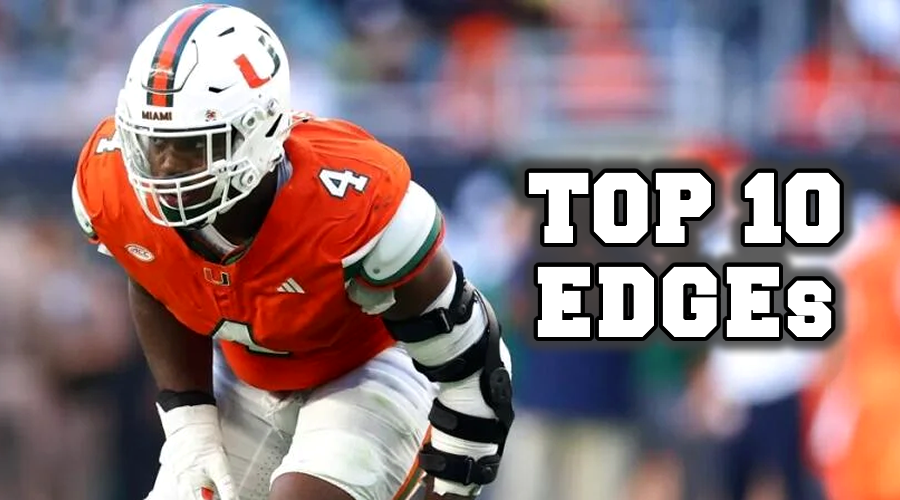
After breaking down the offensive tackle class earlier in the week, we flip things around and look at the guys that’ll be coming off the edge against them, as part of the positional draft rankings series. This includes guys that I project to primarily line up anywhere from a five- to a nine-technique. Ohio State’s Arvell Reese and Michigan’s Jaishawn Barham already were listed among the (off-ball) linebackers.
With Reese not being part of this group for me, even if he may ultimately be deployed on the edge, we may not have that premier, clean prospect atop the ranks, but number one will be a top-five overall prospect in the class for me. I do see a bit of a drop-off to the next name and then an even bigger one to the handful that come after. However, ultimately I would be fine with the entire top 10 coming off the board within the first 50 picks, and even the two guys that just missed the cut for me, could easily go at the end of the second round. Plus, then there are probably around 30 total guys that I’d deem “draftable”.
This is how the class stacks up for me:
1. Rueben Bain Jr., Miami
6’2”, 265 pounds; JR
While we have yet to see how exactly Ohio State’s Arvell Reese going to be deployed in the NFL, since he’s arguably the most talented guy on the board, there was no more impactful front-seven defender in college football than Bain last season. His 83 QB pressures were tied for the most ever in the PFF College Era (since 2014, on 557 pass-rush snaps), and he really turned it on in the playoffs, with 24 of those coming across the final four games, en route to becoming national title runner-ups.
This dude has dynamite in his hands and regularly and rocks back the pads of offensive linemen on first contact. Then he’ll force the ball-carrier to run into that guy’s backside or pull them off himself near the point of attack, to get involved on stops. Bain is explosive laterally to back-door and arm-over (zone) blockers, and he blasts through the inside shoulder of tight-ends who think they have any chance of sealing him away from the action, to where he’s getting tackles for loss himself on counter plays. He’s capable of two-gapping against tackles or at least having the suddenness to fall back inside on zone runs and absolutely stone-walls pulling guards to create heavy traffic in the backfield. Plus, really studying his film, I was highly impressed with his awareness for formations, understanding tendencies and anticipating plays. He does duck his head on contact against base blocks too often and loses vision on the backfield momentarily, and he needs to become more alert with maintaining leverage outside, since his long speed out to the sideline against perimeter plays is only average.
The main worry with Bain’s profile of course are his arms being in the 1st percentile among edge defenders (just short of 31 inches), which forces him to be precise with his hand combats – in 2024, he regularly missed the elbow or wrist of protectors on the initial club. He certainly became more refined as a pass-rusher in 2025, but his hand counters with lesser room for error still have to become more tactical to not become problematic against NFL tackles. Nonetheless, by now everyone’s seen his insane bend going through bag drills at his pro day, and he’s really improved his timing to down the outside arm of tackles to win with speed, as well as being strong in his ankles, hips and core to flatten through contact. However, first and foremost, he’s going to angle his rush through the chest of blockers and put them in survival mode. As they try to lean into contact, he can either yank cloth or get around them with the arm-over. Bain showcases impressive fluidity and coordination to link his arms and hips to actually step past protectors with a high club-swim combo, including off chips or looping inside and having a center slide his way, to go all the way to the opposite A-gap. He packs the raw force to blow through one shoulder of a guard with the rip move or split a momentary double-team as the table-setter on twists, and he provides great second and third efforts to grind through opponents and somehow get home.
Grade: Top five
2. David Bailey, Texas Tech
6’4”, 250 pounds; JR
After making noise as clearly the most talented player on a Stanford for the previous three years, Bailey became the headliner of a loaded incoming transfer class for the Red Raiders, who ended up earning a first-round bye in the College Football Playoff. He finished behind only Miami’s Rueben Bain Jr. with 81 QB pressures and was named a first-team All-American alongside him.
Where I get hung up seeing Bailey mocked as high as number two overall is his run defense. Overall I’d call it “streaky”, as he definitely has room to play with better extension through blocks, keep a square base and keep his frame clean. You see him get washed down the line quite a bit. He’s definitely active in that area, working hard to knock away the hands of blockers, and I thought he improved as swiping off bodies to create stops around the line of scrimmage. His ankle flexion that shines as a pass-rusher also helps him operate with leverage taking on bigger bodies. Typically, Bailey will aim at the quarterback on zone read plays with the acceleration to force an early give, yet then still has the speed to flatten down the line and track down the runner a lot of times. He’s capable of mid-pointing speed options, the open up and chase the back receiving the pitch out of bounds. Bailey quickly registers and is sudden in his ability to elude cut-blocks, with the wheels to track down perimeter screen passes, if he doesn’t jump up and bat them down altogether. Plus, he wraps up with authority when he arrives at the ball.
Of course, you’re drafting Bailey for his ability to hunt down quarterbacks. He features an elite get-off, paired with the mobility in his hips and ankles to win around the corner. He’s sudden with the way he can drop his shoulder or flatten at the top of his rush with an effective club-rip combo. With the speed threat he presents, he can work in these jab-step moves to cross over tackles, and he’ll occasionally catch them off balance when incorporating stutter-bull rushes. I believe he’s become more impactful with applying force to the outside pec and going underneath protectors, and he packs a strong arm-over to free himself from stalemates. His spin move at this point is a little lethargic at this point, as he needs to do a better job of threatening the upside shoulder before dropping his weight and executing in one fluid motion, but the rotational force when set up correctly is definitely potent. Where I struggle is seeing him frequently overshoot the arc and not finishing his rusher stronger through contact, even if he can’t get under the tackle’s reach, and he lacks the raw strength to steer offensive linemen and create escape paths for himself. He can win from various widths of alignment though, and what I’ll definitely say is that he displays excellent agility and eyes to track and mirror the movement of scrambling quarterbacks.
Grade: Top 15
3. Cashius Howell, Texas A&M
6’3”, 250 pounds; RS SR
A month ago, if you had asked where Howell might come off the board, most people would’ve told you somewhere from the middle to the end of the first round, with arm length being the main detractor. Then he came in even shorter, with only 30-and-¼ inch arms and didn’t jump out of the gym at the combine. However, nothing has changed about what he looks like on tape and now he’s somehow becoming completely overlooked.
He’s not particularly disciplined with his run fit and contain responsibilities, blindly scraping over the top of blockers regularly when the play is designed away from him, and he’s truly excessive in his usage of the spin move, including to get off blocks in the run game. Yet, he added good weight and play-strength for 2025, and still plays above his weight class, aggressively shooting his hands into the blocker’s frame and using a relentless motor to create angles to the football for himself. He takes being blocked by a tight-end personal and may bend them backwards as he takes them to the runner with him or crash through the C-gap. And considering he often conceded 80-100 pounds to pulling guards, Howell’s stopping power on kickouts, stepping with the same foot and shoulder with great leverage, was a big plus I noted. He covers a ton of ground laterally shuffling along with the mesh point (on option plays), has the agility to redirect if the quarterback pulls the ball, yet when it’s handed off, his speed in pursuit from the backside pops off the screen.
Although he’s largely eliminated it, occasionally Howell still has a small false step with the front-foot out of his two-point stance in passing situation. And his lack of mass does show up when tackles catch him with a strike to the chest as he tries to set up some kind of in-and-out move. With that being said, he rarely allows his lack of length to keep him from getting to the quarterback. He pairs an impressive get-off with equally noteworthy bend around the corner and wicked cross-chops or two-handed swipes to defeat their punch as he’s nearing the top of the rush. His strong hips and mobile ankles allow Howell to corner and circle back around when it looks like he’s about to overshoot the arc and try to hawk the ball out from behind. Howell features a lighting quick spin move or swat-and-slip inside of tackles when they try to jump-set him. With his suddenness to cross the face of blockers who commit their hips to the speed rush, he can fool them with a jab inside, often into a quasi-ghost move to get around the arc, or stutter into an arm-over as they try to come to balance. He’s dangerous on loops and twists, with how he can stick his foot in the ground and jump over a couple of gaps and track down scrambling quarterbacks with tremendous closing speed. He also flashes a capacity to carry running backs/tight-ends vertically when deployed in coverage.
Grade: Mid- to late first round
4. Akheem Mesidor, Miami
6’3”, 260 pounds; SR
The main talking point around Mesidor in this pre-draft process has been that he’ll be a 25-year-old rookie, who’s needed foot surgeries at both West Virginia and Miami. I think the conversation needs to shift towards what this could provide for a franchise over the next five seasons, because that’s what you’re drafting him for – someone who can contribute straight away, whilst you have him on a rookie deal, and you don’t “waste” a couple of years possibly trying to develop him.
Having scouted him for multiple years, it’s been funny to see him transition from this guy who’d line up everywhere along the front to a more traditional edge defender after trimming some weight. Trying to make a case against him, you could label him somewhat of a tweener without a clearly defined role or alignment he’d excelled from over the course of his collegiate career. And he does get outreached at times with rather short arms (just over 32 inches), which also limits his range as a tackler. However, Mesidor is explosive and violent off the ball. He can fill the role of a big base D-end on early downs, with the strength to set a hard edge and funnel the ball inside to his teammates. On the interior, he was quick to ID and swim over the top of down-/-back-blocks to run plays down before they have a chance of getting going. He instinctively drops his knee to linemen arriving on an angle for double-teams, and he displays great activity to work off blocks and pursue the football. On quick screen, you see him retrace his step, hit the accelerate and want to detonate receivers. He’ll make sure the ball is definitely handed off as he aims at the near-hip of quarterbacks, but never gears down, tracking down running backs 10+ yards down the field frequently.
Only as a sixth-year senior did I feel like Mesidor was truly rushing the passer with much of a plan in how he set up moves throughout games, under the tutelage of Hall of Fame D-line coach Jason Taylor. He already previously lined up over tackle regularity and showed the ability to corner his rushes like somebody playing there full-time, with tremendous ankle flexibility. Yet, he started to develop a multi-faceted approach that kept him ahead of the competition. So he’d win to the outside with cross-chops and two-handed swipes. Then he’d punish tackles for oversetting by pairing short-area quickness and fluidity to get through the B-gap. And then he’d complete the trifecta by using the threat of working cross-face with some euro-step maneuvers. Miami often utilized Mesidor on stunts and loops, where he did an excellent job of taking a couple of shorter steps before emphatically jamming his foot in the ground to go around one of his fellow D-linemen. Plus, setting up twists, he’d turn his pads away from contact and swipe up the arms of blockers, so he could actually split those supposed doubles. I’d call his twitch and raw power more so average though.
Grade: Late first round
5. Keldric Faulk, Auburn
6’6”, 280 pounds; SR
I understand that Faulk’s game may be a bit of an acquired taste, considering he doesn’t have the body type of your modern speedball off the edge, and his role at Auburn didn’t always lend itself to great production. This was one of Bruce Feldman’s top ten names on his annual “Freaks List” as long, well-proportioned defensive end, who excels all-around in the weight room and can play anywhere from a 3- to a 7-technique on the field.
Faulk has the length and strength to stand up and two-gap offensive tackle in the run game, where he excels at mirroring the steps of the O-line and staying square against zone flow. He constantly keeps his feet and hands moving to hold and then disengage from blocks as the runner approaches and while he may have room to improve the alignment of his lower body against double-teams, you do see him slip through those every once in a while, with the contact balance and quick burst to create stuffs. Yet, when he’s allowed to penetrate, you see Faulk turn his shoulders, flatten down the line and track down horizontal runs from the backside, and he flashes the processing skills and suddenness to back-door blocks with a fluid arm-over occasionally. There’s certainly room to become more pro-active with knocking away the hands of opponents on down-/back-blocks in order to not get caught on the wrong side of those, and with his higher point of gravity, his change-of-direction skills are a little more choppy. However, when he can stride out with that lengthy reach, he’ll make plays off his landmarks.
Auburn asked Faulk to rush from various alignments out any stance you can think of and he’s flashed the skills to deploy various maneuvers. Last year, I thought he became more focused on winning around the corner, where he shows some pretty snappy hips and great ankle mobility for a guy his size to flatten at the top of the rush, often paired with the move. He can dynamically stick his outside foot in the ground to crash across the face of blockers, yet what I appreciate about him is that he never seems to void his rush lanes. Faulk wasn’t afforded the luxury of rushing one half of the man from wider alignments with any regularity, often times being asked to slant outside and prioritize contain, but when he did, he’d frequently shorten the arc for himself with a potent long-arm. Now, too often, he lands his hands too high, limiting his effectiveness on the bull-rush, but when they connect properly, he can create significant vertical displacement, even against guards. If he wants to be a full-time edge rusher at the next level, Faulk will need to threaten the outside shoulder with speed in a more meaningful way, and you’d like to see more of a concerted effort to soften the edges of pass-protectors for himself, adopting some footwork and shoulder-fakes. However, he only turns 21 in September, and his long levers to afford him more room for error.
Grade: Late first round
6. T.J. Parker, Clemson
6’4”, 260 pounds; JR
A top-50 national recruit in 2023, Parker already left his mark as a part-time starter as a true freshman, before posting massive numbers the following year – 19.5 tackles for loss, 11 sacks and a school-record six forced fumbles. All of those were basically cut in half (zero FFs) as part of a Clemson program in decline, but some dominant moments of putting offensive tackles on their backsides during Senior Bowl week, put his name back on the first-round radar, after he was a projected top-ten pick last summer.
Parker could do a better job of protecting the outside shoulder and making sure the runner can’t get wide on him, but he rarely allows tackles to turn his base on drive-blocks and has the triceps strength to create separation from them without giving ground. He bends tight-ends backwards in the run game and smushes down the C-gap with regularity, while showing the grip strength to yank down opponents and be able to corral the ball-carrier. On zone concepts, I regularly saw him slip inside of blocks as he sees the runner cut up that way, and overall he frequently creates angles to the ball for himself as rips through their reach and squeezes through creases. Parker accelerates and drops the near-shoulder into pulling guards to halt their momentum on kickouts, and he’s capable of getting low and contorting his shoulder to offer little surface area to blockers when asked to slant across a gap. His change-of-direction and short-area burst are underwhelming after shooting up the field, to still run down NFL-level athletes, but he’s a forceful tackler when he does arrive there.
As a pass-rusher, he packs an explosive first step and can grease the outside shoulder for himself with a quick stutter/shimmy into a chop-rip move, but he would benefit from threatening up the field rather than engaging in close combat as early as he does (even if he wants to power speed-to-power), and he has yet to adopt any reliable counters he can confidently access. He rushes with a lot of forward lean and tests the anchor of tackles, as you see their feet lift off the ground and trying to (re-)gain traction against him, and he’ll occasionally just ride those guys so far up the field that he can simply slide underneath once they’re level with the quarterback. Parker loves to build off the long-arm, which he can pull off to chop down the outside hand in order to go power-to-speed, and he does well to control the outside wrist as he has the opposite hand dug into the chest of blockers. You frequently see him de-tach the mitts of opponents and free himself late in the down or kind of steer them out of the way, and has racked up 92 QB pressures across 697 pass-rush snaps over the last two years combine.
Grade: Early second round
7. Zion Young, Missouri
6’5”, 265 pounds; SR
The level of intensity Young brings to the table is second to none for really any defensive player in this class. Where he went from a great college defensive end to a likely top-50 pick this past fall was how he developed his technique and converted it into production as a pass-rusher. He was named first-team All-SEC, thanks to posting career-highs in TFLs (16.5), sacks (6.5) and forced fumbles (two).
As a pure run defender, Young is right up there with just about anyone but maybe Miami’s Rueben Bain Jr. – and his arms are almost three inches longer (33 inches). He has room for improvement in his hand-placement to play with extension through blocks, but you clearly see the pop in his hands to rock back the pads and set a physical edge, with great lean and a solid base, against massive SEC offensive tackles on base- and drive-blocks. He’s able to hold his ground against double-teams between a tackle and tight-end or split two TEs in order to get involved on stops, and he’ll stone-wall or slip inside of kickouts, violently throwing off the action in the backfield. This guy absolutely wants to kill tight-ends trying to seal him on the backside or sift across for him, and he only had a 11.9% missed tackle rate despite his fiery playing style, because his hands and arms are so strong to pull running backs to the ground as they’re about to run by him. You do see the ability to occasionally arm-over guys lunging into contact, but his feet appear a little heavy when asked to redirect against more complex backfield action.
Rushing the passer, this isn’t someone who’ll explode out of his stance in a way that threatens the outside shoulder in a way that forces tackles to commit their hips or and open the door inside, but where he became so much more potent was his ability to angle his rush through their chest and put those guys on skates with speed-to-power conversion. Young doesn’t showcase great flexibility or quicks necessarily to really stress, and you do see him end up in some stalemates as he tries to stutter and find a path for himself, but if he’s able to get to that outside hip, he’ll spam the rip move and tighten the corner for himself through contact. Those long limbs provide some room for error on his hand-combats and he makes it tough for quarterback to loft the ball over them as he’s closing in. Young brings the sheer force to create displacement as the set-up on man on twists and will grind through creases between linemen if they’re not firm with securing him, and he’s started to develop a knack for swatting at the ball as the quarterback is being brought down to force fumbles. His pass-rush win rate jumped from 11 to nearly 18% this past season, as he recorded 57 QB pressures on 326 opportunities.
Grade: Early second round
8. Gabe Jacas, Illinois
6’3”, 270 pounds; SR
Despite only being a three-star recruit in 2022, Jacas immediately made his presence felt, being named a Freshman All-American and posted quality production especially in the final two of four years with the Illini, becoming a team captain this past season. He almost has more of five-technique body type, where he can play head-up on the tackle, but slide inside or out depending on situation, leading by example with the rugged physicality and motor he displays. The question will be if some teams consider him a tweener currently.
Jacas needs to do a better job of protecting the outside shoulder, especially when playing head-up on the tackle, and not allowing plays to bounce wide against him, as well as generally improving his hand usage to deconstruct blocks, but he’s a bad-ass run defender. He shoots his hands into the chest of offensive, rolls his hips and extends through in order to re-set the line of scrimmage. He regularly knocks back tight-ends at the point of attack by a couple of steps and sits there in the C-gap. Illinois used some 3-3 fronts with their D-ends in 4i-alignments, where Jacas displayed the anchor ability to own his space against combination blocks, and he’s been a monster at the goal-line. Rarely do you see Jacas him get bumped back at all taking on kick-outs by a pulling guard or a sifting tight-end, even as he’s largely stagnant at the time because he’s still deciphering the action. You frequently see him pull the opposite arm to create the initial wrap on running backs and while still engaged, he’s so strong that he can halt their momentum by reaching out, and allows the rest of the defense to converge.
Although he has plenty of snaps where he has tougher paths to create pressure from these three-down fronts, in defined passing situations, Jacas primarily rushed as a stand-up outside linebacker. Overall, he would benefit from playing with lower pads and attacking half the man in both phases. He offers an impressive get-off for a man his size and packs a heavy club to knock down tackle’s outside arm to open up the corner. However, he wants to go through their chest more often than not with the shock in his hands and how he transfers force from the ground up. You see him throw tackles further up the field and open up a direct path to the QB for himself, he never stops working and then his burst to track down scrambling quarterbacks really stands out. Lining Jacas up over the guard and using him as a spiker as part of a T-E twists, he may blow through the B-gap if the O-line isn’t firm with securing him, and his acceleration as a looper pops equally. For a full-time edge rusher, there has to be more of an emphasis on threatening the upside shoulder, even if wants to ultimately convert speed-to-power, and he doesn’t yet reliably access counters on time, where too often they feel like a last resort rather than a pro-active second phase of the approach.
Grade: Top 50
9. R Mason Thomas, Oklahoma
6’2”, 245 pounds; SR
R Mason Thomas has been one of the most effective pass-rushers in college football on a per snap basis over the past two seasons. The 2025 Auburn game best illustrated that, when he was suspended for the first half, but then got a sack on the first dropback he was on the field for and the last – which sealed the game on a safety. Unfortunately, he missed some time after that, which led to his name not being brought up as much.
This is an undersized but highly competitive run-defender. He routinely is first and inside with his hands taking on blockers. Now, his limited arm length (31-and-5/8 at the combine) doesn’t always allow him to play with vision through blocks, as he can just be “out-reached” by opponents. His pad-level and arm strength are definitive positives to bend even tackles backwards who have 70-80 pounds on him. He consistently re-sets the line of scrimmage against tight-end and can slip underneath as the running back approaches on the front side of zone concepts, and squeezes those guys into the action when they’re supposed to seal him away from it. And he steps with the same foot and shoulder underneath pulling guards to minimize lanes inside of him on kickouts. Thomas keeps his shoulders parallel to the line of scrimmage as he diagnoses the play as an unblocked edge defender and tightly attaches to the hip of tackles stepping away from him. He does need to become more alert for pin-downs and crack-blocks, in order to not get caught behind the play.
The main selling point with him is how he can heat up quarterbacks however, with the way he gets off the ball, turns the corner and flattens at the top. He’s very natural in his hand-combats and how he counters off those, in order to keep his frame clean, and he displays tremendous flexibility in his lower body to rush under the reach of pass-protectors and turn tight corners, including through contact and drawing flags for holding. Off the speed rush, he packs a nice euro-step move, and even when he slightly overshoots or gets past the arc, he’s able to circle back around and hawk down the quarterback from behind. When he takes advantage of his leverage on well-delivered speed-to-power conversion, Thomas can go through some blockers who get too tall, although he has small hands that lack truly disruptive force. Due to their range advantage, tackles are able to push him onto elongated tracks if their outside hand connects, and you see him gamble on the snap count occasionally. Whether on twists or as off-ball blitzer, Thomas has a knack for angling his rush to squeeze through vacated lanes and make quarterbacks uncomfortable, even if he can’t quite get home. And he shows good awareness as a zone dropper, muddying up the picture underneath and sticking to targets once the pattern has developed.
Grade: Top 50
10. Derrick Moore, Michigan
6‘4“, 255 pounds; SR
Despite being one of the nation’s top 100 recruits four years ago, Moore had to earn his role on the edge, coming through the ranks for a defense pumping out draft talent at that position annually. In 2025, he was able to hit double-digit sacks and was named first-team All-Big Ten, even if the Wolverines weren’t quite up to par. Clips of him putting Miami’s 350+ pound left tackle Markel Bell on his backside at Senior Bowl practices were trending on the internet, but his every-down play may actually be more impressive.
Moore is swift out of his stance and into the pads of blockers. He packs some jolt in his hands and plays with good extension in the run game, to where Michigan regularly would line him up on longer downs or end-of-half situations and he’d control his space against guards. When the play is designed away from him, he makes sure to ride tackles into the pile, he shows impressive contact balance to get banged around but stay on his feet against combination blocks and slide off bodies to get a wrap on the ball-carrier, and he’s immediately looking to shed pullers after taking them on. He has more of that high-hipped build and struggles to play with great leverage, and at times he appears more focused attacking blockers rather than actually diagnosing run plays. However, he’s disciplined with staying square and deciphering through option plays, misdirection or bootlegs, with the springy feet to close ground once it’s time. And he improved his overall PFF grade every year as he continued to become a bigger piece to the Wolverine defense.
As a pass-rusher, I do see some stiffness that limits Moore from turning tight corners and reducing his frame, which is only magnified by lacking precision on his initial swipe/club to actually knock away the hands of tackles and actually clear their hip as he follows through. With that being said, he gets off the line with no wasted movement and quick acceleration out of his (wrong-foot forward) two-point stance. He brings the power to condense the edge with the bull-rush, especially from these tited wide alignments, and while caging in quarterbacks may not always lend itself to great individual production, staying true to his lanes allows the rest of the defense to clean up regularly. Off that, he can knock away the hands of tackles and create paths to the passer for himself. Moore is capable of picking linemen and creating opportunities for fellow rushers on different games, especially if he lines up a couple of yards off the line, so he can build up that momentum, and he has a few snaps where he runs over guards. His lateral agility to pull off cross-face moves with suddenness, rather than having to violently plant his outside foot, went to a different level in 2025. That helped him record a career-high 41 QB pressures on just 234 pass-rush snaps.
Grade: Second round
Just missed the cut:
Keyron Crawford, Auburn
6’4”, 255 pounds; SR
After starting last season somewhat in the shadow of projected top-20 pick Keldric Faulk along that Tigers front, after transferring over from Arkansas State previously, and the team only winning one SEC game all year. However, he actually out-produced his teammate, with 43 QB pressures on just 240 pass-rush snaps, and showed improvement in several areas to complement his red-hot style of play.
The way this guy unloads into contact and strikes the chest of tackles as he erases the distance between them, allows him to play above his weight class in run defense. While he has room to improve his hand-placement and general response to different blocking schemes, he largely keeps his base square and near-arm extended taking on base blocks. When tight-ends are asked to occupy him, he’s looking to punch and yank cloth to quickly disengage from them. Crawford regularly lined up in this tilted wrong-foot-forward two-point stance and just attacked the mesh point with zero reservations, and certainly no hesitation if a pulling guard was coming his way, creating traffic in the backfield. He clearly has the speed to flatten and chase down the running back on wide zone concepts as the unblocked backside edge defender, while his change-of-direction skills and rapid burst allow him to track down quarterbacks pulling the ball or even receivers on screen alerts. Although, too often he over-pursues the ball-carrier and doesn’t calm his feet to reliable get him to the ground – only had a missed-tackle rate below 20% in one of four seasons.
Crawford comes out of that loaded two-point stance wound up to test the foot speed of tackles. In 2025, he significantly improved his effectiveness at chopping down their outside wrist and he has the flexibility to flatten at the top his rush, having added a wicked cross-chop to his arsenal. Even having to corner through contact on a dip-and-rip, his strong ankles allow him to at least force quarterbacks to hitch up into the pocket. You see some clean wins with an elongated step of the outside foot into an inside swipe/swim, after threatening with speed, and then he can soften the upfield shoulder and get underneath with eurostep-style moves. Off those in-and-out moves, I like what he brings on stutter-bull-rushes, and you have to love his ability to stick his foot in the ground and cover ground laterally when looping across multiple gaps. On too many reps, Crawford still attacks pass-protectors them pretty straight-up however. He’d benefit from being more diligent with setting up and stacking rush moves on top of one another, as well as altering tempo a little more, and with only 32-inch arms, becoming more pro-active and skilled with his hand counters will be crucial to not get hung up against longer blockers.
Having played the “Buck” stand-up backer position for Auburn, Crawford has plenty of experience dropping into coverage, where he’s well-coordinated getting to his landmarks with eyes on the quarterback, capable of flipping his hips around 180 degrees with no excess steps as he floats underneath routes in his vicinity, and quickly shuts down potential for run-after-catch.
Grade: Late second/Early third round
Joshua Josephs, Tennessee
6’3”, 245 pounds; SR
Although he wasn’t quite as productive as eventual Falcons first-round pick James Pearce Jr. – whose career may already be over again after a promising rookie season, based on a domestic violence case – I don’t really understand why Joseph isn’t being talked about at all in the lead-up to this draft. Similarly to his teammate, and pretty much all Tennessee D-line for that matter, he was never a heavy-snap player (365 exactly on defense each of the last two years), but you could definitely feel his impact across those.
Joseph is a long hybrid edge defender with vines for arms (34-and-¼ inches) to keep separation from blockers when he uses good technique in run defense. He presses off and discards tight-ends near the point of attack with those 10-inch mitts, while his lateral agility and hand-usage to work over the top of blocks on plays out to the perimeter. He makes sure to plug the B-gap with the backside of tackles trying to seal him on the backside as he digs his hands into their chest of tackles, and he typically protects his lower body well against cut-blocks. Josephs impressively erases ground, slows his feet and then re-accelerates them to get involved on stops on option run plays. Tennessee involved him on a bunch of early-down stunts, where he’d plow into guards and squeeze through gaps. He provides tremendous all-around effort, chasing the ball all over the field, with the speed and long reach to expand his tackling radius. Now, he’ll occasionally trail eye candy blindly and void his run fit. He braces for rather than crashes into pulling linemen, and has some snaps where he BADLY gets washed down by pin-downs/crack-blocks.
In the pass game, he needs to be more intent with rushing half the man, especially with a little bit of ankle tightness you see as he gets to the apex, and he doesn’t utilize the long-arm technique frequently enough for my taste, especially considering his build. However, he pairs impressive upfield burst with a nice chop-rip or cross-chop to turn pretty tight corners. Occasionally, he’ll throw in a little shoulder shake to create a softer outside path for himself around the tackle, and where he improved as a senior was how he followed up to swipe down the outside hand so he doesn’t overshoot the arc as he gets ridden that way. From wider alignments, he effectively converts speed-to-power, but then he can also snatch and pull cloth forcefully or deliver a two-handed swipe-down off the bull-rush to win outside. Josephs has some slipperiness to him to get off contact late in the rep when he was just hung up with pass-protectors, and makes quarterbacks uncomfortable when he puts those long limbs up as he closes in on them.
Grade: Late second/Early third round
The next few names:
Malachi Lawrence (UCF), Dani Dennis-Sutton (Penn State), Romello Height (Texas Tech), L.T. Overton (Alabama), Mason Reiger (Wisconsin), Nadame Tucker (Western Michigan) & Anthony Lucas (USC)
 Halil's Real Footballtalk