
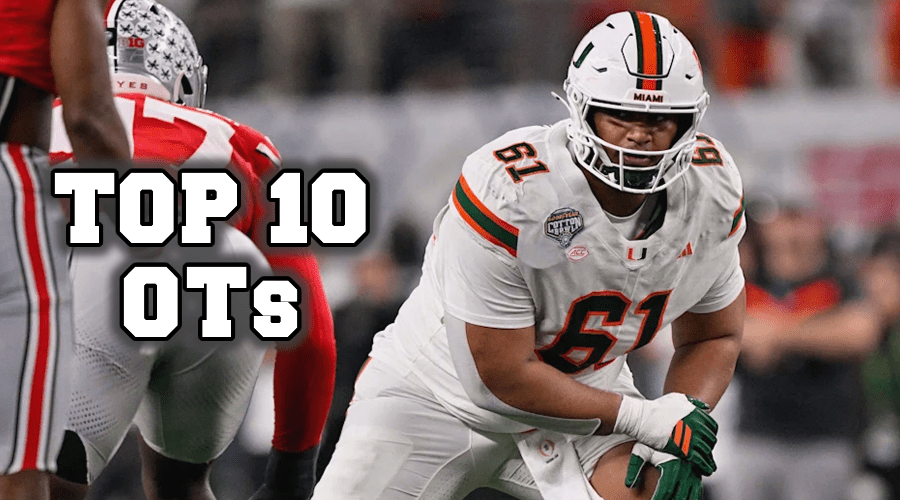
We’ve arrived at the big boy portion of this positional draft breakdown series, where we’ll start with the offensive tackles before transitioning to edge defenders and then moving on to the interior of the trenches next week. For clarity’s sake – you will find names like Iowa’s Gennings Dunker and Duke’s Brian Parker II among the “IOL” list.
Although we don’t have this one perfectly clean OT prospect in the class, I believe the top seven names are all worthy of going in the first round. After that, I see a steep drop-off, to where I wouldn’t touch anyone else until the third round. In fact, despite there being a few interesting developmental options, with a couple of massive guys that present certain flaws, outside of this top ten, I would only consider an investment either very late on day two or early on day three.
This is what it looks like:
1. Francis Mauigoa, Miami
6’6”, 330 pounds; JR
Growing up in the American Samoa, Francis “Sisi” Mauigoa got a later start to life in the US, being sent home during the pandemic after starting in high school, prior to coming to IMG Academy in Florida and becoming a highly touted recruit, who joined the nearby Hurricanes and ended up logging 42 consecutive starts at right tackle and more than 2800 offensive snaps without missing a single game.
Mauigoa already made it onto Bruce Feldman’s Freaks List back in 2023 before even stepping onto a college field, and his head coach Mario Cristobal once said he had the “greatest muscle density in Miami history”. He regularly dips his head and doesn’t quite accelerate his feet all the way into contact as a run-blocker, but he has the wide chest and functional strength to gain control of D-linemen trying to slice through the play-side gap, with a strong inside hand to move edge defenders to his outer hip and beyond, in order to create lanes underneath to the front side. You see the agility to fold under or step behind and make sure he scoops up 2-techniques on the backside of wide zone, and he takes sharp angles out of his stance along with the urgency to get to the correct shoulder of targets on the second level. He’d generally benefit from operating with more knee flexion, which can somewhat limit his movement skills, but he’s capable of re-accelerating his feet and winning the battle even when he initially loses leverage on the initial interaction. Mauigoa has the speed out of his stance to be trusted with long pulls to kick out the end or wrap around from the backside, and if the picture changes post-snap, he realizes opportunities to bury guys in pursuit as he peels back on them.
There are definitely things he needs to clean up as a pass-protector. His elbows are out wide and high a lot, while generally costing himself strike force by having his arm fully extended. And he needs to do a better job of protecting his edges, whether he’s offering a soft outside shoulder or lunging in a way that opens the door inside. With that in mind, he features that explosive initial kick into his sets and overall looked like he operated with more conviction and balance in his movements as a junior. You see him change up his initial approach and throws in the occasional fake-stab to keep rushers off kilter, weaponize his length by meeting rushers early and then is active to re-fit those mitts in order avoid disadvantageous positions. When his cleats are firmly in the turf, Mauigoa packs plenty of stopping power against the bull-rush, and he has more than adequate foot quickness combined to either guide opponents beyond the arc with measured shuffle steps or take inside counters off track.
Grade: Top ten
2. Spencer Fano, Utah
6’5”, 305 pounds; JR
I already know there’ll be some people calling me a hypocrite for having Fano even listed as a tackle and even more so that I have him near the top of the list, when I said that year that Will Campbell will be a guard in the NFL. Now, those who add a layer of context and remember that I stated that not solely based on length concerns – which Fano’s arms are somewhere between 32 and 33 inches, depending on if you take combine/pro day measurements, but there are also other areas that I feel more comfortable with the reigning Outland Trophy winner staying out on the edge.
This guy erases the space to and makes sure to keep D-tackles there on down-blocks, latches his hands with a firm grip and rides his feet through contact. Yet, his fluidity and how he can take care of challenging assignments is even more impressive, as he consistently is able to get to the outside shoulder of edge defenders or cuts off 2-/3-techniques on the backside of outside zone calls. Although he needs to do be more alert with tracking the movement of linebackers he’s supposed to climb up towards, Fano smoothly glides up to the second level and secures moving targets with great success. He’s too tall into contact as a puller, if he wanted to truly maximize his impact, but he’s swift out of his stance to take on those duties, where he has the reactionary skills to adjust if the defense changes up the numbers, as well as the loose hips to pin crashing D-ends inside as they try to wrong-shoulder him. Utah regularly went with unbalanced lines and found ways to specifically run right behind #55, as he also gets after it with secondary efforts to kick opponents out of the club, re-accelerating his feet.
As a pass-protector, there’s a little more concern around him committing his shoulders early or getting too heavy on his outside foot against rushers hat really threaten him with speed and open up a path underneath, as well as leaning into them as they try to dip around him – hence why he was charged 16 penalties in his career (2204 total snaps). However, he works out of a rhythmic kick-slide with a solid base and consistent hand carriage. He can switch to a more diagonal approach against wider alignments, throws in quick fake one-handed stabs to force rushers to commit, and recognizes when he can turn a pass-pro into a run-blocking rep, smashing guys into the scrum. He grabs and battles the wrists of opponents to protect his chest, and deploys some two-handed swipe-downs in order to counter bull-rush attempts. He’s an incredibly easy lateral mover transitioning through twists and he delivers some knock-out blows if the end drops out and he can help out the guard. That’s how he only allowed five QB pressures across 382 pass-blocking snaps last year.
Grade: Top ten
3. Max Iheanachor, Arizona State
6’6”, 320 pounds; RS SR
Despite actually being a redshirt senior, Iheanachor didn’t touch a football until junior college. In 2023, he transferred to ASU, where he started the final 31 games for the Sundevils at right tackle and proved himself in strong showings against that uber-talented Texas Tech front for example. Even during Senior Bowl week, you saw the steady growth throughout the event, where nobody he was facing could lay a hand on the quarterback and he had some impressive moments of pulling out to the corner.
Right off the bat, Iheanachor doesn’t provide a ton of displacement on the front side of run calls, with irresolute footwork, and occasionally ducks his head into contact when he tries to. But this is a loose athlete, who carries his 320+ pounds with ease, has improved how he centers and really activates his lower half on drive blocks this past season. He’s very much under control on run plays, understanding where the point of attack is and altering his level of aggression into contact accordingly. His feet never seem to stop moving and he displays excellent dexterity to stay latched until deep into the play-clock. Whether he’s covering ground horizontally out of his stance or his peels off combos, he’s shockingly sudden to take away the space for defenders. Iheanachor has those oily hips to get his base all he way around and wall off bodies, and he has some impressive snaps of folding under the guard and actually still beating the stack linebacker to a spot on the backside of concepts. He’s a little too measured with “releasing” off the line of scrimmage to get to his targets on the second level, but he’ll fly out to the corner on toss play and perimeter screens, where he’s coordinated in how he gathers his feet leading into contact.
Iheanachor features a rapid first kick to choke off the angle for edge rushers in passing situations, yet then comes to balance if they slow their feet. He glides laterally when mirroring active defenders or sliding in front of blitzers when working inside-out. He keeps his weight centered and never appears to be caught off guard by spin moves. Now, he carries his outside hand too low and presents a soft shoulder, allowing defenders to dip around, and he won’t get away with it as frequently against pros, as he grants access to his chest for speed-to-power maneuvers. He clearly did have the contact balance to absorb meaningful initial contact against Big 12 competition, and showcases good understanding for the depth of the pocket, and guiding opponents beyond the quarterback. Iheanachor has become very tactical with his outside hand, actively pulling it back after baiting defenders, doesn’t get antsy when picked up chipped or delayed rushers, and you rarely see spiking rushers squeeze through the B-gap.
Grade: Top 20
4. Monroe Freeling, Georgia
6’7”, 315 pounds; JR
Freeling is a rapidly ascending 21-year-old, who already started the five final games of his true sophomore season as a swing tackle and then took over the starting job on the left side this past year. With basically 35-inch arms and a near-perfect relative athletic score (9.99 out of 10), he’s an intriguing physical specimen on the outset, but his he’ll he highly coveted based on how quickly he became an impact starter in the SEC.
Although he would benefit from adding some more functional mass, especially with a higher center of gravity limiting his impact as an at-the-point-of-attack run-blocker, this young man really drives from the ground up through contact as a run-blocker against first-level defenders. He has some textbook reps of latching with tight grip and rolling his hips in order to move bodies against their will. He incorporates a gallop step and significantly bumps over defensive tackles on quick combos, to allow his guards to secure their block, and when working actual doubles, he shows good timing for when to stay thick or peel off, with a quick couple of steps when it’s time to make up that ground. The only thing I’ll add there is that he can get little top-heavy into contact with linebackers. Freeling displays impressive mobility to pull around and seal bodies inside when Georgia tried to get the ball out to the edge, he can de-cleat corners on tunnel screens, and he blew me away a couple of times when he realized his quarterback decided to tuck it or a ball-carrier changed course, with that gear he could access to get out in front and land a key block.
With how much focus Freeling puts on his outside foot getting to a certain spot in pass-pro, he becomes vulnerable to guys blowing through the inside shoulder or hitting spin moves on him. He sells out for that two-handed strike as he gets his post foot down in order to take away the B-gap and skilled rushers will be able to slip off that. And he’ll need to diversify his approach against NFL competition, incorporating some independent hand usage. Having said that, he quickly gets his second kick down in those diagonal pass sets to force edge rushers to take an elongated track around him. He times up his strike well as he sees defenders try to attack his frame, stunning them on basically simultaneous contact, is very active with re-fitting his hands and creating leverage for himself, and maximizes his length in how he guides edge rushers just beyond the arc. Freeling is able to absorb and transfer force into the ground as defenders arrive on contact off a runway, and he makes sure to knock slanting rushers off track before redirecting to pick guys looping out towards him.
Grade: Mid- to late-first round
5. Caleb Lomu, Utah
6’6”, 305 pounds; RS SO
Lomu certainly isn’t as technically advanced in terms of how he uses his hands or as far along in how he’s developed his body, making the transition to the pros, but he’s about as talented as any tackle in the draft class. After taking an initial redshirt once he sparingly appeared three games in 2023, he started 12 games each of the past season on the left side, and was named first-team All-Big 12 in the latter one of those.
Even though he doesn’t pack the vigor in his hands to create knock-back and that initial momentum to truly displace defensive linemen in the run game, you rarely see him miss any of his assignments. This fluid, well-coordinated lateral mover in the zone run game. He makes sure edge defender stay on his outside hip on the front-side, but rapidly closes down the B-gap and forces D-tackles to take the long way when asked seal them away from the action. Lomu instantly erases the space to his guard and slightly steps behind him in order to take away any opportunity for double-teams between them to be split, and he fluently advances to the linebacker off combos. He does need to improve his upper body strength to not allow those guys to shoot the gap on him, if they decide to get downhill and blow through one shoulder. Lomu provides the quick burst to pull out in front and wrap around from the backside of gap concepts, with the nimble feet to work around traffic and find his lane, even as the picture slightly shifts. And he’s a graceful athlete when he gets out in space and turns the bodies of smaller targets as part of the screen game.
Even though he’s still growing of course, I will say that he shows some unsustainable tendencies in his pass-pro technique, which will be punished more regularly by pros, such as punching first with the inside hand or dragging his cleats along. Lomu has the quick feet to beat pass-rushers to the spot and stay in front of them throughout reps. He smoothly guides opponents trying to beat him with speed-based approaches around the arc, and can mirror outside-in moves. The redshirt sophomore regularly is first to land meaningful contact and forces opponents into secondary maneuvers, yet he displays the ankle flexibility to give ground in order re-anchor if rushers do win the initial interaction. Combining his agility, coordination and body control, he has some impressive reps of recovering when initially beaten. Spiking interior rushers can bowl him over occasionally when he’s not ready, due to limited contact balance, but he brings alert eyes and the connective tissue to process information to his lower body on different stunts and games, including a handful of times where he picks up a corner blitz after stepping inside.
Grade: Mid- to late-first round
6. Kadyn Proctor, Alabama
6’7”, 350 pounds; JR
There were some ups and downs with Proctor early in his junior year, after he was discussed as this potential top-five pick come April, which changed the conversation to some degree, but he’s probably become undervalued/-discussed at this point. There simply aren’t many people on earth who carry 350-360 pounds as easily as this guy, can lift his weight 32.5 inches vertically and pack over 800 additional pounds on for his squats. And after joining the Crimson Tide three years ago, he started all 39 games on the blindside.
This dude has tree-stumps for quads and can truly bulldoze defenders in the run game with those. He can definitely get a little top-heavy and lose his balance if his hands don’t connect, but there’s real shock in his hands and he features powerful strides to create angular displacement on gap concepts. On zone calls, his mobility and the wide chest cover up bodies provides his ball-carriers space and time to allow lanes to develop, and he has a few impressive reps scoop-blocking 4i-/3-techniques on the backside of those. Proctor glides up and just swallows linebackers on these longer-developing set-ups, and he’s fully competent on skip pulls, including turning those bodies as they try to shoot the gap and sealing them behind the play. He simply lacks the speed to be trusted frequently to pull all the way across the formation and seems like he’s laboring, not being nearly as comfortable locating targets and flying out to them in space.
Savvy pass-rushers are going go give him trouble early in his career, until he’s refined some technical nuances. Right now, he resorts to leaning into or hugging rushers who have a step on him up the arc, making him susceptible for (late) counters, and you see him step and strike with the same hand and foot, opening up opportunities to beat him on cross-face moves or lift his opposite cleat off the turf. Nonetheless, there’s good rhythm to his kick-slide and he requires a long track around him, while he added a jump-out set against wide-techniques recently, to take the fight to them. Proctor is capable of widening his base and taking steam off bull-rush or absorbing long-arm moves. He has vice grips for hands that clutch plenty of cloth when he’s able to land them inside the chest of rushers, to basically end the rep, as well as the triceps strength to create separation if he finds himself in uncomfortable positions. Proctor is patient in the way he sorts out different looks from the front and slides in front of his ultimate assignment, consistently taking care of the inner-most rushers and offering enough reactive agility to handle loopers, where he uses their momentum against them.
Grade: Late first round
7. Blake Miller, Clemson
6’6”, 310 pounds; SR
The fact I don’t have Miller any higher than this is more of an indication of the quality of this top ten – as mentioned in the intro – and far less about the player, who I’ve been a fan of ever since I evaluated his sophomore tape. This guy immediately earned the starting gig at right tackle and manned it for all but two of 54 games since, flipping over to the blindside for those. Plus, he earned an RAS of 9.94. Although he’s added about 20 pounds of functional mass since I first started taking notes on him, the main concerns with his projection to the next level are based around true play strength. Heavy-handed edge setters typically have the upper hand at the point of attack and NFL bull-rushers are going to challenge him to a different extent, which also opens up the potential for push-pull maneuvers.
Nonetheless, there’s a lot to like about what Miller provides in the run game and how he diversify what you can do. Even early in his career, I thought he understood angles and how assignments need to be adjusted so well for a young player already, and I love the urgency he plays. He effortlessly takes care of backside seal-/hinge-blocks, covers a lot of ground horizontally in the zone run game, and generally operate with great sink in hips, working upwards through contact and churning his feet. He does a tremendous job of allowing twists/stunts to develop and taking advantage of the momentum of slanting D-linemen in order to take them off their landmarks, smoothly glides up to the second level and is explosive laterally to get rolling for skip-/wrap-around pulls from the opposite side of the play or escort the ball out to the corner. Too often he simply prioritizes getting to a spot over having a solid footing as he arrives there, where he can be back-doored or yanked forward.
Miller changes up his approach depending on the rhythm and dropback depth of pass calls. He gets that second kick down and is able to choke off the angle for speed-rushers in impressive fashion, and he showcases super easy movement skills to survive laterally matching rushers, with uncanny patience and anticipation for a college tackle. He started to incorporates stabs with his outside hand more these last two years to throw off opponents, does well to knock off their wrists on long-arm attempts, and overall keeps his elbows in tight. Other than a few moments of uncertainty when LSU brought an extra man to his side in the 2025 opener, where he didn’t really (firmly) take care of anyone in protection, his eyes and the way he’d transition information to his feet, slide in front of whomever he’s ultimately responsible for, was highly impressive.
Grade: Late first/Early second round
8. Austin Barber, Florida
6’7”, 320 pounds; RS SR*
Barber’s name I have barely heard at all in the lead-up to this draft. However, he’s been a fixture on the left side for the Gators in all 34 contests he was available for over the last three years. So, even though his worst outing in 2025 came against that duo of likely first-round edge defenders for Miami, combining that with the SEC guys he’s face, he’s certainly battle-tested.
Despite being 6’7”, Barber fires off the ball with great pad-level in the run game, applies rotational force expertly to get edge defenders to his outside hip on the front-side, and connects his hands and feet very well to gain and stay in control deep into reps. I wouldn’t say he’s someone who’ll just take edge defenders for a ride, so you can run behind him, and the one error I saw pop up a few times was him being a split-second late to react to stunts, where at best is able to keep them at the line of scrimmage. He shows the short-area agility and hip flexibility to get to the play-side shoulder and reach or wall off defensive linemen on wide zone concepts, his reactionary agility to peel off combos as his secondary target tries to go around, to still guide him off track, is excellent, and he glides up to the second level with light feet and good composure. He just earned by far his best PFF run-blocking grade of his career as a redshirt senior (90.0), and he gathers himself to snatch up defensive backs in the screen game.
In pass-protection, Barber features a rapid first kick to force edge rushers to run the hoop around him. When facing these wide-nines, his ability to still erase their angle and force them into combat sets him up well in defined dropback settings. He has that strong inside hand to lock up opponents as they get too close to his frame, if his mitts do get knocked away, they re-attach with little delay, and he packs a swift two-handed swipe-down maneuver himself, to make rushers nose-dive as they get too far out in front on the bull-rush. Although, he does well to really activate all the joints in his lower body to hang in there, Barber simply lacks some raw mass and strength to hold up completely against top-end power rushers at this point. In particular, you see them be able to push through the inside pec and gain the direct track at the quarterback, and because he relies on some two-handed punches that allow guys off the edge to either dip underneath or spin off him. That triggers him to hold an insane 29(!) times across his four seasons as a starter. He did limit opponents to just one QB pressure every 24 pass-blocking snaps for his career, and maximizes his length when passing off various games.
Grade: Third round
9. Caleb Tiernan, Northwestern
6’8”, 325 pounds; RS SR
If I were to solely evaluate Tiernan as an offensive tackle, he’d probably be a couple of spots lower, since we simply can’t get past the fact his arms only measured in at 32-and-¼ inches at the combine. However, he may be on a similar track as the guy he replaced at left tackle for the Wildcats in Peter Skoronski for all 38 contests over the last three years (five on the right side previously), who has been an excellent starter at guard for the Titans.
Although you don’t see that lower body explosion his 35.5-inch vertical jump would indicate show up, when trying to create that initial momentum against heavy-handed edge setters, Tiernan has a pretty dense build for being 6’8” and has plenty of quality experience in a pro-style rushing attack. Whether he’s digging his inside hand under the arm-pit of edge defenders to present an open B-gap or gets under the rib-cage and/or shoulder plate of defensive tackles, he’s able to lift and turn bodies in a way that creates balance issues frequently. Tiernan fluidly transitions off combos to secondary targets or overtake the down lineman, swiveling his base around to seal them away from the action. He wins interactions with linebackers trying to shoot the gap in a way that enables him to ride them multiple yards into the defensive backfield on several occasions, and in general brings that finishing mindset when he’s moving a man against his will, to actually embarrass and bury them. The lack of length does create problems dealing with stunts, enables defenders to stack-and-shed more easily, and consequently, he dips his head onto contact too often in both phases, to somewhat make up for it.
You’ll find Tiernan leaning at times in protection, plus he can get little heavy to the outside in his sets and lift his post foot, which opens up the door to counter the other way. However, he does take away the angle for edge rushers with two quick initial kicks, while combining a firm grip with good ankle flexion to lock up opponents, as he digs his cleats into the turf. He’s patient with his strike, not getting antsy to overextend if rushers don’t actively close down the distance or try to set up some kind of delayed maneuver, and he’s quick to identify and cut off up-and-under moves. He’s already very savvy with knocking down the hands of defenders and establishing good positioning with his own instead. Strong core and hips are prevalent through his tape, whether he’s not allowing long-arms to knock him off balance, absorbing the charge of blitzing linebackers or defenders simply not being able to grind through one half of his. Tiernan was a top-ten ranked OT In PFF pass-blocking grade each of the last two years, limiting opponents to just 13 pressures in each, on 897 combined such snaps.
Grade: Third round
10. Isaiah World, Oregon
6’8”, 315 pounds; RS SR
There already were plenty of things I’d be concerned about if I was forced to put World out there onto an NFL field early, and now he may need to take a redshirt after tearing his ACL in his final collegiate game against Indiana in the CFP semifinal. Over the last four years, he started all but two of 51 possible games at left tackle between Nevada and then Oregon this past season, where a shaky finish has plummeted his stock.
However, I believe there are also plenty of redeeming qualities for a guy with high-end athleticism and optimal size/length. World makes use of his tight grip and wide chest to occupy bodies on zone concepts. He has that forceful inside hand to get edge defenders turned towards the sideline on the front-side, and is fully capable of backside cut-offs and scoops, with great lower body mobility. He urgently erases space to and horizontally displace defensive tackles on down-blocks and when can more aggressively launch into contact on combination blocks, this can be a “World” mover. Now, he certainly has room to improve his pad-level and initial hand-placement in the run game, and one thing he needs to be more conscious of is colliding with the near-shoulder of edge defenders when tasked with kickouts. Still, he has the athleticism and quick burst out of his stance to pull and wrap around on GT power, while displaying the loose hips and reactionary agility to make sudden adjustments based on the movement of second-level defenders or a slot blitzer. Getting World out in space as part of the screen game, his speed and body-control stand out.
There’s a lot more that needs to be overhauled in pass-protection. He doesn’t cover a ton of ground with that second kick and is forced to commit his hips prematurely against speed. He heavily relies upon on a stiff two-handed punch, which can be lifted up fairly easily, and he’ll momentarily stop his feet or get caught lifting his post foot excessively, which presents a soft inside shoulder to blow through. Aggressive upfield rushers regularly get pushed (way) past the arc by World, with help from his 34.5-inch arms, and he successfully bumps them off track when attempting cross-face moves. He’s highly active with re-fitting his hands and gaining control of the rep, yet then also has the grip strength to yank down rushers who get too far over their skis or leaning one way. He does show the mental capacity to recognize D-ends or slow-playing on twists, and you see him ID nickel and boundary corner blitzes, where he extends his kick-set and is able to put a wall in front of them that they can’t get through. Those technical flaws led to World being penalized at least eight times all four years in college, as he finds himself in recovery mode too regularly, not keeping his weight centered.
Grade: Top 100
Just missed the cut:
Markel Bell, Miami
6’9”, 345 pounds; RS SR
There are only so many people on planet earth built like Bell. Even after having shed a bit of weight, he came in at 346 pounds and even with the less beneficial combine measurements, his arms reached 36.5 inches. One of the top JUCO recruits in the country for 2024, he started five of 13 games at left tackle that year before securing that gig for all 16 contests for the national championship runner-up Hurricanes last year, when he logged a massive 1034 total snaps.
Bell is way more passive than you’d like from a guy his dimensions in the run game, where he needs to become more urgent with taking away the air between him and defensive linemen, and simply is going to lose the leverage battle pretty much every time, and he weirdly only has nine-inch hands, which limits ability to sustain as he slips off some blocks. Still, he’s capable of just mauling smaller defenders, with how he covers them with his wide body. He has that strong inside hand to create rotational force on edge defenders and present a clean B-gap to the runner. He brings those long first two diagonal strides to get to the play-side shoulder of three-techniques on the backside of wide zone. Bell feeds defensive tackles to his guards with gallop technique on quick combos, yet on actual double-teams, he and his guard can take those guys for a ride. This isn’t someone you want to task with long pulls or who feels particularly comfortable getting out in space as part of the screen game, but you do see him push around or even knock over smaller bodies with his arms alone pretty much
His high center of gravity clearly creates issues in some areas, particularly when you opponents dig into his chest and make his feet bounce back in pass-protection. Turning his post foot out to speedy rushers and makes himself vulnerable to cross-face moves, where his lower body now trails behind. Yet, combining his monstrous frame with that wingspan, getting around Bell presents a monumental challenge for pass-rushers. He covers plenty of ground with that initial kick to choke off the angle for guys off the edge and does well to sync his hands to take them beyond the arc. However, it’s his ability lock up opponents with that lengthy reach, even when they have inside position, to lock them up. Looking more closely at his tape, you see Bell actually holding and pulling guys in closer, so they get trapped inside his body with no room to escape. He’s smoother in his lateral movements transitioning through twists than his build would indicate, and obviously has incredible range to force nearby rushers to work overtime.
Grade: Early fourth round
The next few names:
Carver Willis (Washington), Jude Bowry (Boston College), J.C. Davis (Illinois), Drew Shelton & Nolan Rucci (Penn State), Dametrious Crownover (Texas A&M), Aamil Wagner (Notre Dame), Fa’alili Fa’amoe (Wake Forest) & Tristan Leigh (Clemson)
 Halil's Real Footballtalk