
With all veterans across the NFL arriving at their team facilities for training camp, it’s time to look at the most interesting and/or meaningful competitions for starting jobs. I want to describe what role needs to be filled – some more distinctly defined than others – with a quick summary of why the spot is up for grabs, present the candidates with some statistics to back up their case, discuss some schematic nuances and who I consider as favorites based on what those coaching staffs are looking for as well.
I settled on six position battles on each side of the ball, without repeating positions. Some of the them may be more critical, as we’ll get to in a second – while others may be more niche roles or at least could look as much, as these battles play out. At the very end, I added one more position group for all 32 teams, where there’s some competition to keep your eye on, listed by alphabet.
Let’s dive in:

Raiders QBs – Aidan O’Connell vs. Gardner Minshew
There are some interesting battles for starting quarterback jobs across the NFL ahead of the 2024 season, largely between veterans and rookies, to go along with Russell Wilson vs. Justin Fields in Pittsburgh. I decided to opt for the Raiders situation, since I believe it’s the tightest battle among those and there’s implications that would necessarily favor one side over the other. Zooming out to where this franchise was last offseason, they had just made a surprising decision towards the end of the 2022 season to bench Derek Carr and ultimately were forced to cut him the ensuing offseason due to not being willing to waive his no-trade clause. Yet, despite having several veterans on big-money deals, they opted for replacing Carr with more of a serviceable passer in Jimmy Garoppolo to run head coach Josh McDaniels’s offense. Clearly that didn’t work out as they hoped for, reuniting those two sides.
Therefore, Las Vegas made the transition to fourth-round rookie Aidan O’Connell under center and McDaniels was fired shortly after. They went on to win half of their final ten games, with then-interim head-man Antonio Pierce relying more heavily on the run game, but among the 32 quarterbacks who took 300+ dropbacks, AOC finished 25th in EPA per play. You like his ability to stand tall in the pocket and deliver some big throws down the field, off play-action especially, but for today’s standards, his mobility and ability to create secondary-reaction plays is very limited. Therefore, new leadership decided that they needed to invest into that position, but instead of getting an actual bidding war with Atlanta for Kirk Cousins, they opted for signing Gardner Minshew to a two-year, 25-million-dollar contract. The fan favorite in Jacksonville, returned to the AFC South on a bargain deal last year – following one season in Philadelphia – and came one badly placed flip out to his running back in week 18 short of beating the Texans for the division crown. Unfortunately, the lack of arm talent and high end throws combined with some questionable decisions have not made a team want to commit to him, even if he offers some more slipperiness and will hit the primary read if you set it up for him conceptually.
The Silver and Black did have another chance to get involved in the quarterback run during the draft, but they didn’t trade up and by the time they were on the clock 13th overall, the sixth name was just picked. So now they sit here with a fourth-rounder who performed like a replacement level guy as a rookie and someone who’s established himself as more of a spot starter, who can rally the troops and win his team a few games when needed for a certain stretch. To me, from a perspective where you look at the state of the roster and which phase of the team’s life cycle they should be in, that doesn’t really make sense. Sure, having Davante Adams and a quality receiving corp helps out any QB, but by the time you really find out what you have under center, you’re probably moving on from him, and you’re not signing D-tackle Christian Wilkins for 110 million bucks over the next four years. Nevertheless, new general manager Tom Telesco uncommonly got his second chance inside the AFC West and has to make this work quickly. So seeing who can run this attack under OC Luke Getsy and if the defense can take another step under Patrick Graham will be critical factors. I think the smart move would still be to give O’Connell a more extended run, since we know what Minshew is, and ultimately he’ll probably replace the starter yet again. Neither of them are capable of exhausting progressions or create a whole lot out of structure, but with those receiving options, they may not need to.

Bengals starting RB – Chase Brown vs. Zack Moss
Cincinnati definitely have a more settled quarterback situation, but they decided to move from the guy that has been paired with Joe Burrow in the backfield ever since he was drafted first overall. In fact, Joe Mixon was already there three years at the time Burrow joined in 2020 and he’s been one of the most heavily relied upon running backs across the league. Aside from his rookie season, he logged at least 59% of snaps and his 18.2 touches per game last season was actually the lowest mark over that stretch. We have yet to see what exactly the Bengals offense looks like now that Brian (and his father Bill) Callahan have moved on to Tennessee, with more of the responsibility going back to head coach Zac Taylor and his new OC Dan Pitcher. The latter has been in Cincinnati since 2016 as an offensive assistant and later quarterback coach. Depending on who’s in charge of personnel decisions and some of the schematic changes we may see, it’ll be interesting if they split opportunities more evenly among their RBs, but we know that 309 voided touches are up for grabs.
The guy who is already familiar with the Bengals’ offensive system and we’ve seen have success in flashes is last year’s fifth-round rookie Chase Brown. He didn’t touch the ball more than twice until week 12 and by the end of the season, he was only up to 58 total, which he turned into 335 yards and one touchdown. With that being said, there were plenty of positive signs on his tape, looking at the start-stop quickness, explosiveness blowing through the line of scrimmage and the speed to rip off big plays. In the pass game, we have very little basis to evaluate him based off in protection, while he only dropped one of 15 catchable passes and forced a missed tackle on half of the actual ones he secured. Rather than paying up for a running back who has handled a large chunk of opportunities throughout his career, Cincinnati paired up the second-year man with another former mid-round pick in Zack Moss, who was traded from Buffalo to Indianapolis for along with a sixth-round pick for Nyheim Hines. Over the course of the nine games in which he logged at least 40% of the snaps for the Colts, Moss enjoyed the best season of his career, averaging 21 touches for 100 yards and 0.8 touchdowns. He became a more decisive runner, capable of forcing the second level of the defense to commit a certain way and sticking his foot in the ground to take advantage of lanes he opened up for himself. Along with being more conceptually sound on the ground, he did post a 13.5% drop rate, but he didn’t fumble once. That’s why he received a two-year, eight-million-dollar deal.
So without even considering how those even opportunities will be split between the two names mentioned here, I have to mention that Trayveon Williams and Chris Evans are still as former late-round draft picks that have been part of this system for multiple years. However, after being reserved for special teams as a rookie, Williams has averaged less than 20 touches per season, and Evans has touched the ball just six times on offense since his rookie campaign in 2021, when he popped as a return specialist and change-of-pace option. Therefore, I think it’s safe to say that the majority of playing time will be split between Brown and Moss, and now it’s up to how far either can pull that in his direction. Considering what he showed last season and that Cincy handed him some solid money, I think the latter is a slight favorite to start week one and his advantages in pass-protection gives him the upper hand on third downs. Having said that, Brown offers a level of dynamism to stress the edges of defenses and make things happen in condensed space, that the veteran can’t really match. So ultimately I believe we see a pretty even split on snaps, but the second-year man receives more of those high-value touches, which is why I outlined as one of my young breakout candidates.
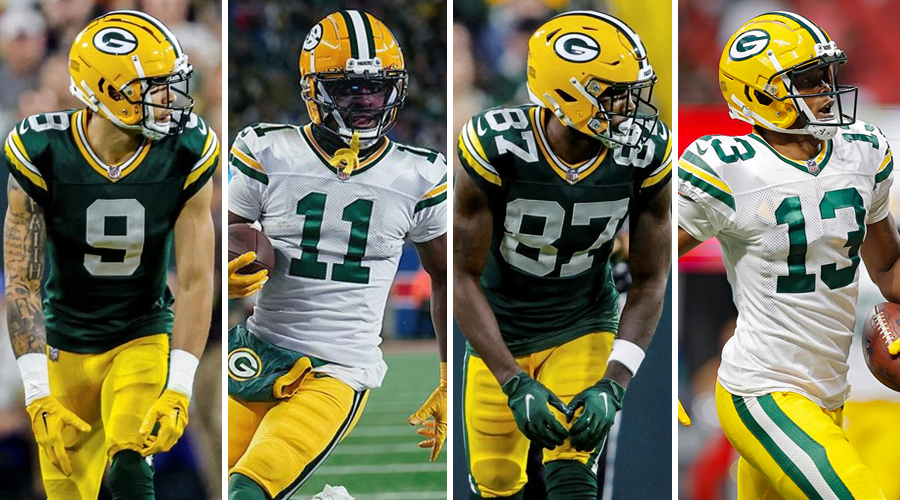
Packers full WR depth chart
While most of these position battles are between two or three options competing for a starting spot, this next paragraph is more focused on trying to figure out the pecking order of pass-catcher altogether in Green Bay. Since general manager Brian Gutekunst traded Davante Adams to Las Vegas two years ago, there’s been some lacking clarity among that group generally and especially into last season, there were a lot of questions about the guys about to catch passes from first-time starting quarterback Jordan Love. As it turns out, the guy replacing Aaron Rodgers behind center for the Pack was/is pretty damn good, finishing fifth league-wide in EPA per play. Moreover, his options of where he can go with the ball look a lot more appealing than what we originally thought. The player expected to be the alpha of that receiving corp in Christian Watson was only available for nine games and limited by injury even then. Yet, six other guys caught at least 30 passes during the regular season and these first- and second-year receivers looked like real long-term contributors at different points who could take on extensive roles.
I do feel like we have to start with Watson, considering he looked like a superstar on the rise, averaging 76 yards and basically one touchdown per game over the second half of his rookie season, once he returned from injury. Hamstring issues plagued him throughout year two, but he famously was the subject of extensive tests, which determined that he had asymmetrical muscle distribution and after working with experts this offseason, he could be in store for a big bounce-back season, since he has elite speed and impressive flexibility for his build. Meanwhile, Romeo Doubs hasn’t had the same type of high-end moments as the guy he was drafted a couple of rounds later than, but his 1100 receiving yards and 11 touchdowns over 30 career games leads that crew. He’s not a special talent, but his ability to create advantages off the line, set up route-breaks and win at the catch-point secure him a certain role. Last year’s second-rounder Jayden Reed led the way in catches (64) and yards (793), while operating out of the slot on just over three quarters of snaps. He adds a vertical component on the inside, but more so eats on crossing routes and can be used as a gadget player, who they designate with jet sweeps and end-arounds. And then there’s Dontayvion Wicks, who has become the apple of the eye for a bunch of fantasy analysts – and for good reason based on what he shows on tape. A fifth-rounder out of Virginia last year, he put up nearly 600 yards and four TDs on just 42% of the snaps. I love the fact that he can operate from any receiver spot, the way he adjusts his landmarks/angles, how he snaps off routes and runs through the catch.
So on paper, there’s a mathematical problem where all four wide receivers can’t be on the field at the same time unless they plan to use a heavy rate of 10 personnel – which I wouldn’t expect based on the fact that they want to use both of their day-two draft picks at tight-end from last year. Therefore, it’s likely that we’ll see a certain rotation among that group and depending on which skill-set they need at a certain time, they will all get their opportunities. Having said that, since week ten of his rookie season, Watson has logged more than 70% of snaps in 14 of 17 contests. So Matt LaFleur and company make sure to get him on the field and with full health, I expect him to make a big jump. Reed appears to be locked in as the guy on the inside for three-WR sets, because he can also present an extension of the run game. Doubs may have the least standout physical skills, but he’s so reliable as someone comfortable on the perimeter and so effective in the red-zone. Wicks is the wildcard here, since he can operate as a big slot at times but you also really like him on posts on deep in-cuts off play-action, as they may transition to more of a vertically-oriented run scheme with Josh Jacobs replacing Aaron Jones as their lead-back.

Giants starting TE – Daniel Bellinger vs. Theo Johnson
Moving on to the tight-end position, we may be looking at a fundamental question between primary blocker and pass-catcher for the 2024 Giants. Based on name value, there’ll be a definite downgrade, going from a previous Pro Bowler in Darren Waller to much lesser proven commodities currently on the roster. Now, what I would add here is that the veteran barely was a factor, most certainly not close to what New York was hoping for when they took him off the Raiders’ hands for a compensatory third-round pick last offseason. Hamstring problems limited Waller to 12 games and even when he was available, he was far from his usual self, catching 52 passes for just 552 yards and one touchdown. Even looking at more of the advanced metrics, he simply wasn’t a difference maker and the brain trust of Brian Daboll and Mike Kafka wasn’t able to use him as a chess-piece to dictate matchups, indicate coverage and more. Although I wouldn’t classify either of these two options I’m about to present as players that could function that way, at least they should be healthy and bring certain qualities.
We’ve already seen Daniel Bellinger carve out a solid role for himself under that coaching staff, when they came in two years ago and shockingly turned this into a top-ten offense by EPA per play with Saquon Barkley, paper clips and rubber bands. The rookie they had targeted at the top of day three in the previous draft started all but one of 12 games he was available for, catching 30 passes for 268 yards and a couple of TDs. New York asked him a lot to leak underneath the formation and become a dump-off option in the flats, but he also does well to settle between zone defenders, drift away from coverage, he has strong hands to finish catches through contact to his backside and when he has some room to turn up the field, you see that low 4.6 speed while bracing the ball with the collision imminent. With that being said, he was actually most valuable as a run-blocker, slicing across the formation for kick-outs, helping get the toss out to the corner on, etc. – he finished with a PFF run-blocking grade of 61.5 and was only penalized twice. This past season, he had slightly lesser production across a full 17-game slate and was less effective across the board pretty much.
So having already shown an interest in trying to upgrade to a more dynamic receiving option at the tight-end position, this opens the door for fourth-round rookie Theo Johnson to take away opportunities from Bellinger. He already made an impression on me when I was studying the previous starter at Penn State and I thought there were definitely some redeeming qualities with him as a draft prospect. However, when he blew up the combine with a near-perfect relative athletic score and there were discussions around him potentially being the second TE off the board the following April, I said that we needed to hit the brakes a little bit. Ultimately, he ended up as one of the first guys to hear his name called on day three and became a value selection with a low-risk, high-reward type of profile. Over his final two seasons with the Nittany Lions, he combined for 54 grabs worth 669 yards and 11 TDs. In terms of his early usage, it was very reminiscent of that rookie year by Bellinger actually, where he’d leak underneath the formation as a run-after-catch specialist thanks to the momentum he could build up to also plow through defenders in his path. You see the quick acceleration in the dropback game as well and he worked the middle of the field more this past season, although his route set-ups and breaks certainly need work. As a blocker, he displays an impressive ability to roll his hips into contact and although he overran the target occasionally, was asked to wrap around as a lead-blocker regularly.
The Giants have two guys here with similar strengths but also weaknesses, as neither one of them is a very skilled or advanced route-runner who can just win within the structure of their standard pass game. The rookie offers some more athleticism while the now-veteran already has familiarity with a variety of run concepts, which should give him the edge early on. So I believe he’s officially the starter by the time the season rolls around, especially considering Johnson was recently placed on the PUP list, but I could see Big Blue condense the formation and get both players on the field together quite a bit.

Chiefs left tackle – Wanya Morris vs. Lucas Niang vs. Kingsley Suamataia
Moving on to the offensive line, I believe one of the situations across the NFL that isn’t talked about enough are the edges of this front-five for Kansas City. Between Joe Thuney, Creed Humphrey and Trey Smith, they have the best interior-three combinations in the game today, but I don’t think people generally realize how poor their tackle play was last season. After making Jawaan Taylor one of the highest-paid tackles in the league, he didn’t miss a single start. Unfortunately, he had eight more accepted penalties against him than any other player out there (20) for more yards (140) than anybody else. Yet, despite finishing tied for tenth in total QB pressures allowed (47), Pro Football Focus handed him a significantly lower run-blocking grade (44.6). The Chiefs will need him to bounce back in a major way in 2024. However, on the left side they have significant room for improvement with a new option there. Long-time veteran Donovan Smith missed five regular season contests, but was on par for the most pressures surrendered if you extrapolate his numbers over a full 17 (3.5 per game). He also logged the worst PFF run-blocking grade of his career (45.1). Now, especially Smith suddenly stepped in a major way once the playoff rolled around and helped KC win their second straight Lombardi trophy, but Patrick Mahomes and the offense altogether had their worst statistical season since they made that switch at quarterback. So they can’t hope for another postseason turnaround but rather need more quality play throughout.
Wanya Morris is the guy who jumped in for Smith at left tackle during his absence and he performed pretty evenly to the veteran. He gave up one pressure every ten pass-blocking snaps (24 on 235 snaps) and was flagged three times. Considering he faced the likes of Maxx Crosby, Trey Hendrickson and Gregory Rosseau – three of the most effective edge rushers in the league – over the course of his time as a starter, you can explain those numbers however, particularly as a rookie. With a full offseason as the favorite in line for first-team reps, there’s potential for a pretty substantial leap. It would seem that he has a clear head-up on Lucas Niang considering the latter has only played a total of 69 snaps over these past two seasons, but that’s also due to Kansas City being pretty settled at those tackle spots based on paper at least and that they designated him as the primary backup on the right side. Going back to his rookie campaign, he did play over 500 snaps until veteran Andrew Wylie returned from injury and had better underlying metrics than both the guy he filled in for and Morris in his debut campaign. With only 22 pressures across 360 pass-blocking snaps and a 70.0 run-blocking grade, he has the best resume among these three options. That brings up to this year’s 63rd overall pick Kingsley Suamataia out of BYU. Opinions on the prospect were pretty varied, as he graded out pretty well as a starter at right and then left tackle for the Cougars, but adding context with what he was asked to do, there are justified worries about his transition to the pros. I definitely like his urgency off the snap, the force in his hands and the way can unlock his hips in the run game, while having experience on longer pulls. For a guy his size, he’s also a pretty easy mover in protection, but he didn’t have to deal with many vertical sets, relying more so on shuffle footwork and struggling to frame rushers.
Altogether, I believe Morris appears to be the most likely candidate to take over at left tackle, considering he was the one being called upon when needed last season. However, understanding that they have a massive need there and Niang started his college career on the left side with Tennessee before flipping over to the right with Oklahoma, he will get his chances to prove he’d be the best option. In part, that’s also due to their rookie not being ready to step in right away at either tackle spot, but having quality tape at both, especially in the run game, where I could see him act as the de-facto tight-end in some sets.

Titans right guard – Dillon Radunz vs. Saahdiq Charles vs. Daniel Brunskill
Transitioning to the interior, Tennessee obviously doesn’t have close to the level of quality there than Kansas City, as they were a bottom-three unit overall this past season based on the numbers and watching the film. The reclamation project of former first-round pick Andre Dillard didn’t work out, since they didn’t have the resources for it and I thought was foolish altogether considering he was coming over from the league’s best O-line coach in Philadelphia’s Jeff Stoutland. Chris Hubbard was serviceable as someone they realized in training camp that they needed to trade for at right tackle, but had to be placed on injured reserve with a biceps injury after eight weeks. Meanwhile, Dillon Radunz ended up starting at three different spots before taking over on the right edge, hurting his ability to find consistency. And they had three other listed tackles registering between 11 and 35% of snaps, while they let previous starting center Aaron Brewer walk out into free agency this offseason. With that out of the way, there is some reason for optimism, with okay tape from last year’s 11th overall pick Peter Skoronski, who was an elite left tackle at Northwestern, best suited to move one spot inside as a pro. They paid Lloyd Cushenberry 50 million dollars over the next four years to fortify the center position, as someone who showed continued growth over the course of his rookie deal with Denver and adds a sturdier presence at the pivot. Most importantly, head new coach Brian Callahan brought along his father Bill, who is one of the few names in conversation for the best O-line coaches in the game, and he probably hand-picked Alabama’s J.C. Latham as a incredibly talented top-ten pick, who they supposedly kick over to left tackle.
So really, I could’ve labelled this the entire right side for Tennessee, since the tackle spot over there is anything but settled. Nicholas Petit-Frere started all but one game as a rookie at RT, but graded out as a 52.3 overall by Pro Football Focus, as someone who expectedly would have some struggles adjusting to the NFL, getting himself into trouble by overstriding with his first step in the run game and opening the door for inside moves in his pass-sets. Nonetheless, I thought there were some intriguing qualities, which the Titans agreed with, when they picked him early in the third round and wanted to maintain him as the starter once he returned from suspension, only to be put on IR with a shoulder injury two-and-a-half games back. So I would think Radunz is fairly in consideration for taking over there, looking at the fact that he showed continued improvement over the course of his seven starts at that spot and easily having his best year as a run-blocker there (78.7 PFF grade). They may ultimately decide putting those two guys together on the same side gives them their best five out there though. In terms of who else has a claim for starting duty at right guard, Daniel Brunskill was brought in from San Francisco as a free agent a year ago and did perform around the standard he had previously set, even though he was unavailable in three games, and Saahdiq Charles totaled nearly 1200 snaps between LG and RG for Washington during his rookie deal. Brunskill to me has always been a better fit at center, where they of course brought in Cushenberry, and I wonder if Tennessee wants to move to more gap schemes, considering the transformation the Callahans were a part of in Cincinnati to operating from the shotgun with a ton of 11 personnel and went away from zone concepts. That would favor the more solidly built Charles at 6’4”, 320+ pounds with his ability to create displacement near the point of attack.
With none of these guys there’s proof of concept as high-end starters at right guard over a longer period of time. The two main factors here will be if this new regime wants to have Radunz at right tackle instead and what exactly they want this ground game to look like. To me, the most likely outcome is that Radunz slots in at the spot in question, while Charles is the primary backup behind him and Brunskill’s experience at center makes him the favored option there, in case of injury. Either way, with two new starters from the outside and the coaching they’ll receive, this unit has a chance to go from near the bottom to average across the NFL.
Panthers RUSH linebacker – D.J. Wonnum vs. K’Lavon Chaisson vs. D.J. Johnson
Before we get to the players themselves, let’s quickly mention the classification here for Carolina’s outside linebackers. Going back to the tape last year, I thought they were locked into sides at times, but in other moments, their alignments were seemingly dictated by the tight-end as the indicator for strength of the formation. So me calling this open spot in defensive coordinator Ejiro Evero’s system “RUSH linebacker” is based on the fact that the Panthers signed veteran free agent Jadeveon Clowney, who at 6’5”, 270 pounds should largely be playing “SAM”, meaning the guy playing on the strong-side edge. Last year they had even longer tenured Justin Houston paired up with their ace pass-rusher Brian Burns, who they decided to trade to the Giants this offseason for an early second-and a fifth-round pick after reportedly turning down a couple of first-rounders plus from the Rams at the 2022 trade deadline. So along with bringing in the former first overall pick in Clowney off a resurrection season, they took shots a couple of guys who have shown flashes in the past along with a day two selection they made themselves last year.
D.J. Wonnum is by far the most accomplished performer among these three names, even though he was the lowest draft pick. A fourth-rounder for Minnesota in 2020, he logged nearly 500 snaps as a rookie, getting extensive run in particular once Yannick Ngakoue was traded to Baltimore following a 1-6 start. That made the Vikings comfortable banking on him as the partner in crime of Daniell Hunter, who was going through extensive back issues. While Wonnum has never been a standout talent, his ability to defeat the hands of blockers and technical sound-ness gave him the opportunity to collect 113 pressures on a high workload these last three years combined (just under 1400 pass-rush snaps). A more exciting option Carolina acquired this offseason based on potential as a more star at LSU is K’Lavon Chaisson. It was interesting when the Jaguars selecting 20th overall in 2020, since they had just drafted Josh Hines-Allen the year prior with a similar profile, where they had shown the ability to play off the ball at times and be an asset in coverage. Unlike the former teammate, who recently became one of the highest paid edge rushers in the NFL, Chaisson’s transition to the pros sadly hasn’t been anything Jacksonville was hoping for. After playing 569 snaps as a rookie, he has combined for less than 800 total these last three years, missing most of 2022 with a meniscus injury. He did just have his most productive season getting after the quarterback (14 pressures on 154 pass-rush snaps) and he’s such a springy, loose athlete that he’s worth taking a gamble on for one year at 2.5 million dollars. Thirdly, we have last year’s third-round pick D.J. Johnson, who wasn’t quite selected as early, but may face some similar challenges, intriguing people with his sub-4.6 speed at 260 pounds, but there’s not much substance to his pass-rush profile at least. I thought attacking half the man and layering moves on top of one another weren’t really there on his Oregon tape. And it was illustrated by registering just three pressures across 83 opportunities.
Therefore, I have a tough time seeing Johnson being anything more than a rotational player, particularly on run downs, where he can fill in for Clowney on the strong-side, since he will launch himself into contact and set the tone with those heavy hands. The favorite has to be Wonnum, since he’s the only one with extensive snap shares as a pro, even though the production rushing the passer was more based on volume than individual brilliance. The wildcard in this race is Chaisson, who unless I’m unaware of some long-term issue with his knee, I believe the talent that made him a first-round pick is still there. His get-off combined with the slipperiness to create favorable angles as a rusher is intriguing, plus if Evero wants to run a lot of simulated pressures, he’s very capable of peeling off into coverage. I mean, this guy was carrying running backs on wheel routes in the SEC.

Browns 3-technique – Shelby Harris vs. Maurice Hurst vs. Michael Hall Jr.
Moving on to the interior and from one of the weakest to one of the elite defenses in the league last season. The Browns emerged as one of those units under the guidance of defensive coordinator Jim Schwartz, who relied on being aggressive with his choice of coverages (running single-high looks on over 70% of snaps) and allowing his D-line to pin their ears back. I thought getting a true shade-nose tackle in Dalvin Tomlinson on a significant free agent deal helped unlock their style of play, since he could occupy and own his space against double-teams, while the rest of the group attacked up the field, and it set them up with more opportunities to get home in defined dropback situations. That also helped Myles Garrett cash in at such a high rate and win Defensive Player of the Year. By bringing back veteran Za’Darius Smith and making sure they have him plus Obo Okoronkwo as more of a speed threat off the edge, they seem well set up to give opposing passers hell yet again. The one spot where there are still some question marks is the second defensive tackle gig, primarily lined up towards the strong-side of the formation shaded to the guard’s outside shoulder.
Last year, Shelby Harris basically played an identical rate of snaps (41.6%) as Jordan Elliott, who pretty much shared that role for Cleveland. He’s been one of the more effective interior defenders across the league who nobody really talks about. Since he settled in on a role with the Broncos in 2017, after three years of battling for a roster spot at different locations, he only missed eight games over the following seven seasons with Denver, then Seattle and finally Cleveland. He’s averaged 25 pressures on 300 pass-rush snaps over that period of time and only once received a PFF grade below 70. He’s just kind of capped around 500 total snaps per year and will be 33 by the time week one rolls around. “Mo” Hurst is another day three draft pick, who has become a more than serviceable player now in his third landing spot. He never lived up to my expectations based on how disruptive he was at Michigan, before a heard condition ultimately pushed him way down in the draft, but he just had his best statistical season and was brought back on another one-year deal. He recorded a pressure on just better than every tenth pass-rush opportunity (18 on 173 such snaps), he was awarded a career-best run defense grade (76.5) and batted down three passes. The third name in this discussion was Cleveland’s first selection in this past draft (54th overall) in Michael Hall Jr. He never quite posted the numbers you’d like to see from a former top-50 national recruit, but he was played out of position as a nose constantly and did work on his ability to anchor vs. combo-blocks, while I thought he looked outstanding during Senior Bowl week, with the ways he could challenge blockers during one-on-ones, being able to win up the field with a rapid club-swim combo and counter off that with cross-face and spin moves.
So other than trying to (re-)order the Packers wide receiver room, this is one of the stronger trios of options the Browns have at their hands. In full honesty, I don’t think any of these guys ends up playing half the snaps outside of injuries, but I’d say Harris is still first in line to earn the starting gig, thanks to how consistent he’s been throughout his career, including already under Schwartz. Hurst was right in line for the same snap total over the course of a 17-game season and with Jordan Elliott out of the picture, I could see a similar split between those two guys. Hall to me has the highest potential and could enable Cleveland to let the veterans walk next offseason. I believe he’ll continue to strengthen his core up until that point and will be reserved for passing situations, but could deliver some key plays when he’s left on an island with a guard on third-and-long. I do have to throw in Quinton Jefferson as another veteran here, who will eat into this workload when they don’t need that 1-/2i-technique on the field, but will be listed as a backup behind Tomlinson on the final depth chart, I’d believe.
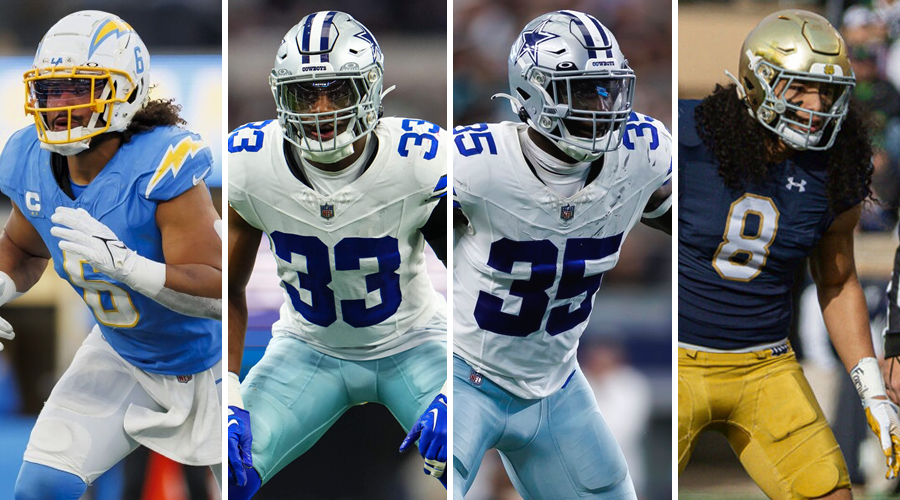
Cowboys starting LB spots – Eric Kendricks vs. Damone Clark vs. DeMarvion Overshown vs. Marist Liufau
This is the first time I kind of altered the exercise, since we’ve otherwise been talking about one specific spot those 22 starters on offense and defense combined. In spite of that, I had to look at this entire linebacker room for Dallas, since I don’t believe any of these four names mentioned have earned the benefit of being locked into a starting slot. Going back to where this Cowboys defense had its issues – and that’s a strong word for a unit that just finished top-five in both EPA and DVOA for the third straight year – nose-tackle and the second level altogether had some really bad moments when they were highlighted by the opposing team’s gameplan. They did draft Mazi Smith out of Michigan last year, who was promptly ask to shed about 25 pounds and struggled at his usual role between the guards, before getting back to a playing weight he’s comfortable in this upcoming season. So I’m going to be focusing on the guys he’ll be playing in front of for the purpose of this discussion. Not only did Dallas use the second-lowest rate of base personnel in 2023 (4.4%), but they were also tied for the fifth-highest percentage of dime (21.1%), largely based on losing Leighton Vander Esch to injured reserve five weeks in – and he would eventually retire medically. Opposing teams would force safeties to be the take-on players against the run and then punish them when they used play-action off it. Just think to when the Packers scored 48 on them at home in the Wildcard Round.
Even though America’s Team didn’t go “all in” as owner Jerry Jones had previously proclaimed, when you look at the roster moves they’ve made this offseason, one of the first things they did was reunite new – in office but certainly not profession – defensive coordinator Mike Zimmer with his middle linebacker from their days together in Minnesota, Eric Kendricks. A Pro Bowl-level performer for an extended stretch with the Vikings, you’d certainly think he earns the nod based on their previous working relationship. Yet, he’s fallen off substantially over the last three years, going from one of the best in the game to more of a liability in coverage, being responsible of passer ratings North of 100 in each of them. I don’t want to the horrendous Chargers defense to taint him too much here, but the tape shows a player in the twilight of his career. Damone Clark was a 17-game starter for Dallas last season – who they stole in the fifth round the year prior due to concerns about his spinal cord – racking up 109 tackles and only missing four attempts. He didn’t make a bunch of impact plays in the pass game, but was a solid contributor, who would be in competition with Kendricks for the “MIKE” spot, I’d think. A big reason he even got the opportunity however is that last year’s third-round pick DeMarvion Overshown suffered a torn ACL in preseason, which cost him his entire rookie campaign. While being slightly undersized makes it challenging for him to take on blockers in condensed space and reliably bring ball-carriers to the ground, the energy he plays with and the closing burst to stuff plays before they can even get going and contribute as a blitzer should earn him at least some role.
That’s why it was surprising that Dallas spent another third-round selection on Notre Dame’s Marist Liufau this past April. There’s no denying the appeal from a physical perspective, looking at guy at 235 pounds with mid-4.5 speed and over 34-inch arms to keep blockers away from his frame. At this point, he doesn’t use those accordingly to deconstruct blocks at a high enough level yet, too often his first step is wrong generally and his tackling in space needs work. So in my opinion, his best usage is as a hybrid player on passing downs, whose length can crowd passing windows as someone Zimmer can use in those double-mug looks, along with rushing from different angles. Kendricks will receive a bump from his DC due to understanding the system already, even if being out of the league for a couple of years, we could see some new ideas from the long-time play-caller. Having more of a run-and-chase player in Overshown could be a nice mid-ground between what we’ve seen previous iterations and last year’s super-light boxes. That would leave Clark on the heels of Kendricks with a fairly short leash.

Broncos field-side CB – Levi Wallace vs. Damarri Mathis vs. Riley Moss vs. Kris Abrams-Draine
This brings us to the secondary portion of the article and I outlined three different positions among it. We’ll start on the outside and in particular the guy who will line up opposite of standout Patrick Surtain II as their primary boundary corner – meaning the shorter side of the formation. With a defensive coordinator like Vance Joseph, who wants to run a lot of fire zones (three-deep, three-under with a six-man rush) and hasn’t followed the trends around the league with as much match principles in quarters (12.2%), that differentiation isn’t as defined necessarily, but I could see a higher rate of man-coverage generally if they feel comfortable with that guy on the other end of the field. This past season Ja’Quan McMillian really emerged as a play-maker in the slot for this group, creating seven negative plays, being involved on six takeaways and breaking up five passes. However, the secondary spot on the perimeter was a rotation between Damarri Mathis and Fabian Moreau, who snatched the starting gig away from the second-year man six weeks in and logged nearly two thirds of defensive snaps. They did allow him to walk in free agency however.
Instead, they brought in another veteran, who has been one of the pre-eminent number two corners across the NFL in Levi Wallace. Whether it was as a walk-on at Alabama, an undrafted free agent in Buffalo or signing a two-year, eight-million-dollar deal with Pittsburgh, he’s come to all those places with fairly low expectations but he’s played at least 69% of defensive snaps in each of the last seven years. 2023 was his worst season as a pro, allowing six touchdowns in coverage and showing his limitations in the Steelers scheme, which relied on a lot of cover-one on early downs. As for the previously mentioned Mathis, he offered an intriguing physical profile as an early day-three pick out of Pitt two years ago, thanks to his combination of physicality and speed (4.39 in the 40). Unfortunately, he was pushed to second-string last season based on his aggressiveness, lunging and drawing flags at a fairly high rate, and still calibrating when to play the man or the ball in the air. Riley Moss deserves to be mentioned here, considering he was a third-round pick just last year and supposedly one of the next white corners to actually make a living in the NFL. So far, the Broncos haven’t really shown any urgency in getting him playing time, logging more than ten times as many snaps on special teams as on defense (23). While he has short arms, allows himself to get stacked vertically to easily and manipulate at the top of routes, he does have easy speed, good awareness for route patterns and a knack for attacking the ball in the air – we just didn’t get to see it in the pros yet.
And then there’s the rookie, who may throw kind of a wrench into this thing. Surprisingly – at least based on the mid-round investment they made each of the previous two years – they selected another corner at the top of day three in Missouri’s Kris Abrams-Draine. Even though I liked each of these other guys in college, I thought he had the cleanest tape and should translate the best. After playing primarily in the slot early in his career, he did line up on the far side of the field primarily these last two years and was one of the smarter DBs I watched leading up to April. Savvy route-runners may be able to throw him off a little bit at times by slow-playing the release and getting him a little off balance with advanced footwork, but his route anticipation, his patience in soft press or off-man coverage and how he adjusts his technique accordingly is excellent. I thought he may be best suited to play nickel in the NFL, because he’s also such a reliable edge-setter in the run game and tackler. So I see him backing up McMillian initially, while Moss backs up Wallace at the question field-side role and Mathis’ physical nature can be more valuable as a boundary guy in case Surtain misses any time. That would give them a solid second option at all three positions, although if Wallace is out for an extended stretch, I expect the rookie to get his chance there.
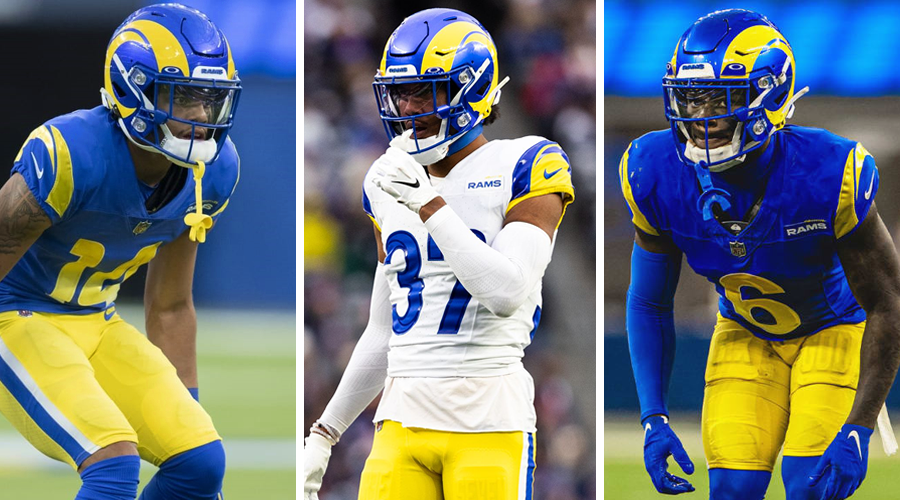
Rams nickelback – Cobie Durant vs. Quentin Lake vs. Tre Tomlinson
In terms of a definitive slot role, the Rams seemingly have an open competition there for a secondary that has seen a massive overhaul over the past two years plus. In 2021, the combination of Jalen Ramsey, Darious Williams, Jordan Fuller and Taylor Rapp gave them one on of the more formidable back-ends across the NFL. All those guys were either traded in Ramsey’s case or walked out the door, with Williams since having returned after shockingly being cut by the Jaguars in early March. Even at that time however, L.A. wasn’t 100% settled on the guy in the slot for them and once again, it looks to be a muddy picture. John Johnson III is another former Ram who came back home alongside Kam Curl as their likely new starting safety duo, along with a mid-round rookie I’ll mention later on. So assuming Tre’Davious White gets the starting nod if healthy on a one-year, prove-it deal that he probably took based on conversation he had prior with the coaching staff, and Williams being best utilized in an off-zone role with vision on the qzarterback across the field, we’re locked in on who is the primary choice inside for a team that actually finished with the third-lowest rate of nickel (55.2%).
I don’t want to say Ahkello Witherspoon turned back into a plum over the second half of last season, but his coverage numbers did get more in line with what he’s been over the course of his career, and the Rams allowed him to walk. Their starter in the slot – Cobie Durant – is actually back and should be considered the favorite to earn that duty yet again. That opportunity was earned by picking off three passes as a rotational player, who excels at clicking-and-closing on stuff in coverage, and broke up another five on less than 300 defensive snaps. Yet, last season he surrendered 8.5 yards per target and missed 13.3% of attempted tackles, without the picks. That’s why I see an opening for Quentin Lake to at least steal some snaps. A sixth-round pick two years ago out of UCLA, he was largely reserved for special teams, but then instead of taking on a more traditional safety role as we saw in college, all but 13 of 451 total snaps were spent in deep alignment, according to PFF. Although he’s not a super impressive athlete, what I loved about him during that evaluation was his ability to decipher route patterns, position himself accordingly and deny opportunities for big plays through the air. He allowed half as many yards per target (4.7 YPT) as Durant last season and has only missed about half as many tackles in his young career. I want to also throw in Tre Tomlinson here – formerly Tre’vius Hodges-Tomlinson – who quickly made a name for himself at TCU beyond the legacy of his uncle La’Dainian Tomlinson as one of the all-time great running backs. He had some of the best ball production across the country, even if he drew flags at a higher rate than pretty much anybody as well and his diminutive size presents limitations. Still, in defined dropback settings, I could see his quickness and ball-skills be an asset, if given a chance.
Personally, I believe Lake would present a more reliable presence in the run game and as a tackler, who can match up with tight-ends and operate as an apex defender in the RPO game, with how much cover-four and -six as they’ve previously run. Now, he does have some competition in what they may label as “big nickel” packages, in the form of rookie Kamren Kinchens from Miami, who could be a more versatile puzzle piece, because of the instincts and ball-magnet qualities he provides. Durant should be the preferred option on longer downs, even if they do put three safeties on the field – not counting Lake as such. We have yet to see what wrinkles defensive coordinator Chris Shula may have in store as he was promoted from linebacker coach and then passing game coordinator, but figuring out how snaps are split among this group will be one of his first major decisions.
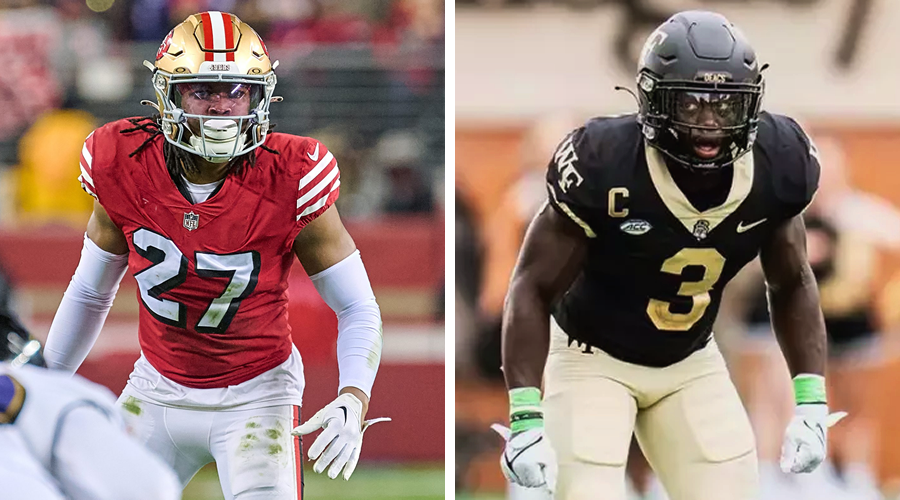
49ers free safety – Ji’Ayir Brown vs. Malik Mustapha
Finally, we do take view a battle for an actual safety spot within the NFC West, as the 49ers have multiple ways they could go here. I’m not a big fan of the traditional designations of free and strong safety, since modern defenses rarely use them anymore in favor of boundary and field-side, and there was no clear order by which they designate the strength of the formation based on a quick peak back at their time when they still had standout Talanoa Hufanga, which would be helpful in this conversation. While they ran quarters at the third-highest rate across the NFL (23.5%), they were basically average in every other coverage category. So it’s not like they rely upon having a rangy high post player that was necessary in years past, when they adapted Seattle’s three-deep principles, and you see Hufanga in single-high looks fairly regularly, even if I think he’s at his best when they split the field and he can attack what’s in front of him. So you’re looking for someone comfortable playing high or low, maybe not playing straight man-coverage for any extended stretches, but he also match routes from depth based on how route concepts develop.
Last year’s third-round pick Ji’Ayir Brown is someone I considered writing about as a potential breakout candidate for 2024 a couple of weeks ago already, but based on the competition I didn’t quite feel comfortable about locking him into that starting job. Nonetheless, I’ve been a fan of his for a while, watching the intelligence and ferocity he played with at Penn State, even if his explosiveness and speed from a testing perspective wasn’t up to par. Clearly the decision-makers in San Francisco were comfortable with putting trust in the then-rookie, only missing one(!) snap over the final eight games he was available for, including the Super Bowl, where he had an interception off Patrick Mahomes to start the second half. That was along with disrupting the catch-point on what could’ve been a couple of huge plays in the NFC Championship. Funnily enough, the player San Francisco selected at the top of day three this past April is somewhat reminiscent of Hufanga, as some big hitters who on the surface would be labelled as “strong safeties”. Both of them I had some questions about their ability to open up and run in coverage and particularly with Malik Mustapha, I don’t love him in isolated situations when giving a cushion. In fact, his tape playing up close against tight-ends I much preferred, he can cover plenty of ground as an eraser when you ask him to patrol the deep post and when he drops down into the box, with his rocked-up frame and mindset, he’s almost like an extra linebacker.
George Odum signed a two-year extension worth 7.5 million bucks this March, as someone who has only played less than 100 defensive snaps across his two seasons with the Niners, but has been a special teams ace, who I felt like bringing up here as a veteran presence, who could be called upon more extensively, if the young guys don’t perform up to the level expected. Having said that, I consider this more of a two-horse race, where both should see the field a fair amount either way. With Hufanga tearing his ACL in week 11 last season, there’s a possibility they want to bring him along slowly anyway and the other detail to consider here is Dre Greenlaw’s highly unfortunate Achilles injury, which probably costs him the entire regular season at least. That would open the door for Mustapha especially to be deployed more regularly as a dime backer. There’s another coaching change in San Fran, going from Steve Wilks, who was fired after one rather underwhelming year considering the talent at hand, to the promoted Nick Sorensen, who will be supported by former Chargers head coach Brandon Staley, who should bring in some new ideas. So I’d expect a few three-safety sets sprinkled in at least, after they were the only team last season with a 0% dime rate, but to stay with the basic question – Brown to me appears to be the designated second starter, the more I dove into this situation.
One more battle for each team:
Arizona Cardinals left guard – Evan Brown vs. Elijah Wilkinson vs. Isaiah Adams
Atlanta Falcons 5-technique – Zach Harrison vs. Ruke Orhorhoro vs. Brandon Dorlus
Baltimore Ravens right tackle – Patrick Mekari vs. Josh Jones vs. Daniel Faalele vs. Roger Rosengarten
Buffalo Bills #4 receiver – Marquez Valdes-Scantling vs. Chase Claypool vs. Mack Hollins vs. K.J. Hamler vs. Justin Shorter
Carolina Panthers RB depth chart – Miles Sanders vs. Chuba Hubbard vs. Jonathon Brooks
Chicago Bears 3-technique – Gervon Dexter vs. Zacch Pickens vs. Keith Randolph
Cincinnati Bengals starting TE – Mike Gesicki vs. Drew Sample vs. Erick All vs. Tanner McLachlan
Cleveland Browns MIKE linebacker – Jordan Hicks vs. Devin Bush vs. Nathaniel Watson
Dallas Cowboys center – Brock Hoffman vs. Cooper Beebe vs. T.J. Bass
Denver Broncos starting TE – Adam Trautman vs. Greg Dulcich
Detroit Lions kicker – Jakes Bates vs. Michael Badgley
Green Bay Packers field-side safety/big nickel – Javon Bullard vs. Kitan Oladapo vs. Evan Williams vs. Keisean Nixon vs. Anthony Johnson Jr.
Houston Texans outside CB – Kamari Lassiter vs. Jeff Okudah vs. C.J. Henderson
Indianapolis Colts field-side CB – Jaylon Jones vs. Dallis Flowers vs. Darrell Baker Jr.
Jacksonville Jaguars strong safety/nickelback – Darnell Savage vs. Antonio Johnson vs. Jarrian Jones vs. Terrell Edmunds vs. Andrew Wingard
Kansas City Chiefs #3 safety – Chamarri Conner vs. Deon Bush vs. Jaden Hicks
Las Vegas Raiders boundary CB – Jakorian Bennett vs. Brandon Facyson vs. Decamerion Richardson
Los Angeles Chargers 3-/4i-technique – Otito Ogbonnia vs. Scott Matlock vs. Justin Eboigbe
Los Angeles Rams starting TE – Colby Parkinson vs. Davis Allen
Miami Dolphins nickelback – Kader Kohou vs. Cam Smith vs. Nick Needham
Minnesota Vikings starting QB – Sam Darnold vs. J.J. McCarthy
New England Patriots primary return specialist – Marcus Jones vs. Demario Douglas vs. Jalen Reagor
New Orleans Saints backup QB – Jake Haener vs. Spencer Rattler vs. Nathan Peterman
New York Giants right guard – Jon Runyan Jr. vs. Aaron Stinnie vs. Joshua Ezeudu
New York Jets #2 running back – Braelon Allen vs. Isaiah Davis vs. Izzy Abanikanda
Philadelphia Eagles boundary CB – James Bradberry vs. Isaiah Rodgers vs. Quinyon Mitchell
Pittsburgh Steelers starting QB – Russell Wilson vs. Justin Fields
San Francisco 49ers right side of the O-line – Jon Feliciano vs. Colton McKivitz vs. Spencer Burford vs. Chris Hubbard vs. Dominick Puni
Seattle Seahawks right guard – Anthony Bradford vs. Christian Haynes vs. Curtis McClendon vs. Sataoa Laumea
Tampa Bay Buccaneers boundary CB – Zyon McCollum vs. Bryce Hall vs. Josh Hayes
Tennessee Titans starting RB – Tony Pollard vs. Tyjae Spears
Washington Commanders TE depth chart – Zach Ertz vs. Ben Sinnott vs. John Bates vs. Cole Turner
 Halil's Real Footballtalk