
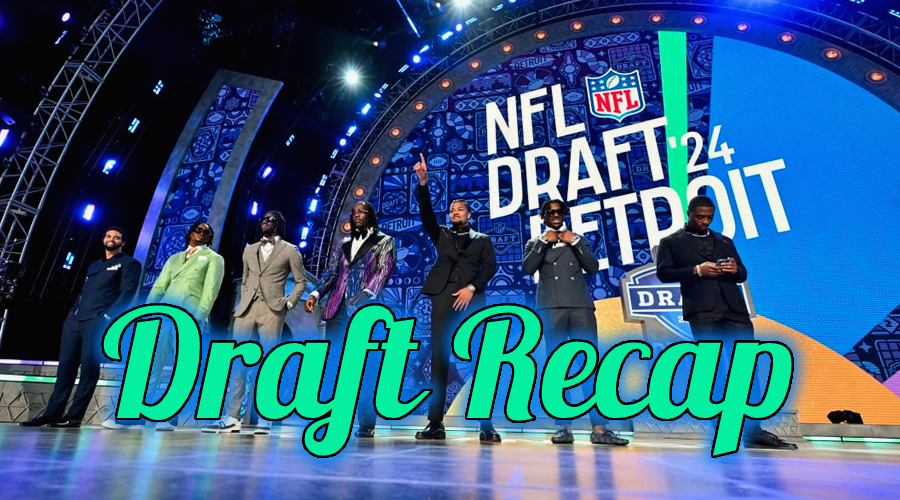
The 2024 NFL Draft is in the books and it’s time to recap all the action. Thursday started off pretty chalky until the Atlanta Falcons sent shockwaves across the internet when they selected Washington quarterback Michael Penix Jr. eighth overall. We didn’t see a defensive player selected until pick number 15. Late in the first round leading into day two, we saw a big run on wide receivers, which the depth of the class was illustrated by 35 total names coming off the board. Offensive tackle came in close behind that with 27 selected and cornerback actually edged out the WRs by one more taken (36), as the two other quality position groups. The big surprise was that we didn’t just get six quarterbacks inside the top-12 to set a new record, but then it took 138 additional spots before we got to QB7.
In this article, I’m going to break down the biggest winners and losers from the weekend, which can be teams overall in terms of the hauls they put together, individual players, coaches or general managers. After that, we’re getting to the biggest steals and reaches, based my individual rankings, consensus boards and general circumstances. All of this of course comes with a certain level of subjectivity and it’ll be another three years before we can make any definitive statements on these new members of the NFL, but I strongly believe in team-building through the draft, understanding where you can acquire value, how to maneuver around the board and how this piece fits into the puzzle, as you consider the way you’ve positioned yourself coming in and the vision behind the operation.
Let’s get into it:
Winners:
Pittsburgh Steelers
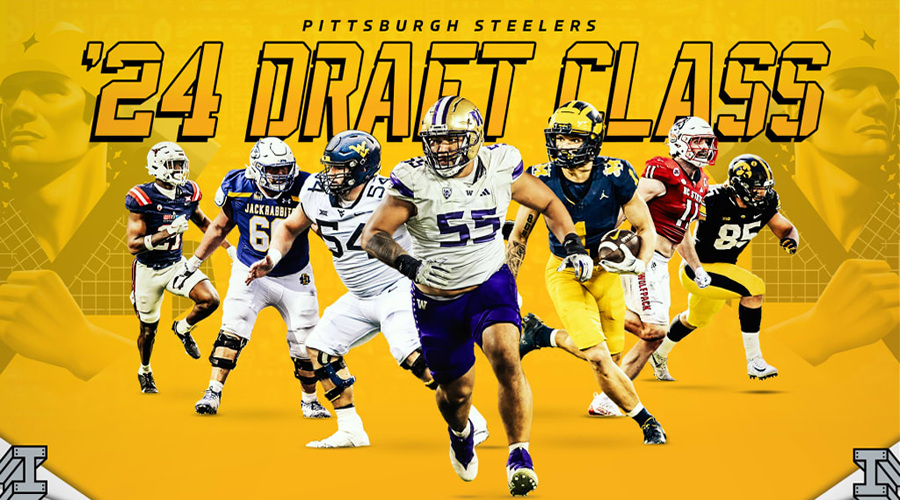
We have back-to-back appearances by the Steelers and I thought this year they knocked it out of the park even more so this year. And we saw their draft reflect very well how one term has dictated their entire offseason – patience. It showed in the way they spent a sixth-rounder (who could bump up a couple of rounds based on playing time) for a QB room of Russell Wilson and Justin Fields, who cost them 4.5 million dollars this year. They signed a couple of starters at key spots in linebacker Patrick Queen and safety DeShon Elliott under expected value and while the late-round pick-swap paired with the Diontae Johnson-for-Donte Jackson trade isn’t a net plus, it feels like they had a player there who didn’t fit in with the culture anymore.
As for this draft class, of their first five picks (20, 51, 84, 98 and 119), all of the players they selected were (in some cases significantly) higher on my personal big board compared to where they got them. Washington’s Troy Fautanu became OT6 selected as someone with elite movement skills, projecting well as someone who can offer positional versatility, even if the raw strength isn’t quite up there with the guys ahead of him. Then they came back in the second round and got what arguably was the best pure center in the class, if not for breaking his leg at the end of the college season, in West Virginia’s Zach Frazier, who is a perfect fit for new OC Arthur Smith implementing his outside zone-based run scheme. Michigan’s Roman Wilson at one point was projected to be a potential surprise pick at the end of the first round with how he was routing everybody up during Senior Bowl week, coming from an environment that didn’t lend itself to major production, but he was the guy the Wolverines relied upon when they needed to move the chains (38 of his 48 receptions last season resulted in either a first down or touchdown). I had a late first-round grade purely based on the tape of N.C. State linebacker Payton Wilson, who brings premiere speed, play-making skills and effort, but saw his career marked by injuries until becoming the ACC Defensive Player of the Year in 2023. And while they already had a couple of veteran guards under contract for this year still, South Dakota State’s Mason McCormick was an absolute ass-kicker in the run game for the FCS champion Jackrabbits, then had basically a flawless week of Shrine Bowl practices, especially in one-on-one pass-pro drills, and ultimately finished with a top-ten relative athletic score (9.97) for guards.
Iowa interior D-lineman Logan Lee (178th overall) and Ryan Watts (195th overall) also both feel very much like Steelers players in reserve roles. So not only did they probably find a starting receiver and linebacker as rookies, I mentioned this on social media, who a little more than a calendar year ago, Pittsburgh probably had a bottom-three offensive line and now they’ve literally improved all six spots, if including their primary backup.
Aidan O’Connell & Gardner Minshew
I’ll get to the validity of the six quarterbacks who were ultimately selected in the top-12, but coming into last Thursday night, if you replace the Giants with the surprising Falcons, there were seven teams in the market for a young signal-caller in that range plus the Raiders at pick 13. As it turned out, they were the ones to miss out on the group. Personally, I thought there was a good chance they might trade up, if the Commanders preferred North Carolina’s Drake Maye compared to LSU’s Jayden Daniels, since new head coach Antonio Pierce has the connection with the reigning Heisman Trophy winner from the days of being involved in his recruitment at Arizona State. As it turned out, Las Vegas didn’t end up moving, despite reports on them trying trade up as high as second overall, and with the record-setting six names selected until the Silver and Black were on the clock, they instead got the final one of the four premier pass-catchers in Georgia tight-end/all-purpose weapon Brock Bowers.
However, it didn’t stop there. The Raiders actively passed on possible options with all of their final seven picks (one in each round, other than two in the seventh). In fact, there was a 138-pick gap between QB6 and QB7 – which I’ll get to more later on – and I personally think all five of the remaining guys drafted (even if Tennessee’s Joe Milton III is objectively pretty raw) had starter traits, at least in relation to Aidan O’Connell and Gardner Minshew, who along with Anthony Brown – an undrafted free agent from two years ago – and Carter Bradley (South Carolina) as their own UDFA pickup following Saturday, make up that quarterback room. Instead, along with Bowers 13th overall, they brought in my personal top-ranked center Jackson Powers-Johnson from Oregon (44th overall), a long and athletic tackle/guard developmental prospect in Maryland’s Delmar Glaze (77th overall) and later on what might be the best pass-catching back in this draft in New Hampshire’s Dylan Laube (206th overall).
So not only did Vegas miss out on the top of the class of signal-callers, but they didn’t even take a shot on anybody else outside of what I look at as a potential QB3 as a UDFA and then they spent their picks in the first three rounds on another offensive weapon and addressed the O-line, along with upgrading their third-down back with Laube, in my opinion. I thought O’Connell showed some real signs last season, even though he may be somewhat limited, and Minshew did nearly lead the Colts to a playoff berth, even if the tape showed obvious flaws. So for the Raiders to come out of this draft with no real competition to those guys has be counted as a massive W for them – although I think they were a perfect candidate to take at least a day-three swing on someone.
The university of Michigan
Two years ago, I talked about Kirby Smart and the Georgia Bulldogs, when they set a new record for most players selected off one team in a year with 15. After them, there are two college programs with 14 each (2004 Ohio State and 2020 LSU), before the Wolverines come in at 13 total names. As you look at that list, the big difference between them and the other groups in that range, is that they’re the only one of 14 teams with 11+ guys drafted, who didn’t have multiple first-round picks. That speaks to the kind of infrastructure they’ve built, where they don’t rely on individual star players, have guys coming back for their senior years in order to compete for a championship and still set themselves up for a future in the pros.
Quarterback J.J. McCarthy went 10th overall to the Vikings, which was slightly lower than betting services had it, but like two rounds higher than where many people considered him when Michigan won the National Championship in early January. So that speaks to the fact their style of play offensively, which makes the quarterback more of a complementary piece, doesn’t necessarily hurt more potential high recruits at that position, while not as much is put on their plate. They quickly turned Mike Sainristil from a wide receiver into arguably the top pure nickelback in the class and the 50th overall selection (Commanders), interior D-lineman Kris Jenkins Jr. went a pick earlier (Bengals) despite limited production in more of a read-and-react style of front, Jim Harbaugh himself (Chargers) grabbed Junior Colson as LB2 off the board, A.J. Barner was a fourth-round pick as somewhat of a one-dimensional player because they turned himself into the top blocking tight-end in the class and even guard Zak Zinter was a third-rounder despite breaking his tibia and fibula.
The two guys that went a little later than I might’ve expected were running back Blake Corum (83rd overall), who was recovering from a torn ACL but will be sharing the Rams backfield with who many comped him to in Kyren Williams, and Roman Wilson (84th overall), who landed in the pre-eminent spot for mid-round wide receiver production in Pittsburgh. The only prospects I had draftable grades on who didn’t get selected were center Drake Nugent and edge defender Braiden McGregor. And even with those two, you see a path why they wouldn’t hear their names called, due to size and injury concerns respectively. So the Wolverines check the three key factors for high school recruits – a top-ten university in terms of education according to Time Magazine, a proven winner (40-3 record over the past three seasons combined) and now also an NFL machinery, under the leadership of former offensive coordinator Sherrone Moore taking over for Jim.
Green Bay Packers
Looking through some draft grades out there, just for fun, I couldn’t that they were middle of the road at best, when I think you can make a strong case that the only class you should put above theirs is the already discussed Steelers. Simply from a process perspective, they came into Thursday with one pick in the first round, two in the second, two in the third, one in the fourth and fifth each, plus two in the sixth and seventh each. Ultimately, they moved back four spots in the second round (from 41 to 45) and in return – through multiple other trades – they moved up 11 spots in the fourth round and 56 spots from the sixth to the fifth round (from 219 to 163). Based on that alone, the accrued value, before we even get to the names they used that capital on.
Now, the first round is where some people may arguably they slightly reached on Arizona’s Jordan Morgan, who is argued to be moving inside to guard because his arms came in an eighth of an inch short of the general 33-benchmark, but he has some of the best mirror skills and ability to block on the move in this entire class, was a first-team all-conference performer in the loaded Pac-12 in a season coming off a torn ACL and was 31st on my personal big board, compared pick 25, where they ended up selecting him, as the seventh of nine offensive taken in the first round. In the second, they addressed their two biggest defensive needs, with Texas A&M’s Edgerrin Cooper (45th overall), as an uber-athletic, long linebacker to pair up with a former first-rounder in Quay Walker, and a teammate of the second-year breakout from Georgia in Javon Bullard (58th overall), who has plenty of quality experience as a nickel and deep safety, as a potential upgrade over Darnell Savage, who left in free agency. In the third round, they selected what I believe is the most talented all-around running back in Marshawn Lloyd (88th overall), in terms of short-area explosiveness, start-stop ability and power, if he can fix his ball-security issues, and what I consider their only questionable selection in Missouri linebacker Ty’Ron Hopper, who brings a lot of speed and violence to the table, but still needs to learn how to read blocking schemes and clean up his massive missed tackle rate.
Day three is where they really won be over however. They got a couple of my personal favorites at the safety position in Oregon’s Evan Williams (111th overall) and Oregon State’s Kitan Oladapo (169th), who I personally had 11th and fourth(!) in my rankings at the position. They played in fairly similar systems and it might give us some insight into what new defensive coordinator Jeff Hafley has planned, as they’re both excellent in two-high structures, where they can read and drive on what’s in front of them, but can also drop down into the slot against bigger bodies. Duke’s Jacob Monk (163rd overall) I got to late in the process, but really liked his physicality and experience at both guard and center. Georgia State tackle Travis Glover (202nd overall) is a lot rawer, but has some developmental qualities. And then their two seventh-rounders are definitely worth taking shots on – I’ll go into more detail about Tulane QB Michael Pratt in the “steals” segment and Penn State corner Kalen King was still projected to be a potential first-rounder a year ago, before plummeting since then.
Bryce Young
While I already discussed Raiders quarterbacks Aidan O’Connell and Gardner Minshew as big winners, based on strengthened job security and opportunity to start for their team, that was never a discussion with last year’s first overall pick Bryce Young. However, even though Panthers owner David Tepper had another infamous moment hours before the draft actually started and I have questions about the class they acquired overall, in terms of helping their guy under center, I’d argue nobody has had a better offseason than Bryce. Before we even got to the actual draft, they hired former Bucs offensive coordinator Dave Canales as their new head coach, after helping resurrect the career of another former number one pick in Baker Mayfield. In free agency, they spent an average of 33.25 million dollars on a new guard tandem with Robert Hunt and Damien Lewis, to slow down the interior pass-rush that was seemingly omnipresent this past season, and then they trade cornerback Donte Jackson for former Steeler Diontae Johnson (combine with a late-round pick swap), who has been a low-end WR1 when healthy.
Heading into Thursday night, the Panthers weren’t even slated to pick due to trading up for Young a year ago, but they moved up one spot – which once again can be questioned in terms of their process behind it – in order to get South Carolina’s Xavier Legette with the final selection of round one. At 6’1”, 220 pounds, he can own the catch-point thanks to his physicality paired with 32-inch arms and a 40-inch vertical. Yet, he also becomes a locomotive with the ball in his hands capable of dragging defensive backs along, if he doesn’t just turn on the jets with that 4.39 speed. You don’t love the late breakout profile and he still needs some refinement as a route-runner, but understanding his background and why it took him a little longer, you at least like to bet on that of skill-set. Once again, I’m not sure if I love the idea of trading up for a running back in the second round, at least not ten spots ahead of the Cowboys as the one team where their owner was also yapping too much that they were “high, high, high” on Texas’ Jonathon Brooks (46th overall), but aside from the torn ACL he suffered in November, he was the top RB on many teams’ boards. He brings that gliding running style with excellent balance that should make him a better pure rusher than any of the guys they already had on the roster, plus then you really like his receiving profile, having caught 25 passes for nearly 300 yards in 11 games last season. And then, with the first pick of day three they selected another former Longhorn in tight-end/H-back Ja’Tavion Sanders. Similarly to teammate Adonai Mitchell falling, there were some unnamed character concerns that led to him being available at least a full round later where he was projected to go, because he was my 42nd overall prospect purely based on tape and will once again be discussed more extensively in the “steals” segment, as someone who can threaten the seams and be a run-after-catch specialist.
So now all of a sudden, Adam Thielen in year 34 season won’t be the number one option but potentially all the way down at fourth. Canales will bring more creativity compared to the elementary passing concepts they relied upon during Bryce’s rookie campaign, they now have guys that can stretch the field horizontally as well as vertically, and their QB can actually stand in the pocket and see over the line instead of having the integrity of the pocket disrupted constantly.
Other drafts I liked:
Arizona Cardinals
Buffalo Bills
Denver Broncos
New York Giants
Philadelphia Eagles
Losers:
Atlanta Falcons
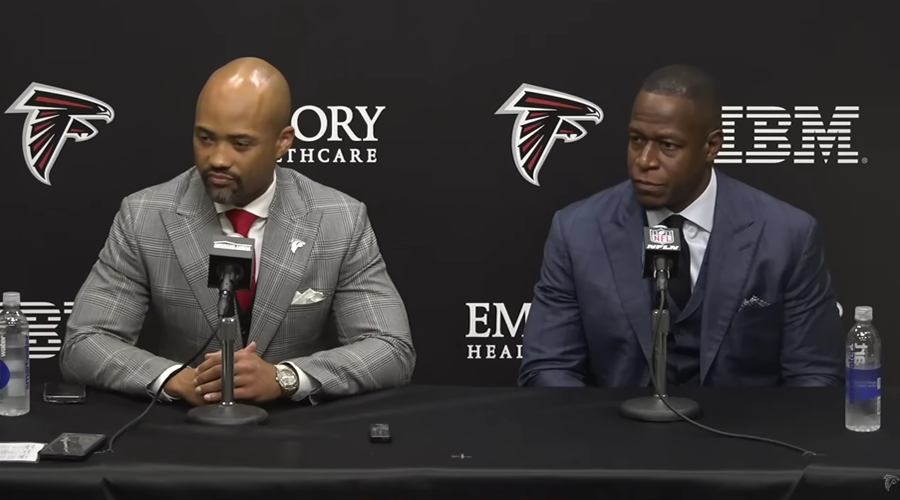
This of course has to start with the pick that lit the NFL world on fire, as they shocked everybody by drafting Washington quarterback Michael Penix Jr. eighth overall. I will go more into detail on most of these quarterbacks in the “reaches” segment, but for the context of this, I had the runner-up for the Heisman Trophy 40 spots lower on my personal big board. So I think you could make a case for him to be a late first-rounder at least based on the benefit of a potential fifth-year option, but that’s the smallest issue here. Just 45 days before the draft kicked off, they signed free agent Kirk Cousins to a four-year, 180-million-dollar contract. That’s coming off a torn Achilles he suffered mid-season and while I’ve heard some people argue that this can be looked at as quarterback insurance, if they didn’t think the veteran would be ready by week one, how can you justify handed out a deal like that? And you’re actually facing disciplinary action from openly tampering with the guy!
I had high expectations for Atlanta’s offense going into this past season, but when they struggled to consistently move the ball, I thought Penix’s aggressive downfield passing could elevate them. That doesn’t however match with a situation where neither the rookie nor the veteran will be particularly comfortable under these circumstances. From all the people Cousins has close connections with, the words “trust” and “security” are up there at the top of the list, and don’t tell me that this is just like the Jordan Love situation – Sure, it was also surprising, but a disconnect between Rodgers and Packers was already developing and they drafted his eventual replacement 26th overall while making clear that this was a future investment into the 22-year-old. Cousins had barely settled in yet, there’s a real chance he may not be ready until the late parts of the offseason – when everybody in the organization has watched Penix sling it around at practice – and they used a premium pick on Penix just over a week before he turns 24. And the statement by general manager Terry Fontenot on Penix potentially “sitting him four or five year being a great thing” is just asinine, because that would entirely defeat the benefit or a rookie quarterback – which is already limited even if they take the earliest exit on Cousins two years from now, which still comes with 100 million dollars guaranteed – and that you still might have very limited tape on a top-ten pick in live action, aside from the fact of course this comes with opportunity cost of having selected their choice of the top defender in the draft or maybe having traded down. I could have listed easily listed Cousins here as well or the rest of that roster now having to deal with that distraction.
Now, while that’s the main crux here, I was also scratching my head when they traded up eight spots in the second round for Clemson interior D-lineman Ruke Orhorhoro (35th overall) in exchange for moving down 107 spots from the third to the sixth round. He could turn into a really useful player with alignment versatility, thanks to how low he plays, his combination of length, short-area quickness and play demeanor, but how he counters double-teams and approaches the initial phase of pass-rush reps still clearly need work. I actually had him slightly higher than consensus boards, but that was still 23 spots later than where he was ultimately selected. The rest of the prospects they picked came at appropriate value I thought, even though I didn’t have draftable grades on the final two, but they also didn’t draft one of their two main needs on defense – corner. When asked about it Fontenot ironically responded by saying “you don’t want to reach in the draft”, when the pick they traded up from in the second round ended up being Rutgers DB Max Melton, who I and consensus boards had higher than Ruke for example.
Miles Sanders
In terms of more specific NFL veteran players, there aren’t a lot of guys who have seen a bigger fall from grace over the last calendar year than Miles Sanders. Now, this by no means is writing off his career entirely and I’m not going to act like he was set up for success under Frank Reich and Thomas Brown bouncing play-calling duties back and forth last season. However, after rushing for well over 1200 yards and 11 touchdowns behind the tremendous Eagles offensive line and being part of their run at a Super Bowl the year prior, Sanders went for just 432 yards on the ground and found the end-zone once, whilst averaging an abysmal 3.3 yards per carry. That was after the Panthers handed a four-year, 25.4-million-dollar deal and the only real competition on the roster being Chuba Hubbard. With what new head coach Dave Canales was able to get out of Rachaad White in Tampa Bay last season, there’s still a chance that Sanders can earn trust as the lead-back for this offense that added a bunch of other pieces, as I already mentioned, but that’s not the message this operation is currently sending and competition just got a lot stiffer.
It’s not just that Carolina selected Texas running back Jonathon Brooks in the second round, but they actually moved up six spots 46th overall to make sure they’d get RB1 off the board, jumping the Giants who might’ve been in the market for the position – they ultimately waited until the fifth round. Personally, I had Florida State’s Trey Benson as the top player at the position, but if Brooks wasn’t coming off a torn ACL, he would’ve been inside the 50 highest-ranked players overall for me. He may not an elite top gear, but he gets up to speed very quickly, is an efficient mover in his transitions, navigates well through condensed space as well as around bodies in the open field, with the contact balance to pull through loose wraps. In terms of the pass game, he wasn’t asked to run an overly complex route-tree, but he can be deceptive in his body-language, he has natural hands and consistently made the first man miss after the catch. So while some of the limitations that Sanders showed with the Eagles showed in terms of not being able to turn 10-15 yard runs into long touchdowns, I see more from him in terms of working in foot-fakes and pulling his legs out of the grasp of would-be tacklers as individual qualities. And watching how he made use of double-teams and pullers as part of Texas’ GT power plays, I like his projection into more of a gap-scheme run game which Canales will emphasize.
Along with Brooks, I also like the big-play potential Jaden Shirden from Monmouth provides as an undrafted free agent. It’ll be a long road to make the actual final 53, but I could see him getting elevated from the practice squad on a few occasions and demand a handful of touches, to go along with the rest of the bodies they had in Carolina last year already.
Kalen King & Leonard Taylor
There are two players in this draft who were projected to be likely first-round picks heading into the 2023 college football season and now actually both declared as true juniors. Penn State’s Kalen King was up there with Iowa’s Cooper DeJean and Alabama’s Kool-Aid McKinstry, who ultimately went back-to-back at the 40th and 41st overall selection, as the top corner prospects. Meanwhile, Miami’s Leonard Taylor was much more of a projection guy, but in terms of movement skills and flashes of dominance he showed on the interior defensive line, there was a lot to like, if he had continued on his developmental track. Yet, King barely squeezed in on day three as the third-to-last pick of the entire event (255th overall), while Taylor didn’t get a call until Mr. Irrelevant had already been announced, and he has since signed with the Jets. Let’s talk about how they got here individually.
During summer scouting, I had landed on King as my CB2 heading into the year and really appreciated his scrappy style of play. While he obviously didn’t come in with the same kind of length or NFL bloodlines as Joey Porter Jr. (33rd overall pick by the Steelers in 2023), watching Penn State tape, he was the better all-around corner. On 59 targets his way, he only allowed 27 completions on 5.8 yards pass thrown his way and one touchdown compared to three interceptions plus 18(!) PBUs, without getting penalized once. The numbers weren’t remarkably worse on fewer looks, but the ball-production dropped off dramatically, without any picks and just two PBUs. More importantly however, I thought the competitiveness toughness and aggressiveness he put on display was sub-par, highlighted by getting roasted by Ohio State’s Marvin Harrison Jr. for a second straight year, but approaching the matchup with more disinterest I felt. Then came the pre-draft process and I’m not sure if I’ve ever seen a prospect tank his stock as much as King. King lost pretty much every single rep during Senior Bowl practices, where he just showed no confidence in his technique and regularly got blown by. Then he went to the combine and ran a 4.61, which reinforced concerns about his long-speed considering his 10-yard split was at least average.
As for Taylor, I was somewhat indifferent on his projection to the NFL, because he was so all over the place technically, his play-recognition and overall consistency. Nevertheless, I did see the potential and high-level moments on his tape. I’m not going to act like he was put in position to succeed all the time, in terms of alignment, what he was asked to do and to some degree probably his player developmental. With that being said, I saw basically no progression in 2023 or things that translate to the next level, with the flashes of dominance became less frequent. Both his number of sacks and tackles for loss were cut down to a third of their ’22 totals (3.5 and one respectively), while his PFF pass-rush productivity was nearly cut in half, down from 9.4 to 5.8. You see him just shoot into the backfield and blow plays up every once in a while when he was allow to attack upfield and you see him ride offensive linemen into the quarterback a few times, but he just doesn’t seem to really know what he’s doing out there yet. Then he went to the combine and for a supposedly freaky athlete, Taylor finished in the 40th percentile or worse in all the combine drills he participated in (excluding short-shuttle and bench press).
The old Eagles corner room
I’ll leave it up to you here if you want to look at the word “old” as in the former or their actual age, but considering how long those guys have been in the league by now, both are very fair. Looking at the personnel moves by Eagles general manager Howie Roseman, the two they would definitely like to take back in retrospect were veteran cornerbacks Darius Slay and James Bradberry, who both received three-year contracts last offseason worth a combined 80 million dollars, with more than half of that number fully guaranteed. By the time this season rolls around, they’ll be 33 and 31 years old respectively and you saw them show their age this past year, as they went from both being Pro Bowlers to below-average starters, which particularly in Bradberry’s case can be considered a mild description. Yet, understanding where this franchise is, with a lot of cap hits of younger plays they’ve built the foundation around about to hit in future years, they didn’t let those financial implications affect their draft investments too much. They took the first corner off the board in Toledo’s Quinyon Mitchell (22nd overall), without having to move up ten spots potentially, which was about where he was projected to be taken, and then they did actually move up ten spots in round two with their division rival Commanders to take advantage of the falling Cooper DeJean from Iowa (40th overall), who was considered a consensus day one guy, even if there was discussion about his ultimate position fit.
Mitchell was CB1 for me and the majority of people in the industry, finishing as the 12th overall prospect on consensus boards. Yet, with the first defensive player not coming off the board until pick 15 (UCLA edge defender Laiatu Latu to the Colts), in large part due to teams wanting to get their hands on the top wide receivers and tackles, along with the six QBs inside the top-12, this pushed everybody else down the board. You can read more about Mitchell as a steal in the next segment, but he was a superstar in the MAC who absolutely rocked this pre-draft process and if he played at a major program, he would’ve most likely been a top-ten pick in the majority of drafts. Meanwhile, DeJean was a bit more of a divisive name, because there was no consensus on where his best spot in the secondary may ultimately be. He almost exclusively lined up at outside corner this past season, but operated out of the slot regularly the year and at a little over six-foot, 205 pounds with his type of football IQ and spatial awareness as a zone defender, you could also project him to play some safety at the next level. With how well he tested and moved around during the Iowa pro day however, it felt like he secured himself a spot in the first round, which he was always projected to go in anyway, even coming off a leg injury.
Both of them project really well into a match-zone scheme under new defensive coordinator Vic Fangio, where they play off and trigger on what happens in front of them, since that’s what they were mainly asked to do in college as well. That’s why both of Philly’s veteran corners are put on notice, while DeJean could also push starting nickel Avonte Maddox, who they brought back for this season at a two-million-dollar price tag.
Alec Pierce & Juju Smith-Schuster
There are plenty of wide veterans already in the NFL prior to this past weekend, who will now be battling rookies for starting or even roster spots, as 35 new names have entered the fold and even beyond that, there was an influx of talent in the market of undrafted free agents. So we could make this a grander point about the veteran pass-catchers, but I want to focus on two names in particular, with Alec Pierce on the Colts and Juju Smith-Schuster on the Patriots. Since the former is only just entering his third season in the pros (as a second-round pick 2022), it’s more about playing time and opportunities, while the latter I could legitimately see getting cut one season into his three-year 25.5-million-dollar contract. Here’s why I’m concerned for the two of them:
While I wasn’t as high on Pierce as some others coming into the 2022 draft (my 16th-ranked wide receiver), because I thought he certainly needed some refinement and take advantage of his physical advantages more consistently, I did of course recognize the explosiveness, catch-radius and ball-skills to make him an attractive vertical target. That profile didn’t make him a great match for the corpse of Matt Ryan during Pierce’s rookie role, along with nothing of note in terms of the passers they brought on in relief for him. Yet, when Indy selected Anthony Richardson out of Florida last year, I got pretty excited about the idea of the match between those two, having a quarterback willing to really air it out. However, we didn’t even get four full games of that experiment for Richardson was placed on injured reserve. Still, I came into this offseason with fairly high hopes for the young wideout. However, that was before the Colts stole my WR4 Adonai Mitchell from Texas 52nd overall, who I’ll talk about in more detail in the next paragraph and believe he’ll be a more complete option alongside Michael Pittman Jr., and then they also used an early fifth-rounder (142nd overall) on Oregon State’s Anthony Gould, who misses about seven inches and 30 pounds on Pierce, but brings nearly the same speed, is savvier at the top of routes and has a lot better make-you-miss skills after the catch, to at least steal some more reps.
Meanwhile, the Patriots actually used an even higher selection on the wide receiver position – even if Adonai Mitchell was valued more highly be me and the draft community – when they used pick 37 on the “other” Washington WR Ja’Lynn Polk, to pair up with third overall selection Drake Maye (QB, North Carolina). However, they came back on day three to select what everybody soon after understood to be a highly confident receiver from UCF in Javon Baker (110th overall), and while officially listed as a tight-end, Florida State’s Jaheim Bell (231st overall) is also relevant in this conversation. Polk may have the type of juice to blow the top of a defense, but he can stack his man vertically and shows no fear attacking the middle of the field, with excellent adjustments to passes mid-flight. Baker also may not quite have that final gear, but he gets up to speed very quickly, can efficiently break off routes when given a cushion and he has special skills at the catch-point, to win through and turn away from contact. And Bell was an all-purpose player between legitimately playing running back at South Carolina for stretches and as an H-back plus big slot at FSU. While the offensive coaching staff has been adjusted, they could look at him as a much cheaper version of Jonnu Smith, as a YAC specialist, who does his best blocking on the perimeter.
Other drafts I have questions about:
Carolina Panthers
Dallas Cowboys
Jacksonville Jaguars
New York Jets
Tennessee Titans
Steals:

Quinyon Mitchell, CB, Toledo – 22nd overall to the Eagles
There are obviously draft picks who went several spots later than where they were projected to come off the board and present better net-plus in terms of value, but when we can all agree that Quinyon was a steal in the first round even, we have to outline him here. This was my as well as the number one corner across and tenth overall prospect, while sitting two spots lower on consensus board. If you take into account the medical history UCLA edge defender Laiatu Latu (15th to the Colts), a strong case be made that Mitchell was the top defensive player on the board, yet with the rest of the league going offense only until the middle of the round and then focusing on the defensive front, he somehow makes it down to Philly. Some people actually had GM Howie Roseman trading up by around ten spots in order to get him, because they really needed to inject some youth into that corner room – as I already went over earlier – yet they stay patient and address their biggest need at great value without having to invest additional resources. He’s a perfect fit for Vic Fangio with his ability to click-and-close on routes from off-alignment and I think he has All-Pro potential.
Jer’Zhan Newton, IDL, Illinois – 36th overall to the Commanders
The name I was shocked to see falling throughout this process that I simply couldn’t believe and still heavily disagree with is Johnny Newton. This guy was in the conversation for the top defensive player in this draft when we started to put together 2024 lists a calendar year ago. And all he did since then was win Big Ten Defensive Player of the Year on an Illinois team with very little help around him. I understand that Newton couldn’t do anything during this pre-draft process dealing with a foot injury and you’d like to have some athletic testing numbers on him, but just watch the damn tape! He was right up there with Texas’ Byron Murphy II – who went 16th overall to the Seahawks – as my top-ranked interior D-lineman and 13th overall prospect. He routinely disrupts plays with his ability to knife through gaps or back-door blockers, he’s pretty advanced with his hand-combats, reading pass-sets by his opponents and he’s the best interior defender at cornering his rushes. This was not an immediate need for Washington, but he can add some juice to the rotation right away and then be your long-term replacement for Jonathan Allen, who has a 23-million-dollar cap hit in the final year of his contract in 2025.
Adonai Mitchell, WR, Texas – 52nd overall to the Colts
I will refer to Colts general manager Chris Ballard’s rant on Mitchell’s reported “character concerns” thrown out there by unnamed sources here. This paired well with people complaining about him “taking plays off” – which I think oversimplifying things – and an underwhelming statistical profile, to push him down the board. If there are no legitimate issues that I’m not aware of, I think the NFL really messed up here. While I did think there was a definitive gap between the “big three” and the rest of the class, Mitchell was next up as my fourth-ranked receiver and 20th overall player on my big board. None of the other seven WRs selected between pick ten and Adonai provide his kind of route-running expertise. His ability to alter tempo, adjust on the fly to the technique of DBs, attack their blind-spots and be friendly to his quarterback are all excellent. He may not have been a massive YAC threat – in part due to his high average depth of target – but he snatches the ball in traffic and only dropped one of 65 catchable targets over the past two seasons combined. I already mentioned third-year Indy receiver Alec Pierce as a “loser” coming out of the weekend because of the talent this team brought in and I actually thought Mitchell had the potential to develop into a number one.
Christian Haynes, IOL, UConn – 81st overall to the Seahawks
I was lukewarm at best on Seattle’s first selections after Haynes to start off day three, which is why I didn’t outline them as “winners” at the top, but I really like their first two picks. New head coach Mike Macdonald wanted to send a message by becoming bigger, more physical in the trenches with Texas interior D-lineman Byron Murphy (16th overall) and then Haynes in the third round, similarly to where the University of Michigan and the Ravens were built as his prior stops. I had Haynes and another interior O-lineman in Kansas State’s Cooper Beebe back-to-back in my rankings as numbers 44 and 43 on the big board. My player comp for him was Blastoise from Pokemon as a compactly build bundle of power. To me he was the best zone-blocking guard in this draft, with his ability to create initial momentum and stay latched with defenders. He’s quick to land and re-fit his hands in pass-pro, with the agility to mirror a variety of moves, if he can just eliminate some of the obvious “take-downs” that drew penalties in college. I think they got a quality starter at right guard from day one in the middle of the third round.
Ja’Tavion Sanders, TE, Texas – 101st overall to the Panthers
I heard some things on Sanders and how he may be falling a little bit, based on previously unreported “character concerns” similarly to his former Longhorn teammate Adonai Mitchell. Without any clarity on that situation, I will continue to call this guy a steal. Based on tape alone, he was my clear TE2 between Georgia’s Brock Bowers and Kansas State’s Ben Sinnott, as my 42nd overall prospect. As a pass-catcher, he offers a dimension this Panthers offense didn’t have yet, as someone who can stretch defenses vertically up the seams. He also has strong hands to deal with contact at the catch-point and then he’s a dynamic mover with the ball in his hands, capable of working around defenders or drag them along as they try to hold onto him. As a blocker, his hand-placement could definitely use some work, but as a defensive lineman in high school, the explosiveness out of a three-point stance and the effort are certainly there. So while I don’t expect him to be a traditional, they already have Ian Thomas under contract, allowing Sanders to operate as a big slot, run leak routes off play-action and other things.
T.J. Tampa, CB, Iowa State – 130th overall to the Ravens
I have yet to hear anything on why Tampa fell this far apart from not participating in the college all-star circuit running in the 4.5s at his pro day, when his agility numbers were actually solid. I had him all the up at number 45 on my big board, as the eighth-ranked corner. Yet, even though some of them will primarily line up in the slot and of course scheme fits and designed qualities teams are looking for have to be taken into account, but there were 15(!) other corners selected ahead of him. Now, I do believe there is some validity to him having just average long speed and with his bigger frame (6’1”, 195 pounds), he’s not quite as fluid as the guys near the top of the class maybe, but if you accentuate his strengths, he can become a quality starter in this league. Tampa brings heavy hands to disrupt receivers at the line in press-technique, either covering guys in bump-and-run or bailing out. So while I projected him to fit best into a more single-high centric defensive structure, with the rolodex of coverage Baltimore likes to run, you can put him on the side of the field with two-deep principles and let him beat up the outside receiver, when you bring heat, he can throw off the timing of routes with a shorter play-clock, and he may also be a matchup piece against big slots. This guy at one point was looked at as a potential surprise first-round selection and they got him at the end of the fourth.
Spencer Rattler, QB, South Carolina – 150th overall to the Saints
Day three of the draft is really fun for me. I get to sit back and watch guys come off the board that the majority of humanity has never even heard of and I’m getting excited on my couch, thinking about how some hybrid safety might fit into the sub-package of a certain defense. So when something disrupts that like Ian Rapoport reporting “teams can’t the image out of their head […] of how Rattler came off during his reality show” QB1: Beyond the Lights. Now, I never actually watched it myself and can’t definitely say it wouldn’t have affected my opinion, but for NFL operations this sounds like they doomed a 17-year-old and didn’t actually do their homework properly. Because even though the path here was pretty long for Rattler, he showed humility and maturity going from a former number one overall recruit to getting benched at Oklahoma and battling through adversity on a weak South Carolina team. And he still has a lot of the qualities that people were in awe of coming out of high school, in terms of the arm talent and plays he makes out of structure, even if there’s some lack of consistency in decision-making and accuracy. For me, the gap between Rattler (75th overall) and my QB6 J.J. McCarthy from Michigan (64th) was actually smaller than McCarthy to the next-highest signal-caller Michael Penix from Washington (48th).
Jeremiah Trotter Jr., LB, Clemson – 155th overall to the Eagles
Another name that you saw in some early first-round mock drafts once the 2023 draft was wrapped up was the son of former Pro Bowl linebacker Jeremiah Trotter (Sr.). Junior and fellow Clemson linebacker Barrett Carter – who ended up going back for his senior years – were generally regarded as the top two linebackers heading into this past season. However, as some other names emerged and people really started diving into Trotter in regards to his NFL future, he started gradually dropping down boards. However, I don’t think many people didn’t have him inside their top-100 lists. I know I was a little higher on Trotter than consensus, but the third-ranked linebacker on my big board was selected nearly 100(!) spots later than where he finished (59th overall). I understand that there are some range limitations in terms being able to run down plays outside the hashes and he only has 31.5-inch arms, but in today’s game, being instinctive, quickly IDing and triggering on plays has become such an underrated skill-set for the position. We see so many of these great athletes at linebacker fail because of how long an adjustment period they have to the pros. I think Trotter presents value because he can immediately contribute and potentially even start for the Philly, and while he’s not a matchup player in coverage, he’s alert as a zone defender and can win in different ways as a blitzer.
Kitan Oladapo, SAF, Oregon State – 169th overall to the Packers
This was one of my big calls and earned a spot on the “my guys” last as my number four safety and 66th overall prospect. Based on consensus boards, this was still nearly a round late for Oladapo, but I simply don’t understand and/or falsely label him. I know you can easily look at him as a box safety at 6’2”, nearly 220 pounds, but if you actually watch the tape and contextualize what he was asked to do, he fits what modern NFL defenses are moving towards very well. With the Beavers, the majority of snaps he was operating from split-field looks, where his ability to match routes from depth really stood out, whether he had to cut off crossers or open to run with guys vertically. He can certainly run the alley or match up with tight-ends from detached alignments, but this guy doesn’t have to play near the line of scrimmage at all, even if he can be deployed that way. He may not have the range to be opened one way, redirect and still make plays, but he sees the full picture pretty well and then he excels at attacking the ball at its highest point if you test him down the field. Of the three DBs Green Bay selected, I believe Javon Bullard (Georgia) goes back to the slot, while Oladapo and another underrated name I like in Oregon’s Evan Williams (111th overall) will battle for the second starting safety job.
Johnny Wilson, WR, Florida State – 185th overall to the Eagles
Similarly to Oladapo, Wilson is somebody else who go labelled a certain way due to his large frame at 6’6” and 230 pounds, as a jump-ball merchant and even as a transition candidate to tight-end by some. Therefore, he was another player who was selected more than 100 picks later than where he ranked for me personally (77th overall). And he can certainly make plays for you when you throw the ball up to him, he boxes out his defender and snatches it off the top shelf with that condor-like 84.5-inch wingspan. However, he did run a 4.52, tested well across the board otherwise and whether you watch him run routes at the combine between guys who weigh 50 pounds less than him or even directly comparing him to former FSU teammate Keon Coleman – who was the first pick of day two – Johnny was the one who created separation more consistently. His ability to reduce that height and come out of breaks cleanly is something I noted on several occasions. The one big gripe I had with him were too many body-catches, but he’s fearless going over the middle, he bounces off hits or just fights through extra yards constantly and he can overwhelm smaller DBs as a blocker.
Mekhi Wingo, IDL, LSU – 189th overall to the Lions
This is the second interior D-lineman I’ve now discussed as part of this segment, which is kind of funny since we did only see one get selected in round one, but then day two started with four guys coming off the board within the first seven picks and we had four more across that evening. In fact, Wingo was the 14th interior D-lineman to hear his name called, when I had him as IDL8 and he cracked my personal top-100. In fact, he was the third(!) guy from that position group drafted coming out of LSU. I understand the concerns with an undersized player like that at six foot, 285 pounds with only 32-inch arms. However, this comes off the ball with some pop and he plays so low, that he was able to either crash through the reach of an SEC guard or knock that guy a couple of yards into the backfield at times vs. the run. And his real value could be as a pass-rusher, where he displays an impressive ability to disconnect his upper and lower half as he tries to squeeze past blockers, but can also win with the bull-rush or push-pull off that. He’s not going to start over the duo of Alim McNeill and D.J. Reader of course, but they may automatically sub in for the latter on third downs and produce early.
Michael Pratt, QB, Tulane – 245th overall to the Packers
It’s really funny how cyclical the NFL has become, to a point where we saw them overreact to what they saw from year to year. Nothing encapsulates that better than then appetite for mid-round quarterbacks they’ve displayed. Two years ago, we saw the 49ers hit the jackpot with Iowa State’s Brock Purdy going from Mr. Irrelevant to a quality starter and even MVP candidate this past season. In the 2023 draft, eight quarterbacks had their names called between the third and fifth round, trying to recreate that type of profile, with a quality backup who has some starter traits. And generally, I’m very much for taking some shots at the position late. However, then we get to this year and we didn’t see one come off the board between picks 12 and 150, with just one more at the end of the fifth round and just three others the rest of the way. What’s funny to me about this is that I preferred this crop of passers and the only guys I would have taken above my QB8 in Michael Pratt (let’s forget Spencer Rattler for now), were Hendon Hooker (Lion) and Dorian Thompson-Robinson (Browns). So since none of those guys from a year ago “hit”, the league pivoted immediately again, to where the Raiders for example completely punted on the position once they missed out on the top six. I don’t want Pratt to completely get lost here however, who may not be a big-bodied gunslinger, but processes information at a high level, delivers the ball with accuracy, is a sneaky good athlete and incredibly tough. He should be an excellent backup to Jordan Love earning peanuts over the next four years.
Other value picks:
Kool-Aid McKinstry, CB, Alabama – 41st overall to the Saints
Jackson Powers-Johnson, IOL, Oregon – 44th overall to the Raiders
Ennis Rakestraw Jr., CB, Missouri – 61st overall to the Lions
Trey Benson, RB, Florida State – 66th overall to the Cardinals
Roman Wilson, WR, Michigan – 84th overall to the Steelers
Troy Franklin, WR, Oregon – 102nd overall to the Broncos
Khyree Jackson, CB, Oregon – 108th overall to the Vikings
Javon Baker, WR, UCF – 110th overall to the Patriots
Jaden Hicks, SAF, Washington State – 133rd overall to the Chiefs
Sedrick Van Pran-Granger, IOL, Georgia – 141st overall to the Bills
Tommy Eichenberg, LB, Ohio State – 148th overall to the Raiders
Mohamed Kamara, EDGE, Colorado State – 158th overall to the Dolphins
Christian Jones, OT, Texas – 162nd overall to the Cardinals
Tyrone Tracy, RB, Purdue – 166th overall to the Giants
Walter Rouse, OT, Oklahoma – 177th overall to the Vikings
Malik Washington, WR, Virginia – 184th overall to the Dolphins
D.J. James, CB, Auburn – 192nd overall to the Seahawks
Tanner McLachlan, TE, Arizona – 194th overall to the Bengals
Khristian Boyd, IDL, Northern Iowa – 199th overall to the Saints
Nathaniel Watson, LB, Mississippi State – 206th overall to the Browns
Reaches:

All the first-round quarterbacks not named Caleb Williams and Drake Maye
I could have talked individually about at least three and you can make a case for all four other first-round quarterbacks here. This was a pretty unique year, because not only did we have three juniors in Caleb who won a Heisman at USC in 2022, Drake who was a quality starter for three years at North Carolina and J.J. McCarthy just helped Michigan win a national championship, with all three being top-six QBs in that recruiting class, but that was paired with three of these super seniors, who have changed schools across their six years in college and left their respective schools at the top of their games, as the top three in this past Heisman voting. Jayden Daniels (LSU) went second overall to the Commanders – over Drake Maye – when I thought he was a late first-round prospect. Michael Penix Jr. (Washington) was the big shocker at eighth overall, when I had him just inside my top-50 overall prospects. And even though the Vikings ultimately only moved up one spot for McCarthy, they did give up a fourth- and fifth-rounder for a six, in order to secure my QB6 and 64th player on the big board. They all have their warts, which I discussed extensively in my quarterback rankings, but what’s important here is that they got pushed up due to the amount of desperate teams inside the top-12, as they set a new NFL record for how early those guys came off the board. To some degree that also includes Oregon’s Bo Nix, who I’d typically be very critical of taking QB6 at 12th overall as the Broncos, but I did have him in a tier with Jayden Daniels as number 28 on my board, and they didn’t actually have to move up.
Xavier Worthy, WR, Texas – 28th overall to the Chiefs
One of the funniest things coming out of this past Thursday night was all of these people making fun of the Bills for making deals with the devil so to speak, as they allowed the Chiefs to trade up for the fastest receiver to ever run a 40-yard dash at the combine, considering how they’ve been the obstacle in Buffalo’s path to a Super Bowl appearance. Well, what if they didn’t think there was a player worthy (no pun intended) or moving up for and would gladly drop down four spots in exchange for improving to picks 95 and 221 up by nearly a full round on both. Xavier Worthy was my number ten wide receiver and player 55 on the big board. He does have that top gear very few can actually match and has improved his ball-tracking skills, but he wasn’t a highly productive vertical target. And while he had plenty of production catching the ball underneath and burning angles, it’s not like you saw him just making people miss in the open field routinely. Combining that with being 165 pounds and basically giving you nothing as a blocker or on contested catches, this is fairly defined piece of a receiving corp rather than someone you trade up for in the first round in my opinion.
Xavier Legette, WR, South Carolina – 32nd overall to the Panthers
Continuing with the wide receiver position, I had Legette five spots lower than the other Xavier on the big board, as my 12th-ranked player at that spot. Visibly these are VERY different physical profiles. I already discussed the strengths of Legette’s game when I outlined Panthers quarterback Bryce Young as a “winner”, as someone with 4.39 speed at a 6’1”, 220 pounds, who can win with physicality at the catch-point as well as once the ball is in his hands, as he clearing arm-tackles and pulling away from guys. With that being said, I never looked at him as a potential number one target in the pros. For me this is less about the worrisome statistical output, where about 75% of his production came in the final of his five seasons at South Carolina, being aware of his background and why it took him longer to really get his opportunity. My issue with him going as high as he did is more about as a 23-year-old, still lacking refinement or diversity in his release package if you wanted to put him at X, the fact that his breaks aren’t as sharp as you’d like them to be and while he’s certainly a notch above their early second-rounder from a year ago in Jonathan Mingo, at least in terms of usage in college, it was also primarily going vertical or horizontal rather than “winning” his matchups.
Maason Smith, IDL, LSU – 48th overall to the Jaguars
If there was one player that I would’ve predicted to land on this list prior to the draft actually taking place, Smith would’ve been my top call. With him continuing to rise up boards and his name entering conversations more regularly, I knew that he was basically a lock for day two. But top-50?! – That is still wild to me. Personally, I didn’t even have him inside my top-130 overall or the top-ten interior D-linemen, largely because I wasn’t sure how to value this kind of player. We all knew he was big, long and naturally strong, with five-star pedigree coming out of high school. Watching his flashes as a true freshman in 2021, it looked like he might go even higher ultimately. However, then he tore his ACL celebrating after making a play in his second season and despite having a full year to recover, he showed no improvement whatsoever as a junior. So this is a bet purely on physical upside, which I’d understand for a team like the Chiefs a round later – which is where I had them going in my day-two mock draft (95th overall) – but not for a group like Jacksonville, who just hit a wall in the middle of last season, haven’t reaped the rewards of taking a gamble of another freaky D-lineman in Travon Walker as the first overall pick from a couple of years ago and just handed Arik Armstead a three-year, 43.5-million-dollar contract.
Patrick Paul, OT, Houston – 55th overall to the Dolphins
Let’s talk about a couple of offensive tackles, who are on close to opposite ends of the spectrum in terms of player profiles and why I think they were both selected too early. For the first one here, I realize that I was significantly lower than consensus on Paul, who even popped up as the final pick for the Chiefs of some first-round mocks during draft week. Looking at my personal rankings, he finished slightly outside my top 100 as my 15th-ranked tackle. I was higher on him in the middle of the season, because I saw a guy who made it work despite some technical deficiencies thanks to a massive 86-inch wingspan and adequate athletic tools. Nevertheless, when I watched him go up against better competition at the Senior Bowl and then really dove into his tape, I became more concerned about how he’d translate to the next level. First of all, he’s a sub-par run-blocker, who bends at the waist, comes in super-wide with his arms and has plenty of missed assignments in that regard. And then as a pass-protector, his length routinely bailed him out, since his footwork needs to be largely overhauled, he presents an open chest for edge rushers to attack, tends to bear-hug guys and overall, there’s disconnect between his upper and lower half. Miami needed O-line help now, even if he’s just your swing tackle, rather than a developmental guy.
Caedan Wallace, OT, Penn State – 68th overall to the Patriots
Now, Wallace is very different in terms of what he presents to an NFL team. He ranked 18th for me among the tackle class. So in terms of how much earlier he was taken than where I thought his value was, he’s pretty much in par with Paul going 13 spots earlier, but Paul at least offers some more upside that you can buy into. Sure, you can make an argument that after selecting a quarterback in the top-three – and I really like the two receivers they paired him up with over the following three rounds – you want to make sure you have guys with extensive starting experience from a Power Five conference to protect that guy. The broad frame is pro-ready, whether he fits his hands in the run or pass game, he’s able to apply force effectively and lock up rushers, with a good understanding of the pocket, when he connects the right way. With that being said, you do see him swing his arms and dip his head into contact trying to create movement, his pad-level is too high and so are his hands in pass-pro, while his lateral agility is below-average for the position, as you see him overset vs. speed off the edge and struggle to mirror inside counters on tape. I think he can start at right tackle day one, but you already have Michael Onwenu there and now you’re probably asking Wallace to flip sides.
Marist Liufau, LB, Notre Dame – 87th overall to the Cowboys
Looking at this linebacker class, the scouting community as well as the NFL itself clearly were down on the prospects available in relation to the other positions. That’s why Texas A&M’s Edgerrin Cooper was the first guy off the board at pick 45 (Packers) as the only one in the first two rounds. That’s why it was surprising to see a bit of a run on the group in round three, with five of them getting selected. The two surprise names here were Liufau and Ty’Ron Hopper going to Green Bay (91st overall) despite already having invested into the position. However, not only did I have the latter a couple of spots higher in my LB rankings and he went four picks later, I don’t think he offers the type of profile Dallas should be looking for. Liufau played a lot of “overhang” and as a matchup player against guys in the slot and while he has great length along with hitting power, his ability to diagnose and flow to the ball from traditional stack alignments is underdeveloped. So based on the player evaluation itself (as my LB14), I thought this was a couple of rounds early. However, when you look through the spectrum of them already missing out on Texas running back Jonathon Brooks in the second round, who owner Jerry Jones proclaimed his love for less than 24 hours earlier, and then still passing on the chance of getting USC’s Marshawn Lloyd, who I thought if he fixes his ball-security fundamentals who could end up as the top back from this class, it makes this even more confusing. Especially considering one pick later the Packers snatched up the latter and he may be next in line to go off for 100 rushing yards against Dallas when they meet in the playoffs.
Luke McCaffrey, WR, Rice – 100th overall to the Commanders
Capping off day two of the draft, we saw another guy with NFL bloodlines hear his named called. Funnily enough, guys that fall into that category actually went later than projected or in some cases even went undrafted, if you take out those two top-five picks in Marvin Harrison Jr. and Joe Alt. McCaffrey to me is one of those where the name value pushed him up higher than I thought he should’ve gone. Now, I understand why you’d want to buy into a player like this. Luke transitioned from quarterback to wide receiver just two years ago, yet he put up just under 1000 yards and 13 touchdowns through the air this past season for Rice. You certainly see the smarts for the position, he catches pretty much everything, he’s incredible tough dealing with hits and he had a nice combine showing. Having mentioned that, he doesn’t separate a whole lot on tape. His stem set-ups, incorporating different pacing, the efficiency in footwork at the top of routes and the burst coming out of those all need work. And even though some of it certainly had to do with forcing passes to his best weapon, McCaffrey’s quarterback also threw ten(!) interceptions going his way. This was my 25th-ranked WR and he was the 16th one off the board in an insanely deep class with a lot of talent on the board at that point (Oregon’s Troy Franklin, UCF’s Javon Baker, etc.).
Jordan Jefferson, IDL, LSU – 116th overall to the Jaguars
I thought about combining Jefferson with fellow LSU D-tackle Maason Smith, who the Jags picked two rounds earlier, since the set-up is very similar as to why I listed those two, but this deserved its own spot. Based on consensus boards, Jefferson was projected to go around pick 200. Myself, I had him outside my top-20 interior defensive linemen and I think you can get this type of player over the course of the final two rounds or even on the undrafted free agent market. Heck, I liked Florida State’s Fabien Lovett significantly better and the Chiefs signed him without giving up any draft capital. Jefferson is capable of owning his space in the run game and he can work the depth of the pocket when put in one-on-one situations, but he lacks the range working off blocks to actually make plays on the ball-carrier and he gives you very little outside of the bull-rush, which reflected in his production as a pass-rusher, being limited to just QB pressures on just over 200 opportunities. And while I don’t want to define a player by one action, him at one point during one-on-ones at Senior Bowl week tossing UConn guard Christian Haynes’ helmet out of frustration after getting shut down once again trying to go through that guy’s chest, was pretty telling for me.
Tory Taylor, P, Iowa – 122nd overall to the Bears
I don’t want to come off as a hater of specialists. I think you can absolutely use one of your late-round picks on securing guys who teams will be calling up for to bring into camp as UDFAs, especially if you have excess capital. However, when you’re the only team to select a punter and you take him in the fourth round, that’s questionable. Then, if you’re only slated to pick twice more outside of your two top-ten selections, you really have me scratching my head. With the 75th overall selection, Chicago brought in a developmental tackle I really liked in Yale’s Kiran Amegadjie, but this isn’t a roster yet where a player in that mold plus a punter are how you should be approaching this. Let’s not forget that they sent a fourth-rounder next year to the Bills in exchange for pick 144, which they used on Kansas edge defender Austin Booker to make their class look better – and I think it’s a worthwhile investment. So this has very little to do with the player himself in Tory Taylor, who was the biggest offensive weapon for an Iowa team that was involved in the games with the lowest Over/Unders on a weekly basis, leading the country in total punts, having nearly 1000 extra yards and still ranking fourth in average (48.3). This is about the opportunity cost and usage of assets.
Tarheeb Still, CB, Maryland – 136th overall to the Chargers
The fifth round started off with what I believe were two overvalued corners, between Auburn’s Nehemiah Pritchett – who I listed below as well – and Still going back-to-back. I did have the former several spots higher in my positional rankings, even that still placed him outside the top-30 of an insanely deep CB class – and it was just one actual pick later, so I went with the Maryland senior here. You like the willingness to put hands on receivers early, the spry feet to play close-up or soft press technique, you like his spatial awareness combined with the mental capacity to identify route-combinations in zone-coverage and he earned an 88.4 PFF run-defense grade in 2023. On the negative end, this is an average athlete with arms with arms that didn’t quite measure in at 30 inches, he gets very handsy at the top of routes, he lacks that make-up gear if he does lose phase with his man and he simply lacks the mass at 185 pounds to bring bigger ball-carriers to the ground reliably, finishing with a 16.3% career missed-tackle rate. Of the 14 corners selected the rest of the way who I actually evaluated (plus two others I didn’t get to), I had 13 ranked ahead of Still.
Keilan Robinson, RB, Texas – 167th overall to the Jaguars
As I get towards the end of this exercise, recapping everything we watched over the course of the weekend, I realize that I could have easily written a couple of paragraphs on the Jaguars among the “biggest losers”, considering this is their third mention across the 12 names I outlined here as reaches. However, I did think like the fact that picked up an extra third- and fourth-rounder from the Vikings along with this fifth-round selection, when they moved back six spots in the first round and still got LSU wide receiver Brian Thomas Jr. at good value, and I think they brought in a couple of solid contributors with high floors between those two LSU D-tackles, to complement general manager Trent Baalke’s unhealthy obsession with big, fast men. So we can argue the validity of complaining about a fifth-round running back here, but there was still plenty of talent left at this point and this was the RB31 on consensus boards – even a couple of spots lower for me – and was the 15th one off the board. This is a 5’8”, 185-pound running back with less than 800 rushing yards in five seasons between Alabama and Texas and only once caught double-digit passes. Clearly this was a pick made with the return game in mind, where he made an impact on kickoffs these past two years, but he didn’t even return punts! One pick before them went Purdue’s Tyrone Tracy Jr., who was my personal RB8, with a receiver and return background. This in comparison profiles as someone who typically goes undrafted.
Other questionable picks:
Ruke Orhrhoro, IDL, Clemson – 35th overall to the Falcons
Roger Rosengarten, OT, Washington – 62nd overall to the Ravens
Matt Goncalves, OT, Pittsburgh – 79th overall to the Colts
Ty’Ron Hopper, LB, Missouri – 91st overall to the Packers
Devontez Walker, WR, North Carolina – 113th overall to the Ravens
A.J. Barner, TE, Michigan – 121st overall to the Seahawks
Giovanni Manu, OT, British Columbia – 126th overall to the Lions
Nehemiah Pritchett, CB, Auburn – 135th overall to the Seahawks
Bub Means, WR, Pittsburgh – 170th overall to the Saints
Jamal Hill, LB, Oregon – 188th overall to the Texans
 Halil's Real Footballtalk