

It’s that time of the year again. As NFL Network’s official rundown is coming to its final stretch, I will once again release my own version of the list. Trying to compare across different positions without a metric-based system always invites a certain level of subjectivity, but considering some of the head-scratching results from the cumulative rankings by the players, I feel pretty good about my process.
So, to clarify yet again, these are my top 100 players for the 2026(!) season. While I don’t want to project a whole lot, this was never meant to be in retrospect of the previous year. Therefore, if some guys showed improvement/regression over the course of 2025, I did understandably take that into account.
Additionally, if there are pre-existing injuries, suspensions or other facts that we already know will likely cost certain players multiple games this upcoming season, that did affect their ranking or made them ineligible for me altogether. Two names I just couldn’t find spots for – reports around Giants wide receiver Malik Nabers’ recovery have made his return date too dubious, and I’m very happy to hear that Nnamdi Madubuike is expected to continue his pro career, after missing all of 2025, with concerns around having to potentially recover medically due to a neck injury.
Now, let’s get to the actual rundown:
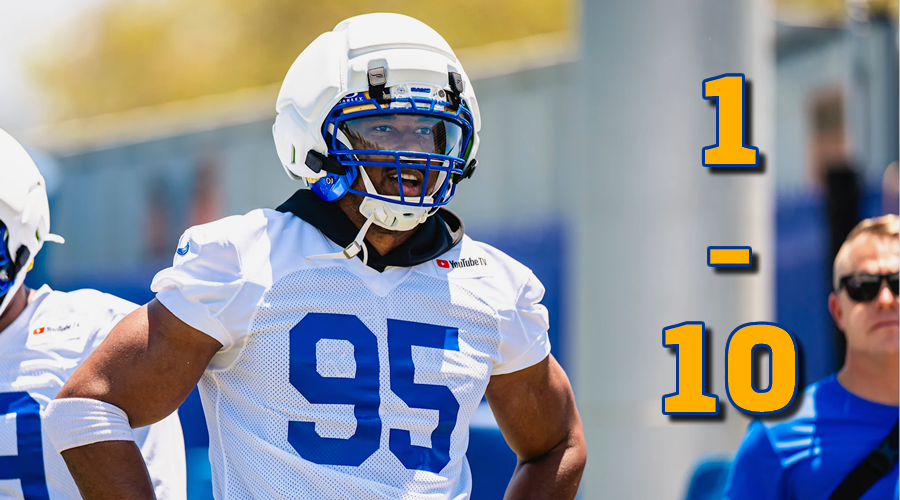
1. Myles Garrett
This is the first time since I started releasing my own lists – which is why I originally felt compelled to start writing a blog – that the top player will be playing on a different team the following season. It’s almost unheard of that an all-time great would be traded, now going from one of the NFL’s bottom feeders to making the Rams the betting favorite to win Super Bowl LXI. Not only did Garrett set a new single-season sack record (23), but he also had five more total tackles for loss than anyone else in the league (33). Those numbers are even more impressive considering Cleveland’s offense didn’t threaten their opponents in a way that would push them into many obvious passing situations for Myles to capitalize on. He’s an alien with flexibility and quickness that almost don’t look real at his frame.
2. Penei Sewell
Speaking directly to the excellence of Sewell – although Cleveland D-end Myles Garrett largely lined up on the opposite end of the line, only one of the eight QB pressures collected came against Detroit’s right tackle in their meeting last season. Sewell’s incredible core and base strength, paired with his athletic tools and technical development since entering the league, have turned him into a premier pass-protector. Yet, it’s the explosion out of his stance and the way he can create displacement in the run game that stand out to me above all else. Even at the very top of the league, there was a noteworthy gap between Sewell and all other offensive linemen in PFF run-blocking grade (96.7). Plus, despite coming up just two snaps short of the 1000 mark, he was only penalized twice last year. Although it shouldn’t be taken lightly, the Lions organization has full confidence in his switch to the blindside.
3. Josh Allen
Number one on my 2025 list remains as the top quarterback on this year’s version, but slides down a couple of spots overall. Allen has set such a ridiculously high standard for himself that last season didn’t register for casual fans as excellent, particularly considering he couldn’t take advantage of a seemingly watered-down AFC, losing in controversial fashion at Denver against the top-seeded Broncos in the Divisional Round. During the regular season, Josh once again contributed 39 total touchdowns (second to only MVP Matthew Stafford), while as a passer, he posted the highest completion percentage of his career (69.3%). He was actually the best version of himself at risk aversion, with the lowest turnover-worthy play rate of his career (2.4%), but having to be Superman in games where his defense let him down did manifest itself in posting the highest pressure-to-sack conversion rate since 2019.
4. Jaxon Smith-Njigba
If you go through his first three seasons in the NFL for Smith-Njigba, it’s clear that he’s continued to improve and increase his usage consistently. This past offseason, there was understandable doubt about Seattle’s offense holding back a defense that was clearly ascending towards being a dominant unit – which was the case. Instead, Klint Kubiak’s play-calling and JSN turning into a superstar helped them become one of the most dangerous aerial attacks in pro football. Their number one receiver led the league with 1793 receiving yards during the regular season, but he also easily accounted for the highest rate of his team’s air yards (48.6%). We already knew that his short-area quickness made him a nightmare to cover underneath and from the slot, but Smith-Njigba nearly flipped his alignment to the outside completely (73.6%) and went an insane 16-of-26 for over 600 yards and four touchdowns on passes of 20+ air yards.
5. Will Anderson Jr.
The counterpart to Seattle WR Jaxon Smith-Njigba from that 2023 draft class, Anderson was the defensive player to go from ascending youngster to one of the most dominant guys at his position. That entire Texans defense is loaded with rabies-infested dogs that want to hunt ball-carriers down, but #51 is the guy who sets the table for them, and the key figure for DeMeco Ryans to turn this into an elite unit. Will recorded 20 tackles for loss last season, and the firm edge he repeatedly sets in the run game doesn’t even put him on the stat sheet. He finished third in quarterback pressures (93) on the fewest opportunities of anyone in that range (476), giving him the highest pass-rush productivity (12.0) among players with 200+ such snaps, on the highest win rate in that regard (26.2%), based on PFF’s tracking. He can either win with speed around the edge or convert speed-to-power expertly, as well as being a demon on stunts/twists.
6. Matthew Stafford
There’s a strong argument to be made that Stafford was the number one overall player this past season, illustrated by earning league MVP honors, at least on the offensive side of the ball. However, for as strong as his track record may be, he reached new heights in 2026, while Buffalo’s Josh Allen has largely carried that team for many years. Nonetheless, Matt just led the NFL in passing yards (4707), first downs (236) and touchdowns (46). Most impressive to me – and we can argue about PFF’s tracking methods, but it does best encapsulate what we actually see – if you include the playoffs, Stafford had 21(!) more big-time throws than any other quarterback in the league. Obviously, having a play-caller like Sean McVay, on the forefront of offensive innovation, with a premier WR duo helps, but what he does to manipulate defenses with his eyes and the ability to thread the needle into tight windows is second-to-none.
7. Ja’Marr Chase
Due to the Bengals missing the playoffs for a third straight year, and Chase catching passes from Joe Flacco and Jake Browning for exactly half of his 16 games played, he felt kind of forgotten, compared to the pair of NFC West wide receivers having career seasons. Still, he was voted as the third name to make first-team All-Pro, as someone who can change the temperature of a game at any moment with one catch, but also has developed into one of the best high-volume targets in the league, capable of lining up anywhere across the formation and keeping the offense on track. Never was that more apparent than when 16 of 23(!) targets in an upset win over the Steelers, in Flacco’s debut with Cincinnati. Over the last two years, Ja’Marr is just two short of Detroit’s Amon-Ra St. Brown in first downs contributed through the air (148), and nobody has forced more missed tackles after the catch (47).
8. Micah Parsons
This one’s a bit tricky, because Micah is coming off a torn ACL and meniscus in mid-December, and there’s no clear return date for him yet. If he ends up missing the first two months of the 2026 season, he obviously wouldn’t be here, but when on the field, he’s a force of nature. If you filter weeks 1 through 14 compared to the final four games (which Parsons got hurt the following week), the Packers dropped from 15th (0.001) to 30th in EPA per play defensively (0.167). Their pressure and sack rates with vs. without him on the field are even more drastic. Individually, Micah finished seventh in QB pressures (79) league-wide, despite missing three games, and he ranked fourth in both pass-rush productivity (11.4) and win rate (22.6%). His ability to win the high shoulder has always been incredible, but how he utilizes his strength and his inside counters have made him even more deadly.
9. Jeffery Simmons
After Chris Jones and Dexter Lawrence had been battling for supremacy at the defensive tackle position since the retirement of Aaron Donald, Simmons earns the top spot on this year’s list for me. This past season, he led all interior D-linemen with 42 defensive stops, as well as pass-rush win rate (19.4%), according to Pro Football Focus. Those statistics were kind of getting lost in the shuffle for a Titans team with glaring issues on both sides of the ball, but the fact that he was such a disruptive force for a team that was losing constantly makes his efforts that much more impressive. Simmons was more of a space-eater and pocket pusher early in his career, who gave everyone on the inside a hard day’s work. However, he’s become more of a playmaker, back-dooring blocks and earning those quick wins as a pass-rusher. Now, with Robert Saleh making him more of a traditional three-technique in even fronts should only help him out.
10. Puka Nacua
As the link between our first and second portion of names, I had a tough time calling either of these next two guys the fourth-best WR in the NFL right now, but ultimately, I gave Puka the nod here for number three, based on his exceptional 2025/26 campaign. He finished number one league-wide in receptions (8.1) and yards per game (107.2). Him getting banged up at times, due to how physical he is for his position and the different ways that shows up, is a small concession you have to accept. Nacua also led all receivers in contested catches (27), missed tackles forced (25) and yards per route run overall (3.71 YRR). The way he can create just enough catch space for himself, survive big hits and then rumble through defenses in order to maximize yardage and come up with key first downs is just insane.
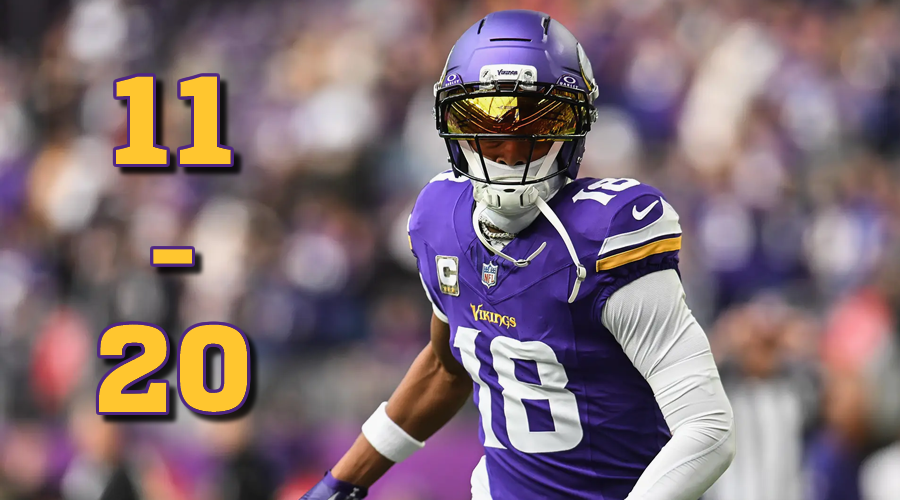
11. Justin Jefferson
As I just mentioned, I hated having to put Jefferson down here, since he has largely been the standard for the position since the Vikings drafted him in 2020, and he owns the record for the most receiving yards through his first six seasons as a pro (8480). That’s despite coming off his worst campaign yet, largely driven by highly inconsistent quarterback play throughout, barely cracking the 1000-yard mark and only reaching the end zone twice. Previously, he had been averaging an absurd 96.5 yards per game. I expect him to live up to that level again with steadier ball placement. Jefferson’s ability to disengage his upper and lower half, set up defenders with faints, and elude contact makes him a unique route-runner, who can overcome brackets and coverage being shifted towards him. Plus, he has some of the wildest catches ever, where he’s forced to contort his body and/or win through contact.
12. Kyle Hamilton
Next is a player who has exceeded even the highest of expectations with what he has meant for the Ravens since they drafted him in 2022. Early on, it looked like my draft evaluations made sense, that he’d be best utilized in a more defined role near the line of scrimmage – and that’s arguably where he remains the most impactful on a down-to-down basis – but he has proven me dead wrong. This guy has become “the fixer” for Baltimore, capable of lining up pretty much anywhere in the secondary, based on injuries or areas of weakness in any given season. Since entering the league, he has averaged 31 defensive stops, 11.5 QB pressures and nine PBUs (to go with five total interceptions). Last year was no exception, as he finished top three in coverage, pass-rush and overall PFF grade (86.3).
13. Bijan Robinson
Ever since he first stepped onto the field at the University of Texas six years ago, Bijan seemed destined to land here. Just like in college, his production has risen all three seasons as a pro. In 2025, he led the league in scrimmage yards (2298), while still averaging 5.1 yards per carry. If you go by individual production, only Miami’s De’Von Achane averaged a higher yards-after-contact mark (3.95 YAC per carry), and if you also include what he did as a receiver, he forced 35 more missed tackles than any other player in the league (112). Robinson is the most aesthetically pleasing runner in the league to me, especially watching him stretch defenses horizontally before getting downhill on zone concepts, but it’s how much more he was utilized as a pass-catcher last season that really boosted his output this past year.
14. Lamar Jackson
Was 2025 up to Lamar’s usual standard? No. If not for the voters splitting first-team All-Pro and league MVP honors between him and Josh Allen, he would’ve won the latter in all but one of four seasons in which he started 15+ games. And he missed a month again this past year. He turned the ball over ten times in 13 contests, and finished with the fourth-highest pressure-to-sack conversion rate (23.1%) among quarterbacks with 300+ dropbacks. Using a quasi-spy lurking at the line of scrimmage and deploying one-off gameplans did give him trouble at times. However, his fall-off has been vastly exaggerated. Jackson still quietly finished fourth in passer rating (103.8) last season – which he’s the all-time record holder for in his career. He also led the NFL in average completed air yards (7.6) and passer rating on attempts of 20+ air yards (132.4), and a shanked field goal squandered a tremendous week 18 performance that should’ve won the Ravens their third straight AFC North title.
15. Patrick Mahomes
Based on traditional statistics last season, it’s hard to make a case for Mahomes to be this high. Yet, I don’t think anyone rational would argue that he’s not still at least in the conversation for the best quarterbacks in the league. Since he took over the reins in Kansas City in 2018, if you include the playoffs, no one has posted a higher EPA per play (0.248). Last year was so glaring because even without tearing his ACL in week 15, he was likely going to come way short of his usual standard of at least leading the Chiefs to the AFC title game in every other season. I still regard this guy as the ultimate problem-solver, capable of mitigating pass-rushes with the quick game, punishing blitzes, and making backyard plays when things break down. The two areas that he has clearly regressed these past two seasons are his accuracy as a deep passer and his ability to avoid sacks, significantly impacted by offensive tackle play.
16. Patrick Surtain II
Arguably at no other position in football is the level of variance as strong as it is for cornerback. That’s how someone like Surtain can go from winning Defensive Player of the Year to being sort of forgotten in the conversation for the top guys at his job. Now, I will acknowledge that he obviously did take a step back, not making nearly as many big plays himself. Having said that, he was only charged with one touchdown and a 66.5 passer rating allowed, even if he only recorded one interception (and no involvement in fumbles). What he’s asked to do, isolating against the opponent’s X receiver on the backside of the formation and rolling coverage away from him, but also positioning himself to discourage quarterbacks from getting the ball out before their pass-rush can get home on fire-zone blitzes, is highly valuable. The one issue coming with his style of play is that he’s been penalized double-digit times each of the last two years.
17. Lane Johnson
This brings us to a pair of offensive tackles, who have become such pillars to their franchise’s success that they’re actually not being talked about enough. Maybe no player in the league represents that more so than Lane Johnson. Once again, last season, he didn’t surrender a single sack or hit on his quarterback (seven hurries) across 262 dropbacks. That marks the fifth time in six years that he’s posted a pass-blocking efficiency of at least 98.6, meaning allowing a pressure on just every 52nd such snap he’s on the field for. He’s also receiving PFF run-blocking grades of over 80 in all of those, even though Philly’s ground game unfortunately fell off massively due to several factors. Now, the hope is that Johnson can stay largely healthy again, missing the final seven weeks of this past season, after starting 15+ games the previous three.
18. Tristan Wirfs
Wirfs appeared like the eventual predecessor to Lane Johnson as the premier right tackle in football, but led the way for Detroit’s Penei Sewell when he switched sides three years ago – and made that transition appear flawless. While the Bucs’ run game regressed and the individual numbers in pass-protection were better in 2024, you can argue this past season was Wirfs’ most complete yet as a pro, even though he missed the first three weeks. He finished with the second-highest PFF grade among all offensive linemen (92.7), with top-five marks as a run- and pass-blocker as far as tackles go. This guy’s a dancing bear, who can mirror just about anyone on the edge, and we saw him get weaponized on the move more under their previous offensive coordinator, while his explosiveness routinely allows him to widen the edge in the run game.
19. Drake Maye
Maye’s improvements from a promising rookie campaign to finishing one vote from winning the MVP award were remarkable. easily led the league in completion percentage (72.0%) despite being just 0.1 yards off the high mark for quarterbacks with 300+ dropbacks in average depth of target (9.7). Naturally, he also finished atop the rankings in actual yards per attempt, passer rating and QBR. More importantly, if you go to the advanced stats – he easily cleared the competition in EPA per play (0.313) and completion percentage above expected (9.2%). His accuracy down the field may already be the best in the league, and he was about as efficient as anyone as a scrambler. The one flaw for Drake was that he took eight more sacks (68) than anyone else at the position, if you include the postseason (fourth-most if you exclude it). For as bad as the numbers were from that point forward, I’d argue that setting up that run to the Super Bowl speaks more towards how he elevated an otherwise mediocre roster.
20. Joe Burrow
Now, while I struggled to separate these last two quarterbacks, closing out my top 20, because the track record is so much more expansive for Burrow compared to Drake Maye, I simply can’t ignore the fact that the former has missed at least seven games in two of the last three years. Although they did miss the playoffs in each of those, when available, Joe has been an ice-colder killer. We saw that during his second and third year as a pro, splitting AFC Championship games with Patrick Mahomes. While I don’t believe his arm strength or athleticism are quite up there with the elites, he’s an assassin from the pocket who does extend plays when needed tremendously well. Although we can argue that he takes too many sacks, he’s been one of the best at making big plays while protecting the football. Even in 2025, he finished second to only Matthew Stafford in big-time-throw rate (6.6%) while also having the lowest turnover-worthy play percentage (0.7%) among QBs with 300+ dropbacks.
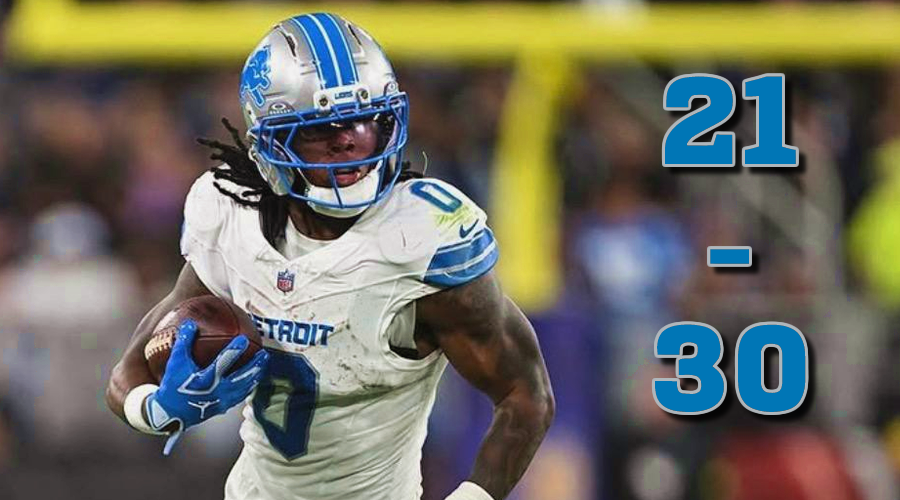
21. Jahmyr Gibbs
Even though Atlanta’s Bijan Robinson earned the top spot among running backs, his 2023 draft classmate is giving him a strong run for his money. Only the Colts’ Jonathan Taylor reached the end zone more often than Gibbs (18) this past season. He also finished third among RBs in receiving yards (616) and second to Robinson with 77 missed tackles forced overall. Gibbs is a home run waiting to happen, who constantly plays around with pursuit angles and has continued to improve as a runner between the tackles, who makes it almost impossible to get a straight shot at him.
22. Aidan Hutchinson
Directly behind Jahmyr Gibbs is Detroit’s top draft selection from the year prior. While you may not quite feel his physical presence like the three guys who I described inside my top ten, Hutchinson has been as productive as any of them by the numbers. Last year marked the second time in three years that he hit 100+ QB pressures during the regular season (led the league in 2025). Sandwiched between those was when he unfortunately tore his broke his leg just five weeks in. Yet, he was actually off to his best start yet, with 45 pressures on just under 200 opportunities. He’s not a top-tier edge-setter in the run game, but he already has five interceptions and eight forced fumbles as a pro.
23. Fred Warner
It’s hard to stand above the rest at the off-ball linebacker position, based on what players do on an every-down basis, that you may not be aware of just watching the broadcast. Still, Warner has managed to establish himself in a tier of his own. Through his first seven years, he had been a model of consistency, only missing one total game, prior to being limited to the first six weeks of 2025. Nonetheless, he finished as the highest-graded defensive player in PFF’s database (93.2), as an omnipresent force who constantly erases what appear like easy completions based on defensive structure and finds a way to finish nearly impossible tackles after eluding blocks.
24. Derek Stingley Jr.
There are a handful of challengers to Denver’s Patrick Surtain for the title as best corner in the game, but Stingley has the slight edge over the others. And that’s simply based on his play-making skills for the position, now with 14 interceptions and 46(!) PBUs over the last three years combined. Even though Houston plays a lot of cover-three and -four on base downs, their corners regularly end up in isolated coverage on the perimeter, and then they run man-free on one of the higher rates to complement that. Those guys throwing off the timing of fronts is essential to the Texans’ four-down front getting home, even though it did lead to eight penalties for Stingley in 2025.
25. Justin Herbert
Was it wild that someone voted for Herbert as their MVP last season over the two front-runners in Matthew Stafford and Drake Maye? Yes. However, he’s a lot closer to that level of player than what the public perception often times would make you believe. I know he has yet to win a playoff game, and his statistics are a notch down from the guys at the top of the league, but the majority of quarterbacks wouldn’t even come close to what he’s done with those supporting casts. No other quarterback (with 300+ dropbacks) was pressured at a higher rate last season (43.6%). Their interior O-line constantly got their asses kicked, and that doesn’t even include the Chargers being without their starting tackle tandem for the majority of the year. Justin being able to mitigate the pass-rush and deliver spirals with defenders around his feet is what routinely saved them.
26. Creed Humphrey
Similarly to off-ball linebacker, there’s a player at the center spot who has been the standard for everyone to follow basically since the Chiefs stole him in the second round five years ago. For the shortcomings across their offensive lineup that quarterback Patrick Mahomes has been able to mask, Humphrey has been the one other constant for that unit over that period. Among centers with 300+ offensive snaps, he’s now finished number one in terms of overall PFF grade (88.8) in four of the past five seasons. Last year, he held opposing rushers to only eight total QB pressures across a massive 742 pass-blocking snaps, and he was only penalized twice.
27. Chris Jones
On the opposite side of the ball for the Chiefs, Jones has been one of the premier pass-rushers in football for a decade now. He has posted at least 58 quarterback pressures in eight straight regular seasons, with an average of just over 68, and some of his best performances have actually come in the playoffs. Although he’s always been more of a “slasher” in run defense, he did conform to playing more gap-control stack-and-shed prior to his worst year in that area in a while. Jones was still right at his career average with 23 defensive stops and easily first among D-tackles in ESPN’s pass-rush win rate (20%), while in reality he’s done even more damage off the edge in defined passing situations for a while now.
28. Maxx Crosby
Another AFC West defender who has been doing it for several years nearly was headed to Baltimore, if not for a curious failed medical reversing the trade. Playing for a winning team in only one of seven years with the Raiders organization and how he rarely comes off the field makes Crosby’s accomplishments that much more inspiring. Although he missed a couple of weeks, only reigning Defensive Player of the Year Myles Garrett recorded more tackles for loss last season (28). Additionally, he was just one defensive stop behind the high mark for all non-off-ball-linebackers in PFF’s database (54), and he was tops among the EDGE position in run stop win rate (39%), according to ESPN.
29. Trey McBride
Closing out this batch of ten names is another duo at a position, who I had a tough time separating. I gave McBride the slightest of edges here simply because I couldn’t ignore how prolific he was last season, with how the Cardinals offense ran through him. His 169 targets were 51(!) more than any other tight-end in the league, and after having a weirdly low rate of touchdowns through his first three years as a pro, he was tied for the second-most touchdowns for all skill-position players (11). McBride is outstanding at finding space and surviving contested catch-points, as well as creating with the ball in his hands, posting a TE-best 24 missed tackles forced.
30. Brock Bowers
Right behind Arizona’s Trey McBride is the guy who may smash several records for the tight-end position, if his career lives up to what he’s shown early on. After Bowers set a new rookie TE record for receiving yards (1194) and top mark for all first-year pass-catchers (112), he unfortunately was banged up for large portions of his sophomore campaign. Still, he once again finished top five in yards per route run among tight-ends and reached the end zone seven times on just 83 targets. Although he’s better utilized detached from the formation, that doesn’t speak to his physicality in contested-catch situations, as he improved his success rate in those situations to an impressive 65.2%.
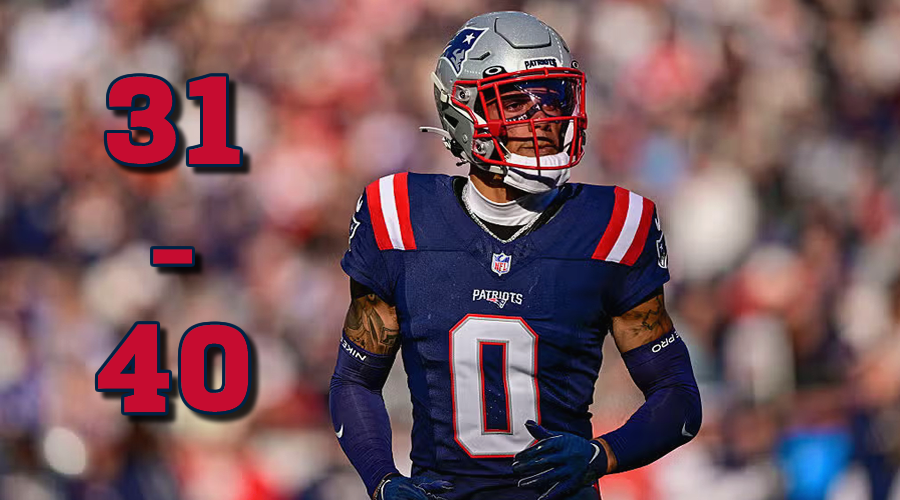
31. Christian Gonzalez
Similarly to the last two seasons, we open this paragraph with a pair of young cornerbacks, who may not jump off the stat sheet, but have been instrumental to the success of their respective defenses. Even if you include this past playoff run, Gonzo has only been involved in five takeaways across 48 career games. However, he’s been about as good a shutdown man-to-man CB as anyone out there. His completion percentage allowed and missed-tackle rate have decreased in each of his three seasons as a pro, with his rookie year being cut short just a month in. Even if you include the playoffs, across 87 attempted tackles in 2025/26, he only missed one attempt, while being responsible for just 4.7 yards per target in coverage.
32. Quinyon Mitchell
Yet again in 2025, it took until the Wildcard Round for “Q” to get his lone two interceptions – just like collecting his first two picks as a pro during the previous year’s run at a Lombardi Trophy – but he collected 17 PBUs during the regular season. We saw Vic Fangio lean more towards cover-one again, with the Eagles coming up just 0.1% short of the high mark set by Cleveland (35.5%), because he had Mitchell neutralizing the opposing team’s top receiver for large stretches. Including the playoffs, he was charged with a completion rate of 43.7% and a passer rating of just 58.4.
33. Chris Lindstrom
While the gap isn’t as large as it is at center, Lindstrom has rightfully been regarded as the top guard across the NFL for an extended stretch by now. This past year, he “fell” to second among guards in PFF’s grading system last season for the first time since 2022. While he’s gone through various offensive coordinator changes, outside zone has been the primary concept for Atlanta during Chris’ pro career, and nobody’s as good as attaching to, progressing off, and overtaking responsibilities on those combination blocks. There have always been guys with better overall pressure numbers, but he’s only allowed one sack each of the past two seasons on well over 600 snaps in pass-pro each.
34. Danielle Hunter
It’s wild to think Hunter entered the NFL in 2015, his career seemed to be on the knife’s edge five years later due to a back injury, and now in 2025, he might’ve put together his best season yet. He beat out his teammate Will Anderson Jr. with 15 sacks, and finished slightly behind him with 83 QB pressures (fifth in the NFL). His athleticism may have dropped off slightly, but what makes him such a nightmare to block is his unconventional style as a pass-rusher, where he challenges opponents with unconventional step-sequencing and body feints, to go with how effectively he sets up twist action.
35. Devon Witherspoon
It’s pretty crazy to think that the Seahawks landed Witherspoon and Jaxon Smith-Njigba in the same draft class just three years ago, as both have been pillars for them on either side of the ball. While JSN exploded in 2025, the former has pretty consistently been one of the best defensive backs in the NFL, lining up inside and out at a nearly even rate. Last year, Spoon finished as the highest-graded CB in PFF’s database (89.9), while cutting his missed-tackle rate in half compared to 2024 (7.7%). He was also insanely effective as a pass-rusher, recording 10 QB pressures across 21 such snaps during the regular season, and three more on seven attempts in the Super Bowl, including a quasi-strip sack (officially counted as an interception).
36. Christian McCaffrey
Considering the myriad of injuries the 49ers suffered throughout the 2025 season, the fact that they battled the Seahawks in week 18 with the NFC’s number one seed on the line almost felt impossible. Their defense was firmly inside the bottom ten across the majority of metrics, and Jauan Jennings was their leader in scrimmage yards not named McCaffrey (643). The backup RB Brian Robinson logged exactly 100 touches, which was second. Christian amassed an NFL-high 413(!). The efficiency on the ground was limited because they couldn’t create a ton of movement, but how CMac helped take up space when getting all five eligibles in the pattern and how they utilized him as the primary target was the key to sustaining drives (924 receiving yards, 17 total TDs).
37. Quenton Nelson
After looking like he was on a Hall of Fame path early in his career, living up to the massive expectations coming out of Notre Dame as a blue-chip prospect, Nelson saw a slight decline in play for about a three-year stretch. He’s back to ranking among the game’s best interior linemen, and in particular, I believe nobody does more damage as a puller today, which is why Shane Steichen constantly weaponized him on the move to create extra gaps. Overall, he finished fourth at the position in PFF run-blocking grade (84.5), among guards with 300+ dropbacks, Nelson finished just 0.1% behind Chicago’s Joe Thuney in pass-blocking efficiency, and he was only charged with two penalties across 1039 total offensive snaps.
38. Garrett Bolles
Although he’s never quite been regarded as one of the premier offensive tackles in the sport, Bolles has unequivocally been one of the most consistent since coming to Denver. Across nine seasons, he has started 14+ games in all but one of those, and has never been worse than an above-average starter. The way he can battle on the edge and stay attached to his man, even when caught in sub-optimal positions, has made him one of the most reliable blind-side protectors. Last year, Bolles had the sixth-highest overall PFF among all offensive linemen (89.3), but he received the highest mark as a pass-blocker specifically (90.8), not allowing a single sack on just over 700 such snaps. Maybe most importantly, he more than cut his penalty total in half (seven).
39. Trent Williams
Going back through the game logs, Williams has rarely missed as much time as I might’ve expected, but it’s pretty crazy to think that he hasn’t played in every possible game for a season since 2013. That combined with the fact that he’s taken a slight step back is why he’s not rare territory for his position anymore, like he still was a few years ago. Nonetheless, this is still one of the scariest men to be in front of, whether he’s driving edge defenders off the ball or bullying some defensive back pulling out to the corner. In 2025, he earned the second-highest PFF run-blocking grade among all offensive linemen (92.8), and while the pressure totals were clearly up from his usual standard, he does regularly wipe out his opponents entirely from affecting the pocket.
40. Cooper DeJean
Quinyon Mitchell may be the better pure cover talent on the perimeter, but his 2024 draft classmate may have been even more impactful to how Vic Fangio wants to run his defense in Philadelphia. Cooper’s physicality in run defense has enabled them to stay in nickel personnel constantly, yet when the Eagles struggled to find stability at that second outside corner spot, he more than held his own when asked to move out, and they instead put an extra safety on the field. Considering the challenges he’s faced as a tackler in space, a 12.7% miss rate is very solid, and while it took until his game-changing pick-six in the Super Bowl as a rookie, he collected two INTs along with 16 PBUs last season, while only being charged with one touchdown in coverage so far in his young career.
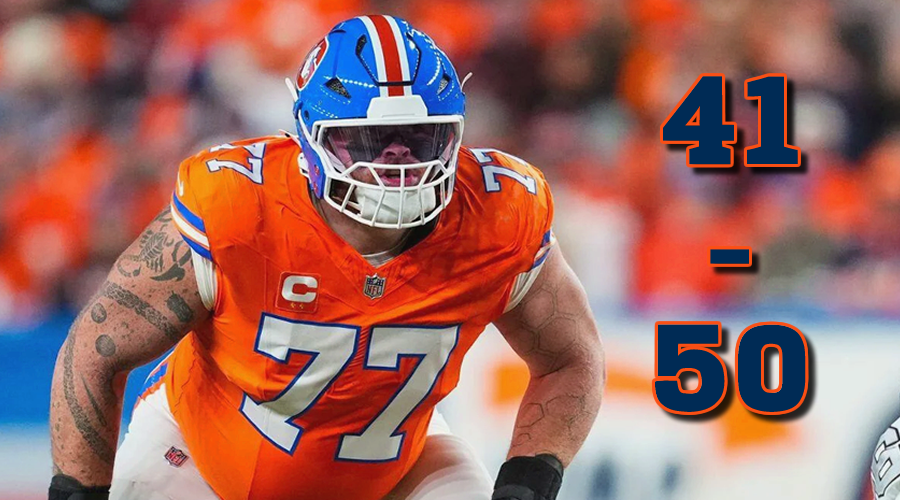
41. Quinn Meinerz
Denver’s offensive line was one of the premier units in the NFL last season. They received the highest PFF pass-blocking grade collectively (78.8), with Meinerz being the highest-ranked guard in their entire database (90.9). They were more so average as a rushing team, but relying on more of a hit-or-miss type of rookie to handle the majority of carries for most of the year lowered their level of consistency. If you evaluate him individually, Meinerz was able to create displacement at the point of attack and create space on kickout blocks with regularity. And despite logging 1239 total snaps (including the postseason), he was only penalized three times.
42. Derwin James
When he came into the league and then a few years under Brandon Staley calling the shots, Derwin was treated similarly to how the Ravens have relied upon Kyle Hamilton as their skeleton key on defense. Rarely allowing him to settle into one spot did have its negative effects, however. Putting him into a more defined “big nickel” role set the table for his best season in a while. He recorded three picks, finished top five among safeties in both PFF coverage grade (83.7) and QB pressures (13). Having him closer to the line of scrimmage and spotting angles to slice past blockers and shut down screen passes also enabled him to log the third-most defensive stops among DBs (34).
43. George Kittle
Kittle presents another curious case, because he suffered a torn Achilles in the Wildcard Round, but the 49ers brass have said that “he’s on track to potentially play week one”. If he’s actually fully himself, he has an argument to rank higher, based on being the gold standard for a two-way tight-end today. He’s regularly involved in those key combination blocks with the tackle on their wide zone concepts, because he can take care of a D-end by himself, if required. At the same time, he was the only TE to average over two yards per route run (2.15 YRR), who may not be *quite* as dangerous post-catch anymore, but has continued to improve his ability to survive contact at the catch-point.
44. Saquon Barkley
What follows is a trio of running backs that felt impossible to break up. Following an all-time record season in rushing yards through the regular season and playoffs combined (2504), Saquon slid down to tenth in that regard (1140). He didn’t create as much individually, but the biggest difference by far was up front, due to being predictable and struggling to re-set the line of scrimmage. His yards before contact mark was basically cut in half, from 2.64 in 2024 down to 1.42 last year. When given space, I still believe he can rack up major production, and he only fumbled once throughout the season.
45. Jonathan Taylor
Unlike Philadelphia’s Saquon Barkley, Taylor found himself in one of the best setups across the league last season. After a couple of down years, their offensive line was at its best since being the rushing champion in 2021, and with Daniel Jones having a career campaign, to go with how Shane Steichen played with defenses thanks to how he presented plays, their offense felt as wide open as ever. Unfortunately, once the quarterback tore his Achilles, defenses were able to lock in on the ground game, and all those explosives Taylor provided largely vanished over the final month. Derrick Henry did ultimately best the Colts RB by 10 yards for second in total rushing, but nobody scored more touchdowns from scrimmage (20).
46. Derrick Henry
Third among this illustrious bunch, Henry’s season was somewhat flipped in comparison to what the Colts’ Jonathan Taylor did. He came out of the gates smoking hot, but a late fumble (one of three lost on the last three) overshadowed a dominant week one performance. As I’ve iterated multiple times, Baltimore’s guard play was an issue throughout the year. That, paired with a couple of backup quarters starting a pair of games, and their defense regularly putting them in catch-up mode, didn’t allow the Ravens to operate on schedule. Yet, somehow Henry still finished second in the league in rushing yards (1595), with his incredible closing stretch over the last month, when he averaged 142.5 yards and 1.5 touchdowns per game. That’s despite facing the second-highest rate of boxes with 8+ defenders in the box (39.1%).
47. Jared Verse
On the opposite end of that blockbuster trade for reigning Defensive Player of the Year Myles Garrett, the Rams sent Verse to Cleveland, who deserves far better than being something like a footnote in the NFL record books. 12 sacks through his first two regular seasons doesn’t do his impact justice, as he added three more in five postseason contests, and if you include those, no other defender has racked up more total QB pressures since entering the league (189). Verse is a master at angling his rush through contact in order to affect opposing passers. Along with that, ESPN credited him with the second-highest run defense win rate among edge defenders in 2025 (35%).
48. Dexter Lawrence
The one other shocking trade this offseason revolved around the best nose tackle in the sport collectively over the last four years. That does include a down season in 2025 for his standards, which combined with requesting a move, is why he’s supposed to be the rock in the middle of the Bengals defense that they’ve needed for a while now. New York’s run defense didn’t live up to their billing these past couple of years, but with how much Sexy Dexy is asked to swallow double teams, that’s put even more spotlight on the lackluster play at linebacker. Since 2022, he’s racked up 108 QB pressures from the nose spot. Nobody else has more than 32(!) over that stretch.
49. Antoine Winfield Jr.
After missing half of 2024, Winfield was back to playing a full 17 games this past season, although he didn’t quite fill up the stat sheet as usual on a Bucs defense in clear need of better pass-rush and/or schematic evolution. He only intercepted two passes and was involved in a couple of other takeaways. However, he was ultra reliable in the open field, with a missed-tackle rate of just 4.2%, and he remains as one of the most dangerous blitzers from the safety spot, with 15 QB pressures on 65 opportunities. He can be that disruptor near the line of scrimmage, but also a ball-hawk when deployed more in deep coverage.
50. George Pickens
Even though there seemed to be some tension early in the offseason about the Cowboys franchise-tagging Pickens rather than taking care of a 25-year-old wide receiver coming off a career season, acquiring him from Pittsburgh for a third-round pick paid off massively. He finished behind only the Seahawks’ Jaxon Smith-Njigba and the Rams’ Puka Nacua in receiving yards (1429) and first downs through the air (73). To go with his exceptional skills to come down with the ball hanging up in the air, he was a problem to bring down once it was in his hands. Pickens finished second in contested catches (22) and was tied for third in average YAC over expectation (2.2 yards). His one major issue was that his handle was too loose (four fumbles).
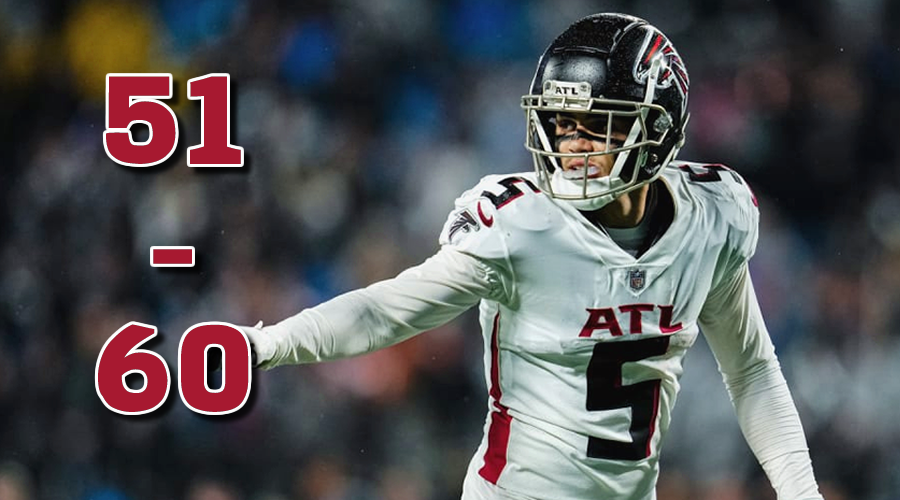
51. Drake London
Moving on to the second half of this top 100, London acts as a good representation, because he has yet to break through as one of the elite wide receivers, but he’s clearly a difference-maker when on the field. Over the last two years, he’s averaged 75.5 receiving yards and 0.55 touchdowns per game. Although his contested-catch rate did regress, in part due to inconsistent quarterback play, he has an extensive track record of being a ball-winner on the outside, but also functions at a high level as a power slot. In 2025, he came up huge when needed most, and only dropped two of 70 catchable passes.
52. Nick Bosa
Just like a couple of other Niners already mentioned, finding the correct landing spot for Bosa after tearing his ACL in week three wasn’t easy. According to PFF’s database, he posted pass-rush win rates of at least 20% in his three seasons prior. And even last year, he closed out week one at Seattle with a strip-sack, followed by dominating New Orleans’ excellent young tackle tandem. Putting him in those wide-nine alignments, he can either win around the corner with those two-handed swipes or convert speed-to-power expertly. Plus, he’s always been one of the most physical edge setters in the run game for his position.
53. Josh Hines-Allen
I gave the slightest of nods to San Francisco’s Nick Bosa here, because his overall track record is a tad more impressive, but Hines-Allen isn’t far off, and he’s simply been more available, only missing more than one game in seven seasons as a pro. That was also the time he failed to log double-digit tackles for loss. In terms of sacks, he’s failed to match his career-best total of 17.5 in 2023 over these last two years combined, but this past season, he actually set a new high personally with 95 total pressures, ranking behind only Detroit’s Aidan Hutchinson league-wide.
54. Quinnen Williams
Thanks to his mid-season trade from the Jets, we follow up a pair of edge defenders with a duo of guys on the interior from the NFC East. Some people were confused why the Cowboys would package a first- and second-round pick for Williams, after moving Micah Parsons for a package that wasn’t significantly different, but in a vacuum, the player pretty clearly is worth that compensation, and he made his presence felt in the Big D. For the season, only Pittsburgh’s Cam Heyward received a higher PFF grade among interior D-linemen (88.8), while Quinnen was credited was credited with the highest stop percentage of any defender on run plays (14.0%), according to PFF.
55. Jalen Carter
I’ll put the Eagles’ top ten pick from three years ago just behind Quinnen Williams, simply because he’s shown a lack of focus and poor decision-making at times (on and off the field). When locked in, he absolutely is a game-wrecker who messes up way more plays than the stats would ever indicate. He finished 17th in quarterback pressures (41) and tied for 65th in defensive stops (17) with only 11 games played, to go with an enormous 31.7% missed-tackle rate. Having said that, we’ve seen him take over in some of Philadelphia’s biggest matchups, helping them win a Super Bowl in 2024/25, and even in that limited time this past season, he batted down six passes.
56. Joe Thuney
Although I’ve never quite viewed Thuney as one of the top two guards in the NFL in any given year, because he simply isn’t up in that stratosphere as a run blocker, his track record now on three different teams makes a compelling case for potentially landing in the Hall of Fame one day. For his career, he’s allowed pressure on his quarterback on just 2% of his pass-blocking snaps, and this past season, he posted the highest PFF grade among all guards in that regard (88.6), not giving any sacks and just one QB hit. Additionally, he was instrumental in installing Ben Johnson’s new run schemes, as according to ESPN, he also earned the third-highest run-blocking win rate among interior O-linemen (77%).
57. Nik Bonitto
I was dubious about Bonitto’s profile coming into the NFL, due to the lack of size and overall power in his game. Having said that, with how much beef Denver has on the interior, it’s allowed him to be that fastball off the edge that terrorizes opposing quarterbacks. If you combine sacks and QB hits last season, he finished fifth in the league (42), and he was in a class of his own when it comes to quick pressure rate (13.4%), meaning applying heat to quarterbacks in under 2.5 seconds. If you go by total pressures (76), he finished eighth despite being 37th in pass-rush snaps (416). He also ended a game with a crucial knock-down of a pass on a decisive two-point conversion against Washington, and logged a career-high 34 defensive stops.
58. James Cook
This guy might be the least discussed rushing leader in recent memory (1621 yards). And by no means was this simply a volume thing, as Cook finished behind only Miami’s De’Von Achane in yards-per-carry mark (5.2 YPC) among players with 100+ carries. He does benefit from playing alongside Josh Allen, and the way Buffalo’s offensive front moves the line of scrimmage backwards, but Cook actually finished with the second-highest percentage of rushing yards over expected among players with 100+ carries (46.9%). His ability to naturally alter pace and knife through creases has turned him into one of the best runners between the tackles. The one major blemish on his record were those seven total fumbles, including the playoffs.
59. Devin Lloyd
Were the statistics a little inflated for Lloyd in 2025 compared to his usual standards? Sure. He still put together a career year at the heart of Jacksonville’s defense turning the tide under new coordinator Anthony Campanile. Lloyd was tied for the second-most interceptions in the league (five), including a game-changing 100-yard pick-six in an early-season win over the Chiefs. He added seven more pass deflections, speaking to his ability to command space and make plays on the ball outside his area on paper. On top of that, there was just a lot more conviction overall in his game, and he was his effective self as a blitzer, with 25 QB pressures on just under 100 opportunities.
60. Trent McDuffie
Not only did the Rams trade for the number one player on my list, but previously they had already addressed the corner position on defense when they sent a first-round pick to Kansas City for McDuffie. While I’d say that he’s been at his best deployed in the slot, he’s clearly a quality starter when asked to move to the perimeter as well. Although he only snatched up three interceptions across four seasons with the Chiefs, we’ve seen McDuffie improve his missed-tackle rate consistently (5.9% in 2025), and if L.A. decides to utilize him more as a blitzer again, his efficiency in that regard can’t be ignored (34 QB pressures across 146 pass-rush snaps).
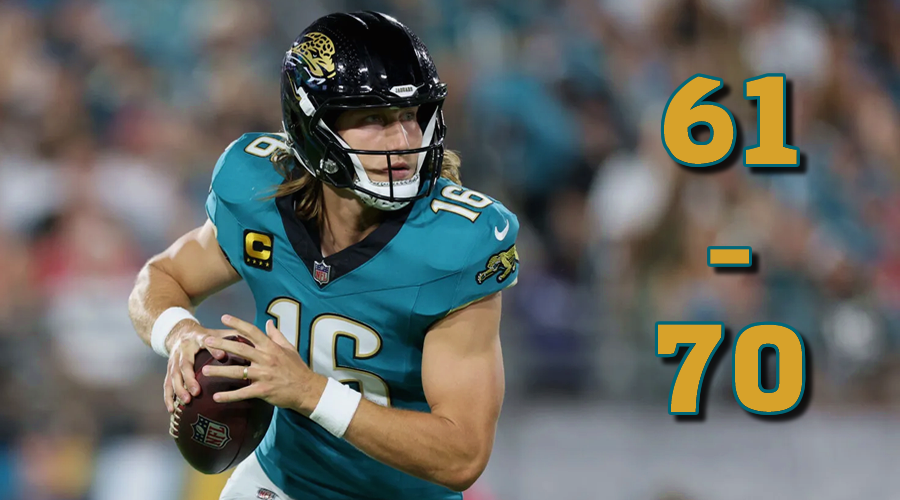
61. Trevor Lawrence
There was plenty of reason for optimism once Liam Coen overturned his previous decision to come to Jacksonville, and what their offense could look like in combination with Lawrence. The early returns were underwhelming, as we saw way too much variance in ball placement and questionable decision-making based on situation. However, T-Law went on a heater once the Jags acquired WR Jakobi Meyers, as he powered them to eight straight wins heading into the playoffs, across which he accounted for 24 touchdowns compared to only six giveaways. He led five game-winning drives, and overall was tied for the fifth-most completions of 20+ yards (57).
62. Nico Collins
Whether you observe the discourse around quarterback C.J. Stroud or what the general temperament around the Texans offense was last season, people’s thoughts appear clouded by their two lackluster playoff performances. Collins was still one of the best big-play receivers in the sport, catching up going up for a crowd for the ball or shaking off defensive backs post-catch. Among the 26 WRs with 100+ targets, Nico’s 15.7 yards per catch was number one overall. That’s while only dropping one pass all year. Since 2023, only the Rams’ Puka Nacua has averaged a higher yards per route run mark (2.72 YRR). And if you go to last season alone, Nico finished behind only Seattle’s Jaxon Smith-Njigba with five receptions of 40+ yards, despite missing a couple of weeks. Unfortunately, missing multiple games in each of his five seasons as a pro has marked his career so far. Nonetheless,
63. Amon-Ra St. Brown
Once again, I just gave a tiny edge to Houston’s Nico Collins on this list, because he offers more explosiveness. However, the level of consistency St. Brown has provided pretty much since entering the league is undeniable. Over the last three years, he’s contributed ten more first downs through the air than any other player in the league (221). And last year, only L.A.’s Davante Adams reached the end zone more often last season among wide receivers (11). He’s not going to take the top off defenses or erase angles with the ball in his hands necessarily, but nobody is tougher over the middle of the field, and he catches nearly everything you throw his way (3.0% career drop rate).
64. Laremy Tunsil
It’s rare to see an established starting left tackle get traded twice over his first ten years in the NFL, but those moves were more so results of the situations the Dolphins and Texans found themselves in, rather than any indictment on Tunsil’s performance. Across the last seven seasons, when he was limited to five games in 2021 marked the only time he didn’t receive a PFF pass-blocking grade of at least 84.9. This past season, he only surrendered two sacks and 13 other pressures on just under 500 pass-blocking snaps. He also received his highest run-blocking grade yet (75.3), and he massively cut down on penalties (eight), which have continued to tarnish his profile.
65. A.J. Brown
This was another player who was difficult to find an appropriate spot for. 2021 was the only one of seven seasons (when he missed three games) in which he failed to reach 1000 receiving yards. Over his first three seasons in Philly, he exploded for just over 4000 yards and 25 touchdowns across 47 regular season contests. He failed to live up to that exceptional standard, and his frustrations about the Eagles’ offense were visible. If given opportunities down the field, I still believe he’s one of the most dangerous fade runners in the league, and he’s averaged a missed tackle forced on just over every fifth reception for his career (103 MTFs on 524 catches). He also only dropped one pass all of 2025.
66. Milton Williams
One of the other key contributors from the Eagles’ Super Bowl run the year prior to this past one was even more effective in a new landing spot last year. Williams actually wasn’t even a starter across his four seasons in Philadelphia, but emerged as one of the most effective interior pass-rushers in the league. In 2025, he actually logged five additional QB pressures (59) on six fewer pass-rush snaps (412), including the playoffs. He provided plenty of disruption against the run as well, but Williams’ ability to crush the pocket and drive interior offensive linemen backwards was a key ingredient in the Patriots’ surprising run to the biggest stage.
67. Jack Campbell
When the Lions used their pair of first-round picks in 2023 on a running back and a linebacker, a lot of people understandably questioned their approach, and even I wondered if they ignored positional value a little too much. Three years later, Jahmyr Gibbs is arguably the most dynamic player at his best position, and Campbell is in the discussion for top LB not named Fred Warner. Last year, he led all defensive players in what PFF labels as “defensive stops” (68), which constitutes a positive tackle for his unit based on down and distance. Only the aforementioned San Francisco standout outperformed him in overall PFF grade for the position (90.2), and Campbell actually ranked higher in run defense specifically, while he’s now moving around in coverage with a lot more purpose than early on.
68. Aaron Brewer
As already mentioned, Kansas City’s Creed Humphrey has cemented himself as the top center in the sport for the last half decade. However, despite Miami losing a lot of its shine due to the regression in quarterback play and injuries plaguing them, Brewer emerged as the second-best player at his position. Only Humphrey received a higher overall grade from Pro Football Focus at the pivot (87.4). While still slightly undersized, nobody’s better at reaching extended landmarks, whether reach-blocking a 2i or wide zone or beating linebackers to the spot on toss plays. Plus, Brewer was only charged with one sack and QB hit each over the course of 549 pass-blocking snaps.
69. Leonard Williams
Big Cat Williams finds himself in a funny spot, where he’s not the biggest star on Seattle’s defense, or is even necessarily viewed as a pillar for them long-term, now 11 years into his pro career. With that being said, he was one of the most productive players on a dominant unit that ended up powering them to a Lombardi Trophy. If you include the playoffs, Williams was tied for first among D-tackles in QB pressures (69). He’s a nightmare to account for on various twists, because he can split (quasi-) double teams as the set-up man or come free as the looper and terrorize quarterbacks. His ability to line up anywhere from 1- to 6-technique on early downs was also pivotal for all the light boxes Seattle relied upon.
70. Caleb Williams
Caleb absolutely is an imperfect quarterback at this point. He finished 26th out of 34 quarterbacks with 300+ dropbacks this past year, as his ball-placement can be a little scattershot, and part of his genius can border on insanity at times. However, no other quarterback led more fourth-quarterback comebacks during the 2025 regular season (six), and the Bears’ standout signal-caller added another one in spectacular fashion when they overcame their division rival Packers in the Wildcard Round. I’d argue he’s better in-rhythm than the backyard-style plays might suggest, and he erased a ton of negative plays on those last season. He was one of only three signal-callers to limit opposing defenses to allowing less than 10% of his pressure to be converted into sacks.
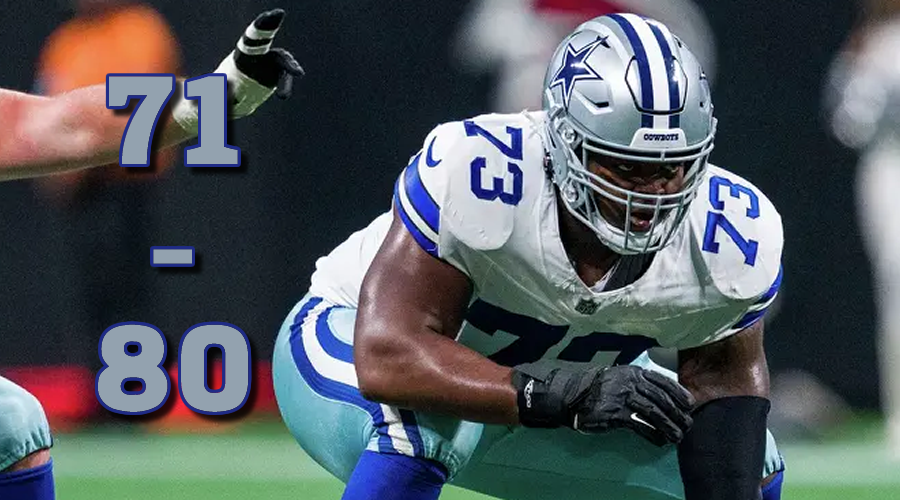
71. Tyler Smith
After doubting Smith coming out of Tulsa, due to how much he relied upon his natural strength, he put together a solid rookie season with the Cowboys at left guard and has since been one of the best guards in the league, when he moved one spot inside the following year. Across that three-year stretch, he has only pressure on his quarterback on 3.3% of his pass-blocking snaps. More noteworthy, he stepped into the shoes of Zack Martin as one of the premier run-blockers in the sport. How he handles combination blocks on inside zone concepts and the force he applies on simple down blocks are top-tier.
72. Jordan Mailata
For as much credit as Lane Johnson has justifiably received on the right end of Philadelphia’s offensive line, Mailata not having played a down of football before being drafted in the seventh round in 2018 and having turned himself into one of the best left tackles in the NFL for the last few years may be even more impressive. Looking at the last couple of regular seasons in particular, he’s only been responsible for three sacks and 41 total pressures across 967 pass-blocking snaps. Not only is he a wall to get through in protection, but once he’s created movement as a blocker, he often truly bullies defenders, including when utilized as a puller despite being listed (conservatively) at 365 pounds.
73. De’Von Achane
Generally, it’s fair to question the viability of a sub-200-pound running back and his capacity to handle an extensive workload. However, Achane has only missed one total game over the last two years, across which he touched the ball 586 times. His burst to capture the corner on wide zone/toss plays under Mike McDaniel enabled him to average half a yard more per carry than any other player in the NFL with 100+ attempts (5.7 YPC) last season. He was the lone running back to average more than four yards after contact last season (4.11 YAC per carry), while also accounting for the highest percentage of his rushing total coming on breakaway runs (46.1%). Trying to get him to the ground as a checkdown option is highly challenging, and he only fumbled once in 2025.
74. Darnell Wright
Despite a lot of draft rankings in 2023 treating Wright as the definitive fourth name in that discussion, the Bears selected him tenth overall, and he has repaid them with steady growth, while starting all but two out of a possible 53 games. His PFF grade has improved every year, and this past season, he only gave up 19 pressures across 639 pass-blocking snaps. What he does to capture the play-side shoulder of edge defenders and stretch out plays or to wash down defensive tackles to create cutback opportunities has really boosted Ben Johnson’s outside zone-centric rushing attack.
75. Jaycee Horn
If you asked me which position group exceeded public perception the most last season, Carolina’s corner duo of Horn and Mike Jackson would be a strong choice. The former was tied for the second-most interceptions in the league (five), despite the second-lowest pressure rate provided by their front (13.3%). Although DC Ejiro Evero didn’t tap into many exotic coverages, the way he’d rotate at the snap at one of the league’s highest rates was key in fooling quarterbacks, and Horn’s intelligence to “steal” routes as a hang corner in cover-three or attack routes off his landmarks really stood out. His one issue – he was responsible for nine penalties.
76. Carson Schwesinger
The Browns’ roster-building strategy post-Deshaun Watson trade has clearly revolved around acquiring extensive draft resources again, and the recent results have spoken for themselves. After trading back and selecting defensive tackle Mason Graham fifth overall, they targeted Schwesinger at the top of the second round to play behind him. The latter ended up winning Defensive Rookie of the Year, thanks to a pair of interceptions and a monstrous 156 total tackles. A third of those was counted as “defensive stops” (54), rather than just meaningless volume. His ability to diagnose keys and the closing burst to shut down wide runs or screen plays was incredible to watch for such a young player.
77. Derrick Brown
Coming into the league, Brown was considered primarily a run-stopping nose by many people, and he’s been a black hole in the middle of Carolina’s defense, which opponents rarely dare to run at. Having said that, he’s continued to improve his lateral mobility in order to get involved on plays off his landmarks, he’s racked up at least 34 QB pressures in all but one of five seasons, if you ignore 2024, when he was knocked out for the year in week one, and what impresses me for a man who has to gather that weight when he gets into the backfield, he has a career missed-tackle rate of just 5.8%. He was also tied for first among defensive players in batted passes (seven) last year, according to PFF.
78. Byron Murphy II
Unlike Carolina’s Derrick Brown, Murphy profiled as more of a gap-shooting three-technique coming out of Texas a couple of years ago. However, following a promising rookie campaign that was cut in half by injury, he emerged as arguably the most integral piece to how Mike Macdonald wanted this Seattle defense to function structurally, as their primary A-gap defender. Although their flexibility was in part due to being comfortable shifting their D-line in reaction to motion, he’d routinely line up as a 2i and create problems for offenses as they tried to set up combo blocks against him. Along with that, he totaled 62 QB pressures across 569 opportunities, including the postseason, capable of looping all the way across the formation.
79. T.J. Watt
As I’m putting together these notes, I already know Steelers fans will lose their minds for listing one of the premier defensive players of the last decade all the way down here, and yet I struggle to see a statistical case for putting him any higher. Among 78 edge defenders with 200+ pass-rush opportunities, he ranked tied for 36th in total pressures, 65th in PFF’s pass-rush productivity and 37th in win rate. He did come up with a pair of interceptions and eight more passes deflected, while there are still very few guys you’d take over him when you need someone to make a big play for you in the fourth quarter.
80. Tucker Kraft
I talked about Kraft as one of the “under-the-radar studs” towards the end of the 2024 season, when he had emerged as a difference-making two-way tight-end for the Packers. This past year, he took his production to new heights, prior to unfortunately having it cut short eight weeks in by a torn ACL. If you extrapolated those first 7.5 games over the course of a full season, he was on track for 73 catches worth 1100 yards and 13-14 touchdowns. What I love about him is the violence he plays with after the catch, stiff-arming and shrugging off defenders trying to drag him down.
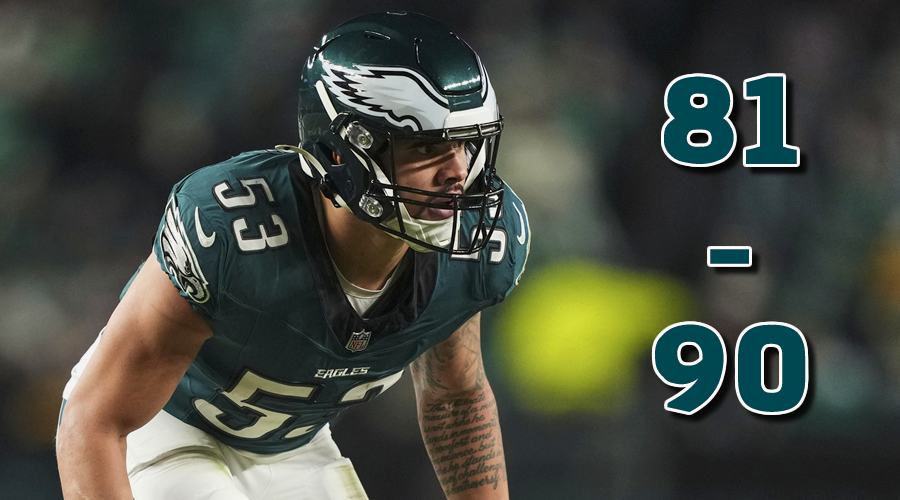
81. Zack Baun
After emerging as one of the biggest breakout candidates of the 2024/25 season and being one of the main figures in Vic Fangio turning around Philadelphia’s defense, to where they were able to put on a dominant display against the Chiefs in their Super Bowl victory, Baun probably showed us closer to what he’ll be going forward. I’d say he was half a step slower to finish plays. Having said that, the numbers were actually better in some regards (two INTs plus seven PBUs), while matching his sack total (3.5) on a slightly more efficient per-rush basis. The Eagles front overall didn’t quite seem as dynamic, which Baun’s ability to change shortly before the snap was a big piece of.
82. Dion Dawkins
Considering how quiet some of the game’s best offensive linemen typically are, and the fact that they’re rarely highlighted if they just do their job, I’d argue that the more outspoken Dawkins benefits from receiving additional recognition. Still, he’s put together an excellent track as a fixture at left tackle for the Bills. His size to engulf defensive linemen shows up regularly in the run game, and his anchor strength makes it difficult to go through him in protection. In terms of ESPN’s metrics, Dawkins was tied for the league’s top pass-blocking win rate among OTs (96%). His 9.7 penalties per year aren’t optimal, however.
83. Tyler Linderbaum
What Linderbaum just did to the center market, when he landed a contract with the Raiders that’s paying him an all-time record 28 million dollars per year, tells us not only how hard it is to find an answer at the position, but also how he’s viewed individually. Disregarding the fact that Baltimore decided to not pick up his fifth-year option due to how he was bucketed, he more than repaid that first-round pick originally invested in him. Linderbaum has ranked top six in overall PFF grade among centers in all four seasons as a pro. His ability to sustain blocks on the move and how he navigates through various games up front are excellent.
84. Brian Branch
Both Detroit’s starting safeties coming off major injuries towards the end of the 2025 season create doubt about their viability on that side of the ball, considering how banged up they’ve been these last couple of years and how they’ve run their defense through them. A lack of discipline before and after the snap bothered me about Branch last year, illustrated by nine penalties, and he didn’t record a single interception across 12 games. Optimally, putting him closer to the ball again this upcoming season again should be helpful, yet what’s noteworthy about aligning deep more is that he posted a career-best missed-tackle rate of just under 5%.
85. Dak Prescott
Prescott remains one of the more decisive quarterbacks in the sport. Last year, he finished top four in the counting stats – passing yards (4552), first downs (220) and touchdowns (30). However, he racked up those totals in service on a seven-win team, and some of his worst performances as a pro have come in the playoffs. What he does on a play-by-play basis, solving defensive puzzles pre-snap and hitting tight windows, makes him one of the favorite watches for purists at the position, though. Only Matthew Stafford posted more big-time throws during the regular season (31). And Pro Football Focus graded Dak as the top quarterback under pressure (77.3), where BTT rate more than tripled(!), up to 8.8%.
86. Ceedee Lamb
While I didn’t have this planned, it appears fitting to me that I put the Cowboys’ quarterback and top receiver for the last several years back-to-back here. That’s where we get to the crux however, as Ceedee actually was clearly outperformed by teammate George Pickens in an injury-marked 2025 season. He still easily cleared the 1000-yard mark in 14 total games, and went over 100 in six of those, while getting knocked out early in a couple of others. He’s one of the nastiest route-runners in the league, who can cross over defenders on whip and option routes of the slot, but drop rates of 9.8 and 9.6% these last two years are quite alarming.
87. Colston Loveland
Even though recent history goes against historical data suggesting it takes a while for tight-ends to acclimate to the pros, just getting onto the field early on can be a struggle. Even a talent like Colston Loveland didn’t crack the 60% snap mark until week one. From that onwards, however, he became a problem for opposing defenses. Going through the Next Gen Stats database, Loveland was the only tight-end last season to rank top ten for his position in both average separation (3.7 yards) and average depth of target (8.9 yards). He only dropped one of 59 passes he got his hands on, and San Francisco’s George Kittle was the only TE to post a higher yards-per-route-run mark than Loveland (1.86 YRR). He’s an incredibly smooth route-runner, and his ability to latch and sustain as a run blocker was vastly underrated coming out of Michigan.
88. Xavier McKinney
Thinking back to the 2024 Packers defense, it was largely held together by paper clips and McKinney’s eight interceptions. With Micah Parsons as their ace pass-rusher, there was more sustainability to it this past season, but they’re otherwise still not rich on play-makers on that side of the ball. McKinney only hauled in two picks, but logged double-digit PBUs for a third straight season, and he was responsible for a passer rating of just 60.1 when targeted in coverage. What he and fellow safety Evan Williams do for them supporting the run from depth, with how much they operate from split-field coverages, and their ability to tackle in space were integral for Jeff Hafley’s scheme.
89. Jessie Bates
Another safety who has pretty consistently elevated the defense he’s been on is Bates. Just on the surface – only in one of eight years as a pro has he intercepted fewer than three passes. He’s also taken one of those back to the house in each of his three seasons in Atlanta. More importantly, he’s been a Swiss Army knife, whose deployment has continued to vary based on what’s been required. In 2025, he spent a career-high 530 snaps in the box and posted his lowest missed-tackle rate yet (6.6%), according to PFF. Meanwhile, playing top-down, his ability to drive on and take away easy completions in coverage shines repeatedly.
90. Jordan Love
Similarly to Dak Prescott in this batch of names, the discourse around Love can be tiresome. A few truly bad performances seem to linger in people’s minds, as if he’d just throw the ball up for grabs constantly. Last year, he was basically tied with Brock Purdy for the second-highest QBR (72.7), and he finished behind only MVP runner-up Drake Maye in EPA per play individually (0.284). What I don’t think he gets enough credit for is his capacity to erase angles for the pass-rush. He finished with the fourth-lowest pressure-to-sack conversion rate (10.5%), and while his general play when heated up did dip last season – where most of those moments that would make you scratch your head decision-making-wise come from – advanced metrics would suggest that he was the top passer when kept clean, including basic completion percentage (77.8%).
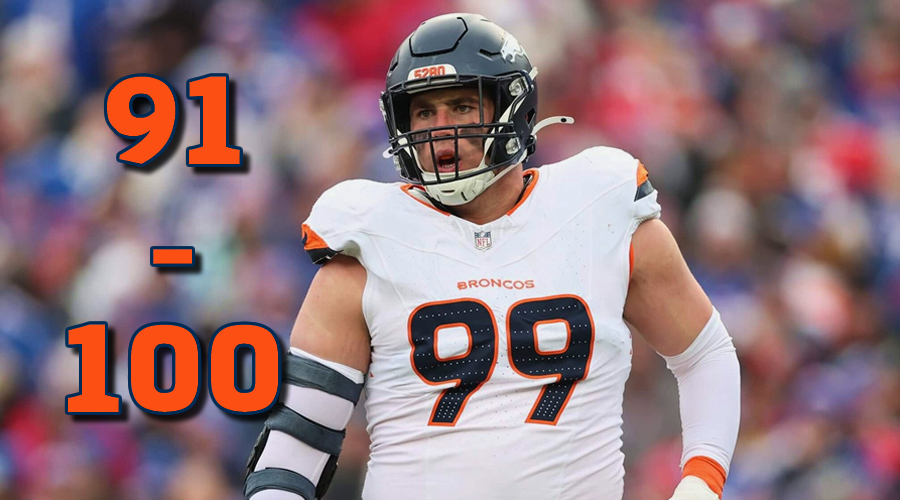
91. Zach Allen
Kicking off our final ten names is one of the most productive players at any position. Just this past regular season, Allen led all defensive players in the league last season with 47 QB hits. While in the playoffs, only Houston EDGE Will Anderson Jr. was more effective at creating pressures based on the number of opportunities he had (pass-rush productivity of 11.5). Only with his ability to work the bull-rush and yank cloth going after quarterbacks, his ability to defend that gap-and-a-half or just occupy space allows Denver to play with those lighter guys on the edge consistently.
92. Jaelan Phillips
Considering a torn Achilles and ACL in the previous two seasons limited Phillips to just eight games played, I was starting to worry about his long-term prospects in the NFL, since he already was forced to medically retire temporarily in college. Seeing him re-emerge with arguably the most complete year as a pro and earning a four-year, 120-million-dollar contract from the Panthers made me that much happier. His impact on the Eagles defense, in need of help on the edge, was clearly felt, as they improved from 15th in EPA per play and success rate allowed to top-ten in both categories after his arrival. Phillips posted 44 pressures across 256 pass-rush snaps, was tremendous in run defense and occasionally dropping into coverage.
93. Laiatu Latu
Speaking of coverage, maybe no defender in the league was more productive at getting his hands on the ball based on opportunities he was given than Latu (65), who recorded three interceptions peeling off the edge. He was right around the top-20 among players with 200+ pass-rush snaps in pressure productivity and win rate. And while he understandably is regarded as a player who excels at getting after quarterbacks, based on the proficiency with his hands, setting up and countering off different combats, he quietly was a plus run-defender in year two as well.
94. Kobie Turner
Closing out this little defensive line segment is one of the forgotten members of L.A.’s now even more formidable front. Byron Young led the group in sacks, the two Florida State teammates Jared Verse and Braden Fiske have received a lot of praise, and of course now Myles Garrett could take them to a new stratosphere, but Turner may have been their most impactful member in 2025. If you include the playoffs, he was tied for first among D-tackles in QB pressures (69). Shockingly not receiving an invite in 2023 overshadowed what an insane athlete he is for the interior, and that is regularly on display with L.A. movement up front.
95. Jayden Daniels
Barely finding a way to get the 2024 Offensive Rookie of the Year on the list feels wrong in some regards, because he carried a mediocre Washington team to an NFC Championship game in his one full season as a starter, before being banged up for most of last year. If he can stay healthy and spark the magic again with what he provided as a scrambler and on fourth downs as a rookie remains a question for me, but he’s already vastly exceeded my draft evaluations. His feathery touch to drop balls into the bucket down the field was already a trademark of his at LSU, but I’ve been so impressed with his ability to defeat the blitz and attack the middle of the field. Through two seasons, he’s posted twice the big-time-throw rate (4.2%) as turnover-worthy play percentage (2.1%).
96. Jordyn Brooks
Although he never quite lived up to his first-round billing in Seattle, Brooks has turned himself into one of the most rock-solid linebackers in the NFL with the Dolphins. He’s a thumper in the run game, who trusts his eyes and plows through gaps in order to create quick stops. While counting stats aren’t necessarily a positive at his position, Brooks did finish atop the league in total (183) and solo tackles (99) last season. Despite that insane volume, he had a miniscule miss rate of 4.2%, and across his two seasons in Miami, he’s piled up 119 “defensive stops”, to go with 36 QB pressures across 162 pass-rush snaps.
97. Nick Emmanwori
For our fourth member of Seattle’s dominant defense, I could’ve gone multiple other directions, but it would’ve felt wrong to leave Emmanwori off the list, considering representative is for what they became in 2025. I’ve already mentioned the importance of those different body types on the D-line, but not being forced to match offensive personnel, because they had that big nickel, who could be at the line of scrimmage setting the edge against a tight-end one snap and cover a top-flight slot receiver the very next. Emmanwori’s range was a major plus in zone coverage, he offered tremendous physicality, and he led all defensive backs with 18 QB pressures on just 64 pass-rush snaps.
98. Cam Heyward
Two years ago, I thought it might be time for Heyward to enter the twilight of his career. Yet, 15 seasons in, he simply refuses to slow down. Just this past year, he was the highest-graded interior defensive lineman for Pro Football Focus (90.4). When he missed half of 2023, that was the only time in the past five seasons in which he failed to hit 40+ defensive stops and 50+ QB pressures. Cam is just so damn strong, when you watch him stack-and-shed blocks in the run game or put offensive linemen on skates in passing situations. Plus, when he gets his hands on the guy with the ball, that’s typically the end of the play.
99. Abdul Carter
I just talked extensively about Carter’s rookie season and the idea of valuing what he did based on recording just four sacks in my most recent video. In fact, I went through all 66 of his pressures in order to illustrate his explosiveness to win around the arc, the incredible mobility in his lower half to access new rush angles, and lateral agility to leave tackles behind in the dust on cross-face moves, while acknowledging he has room to become more physical as a pass-rusher, in run defense and as a tackler. One nugget that traditional stats won’t encapsulate – Carter actually led the entire NFL with 48 quick pressures (under 2.5 seconds).
100. Davante Adams
There were several younger wide receivers I considered here for the final spot on the top 100, who may be more athletic at this stage or are being relied upon by their offenses as high-volume targets, but Adams’ game has aged like fine wine. His release work to put defenders in catch-up mode and create early openings for the ball is pristine, he beautifully adjusts to back-shoulder throws, and he’s a monster in the red zone. Despite missing three games, Davante scored three extra touchdowns through the air last season than anyone else (14), as the guy they’d regularly line up on the backside of these 13 personnel sets in short range, who the Rams just played around with depending on what leverage he was given.
The next 30 names:
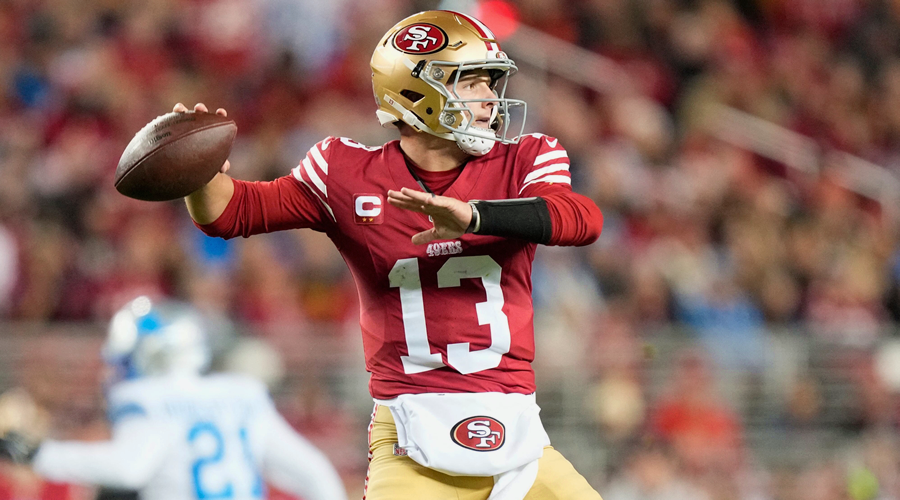
Brock Purdy
DeForest Buckner
Christian Benford
Ed Oliver
Sauce Gardner
Budda Baker
Ernest Jones IV
Landon Dickerson
DeMarcus Lawrence
Talanoa Hufanga
Jared Goff
Antonio Johnson
DeVonta Smith
Peter Skoronski
Breece Hall
Cam Bynum
Kyren Williams
Calen Bullock
Tetairoa McMillan
Kenneth Walker III
Daiyan Henley
Byron Young
Christian Darrisaw
Brian Burns
Kerby Joseph
Baker Mayfield
Terry McLaurin
Gregory Rosseau
Kolton Miller
Azeez Al-Shaair
Trey Hendrickson

