
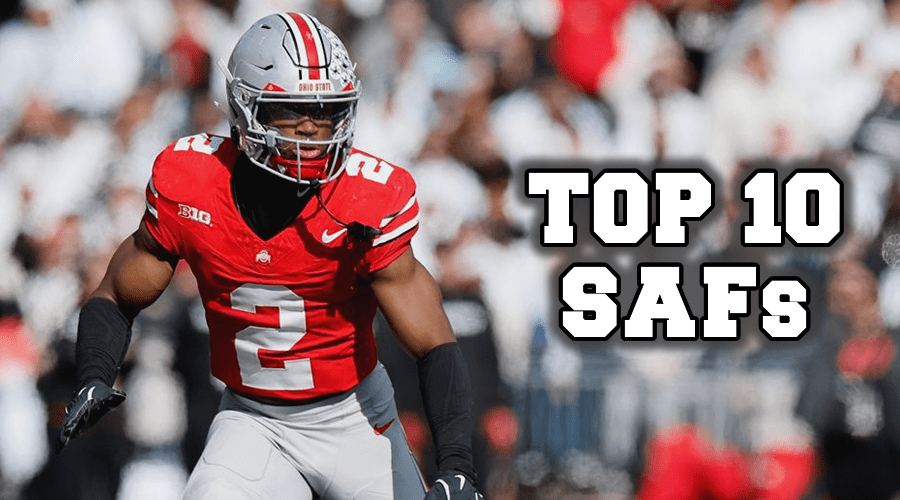
For the final time in my positional draft rankings series, we’re looking at the defensive side of the ball with safeties. Just like how we discussed earlier in the week with the tight-ends, I was more than pleasantly surprised with the depth of this class, beyond the trio frequently coming up in first-round mock drafts.
I do believe that all three of those guys are worthy of having their names called on night one, but then my entire top ten will be inside my top 100 overall prospects, and there are plenty of useful guys beyond that point, even if it may be in more of niche role, and/or they’ll need to earn their stripes on special teams first. Miami’s Keionte Scott was already part of the corner rankings. And as always, please keep in mind that these rankings don’t reflect potential injury or off-field concerns, which I simply don’t have all the information on.
This is what my list looks like:
1. Caleb Downs, Ohio State
6’0”, 205 pounds; JR
I understand that the measurables are more so average and that we don’t have any testing numbers on Downs, but if you go through his tape, there’s no cleaner prospect in this draft than him. This was a top-ten national recruit for Alabama in 2023, who immediately looked like a superstar in Nick Saban’s defense. When the legendary head coach retired the following offseason, Downs transferred to Ohio State and immediately became a team captain for loaded defenses these past two years, becoming a back-to-back unanimous All-American and winning the Jim Thorpe trophy for the nation’s best DB in the latter. He logged 257 total tackles, six interceptions, 12 PBUs, and three forced fumbles.
Downs attacks upfield with an attitude in the run and screen game with a purpose. Even when there are pullers and general traffic that should clous his vision, he steps down and has that wiggle to find and place himself into rushing lanes. He sorts through the trash and rarely allows the ball-carrier to win the corner on him bouncing outside if the play gets boxed in. You see the confidence in his angles to not overrun the ball, uses the sideline as that extra defender, and he hawks down plenty of running backs from outside the box as they’re about to clear the second level. Downs finds the right balance of when he can side-step or has to go through the chest of blockers in space, with some sudden hands to swipe or pull them aside, and he understands where his help is as a tackler. His arms measuring barely over 30 inches can hurt him in those close combats with bigger bodies inside the box, and he doesn’t always use his hands to wrap and finish as a tackler, instead just dropping the shoulder on guys, with his 11.2% miss rate being pretty consistent throughout his career.
This young man’s studying habits and ability to process information are as good as you’re going to see from any college safety. He does well to play over top of routes in deep zone assignments, and he tracks the ball exceptionally well in the high post. In quarters, you see him contest the catch-point on sail routes and light up deep in-cuts towards him. He can get a little too aggressive with bumping down and put his corner in vulnerable positions expecting help inside as receivers bend to the post. Whether it’s being a threat to step in front of the ball or chop off the head of a receiver going over the middle, this guy’s a menace dropping down as a robber. The one thing I will note is that there were a handful of opportunities to attack the ball rather than the man. Still, Downs constantly eliminates the potential for YAC on shallow crossers or rub-plays, where he seems to already know what’s coming pre-snap, and he understands when he needs to take out bigger tight-ends by shoot across their legs.
Although I wouldn’t call Downs an elite athlete, who can match up with the opponent’s number one receiver, if that guy is deployed in the slot, it never showed up in the two best conferences in college football. He’s highly patient without excess steps covering guys one-on-one, immediately identifies and shuffles in from of route stems to not be left a step behind. The Buckeyes would regularly pull him down onto the number three in trips and he’d be physical with denying them access to the middle of the field. He meets tight-ends with heavy hands around the line of scrimmage to impede their progress and round off their breaks, while feeling opponents lean into him and having the balance to not get nudged off at the top of the route.
Grade: Top five
2. Dillon Thieneman, Oregon
6’0”, 205 pounds; JR
Despite “only” being a three-star recruit for Purdue in 2023, Thieneman immediately left his mark on college football, earning Big Ten Freshman of the Year honors. After two seasons with the Boilermakers, he transferred in-conference to Oregon and was a key cog in them making it to the CFP semifinal. Across three seasons, he racked up 306 total tackles, 10.5 of those for loss, eight interceptions (six as a true freshman), and a pair of forced fumbles.
Thieneman is an active third layer of the run defense, who hits bodies around the line of scrimmage with his pads out in front. He understands how urgent he should be in getting downhill based on assignment and offensive design. He does well to gather and re-accelerate his feet as he tracks runs out to the perimeter, but also shows pretty good vision on the backfield when brought down as a box defender. Ther his short-area burst once the runner commits to cutbacks to meet them around the line of scrimmage really pops. When motion involves him in the run fit and he becomes the free defender after walking up, he’s only gaining velocity into those interactions with running backs bending their path towards him. After being exposed to a bunch of one-on-one situations in wide open space as more a true free safety at Purdue, he lowered his missed-tackle rate to a career-best 8.3% this past season. Although he firmly strikes through the chest of wide receivers trying to slide in front of him, I will say that his hand-usage trying to stack and shed blocks could use some refinement. And his initial angles from the high post frequently need to be rounded.
As a deep zone defender, Thieneman displays excellent field vision and awareness to track all eligibles in his vicinity. He excels at clouding multiple options, as he follows the eyes of the quarterback through progressions and translates his film studies to gameday. After staying balanced to mid-point routes, he can access another gear after mid-pointing routes initially and then having to open up with someone trying to split two-high looks. And he tracks the ball down the field with the mindset of a wide receiver and times up how he high-points it very well with that 41-inch vertical. Oregon used a lot of three-safety sets in 2025, where Thieleman patrolled the middle of the intermediate field and his spatial awareness could really shine, and he eliminates a lot of extra yardage on checkdowns or QB scrambles. However, he is susceptible to prematurely opening his hips as a middle-of-the-field defender and getting crossed over. Plus, he didn’t always stay “deeper than the deepest” as a single-high player, which quarterbacks with NFL arm strength will test more regularly by throwing the ball over his head (later in the progression).
When matched up with slot receivers, he’s efficient in his footwork to drive on breaks, and he tugs at their back-hip ever so slightly, to impede their progress yet not draw flags (only two in his career). Yet, he has super oily hips to not lose phase if opponents are able to open the wrong way initially during the stem. Along with running a 4.35 in the 40, his fluidity and speed going through all the positional drills at the combine was tremendous for someone just over 200 pounds. Even if he may not quite have the quick-twitch ability to cover nifty slot receiver at an extensive rate, he took on more of those assignments when asked to step in at nickel by the Ducks last season, and was responsible for just five yards per target overall.
Grade: Top 20
3. Emmanuel McNeil-Warren, Toledo
6’3”, 205 pounds; SR
Toledo is starting to become a DB factory and McNeill-Warren is next in line. However, he was largely being limited to special teams as a true freshman before making noise as a rotational player the following season. Over the last two years, he’s been a fixture in the Rockets’ lineup for all 21 games and he was named first-team All-MAC in 2025. Across that three-year stretched, he’s totaled 207 combined tackles, five interceptions, 13 PBUs, nine fumbles forced and two recovered.
From split-safety alignments, McNeill-Warren beautifully angles down to shut down perimeter runs. Dropping down to the box late, he shows good vision and ability to locate entry points as a tackler. There’s zero hesitation when he’s accelerating into a receiver inserting or being asked to fill the C-gap, dropping a heavy shoulder into opponents to shrink those openings. McNeill-Warren gets downhill in a way that erases crack-back angles, where he can kind of dip under and around when needed. When he can tee off and attack low in narrow lanes, you see some impressive stopping power against running backs with a full head of steam, but he’s also a reliable tackler, who slings his body around ball-carriers and twists them to the ground at the last moment. His previous miss-rate doubled last year, but overall it was still only a little 10% for his career. Now, he does occasionally gets drawn up too far from the short side of the field and ends up getting out-leveraged as the runner bounces or finds a crease late.
That also showed a up couple of times, where he allowed a deep crosser to come in behind him off play-action. On straight dropbacks, he’s light in his pedal gaining depth, redirecting laterally or widening out to the sideline with little to no wasted movement. He feels concepts developing without necessarily having to toggle away from the quarterback’s eyes and has some incredible snaps in deep zone, speed-turning after opening to one of two routes stressing him vertically, yet still getting his hands on the ball. McNeill-Warren shows good eyes poaching or picking up number three in trips on quarters principles and he shoots through the backside of targets curling up into the space underneath. He does a nice job of closing down on completions in front of him with square pads and helping bring the recipient to the ground, and he’s developed a knack for peanut-punching the ball out of the hands of receivers arriving on an angle – hence the nine career forced fumbles. If you put him in the high post, McNeill-Warren can get a little too overaggressive flying out to the sideline as the ball hangs up in the air, which opens up opportunities to be crossed over once the catch is made.
At Toledo, he also collected plenty of experience either matching slot receivers from depth or playing straight man-coverage, displaying excellent route anticipation. In soft press, McNeill-Warren uses his hands to feel things developed without getting grabby and drawing the attention of referees, and his long arms enable him to widen the track of tight-ends. He has the physicality to deal with subtle push-offs and not allow his concentration to fail as he tries to attack the ball in the air. You don’t quite see that instant explosion to pick up slot receivers flat-footed matching them from depth, as he tried to do in college, and there’s room to improve his precision at playing through the hands of the intended target after flipping his head and (re-)locating them. A 57.4 career passer rating against was plenty good however.
Grade: Late-first round
4. Treydan Stukes, Arizona
6‘1“, 195 pounds; RS SR
It’s been a long road for Stukes to get to this point, but he’s earned it every step of the way. This guy walked on at Arizona back in 2020, where he barely saw the field as a true freshman, before becoming a part-time starter at outside corner primarily over the next two seasons (one interception and 12 pass break-ups). These past three years, he’s been a fixture at nickel, totaling six picks and 17 PBUs, along with 125 combined tackles. He became captain of his defense, after gaining respect on special teams and getting moved closer to the ball, so he’d be involved in as many plays as possible.
I know Stukes comes in at a bit of a slimmer face, which will be challenged in different ways against NFL athletes, but you never question his toughness, as a feisty run defender, who will attack the line of scrimmage and seek entry points to get involved on tackles. He rapidly disengages from slot receivers and takes out to legs of ball-carriers to shut down perimeter plays. When brought into the box against multi-tight-end sets, Stukes is quick to meet them with a solid punch and set the edge, and there’s no hesitation coming down and ripping through the outside shoulder of a pulling lineman in order to funnel the ball inside. He attacks low and with no fear against running backs around the line of scrimmage, and throwing screens to his side often is a lost cause, because he shoots downhill instantly and slices through the reach of would-be blockers. The one issue is that he can get a little undisciplined with trying to peak inside and surrendering contain as runners decide to bounce out wide.
As a zone defender, Stukes digests route combination with appropriate pace and positions himself between eligibles in a way that muddies up the picture for quarterbacks. He showcases impressive diagnostic skills, when a concept is supposed to affect his eyes or move him off his landmarks, yet he makes plenty of plays off those. Stukes’ range and vision are more than adequate to line up deep more extensively, looking at what he did when rotating that way. And when he gets a chance to really open up with the ball put up in the air, you see some beautiful snaps of tracking it the entire way and either swiping through the hands of the intended target at the last moment or plucking it himself. I will note here that he tends to get tall and a little restricted out of his pedal if asked to play extensive off-man/match coverage. Plus, although he’s become more reliable as a tackler, too often Stukes still tries to sling his arms around the legs of the ball-carrier when trying to get guys to the ground on the run.
With nearly 32-inch arms and 4.33 speed, Stukes has the physical make-up to man up against different body types in the slot, but he clearly has the mental capacity to match. He’s quick to identify any tilt in the release and not allow easy access breaking either way, understands which way to protect based on splits, he’s balanced in his lateral transitions on slower-developing routes, and because he doesn’t commit his hips prematurely, you rarely see Stukes get caught off balance by double-moves. He clicks and closes from off alignment with optimal angle to either underneath or wrap around the target, makes sure to stay plastered as his man transitions to a secondary route, and when he has guys walled off down the field, he’s a threat to pick off passes himself, as he locates those simultaneously to receivers looking back. Those really crafty opponents may get him tilting or stopping his feet momentarily by throwing false indicators at him occasionally.
Grade: Top 50
5. A.J. Haulcy, LSU
6’0”, 215 pounds; SR
After starting his collegiate career as a three-star recruit for New Mexico in 2022, Haulcy continued to level up in terms of competition and his individual play. He started the final nine of 12 games as a true freshman and he was a fixture in the lineup for all but one half each of the past three seasons (two with Houston and one with LSU). He made first-team All-Big 12 and All-SEC respectively in the latter two of those, combining for 162 total tackles, eight interceptions and 12 pass break-ups.
This dude almost looks like a smaller edge rusher physically and provides outstanding play strength. He’s urgent in run support from depth, playing over his toes as he approaches contact, yet showed massive strides in his initial angles, to not be forced to curve those as regularly. Haulcy does well to not get sucked up too far as the top layer of the fit and pacing himself against plays to the perimeter, locating tracks to the football. Now, the limited reactive agility and the quick burst he can tap into against dynamic ball-carriers can still leave him chasing from behind, and he can be more concerned with inflicting pain than taking on blocks with leverage, since he does show a capacity to be pro-active and keep his frame clean. Haulcy is a physical tackler who wants to set the tone when he arrives at the ball, especially when the initial wrap is set and he can lay the boom, and seeks opportunities to punch it out.
What can get him in trouble at times, especially in the open field, is that too often he just hits with his shoulder rather than wrapping and driving his legs through the ball-carrier (missed 15.2% of attempted tackles these past two years). Nonetheless, he was actually deployed in the high post and discouraged downfield passes frequently. At LSU, their coaches allowed Haulcy to kind of roam as a robber on a lot of their defined dropback situations, where his IQ and spatial awareness could really shine. When he steps down from two-high looks, his understanding for where offense will try to attack and the instincts led to him routinely cutting off crossers or immediately shutting down targets curling up over the middle of the field. His path to the football and how he attacks it in the air speaks to great confidence in his ball skills, yet you feel his presence as an enforcer, where receivers who got blasted once, alligator-arm passes or lose focus as they hear footsteps in his vicinity. Although, you love his decisiveness, savvy NFL quarterbacks may be able to clear him out of passing lanes an open up some big-play opportunities.
Throwing benders or seam routes against Haulcy matching routes from depth suddenly turns lay-ups to the intended target hitting the turf and/or the DB robbing the ball. He’s clearly a film room rat with his anticipation for routes based on formation/splits, and he does well to avoid getting hung up in traffic as he tries to hang routes coming in underneath it, taking angles with the appropriate level of aggression. I don’t quite see the recovery speed or top gear to extensively get matched up against NFL slot receivers one-on-one (4.52 in the 40), but he has surprisingly snappy hips to flip and not lose ground against most vertical routes and wasn’t penalized once all of last year (702 defensive snaps). Only three touchdowns compared to eight picks as the primary defender in coverage since 2024 speaks for itself.
Grade: Second round
6. Genesis Smith, Arizona
6’2”, 205 pounds; JR
Although I fell in love with fellow Wildcat DB Treydan Stukes, watching that entire secondary was really fun, because Smith actually flashed even more in some matchups. Unlike his teammate, he was a fairly high recruit and after already seeing quality action as a true freshman, he’s started 22 of 24 total games over the next two seasons, combining for 140 tackles, four interceptions, 14 pass break-ups, four fumbles forced and three more recovered.
This young man has a nose for the ball in how he comes downhill against the run. He’s light on his toes and keeps his pads parallel as he tries to square up the ball-carrier, often times racing up into the quarterback’s cadence as the plus one in the box with no hesitation of keeping that momentum going into contact with blockers. Yet, his long arms and agility also allow him side-step opponents getting too far onto their skis. He does well to sort through the convoy on perimeter plays, and when he spots an opening joining the pile, Smith will punch at the ball, forcing two fumbles each of the past two seasons. Now, Smith would benefit from adding some weight for those interactions with blockers around the line of scrimmage, and too often you see him get crossed up as the last line of defense, getting his momentum too far out in front (around a 20% missed-tackle rate in all three years with the Wildcats).
Smith roams around in zone coverage with an excellent combination of instincts and eyes. He discourages quarterbacks from attempting several vertical shots as a deep zone defender and finds the right balance between staying alert for targets settling down in front of him, yet not getting drawing up too far to where the ball can be thrown over his head. He’s fully capable of stealing deep routes from the slot coming towards him in split-field coverages if there’s nothing to directly occupy him, and Arizona used often weaponized his processing skills and spatial awareness as a robber. He’s simply not someone you want to test, with that 42.5-inch vertical to high-point throws, or punish quarterbacks for coming his direction late over the middle. Although, how he attacks the catch-point can open the door for some big plays if the intended target has strong hands to snatch it away. Still, he rapidly closes on completions in front of him to eliminate YAC and takes quality angles to force them to step out of bounds.
Moreover, Smith is light on his feet and quickly responds to what the hips of receivers tell him in order to be trusted in man-coverage. He sorts through bunches and picks up his assignment with controlled lateral movements, and does an excellent job of eluding rubs. When the nickel blitzes and he’s capped over a receiver with extensive cushion, he can erase that gap and immediately shut down free access slants, quicks or bubbles. Smith displays impressive recovery burst if he steps down against the run-fake and has to get back underneath like a tight-end off a delayed release, and he excels at getting his hands in-between the mitts of the intended target ato break them up without drawing flags for arriving there prematurely (zero last season). The one thing I did notice throughout the 2024 tape was that there were a few moments where Smith and one of his teammates allowed some receiver to go uncovered, as they failed to pass him off on switch releases or crossing down the field.
Grade: Late second round
7. Jalon Kilgore, South Carolina
6’1”, 210 pounds; JR
Unlike a lot of these college safeties who stuck around for a couple of extra years, Kilgore immediately jumped onto the scene as a four-star recruit in 2023. He named to the SEC All-Freshman team and then second-team all-conference last year, starting 33 of 36 career games. He totaled 178 combined tackles, eight picks and 21 PBUs across that time.
Kilgore primarily played the “STAR” role for South Carolina’s defense and has optimal measurements for a modern “big nickel”, with 33-inch arms and good muscle distribution throughout his frame. That shows up in run defense, where he’s fundamentally sound and understands his assignments. He’s pro-active with his hands to not allow blockers to get into his frame and slide off contact, but also has a good feel for navigating around bodies and getting the initial wrap on the running back when deployed on the edge of the box. From that overhang spot, he squeezes inside and effectively locates entry points as a tackler. Kilgore also identifies paths to the football when getting downhill against screen passes, he shows good agility and balance to respond to, wrap and sling down open-field runners. Having said that, when a tight-end does get his hands on him in congested areas, he’s typically eliminated from the play.
In match assignments, he does an excellent job of playing to his leverage, and throwing a route that breaks towards him becomes a dangerous proposition as he’ll just sit on the receiver’s hip. Meanwhile, when playing a shell, he can kind of float in space and then suddenly stick his foot in the ground to urgently close on targets in his vicinity right as he sees the quarterback initiate the throwing motion, before battling the hands to rip the ball out. You already see a propensity for baiting quarterbacks into throws with his body-language, he peaks behind himself to locate routes he can feather underneath after stepping down against run-fakes, and generally finds work if he has no direct assignments, picking off loose crossers. With that being said, he tends to gamble a little too much and allows the eyes of quarterback to manipulate him, which led to some chunk gains in 2024.
The Gamecocks regularly asked Kilgore to man up against speedy slot receivers with extensive cushions. He does very well to pace vertical routes, not prematurely flipping his hips, and then has the long speed to stay in phase way down the field (4.4 flat at the combine). He’s smooth in his transitions playing off, and has no issues when forced to speed-turn if receivers get him to tilt the wrong way during the stem. Some guys who throw foot-fire at him can make Kilgore look like he’s stuck in quicksand and immediately put him in catch-up mode sporadically, and he’ll occasionally go for the ball at an angle rather than actually wrapping up the runner or at least making sure to hold him up. However, he typically doesn’t allow tight-ends to run into and nudge off on him, as he uses his hands to contest the interaction, and he already expertly arm-bars or pins down the arm of opponents as he’s engaged with them down the field, to impede their path to the ball ever so slightly. Kilgore improved his passer rating allowed from freshman to sophomore and then junior year (down to 68.1), with five TDs vs. seven INTs over the latter two combined, and he had several excellent reps isolated against dynamic names like Luther Burden III and K.C. Concepcion.
Grade: Early third round
8. Bud Clark, TCU
6’1”, 190 pounds; RS SR
I’m sure some evaluators won’t love that Clark will be 24.5 years old when his rookie season begins and that’s missed time with injuries in three of six seasons with the Horned Frogs, but he’s been one of the top safeties in the country over the latter two. He started 41 of final 47 contests, combining for 201 tackles, 15 interceptions (two of which he returned to the house) and 21 pass break-ups. He was named second-team All-Big 12 the latter two seasons and a team captain for three consecutive ones.
Clark deciphers the action when there’s traffic at the point of attack to the open side of the formation, but then rapidly takes away the corner if run plays bounce wide. He quickly recognizes slot receivers cracking back inside and cuts off sweeps/tosses before they can really get going. You regularly saw him get involved on gang tackles all the way outside the opposite numbers as plays get strung out. He quickly slices through one half of receivers blocking on perimeter screens, casts a wide net as a tackler, including after greasing his body around blockers out in space. Clark is definitely a little too aggressive with his initial angles and ends up as a bit of an ankle-biter – finishing his career with a 14.8% missed-tackle rate – be was also put in a ton of tough situations one-on-one in wide open space. My main problem is how he gets stuck on blocks by slot receivers, still having to utilize his arm length better.
This guy digests pass concepts like a pro already and understands where his defense may be vulnerable. You routinely see him get a head-start as he sees the quarterback load up and has the range to make plays on the ball towards the edges of his landmarks as a deep zone defender. That includes beautifully playing between vertical routes, where he’s a threat to jump either with calculated angles and ball-hawking skills that led to 15 picks over the past four years. He drives hard on routes in from of him in split-safety coverages and wraps around the intended target for PBUs, but also is disciplined enough to stay home when the flow of the play is away from him, but there’s a throwback action he can’t leave alone. The one issue that shows up is how he commits his shoulders to someone pushing through the middle in cloud coverage, where NFL quarterbacks will be more willing to push the ball towards the sidelines deep.
When asked to man up, Clark showcases outstanding route anticipation and his studying habits show up routinely when it comes to knowing what might came based on certain formations. He doesn’t overreact to drifts during the stem and slot receiver better foot-fake him or give him something at the top of the route in off-man coverage or they’ll quickly get undercut. Clark is low and natural in his footwork going from shuffle into a cross-over step and then actually open up to run with guys, and then he can really run (4.41 at the combine). His aggressiveness to drive on the initial break can get exposed on the occasional double-move and he was unnecessarily grabby down the field last season, in part because he’d be a beat late to actually flip and run (getting flagged seven times), but then he barely lost a one-on-one rep during the Senior Bowl. Even when it appeared as if opponents were in control of the route without contact, Clark didn’t panic, but rather kept his eyes locked on the opponent’s hips and was still able to contest the catch-point.
Grade: Third round
9. V.J. Payne, Kansas State
6’3”, 210 pounds; SR
Slightly outside the 1000 top recruits in the nation in 2022, Payne played in all 14 and already started four games as a true freshman. From that point onwards, he was a fixture in the lineup for all 38 contests, racking up 180 total tackles, 9.5 TFLs, four interceptions, ten pass break-ups and four forced fumbles. He was named a team captain for 2025. Yet, he wasn’t really on my radar for draft purposes until he left a real impression on me during Senior Bowl week.
First and foremost, this is an elite height/weight/speed profile, with nearly 34-inch arms and a 4.4 flat in the 40. Payne fills the alley from split-safety alignments with a purpose and doesn’t mind attacking the chest of linemen pulling out to the corner. From the apex spot or edge of the box, he shuffles inside with square shoulders and noteworthy hitting power off a short runway, as he’s taking on lead-blockers or bigger runners in the hole. His 2024 game against Arizona State is almost a highlight reel of Payne playing downhill and blowing up plays. Over the slot, he punches with those long arms and swipes away the reach of receivers trying to stalk-block him on, yet he’s also pretty sudden with side-stepping and reducing his near-shoulder as they’re trying to shield him to the outside. Having said that, he gets sucked up too far against horizontal flow and puts himself into catch-up mode as the ball-carrier cuts across the grain, and he’ll blindly step down against token run fakes and void his landmarks for no actual reason at times.
That certainly affects him in zone coverage. Along with it, he’s pretty upright in his back-pedal, which delays his redirections, and doesn’t position himself optimally to affect multiple routes, while as the high post defender, he ends up covering grass too often, still developing that eye balance to track both the quarterback and nearby targets. Nonetheless, Payne is a versatile defender on the back-end with over 100 snaps at deep safety, slot and the box in each of his three years as a starter. He does have legit range to play single-high free safety and his closing burst, either driving on routes over the middle in quarters or even having to work around traffic, really pops. Even if he steps down against eye-candy, he has big-time make-up burst to get back underneath someone freely streaking downfield and disrupt the catch-point. And when he sees it, he can separate targets from the football, lighting up guys extending for passes at the sideline.
Payne is athletic enough to match up with wide receivers, but with his body type, he has the potential to become a tight-end eraser at the next level. He’s smooth in his lateral transitions and trusts his speed to not open his hips prematurely with that two-way go in the slot, trailing them all the way across the field frequently. He smothers opponents down the field in man-coverage, squeezing slot fades into the sideline regularly and not providing any entry points for the ball. And with that massive wingspan, Payne is able to sling his body around in a way that dislodges the ball and takes down the intended target when it looks like that guy has half a step on him. Last year, he only allowed 158 yards, one touchdown and interception each across 38 targets his way. The biggest issue right now is that he doesn’t gather his feet, line up and drive through open-field runners particularly well (missing at least 10.7% of tackles in all four seasons with K-State).
Grade: Top 100
10. Zakee Wheatley, Penn State
6’3”, 205 pounds; RS SR
Although it took until his redshirt senior campaign for Wheatley’s to enter the draft, due to the long line of Penn State safeties heading to the pros, he took a pretty conventional path up to this point. As a four-star recruit in 2021, he initially took a redshirt, put in quality time as a backup for two years and then become a fixture in the lineup for all 28 contests these past two, posting 170 total stops, 4.5 TFLs, five PBUs, four INTs, one fumble forced and three recovered.
Wheatley is a disciplined run defender, who doesn’t blindly void the high post as a last line. From split-safety looks, he buzzes down under good control to the front-side and stays home for cut-back lanes, while responding for the runner’s decision in a way that allows him to square up and bring them that guy to the ground to great effect. He’s sudden and times up his swipe-downs very well to avoid getting occupied by players in the slot working up to him. Last year, Wheatley transitioned into a more box-centric role, where he keeps his shoulders square and is reliable with his gap assignments. Down low, he punches and releases to great effect against tight-ends down low, and he brings great hitting power in close spaces. Now, he missed at least 11.5% of attempted tackles in all four years with extended playing time, because he can get overzealous on longer venture and largely tries to take out the legs from underneath ball-carriers instead of staying on his own. And although he’s not afraid to mix it with bigger bodies around the ball, he ends up getting ridden out of rushing lanes typically when linemen get their hands on him.
This is a well-coordinated mover to take on a variety of coverage assignments from different alignments, while both is awareness for what’s happening around him and his decisiveness to get involved took a real step in 2025. Wheatley is light in his pedal to gain depth and smoothly transitions between that and widening to a deep half. He moves laterally to not allow openings underneath in zone assignments and makes his presence felt is someone wants to cross that area. Penn State used plenty of three-safety packages last season, where number six would basically be the middle dropper in Tampa-2 or a robber, catching crosser and negating the intermediate option of these layered concepts. He’s made some awesome tackles in the flats to negate big run after catch, where he took off as the ball was still leaving the quarterback’s hand, and he does really well to use the sideline as a 12th defender. I don’t believe he offers big-time range to make plays at or outside the numbers as a deep middle safety, and he could do a better job of finding work in coverage off play-action, particularly targets come in behind him.
In man-coverage, Wheatley does well to read the hips of his opponents, confidently clicks-and-closes on slot receivers quickly breaking on routes he’s capped over with a cushion. He brings the size, athleticism and physicality to extensively match up with tight-ends, having the contact balance to not get pushed off if they attack his chest. I didn’t see him plenty any extensive press until Senior Bowl week, and he was nudged off in those situations a few times by bigger TEs. However, his long arms expand his reach trying to break up passes, and I like how quickly “sheds” his man, in order to get involved in shutting down nearby completions.
Grade: Top 100
The next names up:
Louis Moore (Indiana), Cole Wisniewski (Texas Tech), Kamari Ramsey & Bishop Fitzgerald (USC), Robert Spears-Jennings (Oklahoma), Jalen Huskey (Maryland), Miles Scott (Illinois), Michael Taaffe (Texas), Jakobe Thomas (Miami) & Xavier Nwankpa (Iowa)
 Halil's Real Footballtalk