
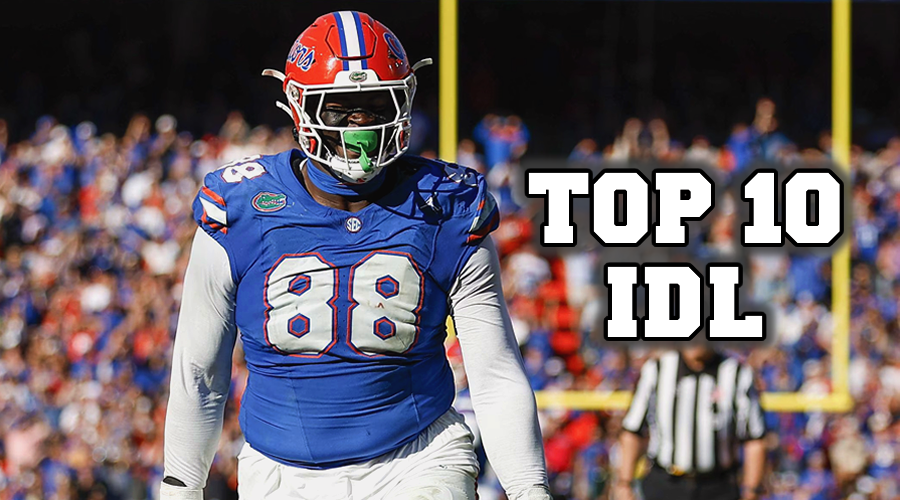
We’re closing out our two-week venture into the trenches, as part of the annual positional draft breakdown series, with all interior defensive linemen. In this group, I include I include everything from a true zero-technique head-up over the center all the way out to a 4-/5-technique over the center. With how versatile front alignments have become, even though I incorporated what players are best suited to play as, and some as more defined in the roles they’ll be put into, most of them will be asked to wear different hats.
Right off the bat, I was pretty underwhelmed with this group. There’s a player atop the list who could’ve been a top-15 pick if he wasn’t still dealing with a lingering injury, but another name that was discussed in that range last summer has massively fallen off and there are hold-ups I have with most names beyond that point as well. Altogether, eight of the first ten names are all in the 30-to-100 range.
Once again, these grades do not reflect potential injury or off-field concerns, which is particularly important to point out for this crop of prospects. Let’s talk about them:
1. Caleb Banks, Florida
6’6”, 330 pounds; RS SR
Banks is one of those rare redshirt seniors, who somehow didn’t log 1000 snaps in his college career. Unlike another player on this list, who also was projected to be a high first-round pick, for him it wasn’t a lack of individual or team success necessary that took away from the attention, but rather a foot injury that be tried to play through in one game, before shutting it down, yet returning for the final two weeks. Although it’s a lingering concern that NFL doctors have more clarity on than me of course, that also spoke to his football character.
Physically speaking, this is a true unicorn. Banks carries his weight really well (327 pounds even at the combine), with arms for days, hitting an insane wingspan of 86 inches and basically 11-inch hands. That superiority expresses itself in run defense, where he routinely shoots his punch first and rattles pads of offensive linemen, often times bending them backwards as they try to block back/down on as part of gap concepts. He then has the strength in his upper body to yank them aside after owning his space to just clog up the rushing lane with his large body. The way Banks can turn his shoulder, hit the rip and squeeze through gaps gives him disruptive potential for teams relying heavily on zone concepts. Plus, his high swim to change things up and back-door them has become truly devastating. He does gets fairly tall when he tries work around blockers in the run game, exposing him to getting washed out of his space occasionally. Banks needs to refine his footwork and weight distribution to anchor against double-teams, but his contact balance to slip through those or bounce of moving bodies to get involved on tackles is pretty wild. The one thing that severely limited his backfield production – he’s an almost comically back tackler, missing 10 of 31 attempts over the last two years. He allows his base to narrow, loses his balance and leaves his feet on several occasions.
Banks delivers an equally rapid as hefty hook to the shoulder-pad of pass-protector that’ll literally knock them to the turf occasionally. He pairs that with a fluid arm-over, where he gets that hand all the way onto the back of the according shoulder-pad. You see him leave guards behind in the dust with his cat-like quicks on in-and-out moves, and he generally is able to lean one way and use the fact that protectors shift their weight towards him against them, thanks to his combination of strength and suddenness to work across. He packs an effective push-pull move, that comes in particularly handy on play-action, flashes a propensity for lifting the arms of blockers, but will also trap those levers and ride opponents into the depth of the pocket if he can’t cleanly hit his moves. It almost looks surreal how swift Banks’ counter spin is at 330 pounds to win late in the rep, and he displays uncanny balance to get knocked around by opponents, yet somehow stay on his feet and get back en route to the quarterback. Now, for as explosive as he is in short areas, he could do a better job of staying true to his rush lanes and he doesn’t bring a cohesive plan to the table yet.
2. Kayden McDonald, Ohio State
6’2”, 325 pounds; JR
A four-star recruit in 2023, McDonald was reserved to a rotational role for his first two years, with another Buckeye nose tackle being drafted in the most recent first round. This past season, he became the rock in the middle of that Buckeye defense that led the country with just 9.3 points allowed per game, and received first-team All-American accolades, when he posted 65(!) total tackles.
This is very much a straight-forward evaluation. From day one, whether you run an odd or even base front, McDonald is going to improve pretty much any team’s run defense. He’s a big presence on the interior with outstanding muscle density, is low and loaded in his three- and four-point stance, with quality processing skills for various blocking schemes. When applying the peak-and-shed technique correctly, has the strength of a bear to truly stand up and toss aside centers depending on where the running back’s going as a zero-technique. He was right in the middle of some big goal-line stops for the Buckeyes, where he just creates a wall. When this guy gets a solid jump off the ball, you’re just not going to stop his charge up the field in a more gap-attacking front. McDonald shows sudden hands to work over the top of down-blocks, and last year, he added quick arm-over to occasionally take advantage of lunging centers as a shade. And if he just gets one arm wrapped around the running back at the line of scrimmage, that guy typically isn’t getting away anymore – missed just two tackles in 2025. The two negatives with him in that regard – his pad-level off the ball is still a little inconsistent at this point, just popping up out of his stance occasionally before this past season, and he doesn’t offer a whole lot of speed in pursuit of longer voyages. Still, in an NFL world defined by two-high safety structures and box counts, this guy is a math changer, with the way he occupies bodies and keeps his teammates running freely.
McDonald does bring more a slow down pass-rush however. He doesn’t attack the edges of blockers or throw multiple moves at them, while lacking the flexibility to turn tight corners rushing the B-gap or winning on cross-face moves with regularity. Having said that, he does pack a pretty devastating bull-rush that he can unleash when allowed he gets a good jump off the snap with the right leverage. He continues to knock away the hands of interior pass-protectors to gain access to their chest and works into the depth of the pocket. Plus, there’s potential to make push-pull maneuvers a problem for opponents if he continues to progress. The way he’ll earn third-down opportunities is with how he can free up his teammates on twists and three-man games. You legitimately see McDonald take the center with him slanting towards the guard, fully occupy those two and create wide-open lanes for someone to loop around untouched. Plus, he tracks the quarterback very well and slides over to put a wall in front of that guy trying to run up the middle of the pocket.
3. Christen Miller, Georgia
6’4”, 320 pounds; RS JR
Georgia has been pumping out draft talent along the defensive line throughout the Kirby Smart era, and waiting his turn for a couple of years, Miller brought that same presence to the field, being the biggest, strongest guy out there for the most part. His production doesn’t match what his draft capital will likely reflect, but you could definitely feel his impact, even in a system that doesn’t necessarily lend itself to individual standouts.
This young man is built like a freight-train with wide shoulders, hips and good muscle density throughout. He packs dynamite in his hands, which you really see when he can attack interior linemen from shade alignments and bends them backwards. He has the upper body strength to frequently create separation from blockers (with 33-inch arms) and then pull them aside, being fully capable of taking care of a gap-and-a-half, stay square against zone-blocking and then fall back inside as the runner cuts up behind him. Miller packs a potent high swim paired with his lateral agility take advantage of lunging blockers. That along with his core strength also shows on gap-exchanges on early downs, without getting washed out of his space. Although you see him flash the ability to rip under and lift up the reach of zone-blocker when asked to slants, Miller would benefit from turning his shoulders and fighting for the play-side shoulder of linemen when he should be getting flat down the line. And he’s still learning the intricacies of dealing with combination blocks, with how he anchors against angular force. However, he just earned an elite PFF run defense grade (90.4), thanks to his instincts, processing skills, and the row force to fight off contact and get to the ball.
You also see that as a pass-rusher, where if his club-rip hits, there’s not much that can be done to slow down his momentum. Miller slaps and swats down the mitts of pass-protectors, in order to create angles for himself to get around those guys, with the ankle flexion to corner his rush. That’s why the Bulldogs would occasionally loop him from the three-technique all the way to the opposite end of the line. Miller showcases big-time rotational torque and core strength, and he’s generally become more well-coordinated with linking his upper and lower half to get past the hip of blockers as he executes counter maneuvers. Miller needs to become more precise with his initial club for hand-combats to become an effective pass-rusher, and he doesn’t gather and redirect particularly well against scrambling quarterbacks. That’s why Georgia didn’t put him on the field for many third downs or end-of-half situations. Having said that, he identifies and takes advantage of both slide protections and zone flow on play-action, using the momentum of blockers against them, to either pull or club them aside and shake loose. Plus, he’s able to collapse the pocket with power in the second phase of the rush, even if his initial move didn’t land.
4. Lee Hunter, Texas Tech
6’4”, 320 pounds; SR
A five-star recruit in 2021 with Auburn, Hunter redshirted his first season before following his head coach Gus Malzahn to UCF, where he posted a massive 114 total tackles over a two-year span. For his redshirt senior campaign, he joined a loaded Texas Tech front, where he became their table-setter in the middle and a first-team All-Big selection, posting double-digit TFLs and receiving more of the national spotlight as this process has gone along.
Hunter is built like a fridge with a wide chest and 6’9” wingspan, but has surprisingly skinny ankles. He’s a dancing bear with quick hands and feet, showing the lateral agility to go from head-up alignments to establishing himself in the gap and forcing immediate cutbacks. His lateral agility allows him to elude back-blocks with a swift arm-over and he has plenty of “instant wins” in the run game, where he pulls offensive linemen off himself as they lean into contact. Hunter is capable of two-gapping offensive linemen and matching their footwork zone concepts while staying ready to fall back as the running backs tries to cut off that guy’s backside. And he has such incredibly strong hips and core, where he may use that swim move on the first man, yet still be able to anchor against contact on an angle as someone else attaches for combination blocks. You do occasionally see him raise his pads excessively as he tries to slice through gaps and opponents are able to use that momentum against him as he they get underneath his pads, opening up cutback lanes, and overall gets a little obsessing with shedding blocks rather than owning his space. In the Big 12, Hunter was able to just eat double-teams for breakfast and keep his linebackers clean, but he’ll need to learn to drop his knee and how to contort his body rather than absorbing contact if he wants to have similar success at the pro level.
I don’t believe he’s particularly explosive out of his stance necessarily and as a pass-rusher, he needs to focus on earning more clean wins with quick, well-delivered moves in defined dropback settings, along with staying low so his bull-rush doesn’t run out of steam. When he comes of the ball with good pad-level and gets his hands into the chest of guys, he’ll take those guys for a ride and you see them desperately trying to find anchor points, and then he’ll fluidly transition into a pull-and-swim combo to get around guys if they get too far onto their toes. He feels when those blockers shift too much of their weight onto one foot and is surprisingly sudden in how he crosses their face, often combined with clubbing at that opposite shoulder-pad. When Hunter is allowed to just rush half the man, combined with the rip move, he can be nearly impossible to stop or even take off course, and then every once in a while he’ll shock the opposite when he pulls out a counter spin. His lateral quicks to come loose on different twists and loops shows up when involved on those, plus he’s enough of a force of nature to just split through creases between linemen if they aren’t firm with closing those down.
5. Peter Woods, Clemson
6’3”, 300 pounds; JR
Before last season started, Woods was considered a consensus first-round. He was one of the nation’s top 100 overall recruits three years ago, who already flashed massively as a true freshman and built on that the following season despite arguably playing out of position. However, his decline as part of an overall disappointing campaign for Clemson has made him one of the more volatile names in mock drafts. His PFF grade has decreased in both of the past seasons, without improving his production with more playing time.
A lot of the things that got people excited when studying Woods during the summer are still clearly there. He has the powerful hands to re-set the line of scrimmage if they connect and playing a lot as that super-sized D-end for the Tigers in 2024, you saw him apply the principle of one arm being longer very well. Aligning as a 1- or 2i-technique, Woods is capable of clogging up the opposite A-gap when centers try to down-block on him, but also rip and go underneath those angled blocks, with the short-area burst to still mess up the play. It may not be by the book, but you saw him occasionally extend one arm onto either lineman as he tracks plays horizontally to occupy both of them, showcasing impressive mobility against wide runs, and scraping over the top of traffic if necessary. Off that, he has the quick hands and feet to fall back a gap and eat up the ball-carrier. And he has those freaky moments, where he looks like a linebacker as he side-steps trap blocks and gets initial contact on the runner in the backfield. Having said that, his arms only being 31-and-¼ inches shrinks Woods’ margin of error with hand placement, and he can get lost inside taking on bigger guards. He’s not the most disciplined with his run fits, being fixated on working over the top of blocks and opening up big cutback lanes occasionally as a result.
Woods displays an impressive ability to link his upper and lower half to execute some swim variation, and has the wiggle to freeze the feet of interior protectors and make it easier for himself to access the edges of their frame. He has a great feel for the weight distribution of blockers and when he can realize opportunities to cross their face. You saw him rush from basically any alignment, including a two-point stance on the edge or drawing double-teams inside, to create opportunities for his teammates. Woods effectively sells the penetration to pull linemen with him and open up space for himself to loop around on T-T twists, he has the short-area agility to mirror the movement of quarterbacks and the speed in pursuit to erase their angles trying to escape the pocket. Unfortunately, I don’t think you can classify him as the aggressor or finisher that you’d like to see to get these quick wins in passing situations. He needs to do a better job of fending off the initial strike and then not waste time with a hefty club trying to knock the arms of blockers, without actually getting past those blockers. So I think he needs to part of a slant-heavy front that really taps into his athleticism and mitigates his length limitations.
6. Gracen Halton, Oklahoma
6’2”, 290 pounds; SR
Halton is my favorite defensive tackle in this class, and I also just talked about him as part of the “my guys” video I published yesterday. A four-star recruit in 2022, similar to a lot of Oklahoma D-linemen, he was part of a heavy rotation, to where he logged just under 1000 defensive snaps in four years and six of his ten career starts came in those final six games. Nonetheless, he established himself as consistent disruptor for the Sooners, who regularly popped on tape, and then took turned those flashes into a dominant week at the Senior Bowl.
This is an alignment-versatile defensive linemen who plays with the balance to always stay on his feet. Halton is quick out of his stance and to shoot his punch in order to win first contact in the run game, showing no issues stacking-and-shedding guards on base-blocks as a traditional three-technique. Yet, he can also knife through gaps and refuses to be reached/scooped on zone concepts in that role. He lined up quite a bit as a five-technique, where he would just dump tight-end tasked with pinning him down or sealing him on the backside. However, it’s his skilled hands to deconstruct blocks and create angles towards the ball for himself that truly sets him apart. Halton is able to create opposites between his upper and lower half to anchor against force thanks to great core strength, yet not allow a second lineman to attach on combination blocks. Plus, he’s a smooth lateral mover, keeping his shoulders square as he works two gaps over as the second man on gap exchanges. While his processing skills to not got caught on the wrong side of blocks improved significantly in 2025, Halton still needs to develop better awareness for angular force and how to work against it, rather than getting bumped off his landmarks at times and having poor gap discipline. And you see a lot of drag-down tackles.
What you’re drafting him for primarily though is as a twitchy pass-rusher. That ability to contort his upper body and get to the hip of offensive linemen on different swipe moves and then actually corner towards the passer is as good anyone’s in this IDL class. And he’s worked hard on the timing and placement of chops, club-swim combinations, etc. Halton is capable of creating real vertical displacement with the bull-rush from these tilted alignments rushing the outside half of the guard, with the way he can get underneath and drive through their chest. Off that, he can pull cloth and is able to punish opposing linemen for shifting their weight too far one way. Watching how quickly he got to his second and even third move during Senior Bowl week must be a defensive line coach’s dream. Halton almost teleports sideways on stunts and has curvilinear acceleration almost like a running back to turn the corner looping outside. Plus, he brings the fight and force to break loose after initially having his lane closed off these different games. I’d say that he’s still refining his hand combats and developing reliable counters, for as active as he may be, and can be guided off track if pass-protectors get pushing at his hips, but 59 pressures on 490 pass-rush snaps with how often he was asked to act as contain, is excellent.
7. Domonique Orange, Iowa State
6’2”, 325 pounds; SR
Orange is an athletic big man who has lined up anywhere from a 0- to a 5-technique for the Cyclones, although this past season especially, they relied on him as a space-eating nose tackle in their three-down “Big 12-style” front. That production didn’t lend itself to great production (42 tackles and one sack over the last two years), but he was a key cog in Matt Campbell’s defense.
The young man nicknamed “Big Citrus” frequently re-sets the line of scrimmage and takes linemen off balance trying to occupy him in the run game. Playing head-up over the center, you see Orange bench-press that guy and absorb the bump of guards, forcing them to stay longer on combination blocks than intended, which keep the second level clean. You see him snatch and pull cloth to read the ball-carrier and discard the man in front of him once that guy’s in range. Orange shows a quick slide step towards either gap, jolts back guards trying to angle towards him and squeezes down potential rushing lanes. He’s clearly improved his block recognition skills and how he mirrors the first steps of the O-line or works against pressure, and he’s capable of getting surprisingly skinny squeezing through creases, particularly against back-blocks, ripping and dipping around those. There’s some uncanny contact balance, where he arm-overs a zone blocker but bangs into the next man and simply doesn’t get knocked off kilter, being able to split those quasi-doubles. Having said that, he would benefit from learning how to work over the top of down-blocks with appropriate footwork, and partly because of how the teach things in their read-and-react scheme, too often he was a tad late off the ball, which limited his impact as a pass-rusher especially.
Being lined up as a zero-technique with both ends on the outside shade of the offensive tackles certainly contributed to his lack of success and, honestly, effort in passing situations. Seeing him get subbed off the field regularly on longer downs as a junior and then when his role increased this past season, his efficiency dropping off pretty drastically, from a pressure basically every tenth pass-rush snap to one per 24 opportunities, is rather alarming. Orange is kind of a one-trick pony at this point and will need to add to his pass-rush tool-box, but when that club-swim combo hits, he can get some instant wins against quick-sets or play-action. He shows the flexibility to turn pretty tight corners once he gets to the edge of interior pass-protectors, capable of contorting his shoulders, and where many other D-tackles would get knocked off course, with the way offensive lines try to bang Orange around, he remains on his path to the passer typically. His knock-back power opens up shorter paths to the passer for himself, especially when having a couple of steps to build up momentum on slants, but then he also brings the bowling ball quality to cave in one side of the line and allow someone to loop (tightly) behind him. Right now, he gets pretty straight-legged too often and allow his rush to stall if he doesn’t gain an (early) advantage with his power however.
8. Darrell Jackson Jr., Florida State
6’6”, 330 pounds; RS SR
It took a while for Jackson to establish himself as an impact starter. He began his collegiate career as a rotational player for a year at Maryland and then Miami, before having to sit out all but the final bowl game of the 2023 season due to transfer rules. These past two years, he’s been a towering presence in the trenches for FSU, he had some dominant moments during Shrine Bowl week and got the call up to Mobile, where he flashed as well.
This guy was a tank in the middle of that Seminole defense. DJJ has those powerful 11-inch mitts to strike and then 35-inch arms to create separation from blockers in the run game. He’s fully capable of two-gapping against guards or centers, where he creates a wall for the ball-carrier to run into. Plus, you see him pull those guys forward in stack-and-shed technique once the ball is in range for some dominant reps. Jackson routinely clogs up the gap next to home when facing down-blocks if not guide them past altogether and slides over as he recognizes them, you see him bounce off bumps and scrape over the top in order to track plays away from him, and his long reach provides him with an expansive tackling radius, where you regularly saw him just grab running backs as they were trying to get through a seemingly open lane. Similarly to Texas Tech’s Lee Hunter, Jackson is so damn strong that he could just play straight-up against double-teams with one hand controlling either blocker at times, but he’ll definitely need to advance technically in order projecting him to the pros. He relies so much on that physical prowess, rather than reading and responding to blocking schemes, too often being lethargic off the ball and allowing centers to secure his play-side shoulder on reach-blocks. He’s also pretty stiff in the hips with a fairly narrow base in relation to the rest of his body, which can cause him to slip sporadically.
Jackson’s game as a pass-rusher is very much built around his power. He can really test the anchor and toss aside interior protectors, to where you see a handful of reps where he legitimately pancakes guards on his way to the quarterback. He has the violence in his hands as blockers try to square him up, he’s able to pry open one half of them, or he’ll grab the back of the shoulder-plate and to turn their upper body in a way that opens up direct path to the passer. Off that, he features a deadly push-pull maneuver when he feels opponents start leaning into him in order to brace for the bull-rush, and he changes things up with a sneaky arm-over. Now, too often he’ll offer aggressive interior pass-protectors access to his chest as they short-set him – Alabama center Parker Brailsford was all up in his grill in the 2025 season opener, despite giving up nearly 50 pounds and three inches in arm length. Plus, he ends up trying to peak around and doing a lot of nothing when he gets caught by double-teams in dropback situations, not showing a capacity to work multiple moves in cohesive fashion to still make an impact.
9. Kaleb Proctor, Southeastern Louisiana
6’2”, 285 pounds; SR
When I began watching Southeastern Louisiana tape, thinking Proctor’s jersey number was two, it only took me a second to realize he was still wearing 48. This guy just jumps off the screen. That’s pretty crazy, considering he was a zero-star recruit in 2022, before starting all but one of 38 games over the following three seasons and really jumping on the scene this past year as a second-team FCS All-American (with 13 TFLs and nine sacks).
Looking at all the numbers he posted at the combine, this is a superb athlete for the position, with natural leverage advantages and 33-inch arms. When asked to penetrate as a three-technique, his get-off and ability stay low as he attacks up the field really pops. Yet, he could own his space at the point of attack against solo blocks at the FCS level, with his arms fully locked out. Then he’d tightly pulls the opposite arm over after stacking down-/drive-blocks to slide to slide to the opposite side of those and wrap up the ball-carrier. OI do believe he can still become quicker with IDing the first steps of the O-line and countering them in the run game, but he has a few outstanding moments of recognizing the guard pulling, him fluidly scraping over top of the back-block from the center, and meeting the runner in the offensive backfield. He’ll get taken for a ride when he tries to peak through or work around double-teams against NFL competition, but his contact balance to stay square and absorb bumps was a positive I noted. Although Proctor makes himself vulnerable to get taken off balance by excessively turning body on run stunts, his ability to blow through one half of the blocker, lift up their arms create negative plays make him a problem. And he flashes impressive range to get involved way off his landmarks, with tremendous effort in pursuit
I will say that Proctor still needs to develop a real pass-rush plan instead of just throwing different moves at opponents, and he get a little out of control attacking upfield. However, he flashed his potential during Shrine Bowl week, after already beating up that lower level of competition. Proctors packs a strong initial club and very active hands to squeeze past pass-protectors, with a nice rip-through and the force to finish through contact. When guards overset on him as a three-technique, he’ll quickly knife through the A-gap with a fluid swim move as he contorts his upper half, to not get taken off track. He brings a ton of jolt into contact to rock back the pads of guards and get the bull-rush rolling. Yet, it’s his short-area agility and activity to threaten inside-and-out, transition to secondary moves, including counter spins, that make him incredibly tough to stay in front of for lengthy periods. He opens up lanes for his teammates with the way he penetrates the B-gap, as they can’t pass him off, while bouncing off the tackle sliding over to come free himself, and the way he can stick his outside foot in turn a tight corner makes him even more dangerous as the looper on T-T twists. Last year he more than doubled his pressure production on basically the same opportunities (39 QB pressures on 301 pass-rush snaps), along with shutting down multiple screen passes by himself thanks to his recognition and the wheels to track guys down.
T.-10. Zane Durant, Penn State
6’1”, 290 pounds; SR
After only sparingly seeing the field as a true freshman, Durant ended up starting 39 straight games for the Nittany Lions, flashing as part of a very talented front. He reminded us of his athletic gifts in sparks during Senior Bowl week and then put together a freakish workout at the combine – posting the top 10-yard split and 40 time among D-tackles, finishing top-five in both the jumps, showing quick feet and smooth redirections going through various bag drills.
Projecting what he’ll be at the next level is largely dependent on which scheme he’ll be part of. Durant has sub-32-inch arms and lacks the skilled hands to deconstruct blocks to a level that would mitigate it. His involvement in a movement-heavy front was kind of hit-or-miss, as he’d get washed out of his gap at times, caught up with misdirection in the backfield and lacked the agility to come to balance in order to corral ball-carriers at times. Having said that, there’s a lot to get excited about, particularly when it comes to the force he brings to win his gap and disrupt the backfield. Durant makes sure to keep his shoulders parallel to the line of scrimmage as he stays square on the front-side of zone-blocking, yet when the design is away from him, he can crash through the inside shoulder of linemen and create pursuit angles anyway. He takes away the neutral zone and turns his pads away from contact in order to minimize the surface area for linemen arriving to combos on an angle or slip through that crease as he’s getting banged around, and you frequently see him re-accelerate his feet while engaged, when he sees the runner cut up inside of him, to take away space. Durant is explosive with his first step when asked to slant across a gap and is able to create penetration that way, and he plays with a definite violence, as he throws opponents off himself and looks for ways to get to the ball.
Conversely, I’d say he’s too much of a reactionary rusher at this point, trying to peak around the guy across from him, rather than actually getting past them with well-delivered moves. He needs to cut down the number of chest-to-chest reps in the passing game and become the dictator of those. Nonetheless, his get-off is impressive for anyone on the interior. He’s improved his ability to clear the hips of guard as a three-technique with the chop-down, and his edge-to-edge rushing skills give centers trouble if left on an island with him. Durant can work the depth of the pocket and take multiple bodies with him to shrink the space for quarterback to hitch up into, and he’s capable of using a rip and straightening his rush through contact. You see the bull-dozing quality to split the temporary double-team as offensive lines transition T-E twists with him as the set-up man, yet his short-area explosiveness and the momentum he can build up to crash through one shoulder of opponents as they slide over late, make him even more dangerous as a looper on the inside.
T.-10. Rayshaun Benny, Michigan
6’3”, 295 pounds; RS SR
Benny isn’t the easiest evaluation, because you have to ask yourself *what* he is. Coming to Ann Arbor as a four-star recruit in 2021, he joined a loaded D-tackle, which just produced a pair of top-20 picks in last year’s draft, but continuously increased his snap total before becoming a full-time starter this past season. Where he really popped to me was in the actual Senior Bowl game, as he officially only logged one tackle, but his disruptive presence was felt throughout.
Despite coming in a more compact frame, Benny has 33.5-inch arms that he uses to keep the frame clean, and he has experience lining up anywhere from 2i- to a 6-technique. Early on in his career, he was in more of a read-and-react scheme, being asked to play with great extension to track the football in a two-gapping role. He has the core and upper body strength to control his space against down-blocks and go over the top as the ball-carrier approaches, and he grinds through angular blocking and work down the line in order to meet the running back as he cuts up zone concepts. In 2025, he started back-dooring those more regularly, with a potent arm-over and impressive lateral agility. He’s able to turn his shoulders almost perpendicular to the ground as he feels combination blocks develop, to split that crease, yet even if offensive linemen accelerate their feet into contact, trying to knock Benny towards the opposite gap, this guy’s contact balance to hold his ground is pretty wild. He routinely pulls bodies off himself as the runner approaches and he’s a strong wrap-up tackler (4.6% career miss rate). His processing skills from shaded alignments, to not get caught on the wrong side of blocks, are still developing. He tends to lose bend in his knees as plays progress, and he ends up on the ground more than you’d like to see, with sub-par body-control and change-of-direction skills if his base isn’t square.
Projection his potential as a pass-rusher is the trickier part. You often see a very reactive approach instead of dictating terms, in part because he was asked to loop wide and play contain. And he’d rarely just dig his hands into the chest of guards and take them into the quarterback’s lap with the bull-rush. Having said that, Benny’s hands are sudden and active. He packs a heavy club and often pairs it with a tight swim as one fluid motion, while almost teleporting horizontally to get from one shoulder to the opposite hip on cross-face moves before guards can even react. He shows impressive flexibility to corner his rush from the three-technique, along with the ankle strength to do so even if he can’t cleanly defeat the hands. Benny has improved his ability to lift up the arms of offensive linemen and create angles for himself to the quarterback after finding himself in stalemates, he displays a knack for feeling how pass-protector distribute their weight and how he can take them off balance. When tasked with slants/stunts his initial quickness definitely flashes, to where you can see him get more instant wins at the next level, yet the he also regularly squeezes through openings or pushes up the pocket and gets his hands up as he closes in on quarterbacks.
The next few names:
Dontay Corleone (Cincinnati), Landon Robinson (Navy), Tim Keenan III (Alabama), Chris McClellan (Missouri), Zxavian Harris (Ole Miss), Tyler Onyedim & Albert Regis (Texas A&M), Bryson Eason (Tennessee), Skyler Gill-Howard (Texas Tech) & Deven Eastern (Minnesota)
 Halil's Real Footballtalk