
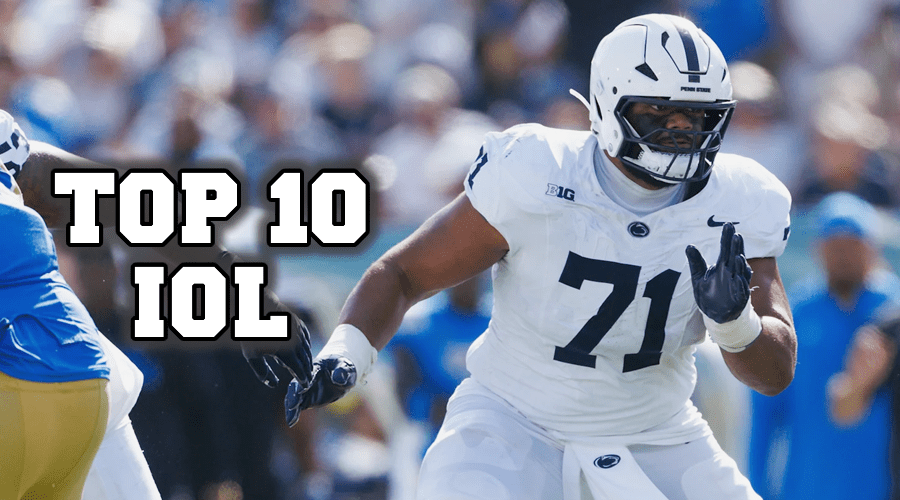
We‘re already officially past the mid-way point of our positional draft rankings series, and after discussing offensive tackles and edge defenders last season, we’re moving to the interior, starting with the offensive side of the ball yet again. This is a group that started to grow on me the more I started to watch, although I did find it funny how many undersized centers and big guards with some movement restrictions there were, to cap the ceiling overall.
There’s one legitimate top 15 pick headlining the class. After that, there are more names I’d have be willing to target early in the second round, before the get to an extensive list of names in contention to have their names called some time over the rest of day two. Altogether, I can get to a number in the high 20s that I’d consider potential rotational players with developmental upside.
Let’s get into it:
1. Olaivavega Ioane, Penn State
6’4”, 325 pounds; RS JR
While he’s only logged 32 career snaps at center and both tackle spots combined, unlike some other names that may over a little more positional value, Ioane is a day one impact starter at guard. He’s battle-tested with 32 career starts, improved his PFF grade all four seasons (80.0 in 2025), and was one of the few linemen in college football who’d be receive his own highlight packages due to some of the ways Penn State used him as, being one of their lone bright spots this past year.
This young man looks like he was built in a lab to play guard, with his wide chest and tree stumps for legs. He’s a mauler in the run game, who provides the raw force to dig guys out of their gaps, with mugged-up backers in short-yardage situations getting taken off screen. He’s capable of washing down 1-techniques to open up massive lanes for pullers to wrap around for, but is also explosive enough out of his stance to get to the play-side shoulder of defensive tackles with leverage on the gap pretty consistently on zone concepts. He does well to torque down-linemen to his outside shoulder and allow his teammates to climb off combos, but also provides the jolt to stand those up and enable his guys to overtake. Ioane shows the loose hips to flip and wall off bodies who try to back-door his blocks, he swallows linebackers try to be patient with deciphering the action and he absolutely kicks edge defenders out of the club on kick-outs to spring power/counter concepts, often times taking their will when given a running start off motion from wing alignments last season. Occasionally, Ioane shows an excessive wind-up and doesn’t have the balance to overcome it and still take care of his assignments in the run game, and I don’t believe he’s someone you regularly want to slow his mass down and secure targets in space necessarily.
In pass-protection, he’s like a wall to get through or around. Ioane quickly gets to his landmarks on slide protections and became intent on lifting under the chest of rushers with his thumbs pointed outside. Last year, he was more conscious on firming up the inside shoulder with short-sets, but he can also absorb stabs by aggressive defenders and keeps his cleats in the turf with good contact balance. Ioane keeps working hard for inside position with his mitts throughout reps and latches them on. Yet, he also understands when they he needs to pull them back, if they did slide off sporadically – was only penalized once as a redshirt junior. You rarely see spiking rushers create any real displacements against Ioane, which throws off the timing of twist action, and he extend through his triceps to pass off friendly targets. Last season, on 311 pass-blocking snaps, he wasn’t charged with a single sack or QB hit (four hurries). I don’t see elite foot quickness or overall recovery skills, and the one thing he needs to work on is gaining more depth in his pass-sets to not allow rushers to squeeze through the crease between him and the teammate to either side, if the picture isn’t clear.
Grade: Top ten
2. Emmanuel Pregnon, Oregon
6’4”, 315 pounds; RS SR*
Being unranked by the recruiting services in 2020, Pregnon didn’t see any live action through his first two years there, but then was named a Freshman All-American, improved in his two seasons at USC and then ascended all the way to being a first-team All-American as a sixth-year senior. Although he didn’t log any snaps at center (one at either tackle spot), he’s been an ultra-durable starter, with a wide build that almost has no bad weight to it.
Occasionally, Pregnon excessively lunges into contact on down–blocks and ends up whiffing entirely, and although he makes sure to really open with that play-side foot, I don’t see the short-area agility or loose lower half to bring it around and make himself a seamless fit for an outside zone-based system. However, he’s swift out of his stance to erase the gap on angled blocks or get to his landmarks on inside zone. He brings his hips, keeps working his feet with a base wide to stay connected and moves defenders against their will, with some snaps of completely uprooting shaded alignments. Pregnon feeds 1-/2i-techniques to his center with a commanding hip-check while staying on track for the backer on quick combos, yet understands when he needs to stay thick on those. He packs plenty of oomph into the collision on kickouts, when force defenders having to shuffle inside are about to get leveled, and USC also utilized him on some skip pulls, to have him dig linebackers out of the lane as the lead-blocker. Despite his aggressive style of play, he was only penalized once each of the past two seasons, averaging basically 900 offensive snaps for those.
Watching him operate in pass-protection, Pregnon delivers some heft in his strikes and displays a capacity to use them in alternate, highly active fashion, battling the wrists of interior rushers for inside position of his own. He uses his 33.5-inch arms to control the space to his teammates to either side of him and to guide wide/loose rushers way off track at times. He provides a stiff help-hand stepping towards the center, while scanning for potential add-on rushers, and is alert for blitzers, while maintaining a flat back as that distance closes. USC used him regularly as a puller on different protection schemes, where he did a nice job of gathering and picking up moving bodies, and he delivers some nasty rib-shots late in the down when unoccupied. Pregnon didn’t allow a single sack across his two seasons with the Trojans, before giving up one but massively cutting down his pressure total (five) in his one year with the Ducks (471 pass-blocking snaps). His arms being fully extended as much limits his ability to gain control, and you see him commit his shoulders too much at times as he trails the initial slanting rusher and puts himself in catch-up mode against someone looping over the top.
Grade: Early second round
3. Chase Bisontis, Texas A&M
6’6”, 320 pounds; JR
If you’re looking for a battle-tested guard from the SEC, who won’t even turn 22 years old until the middle of June, Bisontis is a very appealing option. The former top 100 national recruit immediately earned the starting job at right tackle for the Aggies, before moving inside one spot for the next two seasons (34 combined starts). He’s also a weightroom warrior, whose exploits landed him a spot on Bruce Feldman’s “Freaks List” multiple years.
Bisontis would benefit from slightly better pad level into first contact with defensive linemen, but he adequately centers, uses his wide chest to occupy and moves defenders against their will in the run game. He keeps his elbows in tight and delivers good rotational force to ride defensive linemen off their landmarks, and he frequently washes them way down the lane as they try to shoot through the gap, to allow runners to cut off his backside on zone concepts. Bisontis steps and offers a firm shoulder to allow his teammates to secure the down-lineman as he’s tracking the movement of his second-level targets, where he then climbs with appropriate timing and delivers good thump off a short runway. He’s light out of his stance and covering ground laterally for skill pulls, before taking out linebackers in the hole, and opens up plenty of space when tasked with kickouts. For teams that major in wide zone, he’ll need to get his play-side foot down a little quicker and take away the gap he’s responsible for, in order to avoid penetration.
As a pass-protector, there are some things he’ll need to clean up. Bisontis generally gets onto his toes and overextends too much, creating softer edges if opponents are able to defeat the hands at the line, and he sets too shallow, to where he ends up getting wasted in protection at times if his man drops out. Plus, while he flashes excellent recovery skills when beat across his face, to ride rushers way off their original path and keep his quarterback clean, not oversetting guys up the B-gap and inviting them inside in the first place would be beneficial. Bisontis shows off his boxing skills in how he throws off interior pass-rushers with stunning punches, and he does well to maximize his length (just under 32-inch arms) to elongate the track for opponents. He’s very capable of opening his hips and redirecting laterally to mirror counters and secondary moves, and with those trunky legs and the bend he plays with in his knees, he’s typically able to slowly give ground as they try to go through him. You also occasionally see him deploy swipe-downs with both arms and him re-establishing inside position or guide opponents up the field after they’re able to land a solid bull-rush. Bisontis smoothly he transitions through twist action and understands where trouble is coming from as the picture unfolds, dumping some blitzing linebackers with a jarring strike on contact. That’s how he only gave up one sack all of last year (441 pass-blocking snaps).
Grade: Top 50
4. Jake Slaughter, Florida
6’5”, 305 pounds; RS SR
It took Slaughter a couple of years to build out his body and earn a role on offense, but he ended up starting the past three seasons (33 combined games) and being a team captain for the latter two of those. Now, even after earning consecutive All-American team nominations for a struggling Gators offense and having tons of battles with the most talented interior D-linemen in this class (Caleb Banks) at practice, he’s not receiving the attention I believe he deserves.
Slaughter is pretty tall (and just a little light) for a center and struggles at times against guys aggressively submarining up the A-gap. The other problem I saw in the run game was that too often he’d allow defensive linemen to arm-over when it looked like he was in solid position. Having said that, he features excellent snap-to-step quickness, with precise hands to latch and sustain deep into the play-clock. Almost instantly he cuts down the distance to interior D-linemen on down-/back-blocks to avoid penetration on gap plays, while he’s able to create solid contact with little room for air against slanting bodies on horizontal concepts. He accelerates his feet through contact with defensive tackles to get them to the outside shoulder of his guards, while stay on track for the linebacker on inside zone combos, while showcasing the mobility to fold underneath them if the aiming point is out wide. Slaughter peels off the down-lineman with impeccable timing, in accordance to the second-level movement. Florida took advantage of his athleticism by getting him out to the corner as part of pin-pull action and you see some highly impressive hip fluidity to still wall off defenders trying to back-door his blocks.
His body composition forces Slaughter to operate in a certain way as a pass-protection. If powerful nose-tackles gain access to his chest first, even though he works hard to re-anchor, they can definitely create vertical displacement. Because of that, he’ll at times get overaggressive in his jump-sets against 2-/2i-techniques, and you see his chest fold forward, which triggers him to hug those interior rushers – was penalized seven times last year. Nonetheless, he’s been one of the most effective protectors in college football over the past two seasons, only surrendering one sack in each and a miniscule four total pressures in 2025 (both with over 400 pass-blocking snaps). Slaughter manages that space between him and the guards very well, to where you can leave him on an island. He displays tremendous lateral agility to mirror interior rushers, while keeping his hands tight and feet moving, as well as using the momentum of defenders against them as they search for escape lanes later in the rep. He gains appropriate depth if initially unoccupied, in order to help out his teammates on potential counters, his eyes stay up for linebackers “dogging the back” (meaning adding onto the rush if the RB is locked in protection), and his feet are extremely well-connected to counter twist action. The burst out of his stance also enabled Florida to use Slaughter as a puller to get to extended spots as part of certain protection schemes.
Grade: Late second round
5. Sam Hecht, Kansas State
6’4”, 300 pounds; JR
A walk-on at Kansas State in 2021, Hecht initially redshirted and then saw very limited action over the next two seasons, before earning the starting gig at center for the past two (25 combined games). He was recognized as second- and first-team All-Big 12 respectively, and has been rising throughout this draft process, putting together a strong showcase during Senior Bowl week.
Hecht has a slighter higher center of gravity and limited mass, which limits his ability to truly uproot shades or anchor against true power rushers to a certain degree. Long, strong nose tackles who can legitimately two-gap can give him a hard day or work, stacking and shedding in run defense. However, he’s very much under control and tactical in that regard, IDing fronts pre- and responding according to movement post-snap. He keeps his strike tight, grip firm and rolls his hips into as he works up through contact to sufficiently drive D-tackles off the ball. He does well to “hook” the play-side shoulder of first-level defenders, providing his guards entry points to overtake those, while his eyes are fixated on the linebacker behind it, and he provides excellent dexterity to get his base all the way around and scoop up defensive tackles when he’s the one arriving from the side. Hecht is savvy in the way he applies rotational force and enhancing the flow of slanting defensive linemen, to open up lanes off his backside, and on more vertical concepts, he understands whether to stay thick or suddenly peel off doubles, depending on how the LB responds. He’s fluid out of his stance and covers plenty of ground to take on different pulling assignments. Plus, K-State utilized his athleticism on some misdirection plays, shuffling one direction and then flying across into space.
I don’t believe Hecht brings a lot of pop to set the tone on first contact in either phase, which being “out-reached” if long interior pass-rushers makes him susceptible to push-pull manuevers. Yet, while he’d benefit from integrating some hand counters, he provides excellent activity, continuously fighting for the “upper hand” in reps. He brings easy mirror skills to stay in front of lateral movement and hang with counter spins without looking like he’s actually straining for the most part. He uses that wide base and gets all his cleats into the ground to slow down bull-rush attempts against him, and recognizes when he needs to give ground in order to avoid getting tripped up by trash around his feet or to gather himself if he does get knocked off balance momentarily. Hecht is really quick to slide in front of mugged up linebackers and neutralize them, while looking for extra work if that guy were to drop out. Plus, he makes sure to adequately pass off slanting rushers and ping his eyes back to pick up someone spilling over to get those A-gaps firm. He may be targeted with some spiking rushers, trying to create displacement for a secondary man on games, but not being responsible for a single sack or QB hit in two years as a starter (824 combined pass-blocking snaps) speaks for itself.
Grade: Late second/Early third round
6. Parker Brailsford, Alabama
6’2”, 295 pounds; RS JR
The reasons why Brailsford’s game may not translate to the next level are easy to figure out for anyone. In an NFL full of large men with superb athleticism, you’re looking at a size outlier, who probably never played above 290 pounds over his three years under head coach Kalen DeBoer at Washington and then Alabama. I’m willing to bet on one of the premier centers in college football, to overcome those shortcomings based on everything he’s shown me to mitigate those.
First and foremost, Brailsford provides tremendous snap-to-step quickness and mobility for the position. He weaponizes his leverage and consistently is able to fit his hands underneath the pads of defensive players, regardless of alignment. He has no issues reach-blocking even 2-techniques on wide zone concepts, yet if defenders try to back-door him, his agility to redirect and pin them away from the point of attack seemingly effortlessly, negates a lot of potential issues that could arise. Brailsford erases the gap almost instantly when asked to back-block B-gap defenders when his guards are assigned with pulling. He showcases excellent timing for when to peel off combos and makes sure to cover up backers, with a thirst to putting them into the dirt. This is one of the rare center who’ll snap the ball from shotgun, pull out to the corner and beat the running back flanked that way to a spot on toss plays. Of course, his athleticism and technique advantages won’t be as prevalent against the guys who also are naturally much bigger than him, to where those true nose-tackles are able to knock him back and lock out, in order to maintain angles to the ball. However, he was one of only two real bright-spots for the Crimson Tide in their 2025 season-opening loss against Florida State, putting the clamps on 345-pound nose tackle Darrell Jackson all day long.
Brailsford gets onto A-gap defenders before they can even fully come out of their stance on short-sets in order to take the fight to them. Then if they try to get around him or just attack upfield, he’s able to ride them past the track and not affect the quarterback, while showcasing the alternate hand-usage to greet and level cross-face moves. This is such an incredible easy lateral mover, to be left on an island with twitchy interior rushers and even linebackers with a two-way go. And the way he braces for power and levers slanting D-linemen is very impressive, in order to avoid vertical displacement. His hands are constantly moving to create favorable positions for himself and take control of reps, and he maximized his arm length constantly. Brailsford manages that space between he guards exceptionally well and stays ready for anybody bubbling over towards him, while almost looking like a safety in the way he gains depth and scans back and forth. The one time his lack of pure mass can show is when he’s not ready for a big D-tackle spiking into him, but that really ever happened despite some complex pressure packages that were thrown at him in the SEC.
Grade: Early third round
7. Logan Jones, Iowa
6’3”, 300 pounds; RS SR*
Originally recruited as a four-star defensive tackle in 2020, Jones didn’t get to see the field early on in his collegiate career, before converting to the offensive side of the ball and ended up starting at center in all 37 contests since then. He wound up becoming one of the most decorated centers in college football, winning the Rimington Trophy this past season as the key cog for the Joe Moore Award-winning offensive line. However, being just under 300 pounds and 31-inch arms respectively, there are some concerns about his viability in the pros.
Jones instantly gets into run-blocking rep with his explosiveness off the snap and was incredibly effective on wide zone concepts, as he’d be able to capture the play-side shoulder of defensive tackles who should have leverage on the A-gap. He latches his hands from below and into the chest-plate of first-level defenders to take control, and even though I wouldn’t call him a “gap scheme mauler”, once he gets that momentum rolling horizontally, he takes people for a ride way down the line. Jones rapidly erases the space to 2-/3-techniques on down- and back-blocks and you see his wrestling background show up in how he manages to stay attached deep into the rep, with great core and upper body strength to ride them out of lanes. You see some long, strong nose-tackle bend him backwards when they’re first to get their hands inside. However, Jones displays an excellent understanding for when to step and stay thick on combos, if he can just bump and climb or when to stay patient based on the movement on the second level, with the mental fortitude to digest and adjust to scrape exchanges.
As a pass-protector, Jones is well-timed and firm with that initial hand into the chest of interior rushers, in order to stand them up. He’s busy with his paws, to re-fit, establish leverage and stay in control of reps. He does well to use the momentum of slanting rushers against them and take them off their intended tracks in order for his quarterback to stay clean, while his eyes stay up to be alert for potential crossing action from the second level. Jones almost looks like he’s in a light back-pedal almost as he scans the rush in case a mugged-up linebacker drops out or the defense simply leaves both A-gaps uncovered, and he’s patient in his approach when picking up delayed loopers or blitzers, so his hands aren’t swiped away. Now, while he works hard to maintain leverage, NFL-level power rushers will be able to push Jones into the depth of the pocket or jostle him aggressive aggressive stabs. And even though his identification skills for various pressure looks is advanced for the college level, he did have the benefit of a lot of slide protections within the Hawkeye offense. So he may not seamlessly fit in any system and is a center only, who’ll already turn 25 in October of his rookie year, but I believe he’ll be a quality starter there for two contracts.
Grade: Third round
8. Keylan Rutledge, Georgia Tech
6’4”, 315 pounds; SR
After starting the majority of games over his first two years at Middle Tennessee State, he also was a fixture at right guard for 13 games in both seasons with Georgia Tech. Paving the way for a Yellow Jacket rushing attack that averaged nearly 200 yards per contest, he was named first-team All-ACC in back-to-back years.
This dude comes out of his stance with purpose and aggression, wanting to break the spirit of defenders. He’s capable of uprooting D-tackles out of their gap on down-/drive-blocks or lift them up while keeping his pads square, so his teammates can attach to combination blocks. Rutledge takes correct angles and keeps driving bodies to create cutback lanes off his backside on zone concepts, and turn the pads of defensive linemen in a way that allows the guy next to him to scoop those up on these horizontal plays. He urgently climbs up for his assignments on the second level and beyond if nobody is there, and you see some sling-shot members of the back-seven like projects as he peels off for them trying to run around him. You see him accelerate into and is looking to de-cleat edge defenders on kickouts, to fill up the highlight reel. However, I don’t love the speed to venture towards or the body-control to secure distant targets off long pulls. Rutledge also omes into contact with a slightly exaggerated wind-up as a run-blocker on the first level, and he too often he’ll try to kill linebackers rather than actually coming to balance, latching and securing those blocks.
He operates pretty tall in pass-protection and get a little stiff with his outside hand, but he generally does a good job of staying square and dropping the anchor against interior pass rushers. He’s consistent with carrying his hands at his mid-section and packs a tight, impactful punch. Rutledge wants to take the fight to aggressive gap shooters in passing situations with short sets and is able to lock them up if that initial strike hits, although slippery three-techniques may be able to punish him for it, if he becomes over-reliant. Still, once his hands are inside, that vice grip typically doesn’t release anymore. His strong upper boy and hips don’t typically allow interior rushers to turn tight corners on him, and blitzing linebackers have no shot of being able to go through his chest as he slides in front of them. Rutledge displays excellent awareness and is composed in the way he transitions on twists, while recognizing when he can just ride aggressive linemen slanting or trying to cross-face him into the pile and neutralize them, with over 33-inch arms to aid him. However, while his helmet looks like a sprinkler looking for work if unoccupied, I will say that he’s rather inconsistent with the depth he gains in his sets, being too shallow at times considering what’s happening around him.
Grade: Third round
9. Gennings Dunker, Iowa
6’5”, 320 pounds; RS SR
Similarly to a lot of Iowa linemen, Dunker initially redshirted and had to wait until the bowl game at the end of the following season to get his first start, yet he ended up locking down the right tackle spot for all 35 combined games he was available for over the following three years. Despite arguably playing out of position, his rugged playing style earned him multiple All-Big Ten nominations.
Dunker operates with that extra wide base and a light hand in his three-point stance. He comes off the ball with bad intentions, exploding into contact and rolling his hips through, while being able to create torque but also contort his own frame to drive the target out of the way on challenging angles. You frequently see him turn his base and move edge defenders towards the sideline on the front-side of zone concepts, while getting D-tackles airborne when cutting off the backside. When interior defenders do have leverage on the gap as they try to chase the ball down the line, Dunker will get a hand under their rib-cage and ride them into the turf. If the picture changes post-snap, he’ll find secondary targets or just ride people into the pile as they try to cross his face. Whether getting out in front on crack-toss plays, with his arms pumping hard, or pulling across the formation to kick out the D-end, Iowa utilized his violent nature, as he’d impose his will until the echo of the whistle. Now, not wearing gloves may limit his ability to latch his hands, but Dunker also gets pretty top-heavy, especially off longer runways, and loses his balance momentarily more than you’d like to. He needs to do a better job of erasing space to his teammates and not allowing defenders to potentially split combination blocks, while his transitions off those can feel segmented.
As a pass-protector, he comes in pretty high and wide with his hands, and he definitely looks like a guard to me when you saw how quickly he’d commit his entire body vs. speed off the edge, to go with some tightness in his lower half to open and recover. He does keep his weight center though, and maximizes his length to guide edge rushers onto a wider track. His feet wide and open with sufficient bend in his knees to slow down the bull-rush, and he shows a good understanding for the depth of the pocket, often pushing at the side or back almost in order to get his man too far upfield. His football IQ is apparent, identifying fronts, recognizing blitzes and stunts. The force in his hands and his fighting mindset allow Dunker to impressively recover from some compromised positions. Plus, he punishes jumpers and wants to bury rushers once he catches them under their pads. Last year, he only allowed two sacks and ten total pressures on 316 pass-blocking snaps, and then he put together a tremendous Senior Bowl week.
Grade: Third round
T.-10. Connor Lew, Auburn
6’5”, 305 pounds; JR
Although he unfortunately tore his ACL at mid-season, Lew had already logged 25 starts and showcased his crafty style of play at the pivot. Praised by everyone around the Auburn program, he became a team captain for the Tigers and one of the few bright spots for an offense that gone up and down a lot over these past couple of years.
Lew takes excellent angle and works well in concert with his guards as a run-blocker. He doesn’t prematurely commit his shoulders as he gets out of his stance, when the assignments aren’t 100% certain pre-snap, working off combination blocks with excellent timing, while showing the suddenness and flexibility to take care of the linebacker after making sure the down-lineman is secured first. I like how he maximizes his length to keep defenders on the “wrong” side of blocks as he digs under their shoulder-pad with full extension and pulls turns them late. Lew doesn’t allow himself to get hung up at the line of scrimmage, when his targets are located in the defensive backfield, and connects with them to great success. He displays good contact balance to absorb the force of linebackers trying to blow through one shoulder and redirect it to ride them off track or into the ground, and he finds secondary assignments as he works into space. However, he lacks the raw force in his lower half to create significant displacement on down-blocks, and he regularly gets bumped back a lot of steps as powerful nose-tackle dig their hands into his chest.
In pass-protection, he has the ball snapped and second foot down to get to his landmarks on slide protections before A-gap rushers can get to him. When he doesn’t have anyone over him, Lew makes sure to gain half a step on his guards to be able to close down the lane for their opponents crossing his way. He uses his hands like a boxer, alternating punches and continuing to work for advantageous position, while showing the active feet and balance to stay in front of active interior rushers for extended periods. You see the ability to drop his hips and re-anchor if he does lose first meaningful contact, and his arm length (just under 33 inches) to pass off take over assignments against slanting rushers is a definite plus, using their momentum against them. Lew keeps his head on a swivel as the rush develops and doesn’t get antsy with his strike against second-level blitzers. With that being said, as he shoots his arms out, he becomes vulnerable to having them swipes aside or lifted up straight away by savvy rushers, while lacking the strength in his upper body to steer them out of their rush lanes once they get to his edges. And you see loopers with a runway to build up momentum bump Lew backwards and put him in recovery mode a few times.
Grade: Top 100
T.-10. Brian Parker II, Duke
6’5”, 305 pounds; RS JR
Parker may take a similar path to his pro career as the guy who lined up on the opposite end of the line for the Blue Devils a couple of years ago in Graham Barton, who has been one of the better young centers in the NFL for the Bucs since. Both physically and play style-wise, there are qualities that make me believe he’ll end up benefitting from a transition inside, after starting 25 straight games at right tackle and earning back-to-back second-team All-ACC nominations.
In the run game, Parker erases the distance to defensive linemen on down-/drive-blocks, centers them with quality footwork, connection points and strain to stay latched. I really like his fit in a zone-heavy system, with the way he opens his hip, leading with his play-side foot and covers plenty of ground horizontally/diagonally. When working combos with a tight-end on the front-side, he makes sure to knock edge defenders to his teammates outside hip before sticking onto or peeling back for second-level targets. You see him kind of shove edge defenders up the field further than they intend to go, or applies rotational force if they try to stay square, in order to create space underneath on off-tackle runs. Parker urgently cuts off the B-gap and doesn’t allow 4i-/5-technique to track plays from the backside, climbs off combos with appropriate timing, seeks and connects with alternative targets to how the play was drawn up if the defense changes post-snap. Although he looked right at home playing the pivot for most of Shrine Bowl week, his lack of size and raw strength did show up in the run game against heavy-handed defensive linemen, which generally leads to him drop his eyes occasionally nose-diving.
With arms just short of 33 inches and sub-par core strength for NFL standards, Parker doesn’t have the tools to mitigate speed-to-power conversions out at tackle. His feet are too much independent contractors, where his post leg lifts up to where powerful opponents can drive though his inside half, and he’ll need to become more pro-active with his strikes on the inside as well, because once rushers are able to get to the edges of his frame, he doesn’t have the strength to sufficiently guide them off track. Having said that, Parker didn’t actually kick-set a whole lot at Duke, but operates from a wide base and his toes pointed outside to be stable in that first interaction with pass-rushers. He lifts up with his elbows in-line with his shoulders and redirects the momentum of defenders trying to bull-rush him up the field, to keep his quarterback clean, along with being savvy at swiping down their reach and burying them underneath himself as they get off balance. He offers very little air space to guys slanting across his face and stays connected with them when they try to counter-spin the opposite way. This is someone who identifies fronts and adjust his approach based on alignments/matchups already, while transitioning through twists with excellent timing and hand-placement.
Grade: Top 100
Just missed the cut:
Jalen Farmer, Kentucky
6’5”, 315 pounds; RS JR
Kentucky full interior O-line trio is part of this draft class, and while Jager Burton and Josh Braun have solid chances at hearing their names called at some point, when you put on the tape, you could who was paving open rushing lanes for that unit. Although he doesn’t have the same versatility as his two former teammates, having never taken a single snap anywhere but right guard, this guy is body beautiful with wide shoulders, a muscular lower half but very little excess weight in the mid-section.
Farmer completely uproots D-tackles horizontally on down-/back-blocks at times, when it looks like they have leverage to shoot through the gap, He creates so much space for the ball-carrier to string out zone runs when he attaches to combination blocks, uses the momentum of slanting linemen against when he badly washes them off their landmarks, and he’s able to steer them at the end of his reach with those 34-and-¼-inch arms to open up creases late. He’s sudden in the way he peels off combos and has the strong upper body to torque and ride linebackers off track. I wouldn’t say he’s particularly explosive out of his stance as a puller at this point necessarily, but Farmer arrives there with plenty of oomph to kick out edge defenders or turn them to the inside if they try to attack the wrong shoulder. On longer pathways, he’s able to locate, get through lanes and absolutely bully linebackers waiting for him. He did get caught hooking linebackers a few times in 2024 and was lucky the refs missed a couple of those calls last year-
In pass-protection, Farmer has the stout lower half to stand his ground against a quality bull-rush. He doesn’t look uncomfortable if pushed into body-on-body reps and locks up opponents once they get too close, without getting in trouble, as they try to disengage. Even if interior rushers are able to win first meaningful contact or seem to capture angles on cross-face moves, he’s simply so strong in his hips and core that he’s now allowing them to crash through one side or lift his feet off the ground. Edge rushers trying to slip/counter inside get met by a wall if Farmer is sliding protection that way, and he offers a firm help hand until he actually needs to engage with blitzer off longer runways. I saw some moments of him deciphering more complex (even three-man) games and the adequate agility to redirect in order to cut off someone looping over the top. Plus, he passes off spiking rushers with an impactful shove, to where the tackle has time to get ready on T-E twists. You do see his feet get kind of lazy and him losing bend in his knees later into passing downs, allowing his man to escape and hunt after the scrambling quarterback at times. Plus, Farmer had a couple of moments of allowing a linebacker to blitz through the A-gap untouched when there were two potential rushers outside of him, but one actually drops out at the snap.
Grade: Early fourth round
Matt Gulbin, Michigan State
6’4”, 305 pounds; RS SR
Gulbin has on my radar as a draft prospect for a couple of years, but being outside the top 1000 national recruits back in 2021, then barely seeing the field for the first two of four years at Wake Forest, before transferring to Michigan State last year, where offense has been voluntarily recently, led to him not getting a whole lot of exposure. However, he’s collected extensive starting experience at all three interior spots (over 600 snaps at each) over the past three seasons.
This guy has a compact, dense frame with a block for a head and great contact balance in crowded spaces. He wins as a run-blocker with excellent hand placement, hip extension and leg drive to create movement. His shorter arms (31-and-¾) and smaller hands (9.5 inches) create softer edges to his frame, but it rarely hurts him staying connected in this area, because he has so much strength packed into those that he can extend through his triceps and create that extra push, to get the ball rolling, especially as a zone blocker. Gulbin probably isn’t suited particularly well for a wide zone-based system, with average short-area agility to secure the play-side shoulder of a 2i-technique. However, he connects his mitts under the rib-cage/arm-pit to create that horizontal flow on combination blocks with his guards, where they frequently ride defensive tackles into the lap of linebackers. He transitions off those with good timing, comes to balance if needed, and re-accelerates his feet to move them against their well. You rarely see his base to narrow as the play develops and he finishes strong, often pushing defenders around until the echo of the whistle or putting them on the ground.
The limited range may be more apparent in a pro system that puts him on an island a lot, and in his one season at center, you did see what appeared like a handful of missed assignments on simulated pressures (which may have been a coaching issue to a certain degree). With that being said, he consistently gains inside position and keeps them there with a tight grip. Yet, even if they do get knocked away momentarily, they rapidly re-attach while he maintains his balance. Gulbin gets all his cleats in the ground as he slowly gives ground and stalls bull-rush attempts, and displays impressive balance to absorb the charge of spiking rushers or blitzing linebackers with a runway to build up momentum. His eyes typically stay up if he has to peel off for someone added onto the rush from the second level, as he and a teammate are dealing with someone on the interior, and if unoccupied, he gains the appropriate depth based on the dropback timing, keeps his head on a swivel, and rarely allows leakage into a gap to either side of him, with solid hip- and shoulder-bumps. Last year, he earned an 87.8 PFF pass-blocking grade, only surrendering five QB pressures across 426 such snaps.
Grade: Early fourth round
The next few names:
Pat Coogan (Indiana), Billy Schrauth (Notre Dame), Kage Casey (Boise State), Jeremiah Wright (Auburn), Beau Stephens (Iowa), Jager Burton (Kentucky), Febechi Nwaiwu (Oklahoma), James Brockermeyer (Miami), D.J. Campbell (Texas) & Ar’maj Reed-Adams (Texas A&M)
 Halil's Real Footballtalk