
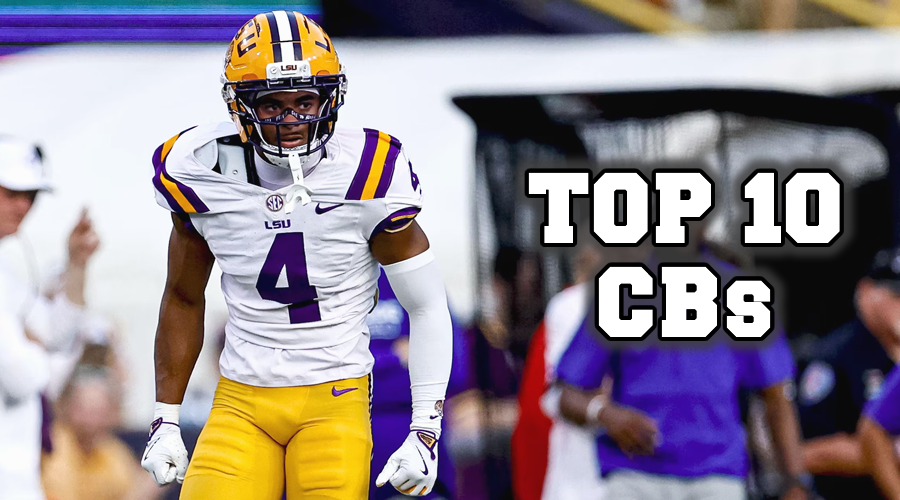
After taking a look at a deep wide receiver class earlier this week, we’re taking at the looks that are going to cover them – the corners. This group includes what you’d categorize as boundary, field-side and slot guys (nickels). As a quick note, you will find Arizona’s Treydan Stukes on the safety list.
As always, my rankings are all based personal evaluations, not taking current injuries or potential off-field concerns into account, since I don’t have insights into medical reports and similar information. And of course, since I’m not working for a specific team, these projections don’t take scheme fit or certain benchmarks into account.
While one of them missed the entire 2025 season with injury, based on the tape alone, we have two top 15-level prospects, another one firmly inside the first round on my end and a couple of others I could easily sneak in late. The top eight names may all end up being among the first 50 players selected, and then there are several intriguing guys, who may lack some refinement but offer certain qualities teams may want to invest solid draft capital into.
This is how they stack up for me:
1. Mansoor Delane, LSU
6’0”, 190 pounds; SR
Whether you look at the advanced numbers or the actual tape, Delane had about as clean a season as a cover corner as you’re going to find. On 357 coverage snaps and 35 targets, he only allowed 14 completions for 165 yards and no touchdowns, compared to his two interceptions, while not getting penalized once. What consistently allows him to be in great position is his film studying habits and route anticipation.
He brings great balance staying square to receivers off the line in soft press alignments, is uber-patient with very little fat in his footwork and keeps one hand connected to his receiver to stay sticky throughout. Although I did see some receivers gain a step on him down the sideline more than I would’ve liked to during his time at Virginia Tech, the fact he’s not worried about people running by him and even if he does momentarily lose phase, is a big plus, thanks to how precise he is with playing through the hands of the intended target.
Delane is an active communicator in zone coverage, who clearly understands rules for passing off routes and where he’s expected to help out, adjusts his landmarks according to route stems/tilts and excels at playing to his leverage in match assignments, getting handsy with guys trying to break against it. The one area I’d like to see a little better route squeeze is when he’s leveraged outside and is lethargic to close against receivers breaking towards the middle of the field in quarters or when guys from reduced splits aggressively push up before snapping off deep curl routes against cover-three.
The one-year standout LSU transfer can be vulnerable to allowing physical receivers to attack his chest in when playing up close and taking charge of him in the run game, but overall he does an excellent job of leveraging the ball and protecting the sideline. He has quick hands to swipe away the reach of blockers on the perimeter as he triggers on screens, and lining up at safety occasionally when needed by the Hokies, Delane’s ability to close space, break down in space and finishes tackles was noteworthy. Although I saw him rely on his arms to sling down receivers on the run a few times, he did finish his career with just a 10.6% career missed tackle rate.
Grade: Top ten
2. Jermod McCoy, Tennessee
6’1”, 195 pounds; JR
Very much on the opposite end of the spectrum to LSU’s Mansoor Delane, we haven’t seen McCoy take part in any athletic activity since December 21st of 2024 (due to a torn ACL suffered the ensuing spring), but his film that year and the physical tools he brings to the table are so impressive that he’s considered a likely top-15 pick. This is muscular press corner, who’s authoritative when he does land stabs as receivers commit to the release and shows some boxing skills to battle the hands of receivers trying to gain advantages in the early phase of routes. That grabby style can get him into trouble at times though, where he runs through the man at the break-point (nine penalties in 2024).
He has the easy gas to hang stride-for-stride with go routes, including against someone like Mississippi State’s Brenen Thompson (with Oklahoma at the time), who posted the top 40 time at this year’s combine (4.26). That also allows him to not allow wideouts to get on top of him down the sideline in three-quarters whilst peaking back over his shoulder. McCoy operates with good eye-balance between the quarterback and ancillary targets in zone coverage, with the hitting power to legitimately separate opponents from the ball, constantly discouraging opposing passers to take the deeper options on high-lows and rapidly shutting down completions in the flats.
For a bigger corner, his closing burst playing top-down in match assignments is stands out, and he has some snaps where he absolutely blows up guys up the seam when he can fall inside in cover-three. That’s paired with exceptional ball-skills, showcased on a high-point interception that he nearly took to the house against Alabama in 2024, after beating up then-freshman sensation Ryan Williams at the line.
Weirdly, he had multiple reps in coverage where he got a late start against (vertical) routes because his eyes were still inside – Ohio State’s Jeremiah Smith burned him for a touchdown on a go ball that way in the College Football Playoff. His arm length (31-and-¼ inches) to maintain vision through blocks on the edge is a definitive plus, but McCoy tends to get hung up with blocks, not nearly being as physical with attacking and shedding opponents as he is in coverage. But he did a much better job of staying on his feet as a tackler his sophomore year.
Grade: Top 15
3. Avieon Terrell, Clemson
5’11”, 185 pounds; JR
Similarly to a lot of other Clemson players, Terrell had kind of become a forgotten name in this corner class, despite his brother A.J. still being top ten in average annual salary for the position in the NFL with the Falcons. I pretty much like everything about him other than size. And while there are some concerns around his slim frame, he did just show up at 186 pounds and looked incredibly dynamic coming through positional drills at the combine, to remind people of himself.
Other than maybe being forced to drag down bigger ball-carriers, I don’t see any concerns with Terrell in run support. He urgently comes downhill, has the agility to side-step bigger bodies pulling out to the corner and attacks low to chop down guys, along with recognizing opportunities to yank the ball out as he joins gang-tackles. Not only does he strike into the chest of wideouts in that area, but this guy is feisty in the way he challenges and throws off opponents at the line of scrimmage.
He’s a disciplined player, but you can clearly spot an athletic arrogance about him in coverage. Terrell packs the gear to quickly close the gap to his man on drag routes when playing off and outside, having to work around rubs, etc., and he showcases oily hips to flip around if he does commit the wrong way momentarily, such as undercutting out-breaking routes after being forced to open towards the middle of the field by the initial set-up. I do believe he doesn’t nearly look as comfortable having to play off-man, being tall in his pedal and not the smoothest in his transitions, and he’ll have to adjust his style as a zone defender to some degree, where regularly he’ll just “catch” guys pushing vertically at him with his feet being dead basically.
Still, he displays impressive click-and-close burst to break on routes in front of him in quarters assignments, keys quarterbacks in the quick/RPO game a way that allows him to challenge catches on simple hitch/stick routes from the slot as a flat defender, and puts his helmet on the ball to jar it loose when it seems like he’s given up catches in front of him already. Plus, then he gives you good peripheral for when passes are completely elsewhere, to help corral the recipient with tight wraps.
Grade: Mid- to late-first round
4. Colton Hood, Tennessee
6’0”, 195 pounds; RS SO
As fun as it is to have two likely first-round picks at the same position coming from one school, unfortunately we never got to see what a Colton Hood-Jermod McCoy pairing might look like, after the former spent one year at Auburn and Colorado each. Yet, he stepped in the shoes of his injured teammate when it came to imposing himself on the perimeter.
Hood plays on the fringes of what’s legal while largely avoiding penalties, does an excellent job of being physical at the first point of contact and arm-barring receivers as they try to stack him on vertical routes. When playing off, he’s composed in his lateral movements to slide in front of the stem, including out of stacks/bunches, with the acceleration to hang with go/wheel routes. His transitions can lack some twitch, where he’s a beat late responding to breaks the opposite direction of how he initially opened his hips, and he can get a little too aggressive trying to undercut out-breaking routes in particular.
Yet, where he really impressed me was his level of comfort to turn his head and back for the ball down the field in symbiosis with his man, thanks to 4.44 speed and a 40.5-inch vertical to win to win aerial battles. In match assignments, he’s light in his pedal, while staying alert to close down and contest routes being snapped off in front of him. He’s an active zone defender, tracking the quarterback working through progressions and muddying up the picture, shows a good feel for feathering off route, so the ball isn’t thrown over his head and he secures some key tackles against checkdown or quarterbacks escaping the pocket his way.
Hood isn’t dying to get involved in collisions around the line of scrimmage from his corner spot, but does well to extend his (31.5-inch) inside arm through the frame of wide receivers as he steps down, to show as a contain defender, and frequently disengages from them at the exact right moment to make tackles on the perimeter. That paired with massive improvements as a tackler with staying on his feet (6.6% miss rate with the Vols compared to 35.2% previously) allowed him to also post 20 “defensive stops”, which constitute a positive tackle for the defense based on down-and-distance.
Grade: Early second round
5. Keith Abney II, Arizona State
6’0”, 190 pounds; JR
I truly don’t understand how there’s seemingly no hype around Abney at this stage, other than not having seen him perform at the combine or an all-star event. He’s on the shorter end of the spectrum (with only 30-inch arms), where bigger NFL wideouts may be able to create openings early and late in the round with physicality against him, but we have yet to see that materialize. As a true sophomore, he held opposing quarterbacks to passer ratings below four in three of the final four contests, and then last year he was even better – 4.46 yards per target, zero touchdowns compared to two picks.
Abney is a twitchy mover, who can rapidly erase the gap to his man on a shallow crosser from off alignment, but then it’s oily hips that allow him to turn against vertical routes or make up for a false step off the line that really stand out. He has quality long speed, while being able to de- and re-accelerate his feet as receivers try to get him with stutters or double-moves. That’s why he appears unbothered by guys pushing hard at him during the drive phase in match principles, and thanks to recognizing any change in tempo nearing the break-point, he provides excellent route squeeze playing top-down.
He does a nice job of mid-pointing routes in zone assignments, he stays low going through his lateral shuffle or quarter-turn to close the space to targets settling him in his area, and his closing burst to fly to fly underneath a deep post route all the way from the opposite end of the field looked pretty wild on a handful of occasions. The one way I saw opponents gain separation a few times was when they really sold the fade after jabbing inside off the line and then snapped those off violently. And I will say that he has room to improve how he strikes through the hands of the intended target with his back to the quarterback – in part why he was penalized 13(!) times since the start of 2024, arriving a tad early.
Occasionally he appeared more occupied with fighting receivers down the field rather than disengaging from blocks and helping corral the football, but he’s urgent with how he sticks his foot in the ground and gets downhill against perimeter runs and screens from off alignment, does well to funnel the ball inside, and he drives his feet through the ball-carrier, leading to a missed-tackle rate of just 4.3% this past season.
Grade: Early- to mid-second round
6. Brandon Cisse, South Carolina
6’0”, 185 pounds; RS JR
Cisse a true outside corner with adequate length and supreme athleticism. South Carolina actually aligned him primarily towards the far side of the field and he didn’t get to put his hands on wideouts a whole lot until later on last year. He operates with phenomenally light, well-coordinated feet mirroring routes from soft press alignment, staying square for a good five yards if he doesn’t feel like he needs to respect the vertical push, rarely gets caught out of position picking up guys off switch-releases and even if he does find himself having to go through some odd-looking transitions, he has the balance to re-collect himself.
He tends to bite on double-moves more than you’d like to see and may lack elite short-are quickness that you want to see against whip/return routes, but his anticipation has continued to improve and he beautifully plays the eyes of the receiver down the field. Cisse has improved his spacing when put in conflict as a zone defender to not provide easy answers to the quarterback, he can be disruptive with his hands as a flat defender, actively looks for work inside and is alert to not allow receivers to come in behind him when the offense tries to tie him down with a quick hitch/in-breaker.
You do see him get turned around the wrong way at times defending back-shoulder throws (down the sideline), but when the ball is put up in the air, Cisse locates and high-points it with great confidence (and a 41-inch vertical). Plus, he urgently closes on completions in front of him and squares up the receiver with good positioning. He’s not particularly disciplined with maintaining contain after being run off on the outside initially and missed tackles became a bigger story for him in 2025 (from a 3.4% to a 14.3% miss rate), but he just earned a borderline elite run defense grade from PFF (89.2).
Against sweep/toss plays, Cisse makes sure to keep his outside arm free. He’s sudden with the way he throws his hand-swipes and shoots past blockers if the runner bounces wide or the quarterback throw a screen out there, there’s no hesitation dipping underneath offensive linemen pulling out to the corner, in order to funnel the runner back inside, and when the lone WR to his side motions across, he’ll will find entry points through the C-gap to create quick stuffs.
Grade: Top 50
7. D’Angelo Ponds, Indiana
5’9”, 180 pounds; JR
I know that both height and weight for Ponds are virtual non-starters at the NFL level for an outside corner, with just 29.5-inch arms. However, he was pretty clearly my favorite guy to watch at the position in college football last season. Indiana primarily put him into the boundary and thanks to his physicality to dictate terms to receivers, they didn’t think twice about matching up with detached tight-ends on the backside despite giving up 7-9 inches. He’s equally apt at providing small cushions, where his film studying habits and IQ to understand which routes to expect based on split and situations allow him to frequently get a jump on them – just ask Oregon, when he pick-sixed a speed out on the first play of CFP semifinal. Generally, his change-of-direction skills, fluidity and acceleration to close down momentary separation jump off the screen. That’s how he limited opposing quarterbacks to just one touchdown compared to five(!) interceptions over the last two years, along with cutting down his penalty total from seven to just one on nearly 500 coverage snaps in Indiana’s undefeated national championship run.
Although the size can become an issue when offenses target him on back-shoulder throws and he simply misses a couple of inches trying to wrap around a big tight-end up the seam, even if he correctly identifies he needs squeeze inside in cover-three. He does time up and launch himself in the air with 43.5-inch vertical jump (top mark among this year’s CB group at the combine) to turn more true jump-ball situations in his favor than his height might indicate. Ponds displays impressive field vision and anticipation for pass concepts out of certain offensive looks, with excellent feel for closing down on targets stopping off routes in his vicinity. He already flashes the mental fortitude to disguise coverages and bait quarterbacks into certain throws, and immediately finds work as a hang-corner if the lone eligible to his side runs a shallow crosser. Even if he’s attached with someone, this guy will race up and shut down underneath completions in a hurry.
With virtually any future opponent “out-reaching” him as blockers, he’ll have to be even more conscious of defeating their hands before they latch into his frame, where he’s already pretty skilled. Ponds certainly isn’t a passive contain defender, stepping inside and showing no reservations over taking on a running back or tight-end leading up through the C-gap. And he’s a physical face-up tackler, especially considering his smaller frame, missing only 6.1% of attempts over the course of his career, and 3.0% this past season.
Grade: Top 50
8. Chris Johnson, San Diego State
6’1”, 195 pounds; SR
I was started to get pretty worried about Johnson when I saw him kind of getting routed him up by guys like Tyren Montgomery from Division 3’s John Carroll early on in one-on-one sessions during Senior Bowl week, but he continued to improved throughout the event and then not only mitigated some speed concerns when he ran a 4.4 at the combine, but also looked incredibly natural going through the positional workout, with buttery smooth hips and great control throughout his movements. Those things are scattered across his film, despite being just a true junior from the Mountain West.
Johnson is well-versed in a variety of zone/match assignments, displays excellent spatial awareness and is fluid going through the requisite transitions between movements. He can efficiently click-and-close in cover-four, climbs back down the ladder with receivers stopping off routes in front of him and punishes them if they elevate for passes. As a flat defender, he keys the quarterback to quickly shut down hook/stick routes inside of him, yet when he has to run with someone down the field and gets into even position, he makes it a priority to actually look back for the ball rather than being content with a reactionary role. His recovery speed when beaten is the one remaining area for worry for me.
When asked to play man-coverage, he brings patient, soft feet mirroring receivers off the line who try to slow-play against him in soft press and not allowing excessive footwork to get him leaning too far a certain way. He showcases the flexibility for being six-foot flat to roll through speed cuts along with wideouts, and slings his arms around receivers in a disruptive way with excellent timing as the ball arrives there. Too easily he surrenders clean inside access when savvy opponents throw split releases at him, and even though it’s a coaching point to some degree, I would’ve like to see him put his hands guys early in the route and dictate terms to them more.
When he makes it a priority, he has good jolt in his hands to lock out and keep blockers off his frame, which allows him to stay in control of plays against the run, and he doesn’t mind sticking his face in the fan when put closer to the ball. He’ll get dragged along for extra yardage by bigger running backs at times, but he’s fundamentally sound with keeping a wide base, staying on his feet and getting ball-carriers to the ground (only missing 5.4% of attempted tackles for his career).
Grade: Second round
9. Keionte Scott, Miami
5’11”, 195 pounds; SR
If you’re targeting a true nickel defender on day two, the choice really comes down to either Arizona’s Treydan Stukes – who will be part of the safety rankings – and Scott. Previously he collected some experience at outside corner with Auburn, where he also looked balanced in his footwork when receivers try to delay their release into fade routes, and he excels at slightly re-routing and just bothering opponents in this soft press technique. This guy showcases impressive lateral agility and sharpness in his movements to stick with whip/return routes, and he has more than adequate long speed to hang with guys on deep crossers and posts/benders. Detached tight-ends can occasionally knock him off when take up that space to him in off-alignment and attack his chest.
Scott can play fast because he’s confident his rules as a zone defender, adjusting his landmarks, giving push calls and making his presence felt when passing off assignments, disrupting opponents crossing his face. He offers good range to contest passing lanes underneath, with 31.5-inch arms and good hand-eye coordination, and rapidly closes on throws in his vicinity to emphatically shut down any potential for yards after the catch. Last, he wasn’t charged with a single touchdown and a long of 23 yards on any catch compared to his two interceptions across 56 targets. I will see that he’s much more of a forward-oriented, specific slot defender than a coverage DB, where he ends up with his eyes trapped in the backfield quite regularly.
This is an excellent, aggressive run defender. He packs a strong punch to take on blockers and is fully capable of holding his ground while playing with extension against tight-ends when he walks down against them. Yet, he’s also very sudden with dipping and ripping underneath receivers from the slot, in order to not allow them occupy him. He doesn’t away from sticking his nose in the dealing with pulling linemen inside the box, and Miami quite frequently blitzed off the edge, where his speed, flexibility lack of fear enabled him to collect 20 QB pressures and 36(!) defensive stops. The two main negatives – he’s missed at least 14.5% of his attempted tackles in each of the last four years, as he gets his weight too far out in front and is forced to dive for ankles or try to sling guys down from the side too often. And he’ll already be 25 before his rookie season starts.
Grade: Late second round
10. Chandler Rivers, Duke
5‘10“, 185 pounds; SR
Although Rivers has basically identical height (half an inch taller) and arm length (both 29-and-3/8-inches) as Indiana’s D’Angelo Ponds, he does bring more functional to the battle. In four years with the Blue Devils, he logged 45 starts, and was one of the nation’s most productive DBs over the last two years. He looks very comfortable mirroring receivers off the line in soft press technique, is disciplined with staying square until those guys fully commit to the release and doesn’t concede easy access to the middle of the field. He truly has a knack for hand-fighting without drawing the attention of refs in a negative light, stays locked in on the receiver’s hips to not overrun the break-point, and he tracks the deep ball with the mindset of a wide receiver. I did get concerned a handful of times about his top end to survive on an island outside, as he relied on a lot of stack-technique against verticals, but the 4.4 flat at the combine gives me more confidence.
In zone coverage, Rivers effectively digests route combinations and recognizes when quarterbacks have moved on in the progression, so he can feather off underneath options. He smoothly redirects forward out of a side-saddle as he’s gaining depth as a flat defender, and displays impressive awareness when he can help out if unoccupied. From the slot, Rivers has experience with a variety of assignments to allow his high football IQ to shine, including bailing out to a deep half. With that being said, he does lack the sudden acceleration to close the gap against (deep) crossing routes when playing off and outside in cover-three/-four. And when he does end up with his back to the football, his precision punching through the hands of the intended target has room upwards.
Rivers routinely shoots his hands inside the chest of blockers first to stay in control defending the run, and he shows zero hesitation about dropping his shoulder into the chest of tight-ends working out towards him from condensed formation. In the screen game, he barrels downhill with a purpose, and is very skilled with his hands to swipe or rip under the reach of receivers to create angles towards the football for himself. Rivers excels at shuffling inside during the quarterback’s cadence blitzing off the edge, with good ankle mobility to bend his path and run down plays designed away from him. His limited tackling radius does show up when forced to corral ball-carriers who have momentum into the interaction and can put a move on him, missing a career-worst 16.2% of his attempts in 2025.
Grade: Early third round
Just missed the cut:
Daylen Everette, Georgia
6’1”, 190 pounds; SR
I was definitely concerned with Everette throughout a rough Senior Bowl week, where he routinely was left a step behind and reacting to wide receivers, making me question if he can truly be left on an island in the NFL. Seeing him run a 4.38 at the combine and then going back to his tape as the Bulldogs boundary CB makes me feel a lot better again. Technically, he looks like a pro already, sitting low in his stance with his eyes nearly level to the belt of the receiver and those long arms in position to strike. He shows the boxing skills and smooth lower body mechanics to stay connected through extensive route set-ups, and clearly trusted this speed during his career in Athens, regularly stopping on the spot with wideouts snapping off routes and contesting those throws because he didn’t sell out for the fade. He’s not someone you’re going to get easy yardage on, as you try to hide his man between fellow receivers or run away from him with motion, taking efficient tracks to erase that distance.
Everette is tall and not overly dynamic in his change of direction in off-pedal technique, but I love his ability to be that backside guy when playing quarters. He dishes out some highly disruptive two-handed punches in press-alignment and then feathering off in zone, leaves very little air in the coverage with quick identification of how concepts play out and their respective rules for those and works back down the stem with receivers curling up in front of him in quarters with great timing to wrap around and collect PBUs. His weight distribution and awareness to squeeze in on routes inside of him and deny easy catch-and-run opportunities help limit opponents regularly.
This is a willing run defender with urgency to squeeze inside, does really well to use the sideline as that 12th defender when angling on the ball-carrier bouncing wide, and he’s quick to crack-replace or come down to funnel the ball to his teammates. Everette isn’t very forceful with his hands to go through the chest of blockers and set a firm edge in the run or screen game, and you do see plenty of jogging when the ball isn’t coming his way. However, his missed-tackle rate jumping up nearly 20% as a junior now looks more like an outlier, as he was between 8 and 9% the other three years, not being content with dive-and-drag maneuver for the most part.
Grade: Third round
Julian Neal, Arkansas
6’2”, 200 pounds; RS SR
Neal is a long, athletic outside corner who has continued to improve with increasing time on task, moving from Fresno State to Arkansas this past season. He’s able to crowd receivers early in the route and stay sticky throughout. When guys in the boundary try to take those wide releases against him, he attaches his mitt to the near-shoulder pad and at times completely eliminated that guy by riding him out of bounds. He has a good way of being handsy and battling for position off the release and at the break-point without being obvious to draw flags, and even if he does open the wrong way initially on these double-releases, Neal whips his hips around pretty swiftly for his height. He’s a little too upright and can be put in catch-up mode when he misses the jam, may not quite have the top gear to hang with true speedsters if regularly isolated on the perimeter and he struggles to turn and locate the football when it hangs up in the air as he’s face-guarding opponents.
Having said that, Neal typically has no issues hanging with wideouts in a three-quarter turn. Whether in cover-two or -three, he understands when he’s sufficiently carried receivers to where he can pass them off to the safety behind him, flip around and get involved against nearby routes. He displays impressive short-area burst out of side-shuffle and quarter-turns in zone assignments. And is well-coordinated in his lateral movements to contest receivers curling/stopping up around his area. You do see him slip a few times relying on the T-step to redirect out of his pedal, and he gets a little too aggressive with his angles trying to undercut throws in off-man or match coverage, where he may miss the ball entirely, opening up big YAC opportunities. However, over the past two seasons quarterbacks going Neal’s way have been limited to 6.36 yards per target.
In run defense, Neal is disciplined with staying home and is a physical presence, who’ll attack forward against fly sweeps, toss plays, etc. He features a good punch and maximizes his length (32-and-¾-inch arms) as he takes on blocking receivers, while staying ready to pull them aside as the ball-carrier comes his way, plus he doesn’t shy away from squeezing inside and engaging with pulling linemen occasionally. And what really helps him is that he was able to cut down his previous missed-tackle rate in half last season (7.3%), just staying on his feet more so and lassoing guys down when needed.
Grade: Third round
Jadon Canady, Oregon
5’11”, 180 pounds; RS SR
After arguably being the top corner over the first two days of Shrine Bowl week, dictating terms and maintaining control throughout those-on-one reps, I wasn’t surprised to see Canady flash all over the Oregon tape. This guy shows well-coordinated feet and excellent balance. His eyes stay locked on the hips of his man and hands around the belt to feel the break-point coming, not allowing himself to get shaken off on scramble drills. His ability to be near full-sprint with someone but then stop on a dime as the receiver works back down on like a wheel-into-a-comeback is wild, and when playing with his back to the football, his precision at playing through the mitts of the intended target is excellent. Last year with the Ducks, he wasn’t charged with a single completion longer than 11 yards and barely over 100 total on 37 targets.
Canady does well to play with vision through other routes to identify which combinations are coming. He won’t allow himself to be tied down or “spaced out” when offenses try to attack soft spots within the coverage structure. He plants his upfield foot in the ground emphatically from a side-saddle technique to click-and-close on stuff in front of him, and once routes have dispersed and he realizes he’s isolated with one receiver, he’ll turn it into a man by flipping his hips and eyes. Now, while I do believe he’s capable of running the pole with slot receivers he ends up matching with inside leverage, I saw a few times in 2024 where he couldn’t tap into that make-up burst when re-gain phase against a bender or deep cross when shading guys outside with legit long speed. And he’ll generally need to alter his approach to some degree playing off, where he regularly gets caught flat-footed and initiating collisions beyond the legal (five-yard) window.
Canady defends the run with the mindset required from an NFL nickel. He basically uses a push-pull technique as he’s dealing with slot receivers in the run game, to completely discard them, and when put into more condensed sets, he’ll aggressively strike through their chest with legit knock-back despite giving up 20+ pounds in certain matchups. He shuffles inside from the backside in that apex spot and shuts down cutbacks on zone concepts, and I like his urgency running the alley when lined up at deep safety. He’s forced to widen his initial angles and makes himself vulnerable to getting crossed over in pursuit, and overall missed 15.3% of attempted tackles for his career however.
Grade: Third round
The next few names:
Devin Moore (Florida), Thaddeus Dixon (North Carolina), Brent Austin & Hezekiah Masses (California), Malik Muhammad (Texas), Davison Igbinosun (Ohio State) & Tacario Davis (Washington)
 Halil's Real Footballtalk
Pingback: Top 10 safeties of the 2026 NFL Draft: | Halil's Real Footballtalk