
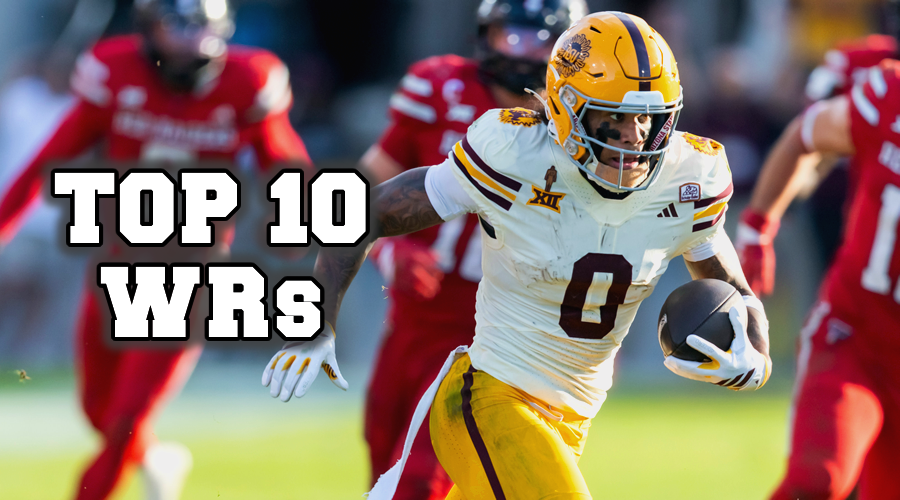
We enter week two of our positional draft rankings series, and already I had to push the release of this iteration back, because of sheer number of draftable wide receivers in this class. I will have watched 35-40 guys when this comes out, and I still feel like I should run through a few more names.
Once again, all these rankings are based on my personal evaluations, not taking current injuries or any potential off-field issues into account, considering I don’t have insights into medical reports and other such information. And of course, since I’m not operating for a singular team, these projections don’t scheme fit or team-specific guidelines/benchmarks into account.
Although we don’t have that true number one receiver who has checked all the boxes in the pre-draft process, my number one guy has top ten ability, there are four other names with first-round grades, and even beyond the 13 total that I’ll discuss here, including three that I listed as “just missed the cut”, there are prospects worthy of hearing their names called on day two.
This is how they stack up for me:
1. Jordyn Tyson, Arizona State
6’2”, 200 pounds; RS JR
Considering Tyson has missed games and played through some injuries to his knee, collarbone and hamstrings as different points, I understand why he’d end up getting drafted later than where his actual grade dictates he should go, but this has been WR1 since last summer and I’ve never really wavered on it. When I watch his tape, I just think to myself that this is how a number one NFL wide receiver moves like. Although it’s almost a sacred name to bring up, his ability to disengage his upper and lower half to deceive defensive backs reminded me of Justin Jefferson.
Now, he’s certainly not the level of route-runner as the record-setting Vikings standout, where too often he tries speed through them and ends up rounding them off, and he makes himself a little vulnerable to be bumped at the top of the route when he can’t get his defender off balance. However, Tyson has easy gas off the line, he’s slippery to elude off-defenders trying to sort of catch/grab him, he packs a nifty swipe-by maneuver if he does have to engage in hand-combats, and he’s incredibly sudden with the way he snaps his head around. Even as just a redshirt sophomore, I thought he displayed an impressive propensity for integrated movements, where he’ll add in subtle false indicators and freeze the feet of guys trying to mirror him at the top.
Focus drops were a big piece of the evaluation in 2024, with some fastballs going off his hands, but he only missed on one of 62 opportunities last year. Tyson plays way above his height in jump-ball situations, thanks to exceptional competitiveness and high-point timing. He rarely allows the ball to slow him down whatsoever, while having that quick accelerator if he is in a more static position, shows good peripheral vision for the pursuit and the flexibility to get into these wide steps and maneuver around defenders try to corral him.
The one negative he still needs to clean up is not giving defenders chances to punch the ball out as he’s making moves (three fumbles since 2024). But his suddenness allow him to pull corners with him as he sells the take-off on run plays, and he’s a patient, fundamentally sound blocker, who operates from a wide base and with a flat back. With a clean medical bill, I’d be fine with going as high as fourth overall.
Grade: Top ten
2. Carnell Tate, Ohio State
6’3”, 195 pounds; JR
Tate presents the cleanest profile of any wide receiver in this class. There was some controversy around his 40 time at the combine, and I thought his top speed was somewhat capped to flat-out run away from quality corners, but his play speed is certainly better than that 4.53 would indicate. More importantly, what the clock says in no way would tell me he’s not a good deep threat. He beautifully sets up (soft) press corners with split-releases to mitigate how they’re shaded and then his acceleration to gain a step on them is definitely noteworthy.
This is a craftsman as a route-runner, who chooses his stems in accordance to the coverage structure and regularly incorporates slight tilts before committing to the break. He’s exceptional at using subtle deceleration and head-fakes to get defenders with deep zone assignments to pause for a split-second that he can use to get on top of when he has those longer runways. Go back to the Penn State and watch the two bombs he set up that way. Yet, he can either drop his weight to stop off curl routes or roll off either foot to come open over the middle on digs.
Tate is pretty upright out of his stance without the play-strength to wrestle off press-corners if he can’t club their arms away, and I’d like to see him finish catches on in-breaking routes at a higher rate, when he has a defender on his back-hip, but his technique when the ball is in the air is pretty flawless. He consistently extends away from his frame to meet the ball at its earliest point of entry, with soft hands that are always aligned properly. He didn’t drop a single pass last year (51 receptions). You see some acrobatic adjustments to haul in throw that hang up in the air, which may allow a trailing DB to catch back up to him, which is how he came down with 12(!) of his 14 contested targets in this most recent campaign.
The one flaw in his game is the lack of creativity or play-making ability with the ball in his hands, as he only forced six missed tackles each of the last two years (on 103 opportunities). But what I did like seeing in 2025 was him becoming a little more aggressive with taking the fight to defenders as a blocker – an area he takes care of in order to earn his targets.
Grade: Top 15
3. Omar Cooper Jr., Indiana
6’0”, 200 pounds; RS JR
A four-star recruit in 2022, Cooper’s usage and production continuously increased, going from a pure special teamer who redshirted his first year, to posting just over 1000 yards and 14 TDs and scrimmage this past season. What truly his game in 2025 was being almost exclusively used as a slot receiver. That did grant him the benefit of a lot of free releases, where he did waste a little too much time at the line when defenders were allowed to challenge him early.
That doesn’t mean he wasn’t effective when asked to play outside, as he really loads up that front-foot to accelerate out of his stance, has a way of keeping his head pointed down and not tip off when he’ll get to the break point and then can roll off the either foot and not lose time on speed outs or digs. Inside however, the fact that he’s such a loose mover, who doesn’t need to cut down his stride length to alter his try, how he bends around overhang defenders, and understands how to work against zone coverage with his quarterback, being friendly out of his breaks and taking advantage of the weaknesses within its structure, really stands out.
Cooper plucks the ball away from his frame, with strong hands to slow its momentum even as he’s forced to overarch his back or turn through the back-shoulder, and he already showcases great awareness for the field of play and how to halt his momentum to not drift out of it. That includes an unbelievable game-winning touchdown catch at the backline of the end-zone against Penn State last year. In terms of physical measurements, there’s nothing special about him, with his 30-and-¼-inch arms being in the 11th percentile among wide receivers.
Yet, his run-after-catch skills are rare. There’s zero delay from the moment the ball touches his hands to Cooper becoming a runner with it. He displays tremendous contact and body control to survive hits, use balance touches and keep going, forcing a massive 27(!) missed tackles across 69 receptions this past year. He does well to choose his angles in the run game and is willing to put his body in the path of linebackers, but he’d stand to land his hands with some more authority as a blocker, and you see some safeties plow through him.
Grade: Mid-first round
4. Makai Lemon, USC
5’11”, 190 pounds; JR
It’s easy to make the comparison between Lemon and another former USC standout-turned Lions slot receiver supreme Amon-Ra St. Brown. Personally, I don’t believe he brings quite the same level of physicality as a blocker, but it’s not for a lack of competitive fire, as he’ll urgently take away the direct path for the football, aggressively striking into the chest of nickel defenders, working with a wide base and continuing to re-fit his hands.
Obviously, Lemon is compactly built and has that instant acceleration off the line. He has lightning quick to foot-fake and separate from defenders in short areas, particularly out of the slot, and he excels at putting and keeping them on his hip throughout fades from that spot. When he did play at the line of scrimmage, you saw some aggressive press defenders disrupt his timing, not having shown much of a release package at this point, and he didn’t always have to win as a route-runner with how much free access he was provided against all the (soft) zone shells the Trojans faced. He did showcases excellent football IQ in that role however, settling down between bodies, replacing them when the defense rotated, getting his head around as soon as he clears the second level, plus he’s highly aware of rules for adjusting his routes as soon as the intended timing is off.
This guy catches everything you put in his vicinity (only dropped three of 134 targets he got his hands on), consistently snags passes off his frame and instantly tucks them away. He’s capable of cranking his neck at awkward angles and stay locked in on passes dropping in over his head, and he seems undeterred by defenders catching back up due to the placement of the ball and trying to swipe through his hands. Although he does well to maximize his catch radius, 30.5-inch arms and 8-and-¾-inch hands at below six feet does limit it to a certain degree. And the big thing of course of the lack of a top gear that allows him to truly detach from defensive backs, particularly on a vertical plane.
Still, Lemon seamlessly transitions as he secures targets and then runs hard after the catch, with great balance and low center of gravity that leaves would-be-tacklers slipping off him (forced a missed tackle on better than every fourth reception over these last two years). Overall, he averaged just over three yards per route run each of the past two seasons and received the highest receiving grade in PFF’s database in 2024 (91.4).
Grade: Mid-first round
5. Denzel Boston, Washington
6’4”, 210 pounds; RS JR
If you’re looking for a rock-solid outside receiver, who you can rely upon making possession catches and turning 50-50 balls into his favor, Boston is your guy. For being a big perimeter target, he uses deceptive body-language and step-sequencing to keep (soft) press corners off balance. He clearly understands how to attacking the blind-spots of defenders and routinely is able to create catch space on simple hitches by making the outside release believable.
You see him add in some hard jabs towards their leverage in order to make them freeze their feet, impresses with his ability to reduce his height at the break point, and then he clearly has the play-strength to fight through holds, as someone’s hooking his arm or he needs to throw a little chicken-wing at them to make them fall off. He’s also cognizant of when to slow himself down in windows against zone coverage. I’d say he doesn’t have the flexibility to contort his frame and elude contact against corners with athletic feet, and he’s more of a one-gear route-runner, who lacks the burst to get on top of corners that want to play stack-coverage against him, or the dynamic ability to break off guys at the top, in order to truly separate from them if he didn’t set them up with his stem work.
That lack of an extra or make-you-miss ability also caps what he can provide with the ball in his hands, but he runs through the catch, gets vertical, is competitive and rugged to fight for extra yardage, while keeping the ball tight to his frame (never fumbled across 132 career receptions). Most important however is how reliable and strong his hands area. Boston finished his career with a 3.6% drop rate, with his 32-inch arms he has no issues securing off-target throws, including when he’s forced to twist around or the placement invites contact at the catch-point, holding on as guys are trying to swipe/punch the ball out. He tracks over his shoulder with laser-sharp focus, seemingly not hearing the footsteps of a clouding safety, and was insanely successful at hauling in contested passes in the air (catching 10 of 13 such opportunities last year).
Grade: Late first round
6. Chris Brazzell II, Tennessee
6’5”, 195 pounds; RS JR
Back in September, Brazzell took the college football world by storm, when he went for 177 yards and three touchdowns on just six targets (and catches). SEC quickly took note of the long wide receiver and the fact he could run like a gazelle with those strides to blow by people. He packs a nice side-swipe move to get on top of his man on fades, but then he’s also way smoother than he should be at his height, rolling through something like a dig. This guy has a knack for stressing the blind-spots of defensive backs and make them feel uncomfortable as they try to mirror him, and he did plenty of damage on blaze outs with the way he could dynamically whip his hips around after selling the vertical stem and/or creating extra space towards the sideline for himself.
Obviously, he ran a very limited route tree in that Tennessee Air Raid system, and as good as he is at making sharp cuts, too often he coasts and rounds them off. Plus, he does have that slender build and wasn’t challenged frequently at the line, to prove his play strength. Early in his career, he’d too often allowing the ball into his frame and/or left his feet unnecessarily, but he only dropped two balls last year (out of 63 that touched his hands). You love how Brazzell works back to the football, especially with how far receivers in that offense line up outside the numbers, he clearly has a talent for high-pointing and plucking passes off the top shelf and he displays that alpha mindset when they’re thrown up for grabs, to position himself and slightly push off at times in order to come down with those.
He isn’t much of a creator after the catch, but he did show a little more creativity on the run last season and can break through the occasional attempted tackle, as a defender tries to drag him down. As a blocker, he does well to eat up the cushion to off-corners and latch his hands inside their frame, but that higher center of gravity, his agility to make sudden adjustments as someone tries to go around him, is limited. As a vertical stretch “Z” this guy could immediately create some big plays if given one-on-one opportunities, and he’s clearly ascending.
Grade: Early second round
7. Chris Bell, Louisville
6’2”, 220 pounds; SR
This brings us to the one big name on this list, who will get drafted later than this most likely, considering he’s coming off a torn ACL late in the college season. Bell has the powerful frame of an NFL X-receiver and uses this loaded stance to get that body moving promptly. He offers impressive suddenness off the line for that size, with a swift shoulder-dip for clean outside releases, he threatens vertically with his pads over his knees for the first few steps to afford himself more room against off-coverage and then can drop his weight in order to stop on a dime. Of course, that strength he does have allows him to gain access in the release game, whether he’s using swim moves or pushes defensive backs up the field, clears plenty of arm-bars and breaks free from aggressive opponents.
I will say that not all of his routes are delivered with the same level of urgency and/or detail, and he more so creates openings for the ball than he truly separates, without a certain level of quick-twitch for underneath routes. Bell had legitimate drop issues early in his career, where passes would simply squirt out of his mitts with some clapping tendencies, but he now frames the ball with apt overhand technique and has improved his drop rate every single year in college, down to 4.0% in 2025. His big frame is a definite plus enables him to shield the ball and dealing with contact to his backside, and he became almost un-guardable on back-shoulder fades this past season, as corners had to do everything they could to stay on top of the route due to his speed (contested catch rate of at least 50% every year).
Where he’s differently than a lot of these bigger wideouts you watch is that extra he can access once the ball is in his hands. This dude can legitimately take a slant or crosser 60 yards to the house. He also shows a knack for pulling his upper body away from defenders reaching out for him, and has the raw strength to throw would-be-tacklers off himself in order to keep going. As a blocker, he had plenty of knock-back power, but will need to do a better job of latching his hands to sustain. If he was healthy right now, he’d probably be a first-round pick.
Grade: Early second round
8. K.C. Concepcion, Texas A&M
6’0”, 195 pounds; JR
Concepcion may not have necessarily been a household name throughout his career, but he immediately was a weapon for N.C. State as a true freshman and amassed 2649 yards and 28 touchdowns from scrimmage across his three total collegiate seasons. He’s definitely on the smaller, shorter end, with arms just over 30 and hands just over nine inches. That led to him using excessive foot-fire approaching the break-point, because he didn’t have the strength to defeat leverage, he was granted a lot of free releases throughout his time with the Wolfpack and the Aggies, and he struggled to bring in contested targets over his first two years.
This past season, I thought he displayed better understanding for where hits are coming from and the concentration between multiple defenders, to rip the ball into his body and even turn away from guys trying to put their helmet on it. As a route-runner, he mixes up how he eats up the cushion to his man, keeps defenders off balance with little stutter and can emphatically drop his hips to create separation on whip/return routes. He’s clearly aware of how the different layers of the coverage work together, how he can affect the eyes of defenders, widens windows with zone coverages for himself and showcases the mental fortitude to find open space on secondary route adjustments, in a way that ties in with the rest of the concept.
This is a dangerous with the ball in space, who frequently ripped off big chunks on screens, end-arounds, etc. He excels at putting on the brakes to make guys in pursuit fly by, he looks like a running back when he applies balance touches as he changes course, and is a lot of stronger than his size might indicate, when you see him clear arm-tackles by defenders around the box on those designated touches – he forced 56 missed tackles across 234 career touches. Concepcion also displays excellent field vision and the movement skills to create explosive plays as a punt returner (where he averaged 18.2 yards per and scored twice last season). The one remaining issue for him is that he cradles a lot of passes without firm hand-positioning, dropping 19 of 205 catchable passes over the last three years in college (9.3%). And he’s not particularly interested in the physical aspects of being an invested run-blocker.
Grade: Top 50
9. Germie Bernard, Alabama
6‘1“, 205 pounds; SR
If I had to point at one wide receiver in this class outside the first round that I’d feel comfortable about being out there in 11 personnel sets and at least being a productive pro right away, Bernard would be my choice. He can line up at any of the receiver spots and win, he has big, reliable hands (an eighth short of ten inches) with a career drop rate of just 2.5%, and even there were some mixed results times as a blocker, he brings the buy-in and grip strength to be a legit contributor in that facet as well.
Bernard presents a strong, compact build with hands ready to battle and negate the ability to disrupt him early in the route. He throws in a little stutters and head-fakes to put DBs a step behind as they try to match him off the line, with the strength to gain stack position even if the do try to bump him, he’s efficient in the way he transitions his weight and slightly nudges off tight coverage, while really snapping his head around coming out of his breaks. Against off-coverage, he gives some false indicators as he gets to the top of routes, paces himself out of breaks when he knows he’s approaching an ancillary zone defender, and always gains back ground towards the quarterback when he has someone clicking-and-closing on him. He doesn’t have special acceleration off the line or long speed to pull away down the field, to where he puts corners on their heels and struggling to redirect forward necessarily.
With being said, he makes natural adjustments to passes outside his frame, climbs the ladder between defenders with zero fear and battles through pass-interferences to make sure he gets that flag thrown. The quality of opportunities he received can be questioned, but his contested-catch rate regressed from 50% the previous two seasons down to 35.7% last year, with only 30.5-inch arms limiting his reach in those jump-ball situations. Bernard leaves you wanting more in his transition from receiver to runner, but he consistently turns through the correct shoulder and slips through some loose wraps, runs low and with good balance, to clear arms swinging at him, shows good field vision, with some criss-cross moves to defenders in pursuit whiff (forced 17 missed tackles across 64 catches last year), and he didn’t fumble once across 156 career receptions.
Grade: Second round
10. Zachariah Branch, Georgia
5’11”, 175 pounds; JR
The highlight reel of Branch over his three seasons at USC and Georgia is as electric as for any receiver in this class, but it’s fair to question what his down-to-down impact in the pros might look like. This guy has legit track speed and actually plays up to it on the field (4.35 in the 40). Asking someone to carry him up the seam with expanding safeties is a death sentence, and because he carries that velocity as he bends his tracks, he can run away from safeties having to overtake him in deep zone assignments, such as on benders or posts.
With how twitchy his movement skills in the short areas are, he’s a nightmare on jerk and option routes. Although he’s definitely shown improvement in how he stems his routes and is often so quick that he can just defeat leverage, at that miniscule size (177 pounds at the combine), Branch is still learning how to tempo his routes and get to green grass vs. zone coverage, while he gets mugged at times at the break point when defenders get their hands on him. He helps out his quarterback by digging out some low throws and had a few moments of elevating in traffic and burying the ball in his stomach, but he didn’t show the sharpest focus with passes arriving over his head over his time with the Trojans. And he has a bad tendency of drifting away from passes as he wants to already start to run and simply lacks the size to win through contact at a high rate – 23.1% through his first two seasons, compared to five-of-eight last year with the Bulldogs.
Where he really separates himself from the competition by looking “different” is once the ball touches his hands. He has that instant acceleration to put opponents in catch-up mode, he has insane short-area quickness, pulls his heels up to step out of the grasp of low tackle attempts and surprisingly bounces off some pretty big thuds. How he maneuvers around blockers shows up screen passes and makes him an electric return specialist, who seems way too comfortable with 11 men charging down the field for him, altering speeds, splitting creases with sudden bursts and crossing up guys. Branch doesn’t really give you anything as a blocker, where bigger bodies just run through him, but he will drop a shoulder into someone to spring the ball-carrier loose and constantly was used as a eye candy because of the threat he presented.
Grade: Late second round
Just missed the cut:
Malachi Fields, Notre Dame
6’4”, 220 pounds; RS SR
I was ready to give Fields the green light and move him up a couple of spots after a highly impressive Senior Bowl week, if he just cracked the 4.5 mark in the 40 – then he ran a 4.61 at the combine. And that’s not a major indictment on him, because he’s more of a big body that builds up speed, but it does cap his ceiling and gives context to the numbers of routes he had where he simply couldn’t stack corners off outside releases, much less actually detach from him vertically. He still relies on strength over finesse to get open, where he’d benefit from incorporating some more head- and shoulder-fakes, and on these deeper curl/comeback routes, he will raise his pad-level prematurely and tip off defenders playing with a cushion.
Now, that doesn’t mean he can’t be a deep threat. He can at least get even with guys down the field, and then his ability to climb the ladder, paired with a massive catch radius with those 32.5-inch arms allows him to play above the rim in crowds and sky over corners. That’s how he hauled in exactly half of his contested targets over the last two years (24 of 48). Fields also has the initial quickness to create early separation isolated on the backside as a prototypical X receiver. You rarely see guys his size drop their weight and cleanly get out of transitions the way he does, with some nice moments of snapping off guys after putting his head down to truly sell the fade.
He displays excellent awareness for finding vacated space within zone coverage and working away from ancillary bodies, as the timing off the concept has run out. That’s why he was very effective operating as a power slot. Early in his career, Fields had too many double-catches and moments of him not being fluid with securing targets, but he only failed to secure three of 94 catchable passes over the past two seasons (3.2%), where he now consistently meets the ball at its earliest entry point and bails out his quarterback a few times when forced to dive for it. Plus, then he gets upfield immediately and becomes a load to bring down for defensive backs.
Grade: Early third round
Elijah Sarratt, Indiana
6’2”, 210 pounds; SR
While he’s not as gifted a mover as his running mate Omar Cooper Jr., Sarratt was the steady drum beat of this Indiana offense and high-leverage contributor in got-to-have-it situations. He kind of lulls DBs to sleep with his route pacing, where he may hit the gas after slow-playing the initial stem to put them into catch-up mode. He actively works towards the leverage of defensive backs playing off in order to have more space as he breaks away from them, can add a little shake and false step at the top of the route to leave guys stuck in quicksand.
Sarratt excelled on stop routes, snapping off right as he forced them to turn, and he finished his career with a 57.4% contested catch rate, really eating on these back-shoulder fades, where he’d put DBs on his backside and was able to absorb the contact. Having said that, the reason quarterback Fernando Mendoza placed the ball that way as frequently is because his top receiver lacked the top gear to actually detach on vertical routes after gaining stack position. And 57 of his 171 catch opportunities over the last two years being deemed “contested” is an illustration of his acceleration out of breaks leaving things to be desired. What makes Sarratt a constant chain-over is how he helps out his quarterback by sliding into open windows after stopping off his initial route, he doesn’t allow closing defenders to discourage him from reaching out for passes, his strong hands and how he rips the ball into his frame in order to offer a minimal window of time for potential punch-outs.
I don’t think he has the top gear to catch up to throws that are put a little too far in front of him or to burn angles after the catch, but he fluidly turns through either shoulder in order to get vertical with the ball, dishes out some mean stiff-arms against corners trying to corral him after catching something like a hitch, and generally is a strong runner, who will pull through arm tackles and slip out of the grasp of opponents, thanks to a lower center of gravity. His tremendous level of competitive toughness also shows up in his blocking, where brings a sturdy base and a strong grip to establish and maintain control through plays, and doesn’t mind mixing it up with bigger bodies inside the box.
Grade: Early third round
Deion Burks, Oklahoma
5’10”, 180 pounds; RS SR
Although he may be reserved for a pretty specific role, I was impressed going back to Burks’ tape as a potential slot receiver supreme. The two areas he’s vastly improved at since his early days at Purdue were eliminating some clap-attack tendencies and the connected drop issues, showing his numbers to the quarterback and framing the football with sound technique, and the way he positions himself for the ball when contact is imminent, illustrated by a 56% contested-catch rate over his two years in the SEC, where a 42.5-inch vertical helps in aerial battles.
Now, his frame probably doesn’t carry a whole lot more than those 180 pounds, and he only has 29.5-inch arms. However, Burks is sudden out of his stance and can leave nickel defenders behind in the dust after hesitating off the line, as he can roll through speed cuts without any real wasted movement, but also stick his foot in the ground to sharply break inside. Clearly, he brings the football IQ to settle down in voided areas, replace defenders either dropping out or blitzing, to keep the offense ahead of the sticks, and he transitions into a secondary route without delay, while using friendly angles for his quarterback to find him on the scramble drill, not allowing plastering defenders to undercut the throw.
He does have a tendency of drifting in some of his routes, choosing the path of least resistance, and turns his head prematurely in the drive phase, and where his limitations show up is in his inability to consistently stack and get on top of DBs on vertical routes despite his clocked speed (4.3 flat in the 40). Where that gear does show up is when he wins the corner on safeties trying to race up into the flats to corral him. He pairs jump-cuts well with stiff-arms to get around defenders, is kind of built like a running back and more than willing to drop his pads into a safety, to barrel ahead through contact, if not pull his feet out of low wraps. OU constantly brought him in motion and handed him these designed touches to great effect, and he’s a solid positional blocker.
Grade: Third round
The next few names:
Antonio Williams (Clemson), Ted Hurst (Georgia State), Skyler Bell (UConn), De’Zhaun Stribling (Ole Miss), Bryce Lance (North Dakota State), Josh Cameron (Baylor), Eric McAlister (TCU), Brenen Thompson (Mississippi State) & J.Michael Sturdivant (Florida)
 Halil's Real Footballtalk
Pingback: Top 10 cornerbacks of the 2026 NFL Draft | Halil's Real Footballtalk