
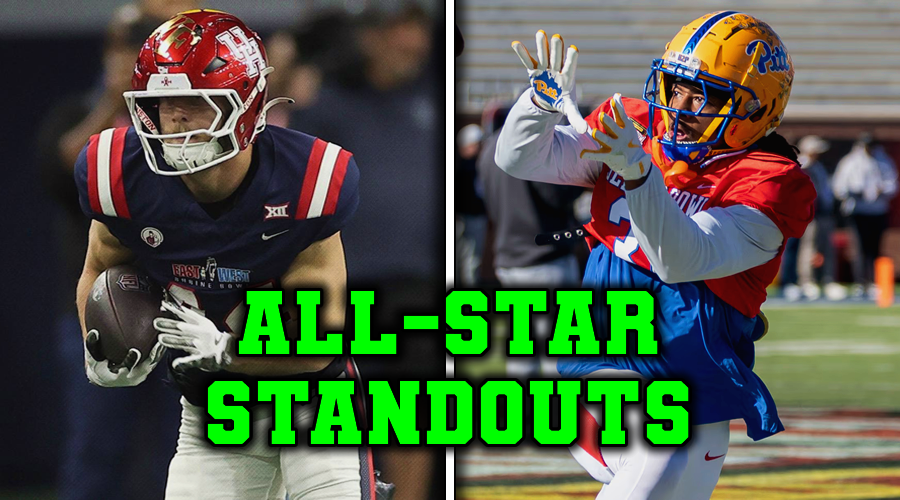
With the Patriots/Seahawks being crowned Super Bowl LX champions, we turn the page and are ready to dive into draft season. I still have a video coming out next week on some of my favorite fits for pending free agents, but some key events on the calendar for this next crop of young talent have already taken place.
So today, I want to talk about upcoming draft prospects, who stood out at the East-West Shrine and the Senior Bowl – ten on offense and defense each. I’ll talk about what I saw from each player throughout the week, some questions they might’ve answered while being asked different things in practice than what they did during their college career, and how it’ll help boost their draft stock. Plus, I listed twice as many names as honorable mentions at the end, since just showing up and competing gives all these guys another chance to stand out to scouts and other NFL personnel.
Let’s talk about it!
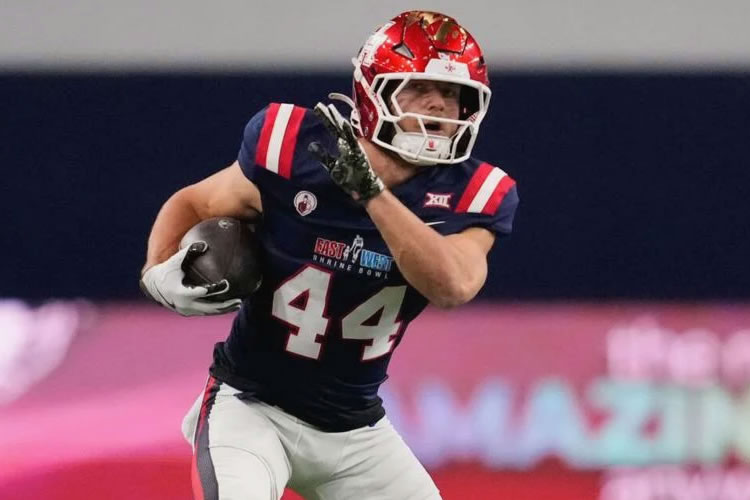
Running back – Dean Connors, Houston
I was very close to putting a pair of Shrine Bowl running backs on the list, since Navy’s Eli Heidenreich showed off his two-way ability of running away from linebackers during one-on-ones and also spot rushing lanes between the tackles throughout the week. However, Connors was even more impressive for the West team. Based on the official measurements, he actually came in two pounds heavier than his listed weight with the Cougars (208), standing just under six feet tall. However, I immediately thought he had trimmed down from what he looked like during the season and his movement skills indicated the same.
Having caught 139 passes over the past three seasons combined at Rice and then Houston, he’s been very involved as a receiver, but his fluidity in setting up his routes and not wasting time when changing directions stood out to me. Multiple times he did well to freeze linebackers with quick feet at the break point and separate from LBs, plus then he consistently displayed soft hands throughout those drills, with one focus drop being the only bad moment for the week. That came after beating Miami of Ohio’s Jackson Kuwatch across his face however, who I think made a strong case for being the top coverage player at that position. And right after, he flashed surprising burst to run by someone else on a litter stutter-go. His pass-pro session was more of a mixed bag, where he overextended at the point of contact early on, but when he was able to sit in the chair and slide his feet, he was largely able to take care of business. As a rusher, he did well to play behind his blockers and get defenders covered up with the way he positioned himself. On day two, he had a couple of nice moments of bending back zone runs and won the initial contact with linebackers trying to slide into those lanes. Connors was voted to the West All-Practice Team and finished off strong on gameday. He may not have been offered a lot of room to operate, but he churned out some tough yardage through contact with his physicality. He recognized when he could bounce around the edge, cutting back a duo run for a touchdown at the goal-line, and then bailed out his quarterback by making a couple of defenders miss on a third-and-long after catching a checkdown.
Although it was a good week-and-a-half for running backs between these two main all-star events, generally there’s nothing like a defined order beyond the one star prospect in Notre Dame’s Jeremiyah Love in this class. Connors having the size and showcasing such a complete skill-set should help him move up the ranks, considering he’s currently projected to go undrafted, based on consensus boards. I was already a fan of his coming in, but I feel much better now about him potentially becoming a legitimately viable RB2 for some team.
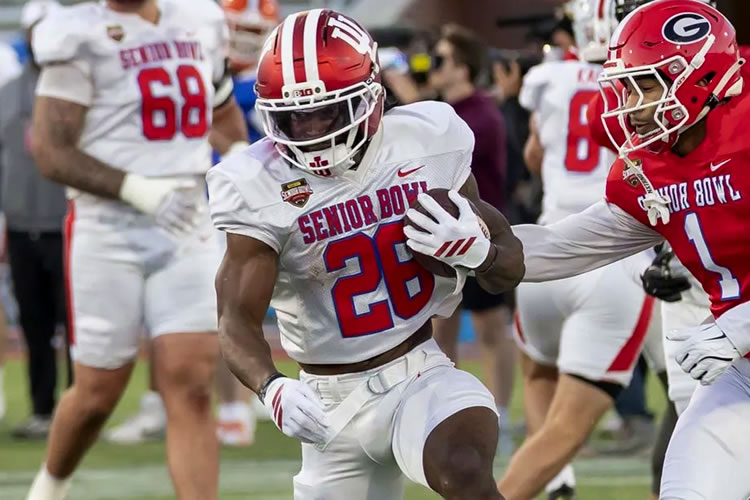
Running back – Kaelon Black, Indiana
Switching over to the Senior Bowl, I thought the competition for who’d get a shoutout here was even tougher, with different profiles being brought to the table. The compactly built Black (under 5’10”, 208 pounds) to me elevated himself above the rest of the group thanks to how he was able to excel in all areas and the effort he brought to the table, starting just eight days after winning a national championship at the end of a 16-game season with the Hoosiers. He appeared as hungry as anyone at the event, trying to further prove himself.
Considering the space that’s afforded to running backs against these linebackers during one-on-one sessions, it obviously favors the offensive players, but Black seemingly won every single rep all week long when he ran routes. Regularly, he’d be more measured in gliding up to the defender, then flashed good twitch and really jammed his foot in the ground to gain separation, breaking 90 degrees in or out on option routes. His opponents, multiple times, looked like they were stuck in quicksand. Now, he did pretty consistently body-catch passes rather than actually extending and plucking them away from his frame, but it never looked as if he had any issues with bringing those in, with one ball being ripped out by someone right on him as part of a late checkdown, which resulted in an interception for the defense. When the script was flipped to give the defense the advantage on blitz pick-up period, Black did have some balance issues, but at least did well to land first contact and keep battling during pass-pro drill. Running the ball during team periods, he displayed appropriate pacing and some nice wiggle on the inside, but also bounced a couple of times when the contain defender got undisciplined. What speaks most glowingly to the player might’ve been what he did on gameday however, as you couldn’t tell at all how long a season he had just gone through with how hard he ran, constantly churning out yards after contact and allowing his offensive line to drive the pile forward.
Between him and former teammate Roman Hemby, both Indiana running backs were already projected to come off the board some time on day three. Yet, the fact that Black’s efficiency never dipped under head coach Curt Cignetti at James Madison or in Bloomington, as his opportunities increased, and he continued to put in great work all-around in this setting, it’ll be easy to make a case for him over some other names once teams get to that point in their draft rooms. The kind of hammer he was in short-yardage situations last year, the fact that he never lost a fumble in his career and dropped just one of 54 catchable passes, certainly helps as a baseline.

Wide receiver – J. Michael Sturdivant, Florida
Considering UConn’s Skyler Bell only participated in one practice, outside of a duo of LSU wide receivers to some degree, this group at the Shrine Bowl was missing star power. So, who was able to help himself the most? I’d throw out a fifth-year senior, who played for three different universities and averaged just over two catches this past season. After very limited action as a true freshman at Cal, he basically totaled 100 grabs for 1350 yards and 11 touchdowns over the latter one there and his first at UCLA, drawing my attention as an eventual draft prospect. That was delayed by a couple of years, in which his production dropped quite significantly, going back to the Bruins and then his one season with the Gators. On this stage however, he made scouts wonder if that was more so connected to the lack of consistent quarterback play during that time.
At just over 6’2”, 209 pounds, I thought he did really well to use that longer frame to his advantage in deceptive ways. I really liked seeing him step onto the toes of DBs, adding little head fakes and creating separation out of his breaks. When playing with extensive cushions, he got guys off balance with deceiving route stems and getting into these wide, elongated steps before committing to where he was going to go. There was one moment on day two where he truly showcased those advanced skills, as he purposefully made his head slightly lag behind as he broke back out to the sideline to cleanly beat the corner on a shake/deep out route. That was following a pair of curls, where he slow-played for a couple of steps and then hit the gas before putting on the brakes. On the first of those, he forced Nebraska CB Ceyair Wright to completely mug him, yet still finished a super difficult catch through contact. He beat the same guy – who had a strong week against everyone else – the following practice, when he really sold a hard inside jab to open up a path for the goal on a fade into the end zone and finished with a nice over-the-shoulder grab. During team period, he made sure to quickly secure and protect the ball on passes into closing zone windows and had a couple of sweet high-point grabs for touchdowns during the final seven-on-seven session in full pads. His only bad drop came on a ball that was slightly high and behind him on day one.
I know Sturdivant will turn 24 years old a few days before his pro debut, but if he puts up solid testing numbers, he should at least be ranked above multiple other names that were also down in Dallas for this event, rather than being on the fringe of getting drafted altogether. To me, he’s a name that’ll continue to rise as people actually evaluate him individually and try to separate him from the situations he found himself in.
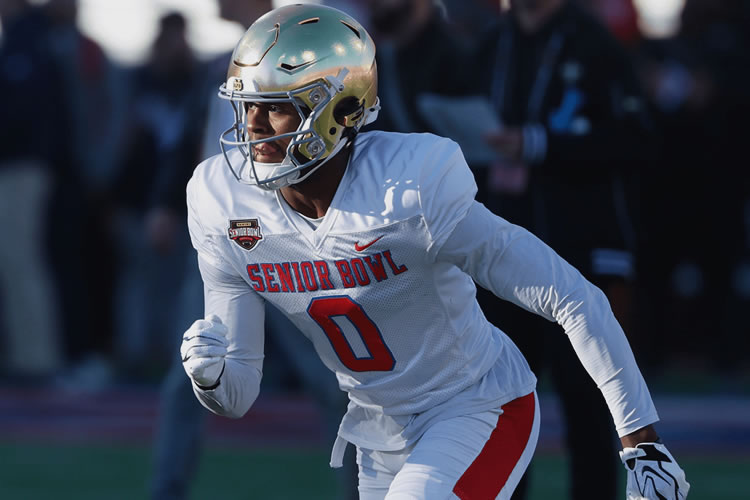
Wide receiver – Malachi Fields, Notre Dame
As we transition to the Senior Bowl, outside of wide receivers who are projected to be first-round picks, just participated in the National Championship game or are currently injured, most guys who got the call actually showed up. Over the first two days of practice, you can easily argue for a Tyren Montgomery from Division-3’s John Carroll as the biggest standout at the position, but in terms of athletic profile combined with how steady his performance was throughout the week, I’ll go to the Independent FBS school that everyone’s fully familiar with.
A Virginia transfer coming off back-to-back 800+ receiving yard seasons, Fields coming in at 6’4”, 218 pounds with about 32.5-inch arms, largely impressed with highlight reel catches down the field this past season with the Fighting Irish. He did flash that on day two as well, when he was able to gracefully track and hold onto the ball with his outstretched fingertips on a Willie Mays-like catch off a post route during team period. And yet, he made people take notes about his quickness early in routes, how cleanly he got out of his breaks and was able to drop his weight effectively for a big wideout down in Mobile. On the very first one-on-one rep of the week, he was able to stack and slightly push off with a straight-arm on Texas cornerback Malik Muhammad for late separation and a touchdown on a go route. That would in no way be the only time he got the better of the former Longhorn, as he was able to gain the early advantage on a slant and then a dig route by being elusive off the line, before he capped off the second practice by snapping him off a beautiful curl route, after selling the take-off. Along with how effective he was during one-on-ones, he was a quality option against zone coverage when the full 11s square off against each other – both in practice and on gameday. Routinely, he’d settle down in soft spots or sit down between hook defenders on crossing routes, before displaying strong hands by snatching those passes and immediately piercing up the field. Field also managed to work his way open at the end line for the two-point conversion on the second touchdown of the game. The only thing he could’ve done better was to not allow his hands to get outside the frame of defenders as a blocker, particularly during that two-on-two screen drill, but his competitiveness in that area was actually a positive in my general notes on him.
Based on the size-speed combination, Fields was already a recognizable name in this draft class, but considering how impressive he was at winning quickly in his routes and how well he operated against zone coverage, paired with what he’s capable of when the ball is up in the air, he might’ve secured himself a spot in the top-50, as long as runs sub-4.5 at the combine.
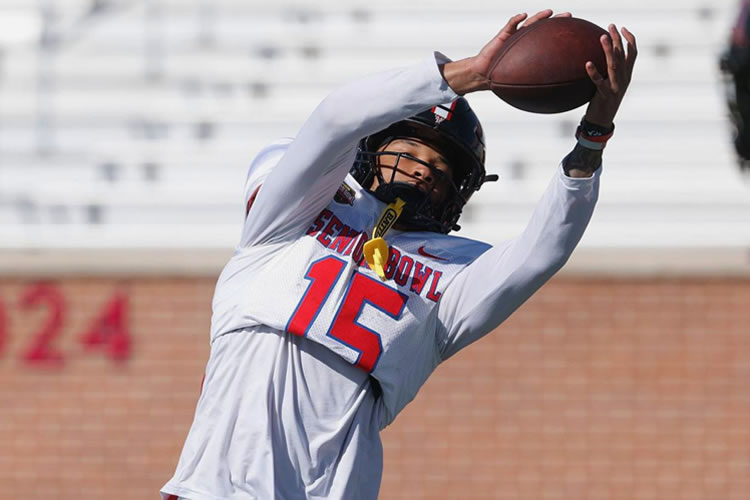
Wide receiver – Reggie Virgil, Texas Tech
Settling on the final one of three receivers, I kind of limited myself to here, wasn’t easy. I already mentioned small-school standout Montgomery and listed a few others below, but I ultimately settled on Virgil, considering he wasn’t really looked at as a household name yet. Even at the Senior Bowl, he came in alongside teammate Caleb Douglas, who led the Red Raiders in receiving yards, while Virgil just edged him out in total touchdowns (eight) for the Big 12 champs.
At two inches shorter and 30 pounds less than the previously-discussed Fields, this guy needed to get defenders off balance and provide easier access for himself against defensive backs in this one-on-one environment without that powerful frame – and he absolutely did. On multiple occasions, he challenged those opponents with a sudden one-two jab and won the outside release, before catching a fade with late hands, even if the throw invited the defender back into the picture. On day two, he just blew past a good corner in UNC’s Thaddeus Dixon on a go ball, where he nicely slow-played the release momentarily before window-wiping away the hands and showcasing that top gear in order to gain 4-5 yards of vertical separation when he actually secured the grab (hitting nearly 21 MPH on the GPS). When they moved to the red zone for such a session during the final practice, Virgil did get a bit excessive with his footwork on three straight fades, even if bad throws on two of those didn’t allow him to stay in bounds. I did like how he maintained space to the sideline and positioned himself to look the ball in over his shoulder on those in general. He did showcase his instincts for the position and was very involved during seven-on-sevens and other team-centric periods as well. You saw that in how he paces his routes vs. zone coverage, creating space for himself in front of defenders who were responsible for the deep parts of the field by selling the vertical push before cleanly coming out of his routes, choosing the right angle on corner routes, forcing guys to interfere with him when the ball was thrown behind him on crossers, and continuing to work back down the ladder and catch a curl late as the quarterback came back to him late during team drills at one point.
Unfortunately, the National team didn’t have his services in the actual game, as their offense struggled for the most part, but Virgil did enough across three days of practice to intrigue with his ability to find success against both man and zone coverage. This was a primary outside receiver in college, who also forced 12 missed tackles across 57 catches last season, but might not have gotten enough opportunities in an offense that heavily relied on the run game to close out wins.
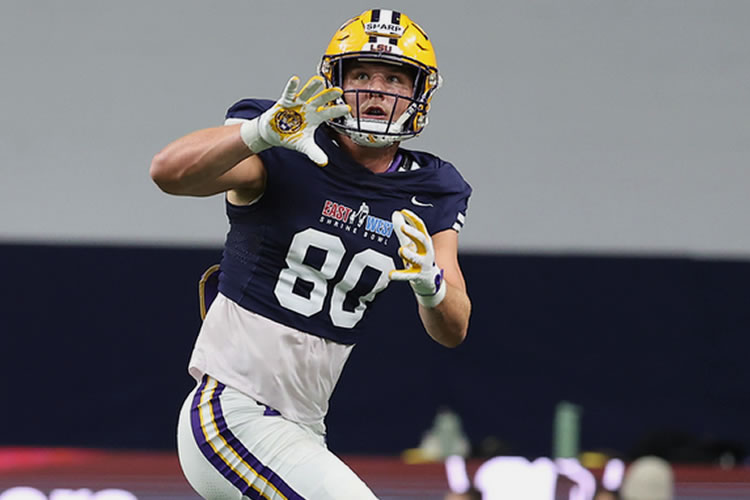
Tight-end – Bauer Sharp, LSU
Although there were a few tight-ends who showed out pretty well in Mobile, those guys letting down quarterbacks by failing to bring in targets on gameday left a sour taste in my mouth. So instead, I decided to highlight the lesser-known name among a trio of former receiving options from the Bayou. Sharp didn’t receive any stars from the major recruiting services coming out of high school prior to spending a year at both Oklahoma and LSU, where he combined for 66 catches worth 576 yards and four touchdowns. He showed scouts that he could be an asset with and without the ball.
First and foremost, this young man showed up an inch shorter but seven pounds heavier than what the Tigers had previously listed him at (6’4”, 251 pounds). Working those individual matchups against safeties, I thought he did a nice job attacking leverage and keeping his shoulder square before sticking his foot in the ground and securing targets. He displayed good focus to both deal with contact early in the route and to finish with tough catches. You really saw on a pair of full-extension grabs over his head during the seven-on-sevens in the day three red zone session, and he also made a great jump-ball catch on an underthrown corner route in an earlier practice, where he did have a step on the linebacker. When he joined the offensive line for pass-pro drills, he put together a pair of excellent reps against New Mexico EDGE Keyshawn James-Newby, where he first guided that guy beyond the arc, with good timing on his strike with the outside hand, and then gathered his feet to not get caught on a little in-and-out move. For his efforts, he was voted as the tight-end of the West All-Practice Team, and later on, we also learned that he had reached the second-fastest GPS-timed speed of ALL players throughout the practice week (21.19 MPH).
So even though the statistical profile leaves you a little uninspired, adding the context of LSU having excellent primary receiving TEs each of the last two years to limit Sharp’s production, him standing out in this environment, including as blocker, and the raw speed he has, he’ll make people go back to the tape, especially if he backs that up at the combine. Adding in how comfortable he looked wrapping around or sifting across the formation on run plays, some teams may circle him as a TE3 on day three, who could end up moving up one spot on the depth chart, after he did play over 600 offensive snaps for the two SEC programs he was a part of. That’s especially true with the recent rise of 12 and even 13 personnel, where you need guys on the field who are at least functional in-line blockers.
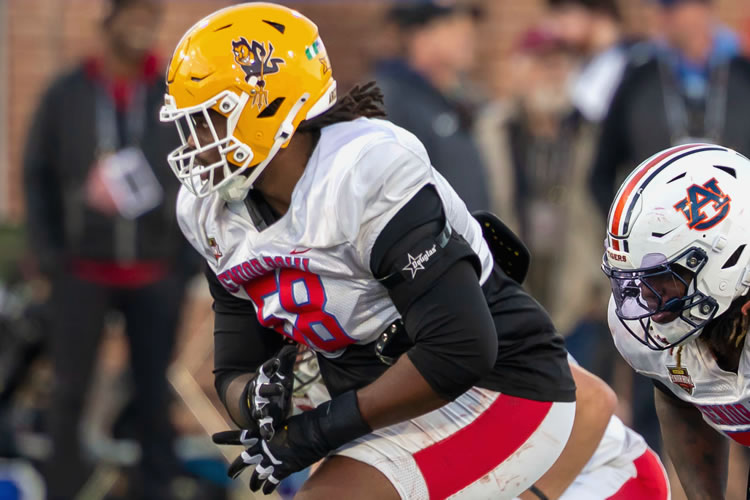
Offensive tackle – Max Iheanachor, Arizona State
Moving along to the offensive line, these all-star games probably provide as much of a stage for these tackles to stand out in a positive but also a negative sense as any position, outside of maybe the WR-CB battles. Being asked to flip sides and being on as much of an island against some of the premier edge rushers in the country (even considering the two Miami guys didn’t end up going, due to participating in the National Championship), isn’t an easy task by any means. And yet, Iheanachor handled that challenge about as well as anyone could.
Above anything else, just how easily he carries those 325 pounds across his 6’5”-and-a-half inch frame, with nearly 34-and-a-half inch arms, will intrigue any O-line coach in the league. Outside of that, what anyone taking notes actually wants to see from these OTs is how much they improve throughout the week, as the defense typically has the upper hand early on, and Iheanachor seemingly was on a completely linear track up to gameday, where he truly shone. As you look at all the talent on this American squad, with names like Illinois’ Gabe Jacas, Missouri’s Zion Young and Michigan’s Derrick Moore – who all received mention in this very article – none of them decided the majority of matchups against the former Sundevil in their favor. When opponents tried to win with speed around the corner, Iheanachor guided them past the quarterback. If they tried to convert to power against him, he was able to pop his feet back and re-anchor. He did lose on a couple of up-and-under maneuvers, but also shut down at least as many by quickly getting his post-foot down to take away that inside path. What I appreciated the most was how he sit back in his space and didn’t “chase” rushers who got off their tracker, and actively pulled his hands back at times, in order to not have them swiped away, as it happened to him a little bit in the first practice session. His urgency off the ball to erase the B-gap and create movement on combination blocks on the backside also stood out on a couple of occasions during team drills, and he actually collected a pancake on one of those, when he arrived from the side on a three-technique in the actual game. That’s along with displaying impressive mobility, pulling out to the corner on a toss play on each of the first two drives, and either striking with the outside hand to take the fight to or giving ground to edge rushers, who tried to dance with him.
The steady growth throughout the week in combination with prototype measurements/athleticism for the premier offensive position outside of quarterback, will cause Iheanachor to shoot up draft boards, after a rather lackluster season for ASU. When it’s all said and done, I won’t be shocked in the slightest if he ends up hearing his name called on opening night.
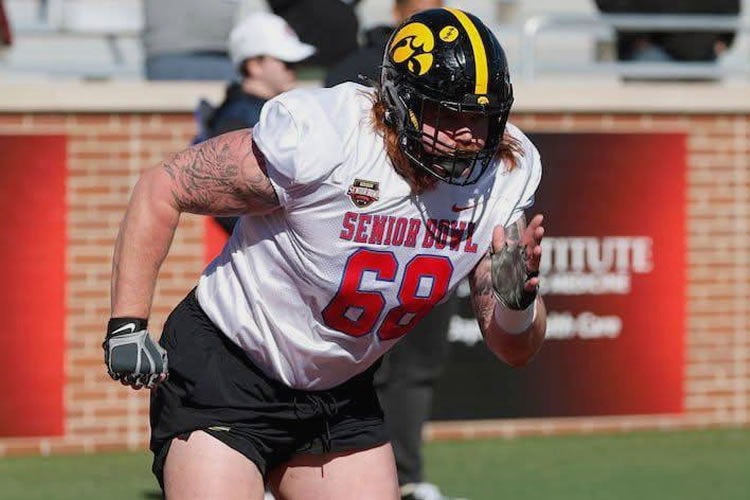
Offensive tackle/Interior O-line – Gennings Dunker, Iowa
Next up, we have another Senior Bowl star, whose ultimate position in the pros isn’t as defined, but was already liked pretty universally by the scouting community, it felt like. Coming to Iowa as just a three-star recruit in 2021, whose first start didn’t come up until the closing bowl game of his second season, Dunker went on to become a stalwart at right tackle for the Hawkeyes, and now left a mark with his play down in Mobile, as much as his looks, with the fiery red mustache-mullet combination.
Coming in half an inch shorter and basically 30 pounds heavier than what he was listed at on the official team’s website (6’4”-and-a-half, 320 pounds), you’d assume Dunker received feedback that the league primarily sees him as a guard. Yet, with 34-inch arms and 10-inch hands, considering how much he held his own when put on the edge, he at the very least allowed some teams to leave both doors open. What popped straight away, regardless of where he ultimately lands, is how this guy can impact the run game. Whether one-on-one or working different combination blocks in these run-centric drills against the defensive line, how he exploded into and rolled his hips through contact in order to create movement is textbook stuff. He flashed on several occasions that way in team periods as well and did so with an edge, making sure defenders knew he just violated when he handed out that final extra shove. However, I thought he put in excellent work in pass-pro as well, regardless of where he lined up. Dunker was able to sit down against the bull-rush of guys like Penn State D-tackle Zane Durant inside and generally did well to stay square, not giving anyone access to the edges of his frame. Out at tackle, he did well to frame rushers, give ground slowly, and if he did lose, it was only very late in the down. His firm strike was a tool he regularly deployed to push guys trying to win with speed onto a longer track, and he was able to stay connected with them for extended periods, either as they tried to dip-and-rip underneath him or wanted to counter back inside.
Ultimately, in an NFL environment that exposes tackles to a lot more pure dropback situations than he might’ve been at Iowa, Dunker may benefit from having those bumpers to either side of him and lock up opponents in a more condensed area, but day one he’ll boost someone’s run game and should act as enabler, so a team can get their best five guys out there. I’d be hard-pressed to see him last much longer than one of the first few picks of day two, considering pretty much every offensive line coach around the league probably would like to work with this dude.
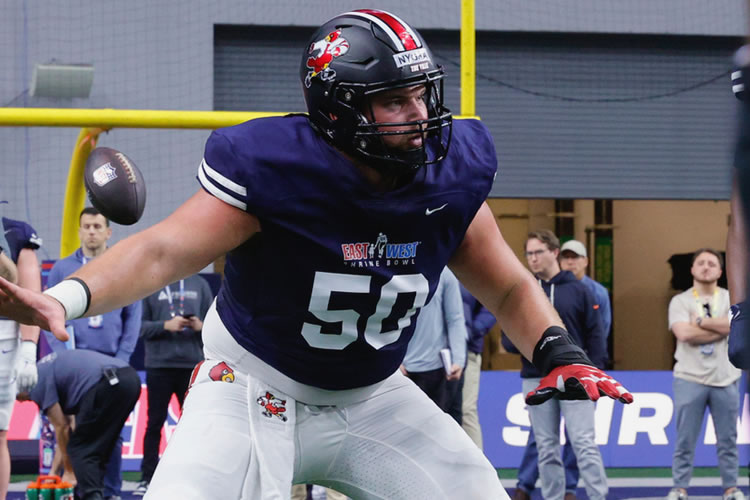
Interior O-line – Pete Nygra, Louisville
Now, looking at someone you feel pretty secure about where he’ll line up in the pros, Nygra represents an O-line group for the Shrine Bowl that has some interesting names, but also had some rough moments on the edges. That’s why sticking with a four-year starter at center – with the first two at Northern Illinois followed by the latter two for the Cardinals – makes a lot more sense here. This wasn’t a name I was particularly familiar with, as he’s still nowhere to be found on consensus draft boards, but he quickly made me mark him down as someone I need to study more soon.
Weighing in seven pounds heavier (302) than what Louisville actually listed him was a positive, but at 6’2” with sub-32-inch arms, Nygra is probably locked into the pivot. And he’s not someone you want to leave on an island against these bull-dozing nose-tackles such as Florida State’s Darrell Jackson Jr., who rode him back into the quarterback’s lap on his first chance in pass-pro. Outside of that, he was outstanding in one-on-ones, however. Routinely, he locked up interior rushers with tight hands and held where the refs won’t see him. When using quick sets, he got onto guys right away and consistently was the one with inside position, slowly gave ground to get the job done during those sessions. Even more impressive were the different techniques and how he applied those to let his movement skills shine. Right away, he made me pay attention when he scooped up N.C. State’s Brandon Cleveland on a quick combo, getting all the way to his outside shoulder as a 2-technique from the center spot. He got his revenge on the previously-mentioned Jackson on day two, when he reach-blocked that guy on a wide zone run. His dexterity and how he was able to bring his base around to wall off first-level defenders after allowing his teammates to climb, by getting himself out of sub-par positions, continued to excite me. Nygra also made sure to instantly erase the space to his guards to unite their force and create momentum on true doubles, at one point on day two, he knocked over a D-tackle by delivering a blow to that guy’s near-hip by incorporate the “gallop technique”, and later on, he got out in front to help spring the back loose for an explosive carry on a sweep play during 11-on-11s.
So this is one of those underrecruited fifth-year seniors, who may not receive a whole lot of attention for being pigeonholed as a center-only, primarily in an outside-zone centric offense. Yet, for teams that major in that run scheme, this may end up being a day three selection that goes pretty much unnoticed by casual observers, but earns a spot on the active roster as a true backup for that spot.
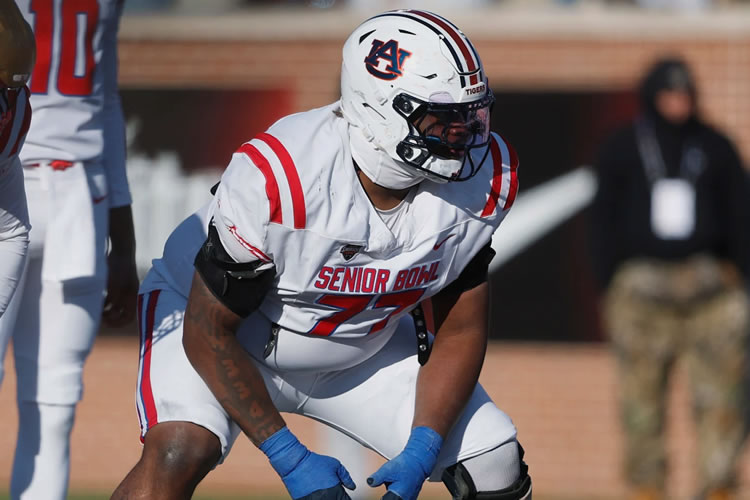
Interior O-line – Jeremiah Wright, Auburn
For the final offensive name on this list, we look at the Senior Bowl once more with a guy from an SEC program that didn’t have a very long drive over, having played in the state of Alabama for the last six years. Coming to Auburn as a defensive tackle, Wright had a slow start to his college career, barely seeing the field as a true freshman and missing the entire following season rehabbing from injury. He did start all 12 games at right guard each of the past two years however, and he looked like a man ready to step up going against the nation’s best.
Part of that was because you’re not going to scare this mountain of a man, when he stepped onto the field at 6’5”, 340 pounds, 33.5-inch arms. On the very first one-on-one rep of the week, he jump set and locked up potentially the first name of the board from this entire crop of players in Mobile, in Florida D-tackle Caleb Banks. That wouldn’t be the only time he got the upper hand on the talented former Gator, as he stunned him by stabbing into his chest later on as well. He did take the fight early to opponents multiple extra times throughout the week, but also showed savvy when he took a more conservative approach, yet flashed the outside hand against guys rushing from the three-technique, in order to force them to commit. Off that, he was able to mirror moves across his face, he pushed aggressive opponents way past the B-gap, and when guys tried to go through him, you saw that’s equally where he wants to be, as his anchor appeared un-breakable. Former in-state rival L.T. Overton from the Crimson Tide learned about that, when he got stone-walled on the one competition rep to end the first practice, as he tried to hit club-rip into a counter spin. Really, his only two clear losses came on the final two-minute drill of the week against another name I’ll discuss shortly in Oklahoma’s Gracen Halton, who first just crashed through the inside shoulder to flash up the quarterback’s face and then put a sweet spin move on him for what would’ve been a sack.
Wright made up for that short lapse to the end of the practice week by keeping a firm interior of the pocket and paving the way for some nice runs on gameday, but he had already done enough to make a name for himself regardless. Center Connor Lew has been the name to know along that Auburn line – deservedly so – but I’d think evaluators will start paying a lot more attention to the guy lining up next to him going forward.
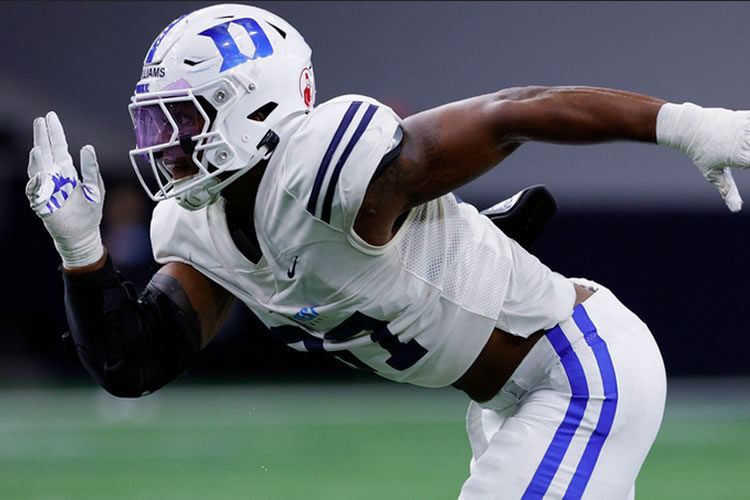
Edge defender – Wesley Williams, Duke
Let’s flip sides of the ball now and start with three “smaller” edge defenders for traditional standards. First up, we’ll look at the guy typically considered third among Duke defensive linemen in this very draft class, and who finished last year with just two sacks across 14 games. Williams nearly matched that total in the East-West Shrine game along – but we’ll get to that here in a second.
From a size profile, this is certainly the least impressive name among the former Blue Devils – with one of the others being with him in Dallas and the other in Mobile – measuring in at a modest 6’3”, 251 pounds with exactly 32-inch arms. Having said that, the juice off the ball and ability to contort that smaller frame allow him to more than overcome that, in particular as a pass-rusher. Williams flashed impressive lateral explosion on a beautifully executed up-and-under move against Ole Miss offensive tackle Jayden Williams on his very first rep in pass-rush drills, including a perfectly timed chop with the outside hand as he followed through. He also showed an impressive ability to turn the corner on other tackles when he was able to time up his hand swipes correctly. Although he did get caught with his weight a little too far out in front and lost his balance at one point. During team periods, even more so, I thought how quickly he recognized and punished guys for oversetting him, when the offense dropped back, is what really popped. Impressively for his size, I thought he routinely set a firm edge in the run game, getting out of his stance well to shoot into contact, along with the triceps strength to extend and control his space. On gameday, he was able to put on the finishing touches. On the first defensive drive, he slipped a block on a zone concept and recorded a TFL, and then barely missed the quarterback for a sack, when he was able to defeat the tackle’s outside hand with a swipe move and turn the corner. Later on, he got loose in on a well-delivered T-E twist and strip-sacked the quarterback in the end zone, which one of his teammates recovered for a touchdown in the fourth quarter.
Personally, I would still like to see this guy mix in with the linebackers on some of the transition drills, to see what he looks like changing directions as someone who might be asked to drop into coverage to some degree at least. Although I did take note of him a few times during the season, Vincent Anthony Jr. across from him is someone I wrote about and certainly was the alpha for a Duke defense that shockingly helped them win an ACC Championship. Comparing what they look like in these two different all-star locations, let’s see who NFL evaluators ultimately prefer.
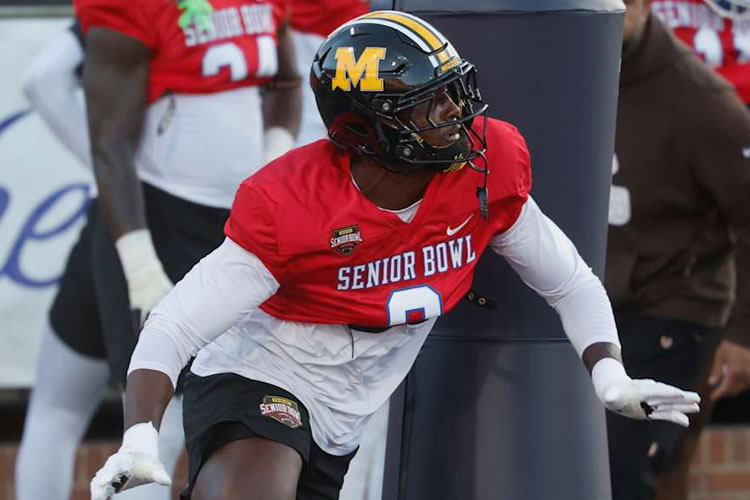
Edge defender – Derrick Moore, Michigan
The class of Senior Bowl defenders on the edge was insanely deep to choose from, and I could’ve easily listed a couple more, with Clemson’s T.J. Parker just missing out after reminding people of why he was projected to be a potential top-ten pick heading into this past season. I limited myself to two guys from the state of Michigan, with the first being a former Wolverine who very much reminded me of the mold of Josaiah Stewart, who was a third-round pick and just had a solid rookie season for the Rams as a rotational outside linebacker.
Size-wise, Moore has a couple of inches and five pounds on his former teammate, at just over 6’3” and 254 pounds, and most encouraging may be that his arms are a full two inches longer (34). He made his presence felt straight away, when he both hands into the chest of Michigan’s massive offensive tackle Markel Bell and legitimately trucked him on a speed-to-power move during one-on-ones, despite being outweighed by about 100 pounds, as he caught the opponent with his feet in bad position. He also turned a tight corner and forced quarterbacks to hitch up into pressure on multiple occasions during team periods later that day. Multiple times during one-on-ones, he was able to lift the outside hand of the guys across from him to access their chest and drive through, plus then he’d follow up well to finish the rep. His most impressive work to me actually came on actual plays, however. That included earning one of the few true wins over Arizona State OT Max Iheanachor on pretty much a straight speed rush, thanks to how well he timed the snap, and beating other guys on cross-face moves, paired with a strong rip-through. The one snap that I remember above all others was when he collected a tackle for like a six-yard loss on day two, meeting the running back on the handoff after being left unblocked from the backside, with his tackle pulling. And he also regularly chased down quarterbacks pulling the ball on bootlegs or scrambling, as he disengaged and rapidly accelerated to take away angles for them to escape.
Moore wasn’t the only Wolverine that made noise at this event, as he sat out the game, in which former teammate Rayshaun Benny on the interior D-line officially only logged one tackle, but made his disruptive presence felt throughout the afternoon. Although the top-end talent for Big Blue may not be quite as impressive as it has been in years past, they have several defenders in this class yet again, and Moore should be the first one off the board, probably somewhere in round two. Unless some concerns I didn’t previously come away with pop up on my re-watch, that’s where he should land for me.
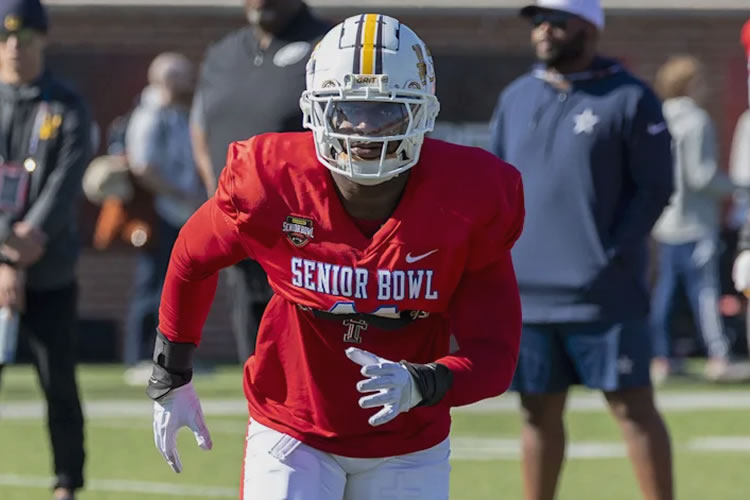
Edge defender – Nadame Tucker, Western Michigan
For the final pick from the edge group, I actually went with the smallest one of the bunch, both in terms of his actual stature and having played for a MAC program. Standing at just 6’1”-and-a-half, 246 pounds with 32-inch arms, the conference’s Defensive Player of the Year collected a pair of sacks in the season-opener against Michigan State with the Broncos, but otherwise saw very limited action against Power Four competition, previously at Houston, and had plenty to prove on this stage. I’d say he more than stepped up to the challenge.
Just watching Tucker go through the hoop drills during individual drills, you saw great bend, which directly translated to him getting around the arc on tackles as a pass-rusher. Having said that, I was really blown away by his footwork to create easier angles for himself. On day one, he beat Texas A&M’s Trey Zuhn III like a drum on a nice inside swim move during one-on-ones, and then in the second practice, he pulled off a beautiful euro-step style move, after hesitating momentarily, for what would’ve been a sack in a live game during the full team session. He actually nearly hurt the quarterback with a low hit on the last third-down play later on, but only because he ran so badly through the left tackle Carver Willis (Washington) the next time he stuttered his feet, leading into a bull-rush from a wide nine alignment. For an undersized edge defender, I thought he brought great physicality in the run game, especially when it came to handling tight-ends, rocking those guys back a few times when they mixed in for run-blocking drills. He also barely allowed someone else to get a hand on him when he spotted an opportunity to crash off the backside of a duo run for a TFL in the final team period. Of course, Tucker also showed up on gameday in a big way. First, he cleaned up an effort sack off a game along the D-line, and then he suddenly dipped underneath Boston College’s Jude Bowry, on almost a ghost move, for a strip-sack, to give his team a chance in the fourth quarter.
I actually remember watching Tucker’s Bronco debut against the Spartans and writing down his name in my notes, before seeing him a couple more times with WMU throughout the year. I did get worried about him being another undersized MAC EDGE after a highly underwhelming rookie season by Mike Green, going to Baltimore after setting records at Marshall, but unlike the latter, having one highlight rep where he dumped a tackle he had caught off balance, Tucker put together an excellent all-around week. With solid athletic testing, I think he’ll be a target early on day three, with a lack of clarity in that range for his position right now.
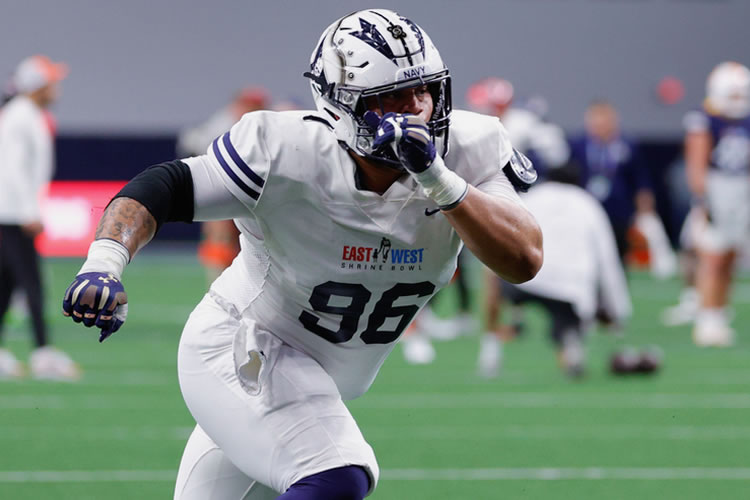
Interior D-line – Landon Robinson, Navy
Moving along to the interior defensive line, although the Naval Academy is obviously a gigantic institution, recognized across the globe, they aren’t known as an NFL factor by any means, based on the level of individual athletes and very specific systems on both sides of the ball. Robinson is even more of a size outlier than the previous name discussed, missing the six-foot mark by an inch, weighing in at 291 pounds, with 31.5-inch arms, but he has a chance to become one of the most impactful Midshipmen in the NFL, with the Shrine Bowl acting as another indication of that.
First and foremost, while the lack of height/length will be a big talking point around this player, you can’t deny how helpful it mostly is for him in run defense. He displayed the ability to play SUPER low against double-teams and not get uprooted during different blocking sessions, along with attacking one man he’s lined up over in order to maintain leverage on his gap. With the limited surface area he provides and how strong his hips are, angular blockers typically had a hard time even attaching for combos, much less actually displacing him (horizontally) on those. That capacity to play underneath blockers also showed up some as a pass-rusher, making it tough for opponents to take him off course. Yet, you saw the hip swivel to tightly get around bags stood out multiple times during individual drills, and it directly translated to him winning cross-face moves where he’d grease his body around offensive linemen, or my favorite rep of day, when he cleanly beat Texas’ D.J. Campbell on a little stutter into a club-rip combo during one-on-ones. Now, he does need to do a better job of not allowing interior protectors to establish first meaningful contact in order to stay in charge of reps, for as sudden as his secondary hand combats are to win late anyway. Robinson also played 33 snaps in the East-West game, including when he single-handedly blew up by a GF counter play, where he slipped the back-block in order to trail the guard and just run down the back for a big tackle for loss.
Navy has had a lot of great defenders throughout its history, but they mostly left a mark with assignment-sound football and instincts. Robinson’s fluidity and suddenness as an athlete, combined with the pure strength at his compact build, make him stand apart from the guys that have come through the ranks. If he were a couple of inches taller and had a similar level of production (14.5 sacks over the past three seasons) for some Power Four program, we’d probably be talking about him being an early day three pick, rather than someone currently projected to go undrafted. I believe we should be talking about him much closer to the first option rather than the latter, given how dominant once again in this set-up.
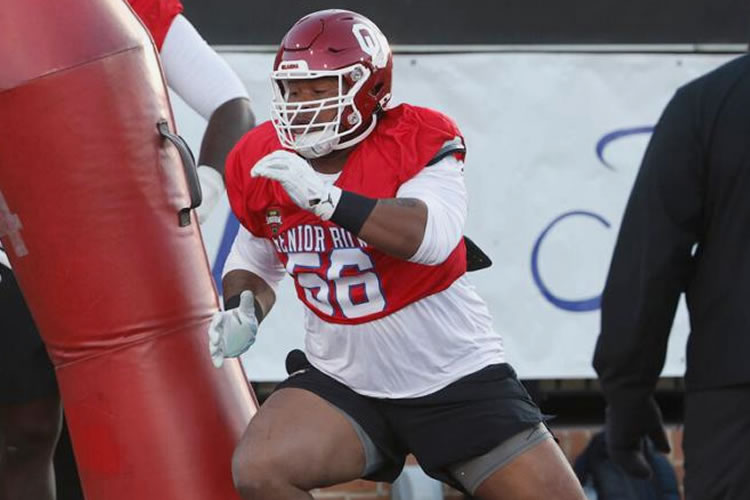
Interior D-line – Gracen Halton, Oklahoma
Now, transitioning back to the crop of Senior Bowl talent, there were plenty of headliner names among the defensive line, in all different shapes and sizes. Of course, without having planned this in any way, I ended up highlighting the smallest one of the bunch on the interior, when it comes to weight and arm length, nearly identical to the previously discussed Landon Robinson (293 pounds with 31.5-inch arms), although Halton did measure in a little over 6’2” in height. Unlike a standout D-tackle from a college better known for what their graduates do beyond football, Oklahoma, under head coach Brent Venables, is well-known for playing quality defense, although especially last season, there weren’t many names accentuated above the unit itself.
Halton really left a mark on me during that first team period, where he came up with a pair of big run stuffs. Initially, he sliced through a quick combo and slid off the tight-end as a five-technique, to get his hands on the ball-carrier, and then he was able to perfectly stack-and-shed the guard as a three-tech, to make that tackle. I thought in general, he did well to contort his body and work against pressure on combination blocks, and it also showed up when he managed to squeeze through the B-gap for a sack on day two as the actual set-up man on a T-E twist. Overall, as a pass-rusher, although you love his quick first step, he did get pushed too for up the field or guided beyond the quarterback when he was trying to win the outside shoulder or work cross-face moves a few times, but the fluidity on his club-swim combo really popped – now he just needed to actually flatten to the passer and not get taken onto a wider track. How quickly he got to his second and even third move must be a defensive line coach’s dream, as he was able to come free on some counter spins and decided the majority of opportunities in his favor. That included probably the only rep where someone truly beat Auburn’s massive guard Jeremiah Wright with power, as Halton won the leverage battle on the bull-rush, before yanking cloth and going around the blocker once he felt him leaning into contact. Plus, I already mentioned those two great snaps he had in that matchup during the final two-minute drill of the practice week, first just shooting through the guards’ inside shoulder for a quick flash up the quarterback’s face and then putting a sweet spin move on him for what would’ve been a sack.
Halton only played eight snaps in the actual game, but did put a hit on the quarterback on his five chances to rush. As we’ve gotten away from watching entire units during the college football season and evaluating individual contributors, I’m looking forward to seeing if I’ll come away equally impressed with the OU D-tackle’s ability to win his gap in the run game and be relentless in his effort as a pass-rusher. He looks like a strong candidate to ultimately sneak into the top 100.
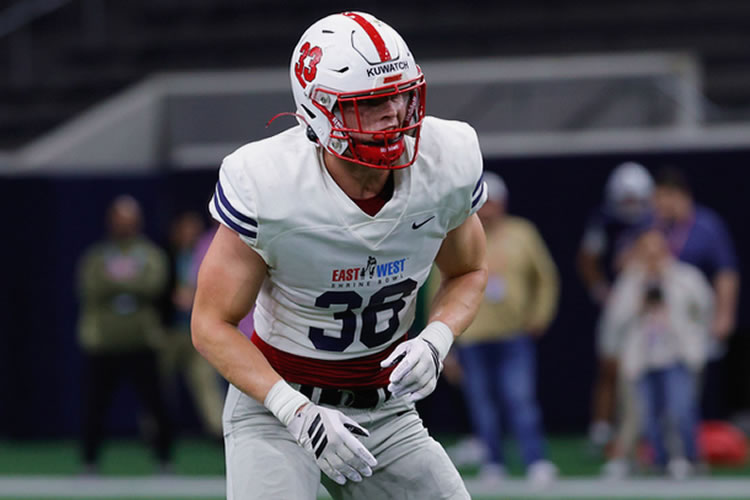
Linebacker – Jackson Kuwatch, Miami (OH)
Jumping back to the second level of the defense, first with another Shrine Bowl standout, you have to contextualize what linebackers can really tell in limited time at these types of events. Defensive structures are rather simplified, in order to allow everyone to play fast, rather than going over run fits and match rules in coverage numerous times. I personally get excited about seeing a couple of guys every year, where I can really feel the presence and command they have over their unit. That’s even harder for someone along a lineup of Power Four players, but Kuwatch elevated himself above names from much better-known defensive programs.
Coming in at 6’3”-and-a-half, 230 pounds, only having 31-inch arms isn’t great for how much length is coveted by the NFL at that position nowadays, but Kuwatch’s strong press-and-pull to rid himself of the trainer holding the bag during individual drills stood out, making that guy lose his piece of equipment a couple of times. I never felt like he was getting eaten up by size when around the point of attack in the run game, and he did a nice job of falling back into the cutback lane on several occasions during team period. Where he really caught my eye, however, was in coverage. You saw an easy lateral mover picking up running backs releasing into their routes, and staying in control of one-on-one reps. His patience and the comfort he showed mirroring guys out of the backfield was the best of the group, where the only time he actually cleanly lost a rep came against the first name on this list – Houston’s Dean Connors – who got the linebacker’s feet to deaden momentarily as he stuttered and cut inside, before luckily dropping the ball. He would get his revenge when sides were flipped, and he smoothly got around the RB on a little jab into a dip-and-rip move in pass-pro drills. Kuwatch’s ability to patrol the middle of the field in zone coverage also shone during seven-on-sevens, quickly thudding running backs on checkdowns and picking off a seam route coming in behind him in the very first session. He never seemed to overreact to play-action, quickly finding work and sinking underneath routes behind him as a middle dropper during team periods. That includes securing more of a lay-up for a pick on an underthrow Hail Mary to close out the actual game.
While I was aware of the Red Hawks making a rather unlikely run to the MAC Championship game, because they largely got their ass handed to themselves by the two Big Ten opponents they faced at the start of the year, and Kuwatch’s 14 tackles didn’t even quite lead the team on that day, as their offense couldn’t move the ball and they were largely just defending the run, I didn’t fully grasp the kind of breakout season the linebacker had. This guy walked on at Ohio State in 2021, but never earned any defensive snaps over two years there, and then just 77 combined over his first two years at Miami (OH), before racking up triple-digit tackles and double-digits of those for negative yardage.
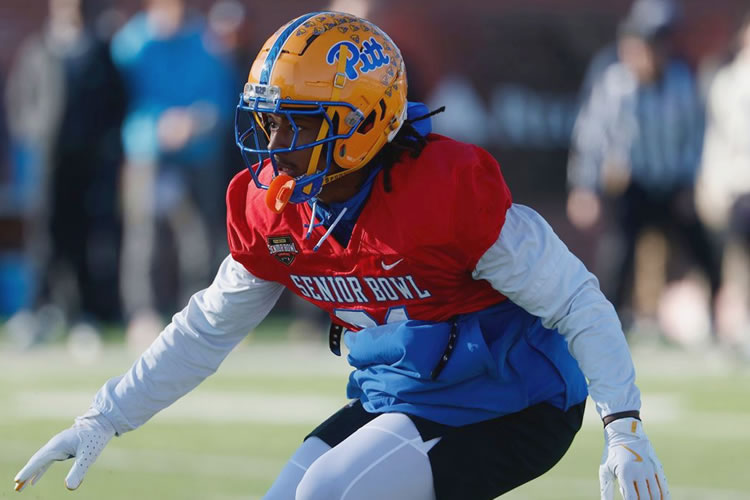
Linebacker – Kyle Louis, Pittsburgh
While I wasn’t prepared for how much Kuwatch would stand out at Shrine practices, I was certainly on alert that Louis could be a rising name coming out of the Senior Bowl. Now, the first day in Mobile wasn’t super encouraging, having a linebacker measure in half an inch short of six feet and 224 pounds. Yet, having 32-inch arms is definitely a plus, and this heavily space-oriented setting at an all-star would enhance his strengths – he more than delivered on that promise.
Unless I missed something going through the tape, the National team only put linebackers against running backs once for blitz pick-up drills. Yet, Louis was able to dazzle with insane bend on a legit ghost move against Clemson running back Adam Randall to close out the session, after already having pulled off a nice cross-face rip move earlier, to really highlight his slipperiness. In team periods, his speed pursuing plays from the backside popped a couple of times, he took care of contain assignments when moved to the overhang/edge of the box, forced blockers to hold him a couple of times due to his suddenness to dip under or side-step them, and at one point, had an awesome TFL, when he recognized an opportunity to shoot the gap and get behind a pulling guard to run down the back. The tape he put out there in coverage though was as good as anyone at that position that we’ve seen at the Senior Bowl in a while. His ability to match running backs through these exaggerated set-ups, going through multiple breaks, working pivot routes, was outstanding. He probably had the best rep of any player for the entire week, when he undercut another an out route by FIU’s Kejon Owens and pick-sixed it. One of his few “losses” seemingly came against Clemson’s Randall, a former wide receiver, who gained a step on him on a slot fade, yet Louis hung in there, turned his head and played through the hands of the intended target for a PBU. He also mixed in with the safeties against the tight-ends, where he might’ve gotten a little too handsy, but showed great body control and ball-skills, with his one catch allowed being a highly contested one up the seam, which he was in perfect position on. On day three, he made a great play sinking underneath a dig route as a middle dropper and breaking up the pass, and then on the two-minute drill, he separated N.C. State TE Justin Joly from the ball going over the middle for what probably would’ve been ruled a fumble.
Louis sat out the actual game, but his ability to cover different body types and how he can immediately shut down potential yards after the catch when quarterbacks dump the ball underneath, at the very least, should make him an intriguing sub-package player for the NFL. I’ll have to study him some more, but I can also envision some looking at him as next in line among these big nickel defenders and not making it out of day two. Texas Tech’s Jacob Rodriguez was another LB with an awesome Senior Bowl, but he also just won basically every postseason award imaginable.
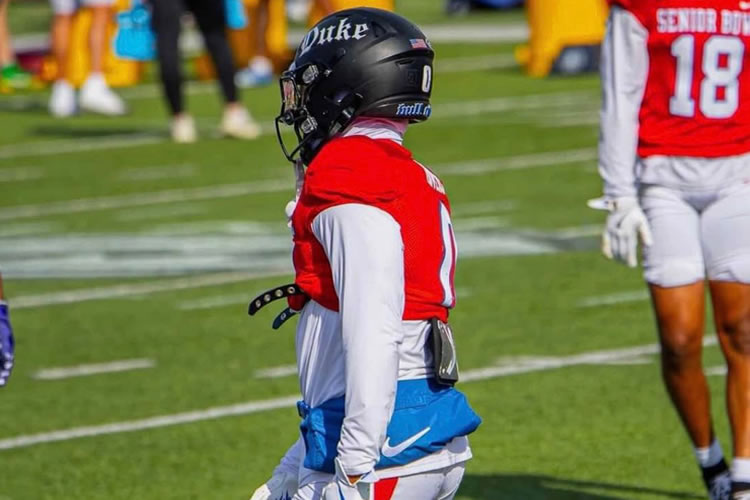
Cornerback – Chandler Rivers, Duke
Talking about undersized players – and defenders especially – became a throughline for me that I didn’t consider at all when finalizing this list, but manifests itself in this next guy, who has the lowest numbers in height (5’9”), weight (185 pounds) and arm length (just below 30 inches) of anyone discussed today. Rivers is someone very much on my radar and among a couple of short corners that I had on the short list of “my guys” when doing my first round of evals during the late summer.
I won’t deny that I have a lot of affection for smaller DBs that are willing to stick their face in the fan and make big plays in the run or screen game, as this young man did throughout his college career. You saw some of that right away in these two-on-two screen drills the National team ran with the wide receivers, as Rivers just refused to get walled off. Later on, he showcased his mental processing when matching guys out of stacks/cross releases, erasing the gap that those naturally create almost instantly. When it comes to one-on-one work, he did get crossed up pretty badly on day two by SMU’s Jordan Hudson, who had a really nice week himself and, on that occasion, was able to really sell the go route before jamming his foot in the ground on a deep in-cut. However, looking at a couple of other standouts from the event – Texas Tech’s Reggie Virgil took that really wide release on a fade, yet Rivers was able to get back into phase, pin down the near-arm and force an incompletion. On day three, he did well to wall off John Carroll’s Tyren Montgomery on the same route on the goal-line, not surrendering any room and actually batting it down himself. Later on in team drills, a safety I’m about to talk about got the glory of coming down with a go ball that the quarterback kind of hung up there, but if you go back to it, Rivers had pinned the intended target perfectly into the sideline, to where that guy didn’t even try to make a play on it. The former Duke standout also had an awesome moment midway through the third quarter in the actual game, when he was playing off and his man from Missouri was sort of hidden behind a stack for a mesh concept, yet Rivers was able to close the gap as he trailed him all the way across the field and tackled him short of the line to gain on third-and-short.
Smarts and toughness are almost mandatory for any defensive back in the NFL today, and Rivers has both in bunches. Height will always be a limiting factor for him, but this guy started three-and-a-half of his four years with the Blue Devils and racked up 16 tackles for loss, 29 PBUs and seven interceptions (of which he returned two to the house). He has great film in the slot and out wide, and he’ll continue to make plays for whoever pulls the trigger on him in the middle rounds.
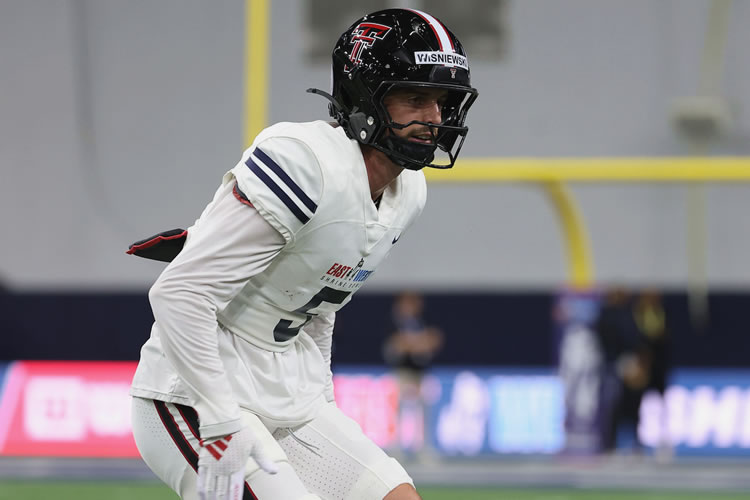
Safety – Cole Wisniewski, Texas Tech
That brings us to our final position group, and I’ll talk about one safety from both the Shrine and the Senior Bowl. Although he was forced to sit out all of 2024, Wisniewski has been on the rise for the last three years plus. After transitioning from linebacker over his first three years, he became a consensus first-team FCS All-American for North Dakota State, then used his final season of eligibility to become a key cog for Texas Tech’s elite defense, and now further cemented his individual ability in Dallas against quality players from other conferences he hadn’t faced yet.
From a size perspective, Wisniewski is actually on the high end of the spectrum for his position at 6’3”, 214 pounds. In the first practice session, he flashed a few times to me, making sure to quickly fill from the backside when down in the box against the run, along with completely blanketing Texas tight-end Jack Endries on a dig route off play-action, on which he broke up the pass. In a more extensive one-on-one session against the TE group on day two, I thought he displayed how well-coached he was with deploying the appropriate movement, whether he was shuffling, used a quarter-turn or when to open his hips dependent on routes, as well as being sturdy dealing with some push-offs, even if he wasn’t quite able to actually dislodge the ball on a couple of reps where he was right there. When he was allowed to actually play with leverage as part of a match-based zone coverage in team settings, he looked even more comfortable, not providing those guys a whole lot of space. He positioned himself well as a deep half safety and clicked back down as soon as the ball left the quarterback’s hand, along with identifying misdirection and picking up guys on delayed releases into the flats. The final practice in full pads may have been his best in terms of isolated coverage, beautifully mirroring both a whip and a dig route by Tennessee TE Miles Kitselman and played through the hands to force a couple of incompletions, and the he optimally stuck in the hip-pocket of LSU WR Chris Hilton a deep out route off an inside release as a slot defender during team period. He was voted to the East All-Practice Team, and then on gameday, he had a sweet PBU defending Georgia Tech WR Eric Rivers on an out route from the slot at the goal-line on the first defensive drive of the day.
Unfortunately, he then dropped a lay-up interception on an ill-advised throw into the end-zone vs. zone coverage, but I won’t let that diminish all the great work he put up throughout the week. If the information I found online is correct, despite being in college for such a long time, Wisniewski won’t turn 24 years old until the end of his rookie season, and he’s continued to raise his level of play as the competition has gotten tougher. For as loaded as that Red Raider defense was, his name should not get buried in a pretty deep safety class.
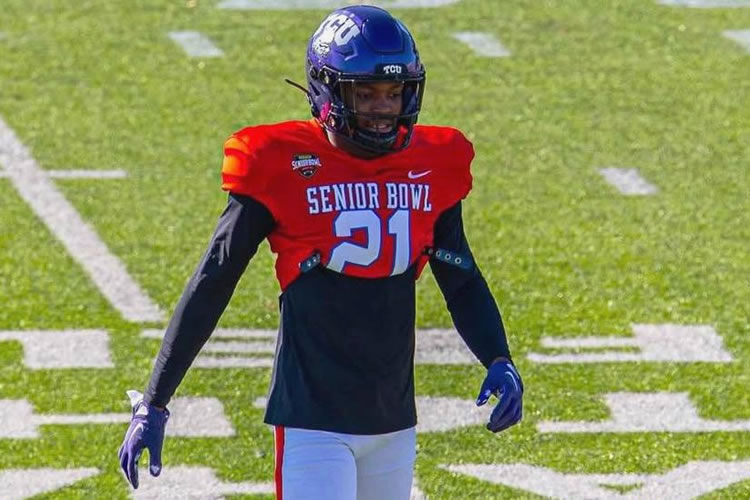
Safety – Bud Clark, TCU
Finally, let’s talk about another guy who’s been at TCU since 2020 and is a well-known name around the Big 12. This dude racked up 14 interceptions (two returned for touchdowns) and 21 more passes broken up across these past four seasons as a starter, but I thought he was getting lost in the shuffle leading up to last year’s declarations, before he decided to push the draft back for one more year, which I didn’t even know he was eligible for. And probably to the surprise of no one, he continued to make plays down in Mobile.
Now, Clark has always been on the lighter side (185 pounds), in the mold of a lot of the safeties we’ve seen from the Horned Frogs through the years, but his height (6’1”) and length (31-and-a-half inch arms) are more than adequate. In that two-on-two screen drill I previously mentioned, he did a great job of either slicing through one shoulder of wide receivers or just fighting through contact in order to help corral the recipient. What stood out during one-on-ones was that it felt like receivers were in control of the route with no contact by the defender, yet Clark didn’t panic, kept his eyes on the opponent’s hips and was still able to contest the (would-be) catch. That was most apparent on day three, when he went up three time against LSU’s speedy Chris Hilton Jr. He couldn’t really get his hands on that guy on a corner route to start off, but then hung in his hip pocket cutting across the back-line of the end zone on the retry when they moved to the low red zone, and also collected a PBU on a slant on decide the battle in his favor. You can argue he got a little too grabby early on a few reps against tight-ends, but rarely actually got flagged, and had one of the best moments of the week, as he kind of mugged N.C. State’s Justin Joly on an in-cut and somehow ended up catching his own deflection with great hand-eye reaction for an interception. He also closed out one of the final team periods for the National team by picking off that previously mentioned go ball that the quarterback let hang up there, with the wideout being pinned into the sideline, where Clark ranged out from the deep post to high-point it. He also finished all three of his solo tackles on gameday, which two would’ve resulted in “defensive stops”.
Going a little more through the Pro Football Focus database, this guy had the best overall grade over the past two seasons (91.3) of any safety not named Emmanuel McNeil-Warren (Toledo) and Caleb Downs (Ohio State), who are both likely going to be first-round picks. I don’t believe Clark has the physical profile to be anywhere close to that discussion, but he’s been undervalued in draft conservations for a while now, I thought, and I don’t believe should make it out of day two.
Others who helped themselves:
QB Mark Gronowski, Iowa
QB Garrett Nussmeier, LSU
QB Cole Payton, North Dakota State
RB Eli Heidenreich, Navy
RB Chip Trayanum, Toledo
RB Kaytron Allen, Penn State
RB Mike Washington Jr., Arkansas
WR Michael Wortham, Montana
WR Tyren Montgomery, John Carroll
WR Jordan Hudson, SMU
WR Lewis Bond, Boston College
WR Cyrus Allen, Cincinnati
TE Lake McRee, USC
TE Will Kacmarek, Ohio State
TE Nate Boerkircher, Texas A&M
OT James Neal III, Iowa State
OT/IOL Garrett DiGiorgio, UCLA
IOL Brian Parker II, Duke
IOL Ar’maj Reed-Adams, Texas A&M
IOL Samuel Hecht, Kansas State
IOL James Brockermeyer, Miami
EDGE Mason Reiger, Wisconsin
EDGE Patrick Payton, LSU
EDGE T.J. Parker, Clemson
EDGE Zion Young, Missouri
EDGE Gabe Jacas, Illinois
IDL James Thompson Jr., Illinois
IDL Tyler Onyedim, Texas A&M
IDL Bryson Eason, Tennessee
IDL Rashaun Benny, Michigan
LB Taurean York, Texas A&M
LB Eric Gentry, USC
LB Jacob Rodriguez, Texas Tech
LB Owen Heinecke, Oklahoma
CBs Andre Fuller & Avery Smith, Toledo
CB Jadon Canady, Oregon
CB Ephesians Prysock, Washington
SAF Myles Rowser, Arizona State
SAF Jalen Huskey, Maryland
SAF Skylar Thomas, Oregon State
 Halil's Real Footballtalk