

As this year’s official NFL top 100 countdown is nearing a close – even though the network pushed back its release by nearly a month – I’m once again presenting my personal version as an alternative. Any content in this format has a certain level of subjectivity, but I believe in my process of putting the list together more so than how the top 20 lists for all the players polled are merged together.
Just as a reminder of what the criteria is supposed to be – a ranking of the best 100 players heading into 2025, regardless of position. Obviously, it’s challenging to not weigh the value of quarterbacks or adequately compare names with very different jobs/roles. However, the aim here to me always is to find the right balance between what someone provides for their specific team and also project how they would fare on a theoretical average franchise, without a defined scheme.
My one quick disclaimer here is that I didn’t include any players coming off long-term injuries, are dealing with pending suspensions or other factors that’ll affect their performance this upcoming season in significant fashion. That’s why the following names weren’t eligible – Christian McCaffrey, Tyreek Hill, Andrew Thomas, Sam Cosmi, Aidan Hutchinson, Alim McNeill, Christian Wilkins and Jeremiah Owusu-Koramoah.
This is what I ended up with:

1. Josh Allen
Not only did Josh finally win his first league MVP, but this is also the time for him to headline this (and hopefully also the official) countdown. He has always been a force of nature, with the ability to launch the ball out of the stadium or run through a linebacker. What he was able to do this past season was maintain his level of explosive plays while lowering the number of times he put the ball at risk. Allen logged five more big-time throws than any other quarterback in the league (43), while having the lowest rate of sacks + fumbles + interceptions of his dropbacks (4.6%). He limited opposing defenses to the lowest pressure-to-sack conversion rate against him last season (8.0%), and what’s crazy about his numbers is that the BTT rate actually rises quite significantly when he’s pressured (11.0%), as his average depth of target nearly doubles.
2. Lamar Jackson
The battle for the number one spot was a tough one, which had already been illustrated previously when Lamar was named first-team All-Pro before Josh earned MVP honors. Outside of 2021 – when he missed five games – offenses quarterbacked by the Ravens’ dynamic dual-threat have been a top-rushing attack in every year with him as the starter, and he just put together his best season as a passer from the pocket. His big-time throw rate (6.3%) was four times as high as his turnover-worthy play percentage (1.6%) – those numbers were fifth-highest and second-lowest league-wide respectively – and he finished behind only Josh in EPA per play (0.296). We can debate if he’s been able to match that level of play in the playoffs, but the central moments in their last two exits were a fumble and a drop at the goal-line each.
3. Saquon Barkley
There’s a good reason why I and many other fantasy managers won their leagues this past season by investing in Saquon. I thought putting an all-time talent to run behind the league’s best offensive line was going to bring fireworks all the way – even if the quarterback “stole” several goal-line touchdowns. Barkley set the record for rushing yards in a single season, including playoffs, at 2504 yards. The after-contact numbers weren’t crazy for Saquon, but he maximized what the elite blocking provided him. He led the way with a 44.2% breakaway rate (percentage of production on 15+ yard carries), while finishing second in both missed tackles forced (83) and yards per carry (5.7) among runners with 100+ attempts. His improved pacing on gap concepts and then the acceleration once he had a crease often set up huge runs to close out wins.
4. Ja’Marr Chase
While I do believe it’s a two-man race for the title as WR1, it’s pretty easy to make a case for Chase here, as he just earned the NFL’s triple crown for receivers with 127 catches for 1708 yards and 17 touchdowns. Having that chemistry with Joe Burrow since his early LSU days is a huge component, but the individual growth in how much more versatile his usage is now, is at least equally important. The only real point of critique is Chase’s 7.3% drop rate, but the reason I’m willing to put him just ahead of his former college teammate is that he’s more of a threat to turn a routine catch into an explosive play. He forced 24 missed tackles last season, averaged 6.3 yards after the catch despite his massive workload, and didn’t fumble once. Plus, he’s also been a massive threat in the red zone, reaching the end zone 46 times in 61 career games.
5. Justin Jefferson
Now, for as impressive as Chase’s production has been through his first four seasons, Jefferson has actually outdone him slightly with one more year in the pros, as he’s averaged nine more yards per game (96.5 YPG) for his career. Until the recent rise of Jordan Addison as the number two in Minnesota, I’d argue those guys relied even more on Jettas, but the efficiency at his involvement is what jumps out. He’s finished each of his five campaigns with at least 2.5 yards per route run, and while he’s more elusive than truly explosive with the ball in his hands, he actually has come down with more passes through contact, so far posting a 51.8% career contested catch rate. The way he can disengage his upper and lower half to keep DBs off balance as a route-runner makes him “the guy” I’d choose to win one-on-one in a must-have situation.
6. Myles Garrett
Although I believe you can argue that someone should push up into the top five, Garrett is my top-ranked defender here just outside of it. That kind of was reflected in a somewhat odd Defensive Player of the Year race – without trying to take anything away from the winner, who’ll follow here soon – as no one had a truly dominant season on that side of the ball. Still, Myles was able to become the first player in NFL history to finish with 12+ sacks in six straight seasons, while also leading the way with 22 tackles for loss. Taking out Aidan Hutchinson’s dominant start to last season, before being lost to injured reserve, no other defender earned a higher grade from Pro Football Focus (92.3), despite receiving almost no help from the offense, to put him into advantageous situations for rushing the passer.
7. Patrick Mahomes
I literally said that “a case [could] be made for a different player [than Mahomes] to top the list” last year, after a challenging offensive season in Kansas City, but his incredible run to his third Lombardi Trophy would’ve made me feel bad about putting anyone else there. It’s much easier this time around for me to drop him all the way down to seventh, as he fell to tenth in both EPA per play (0.165) and dropback success rate (50.9%). While the lack of downfield threats absolutely contributed to this, the Chiefs have now gone from an offense that embraced the transition to a more uber-efficient approach against two-deep shells to one that struggles to capitalize on opportunities for explosive plays through the air against man-coverage. The king of pressure-to-sack conversion rate becoming average in that metric (17.0%) was a major component as well. What remains special – Pat had two more fourth-quarter comebacks (five) and game-winning drives each (seven) than any other QB in the league.
8. Micah Parsons
For as freakish as the flashes are for Micah, I do believe he’s pretty firmly behind Myles Garrett for the title as EDGE1 coming into next season. Having said that, it absolutely just feels like it’s a question of *when* he will have that complete season that leads to him taking home some more hardware. He’s earned PFF pass-rush grades of at least 91.6 in all four seasons in Dallas, and logged 12 sacks in each of those (while missing five weeks last year). This is someone you simply can’t leave unblocked on the backside of run calls or leave in isolated matchups against relatively slow-footed tackles when dropping back, because he can wreck the game otherwise. Now it’s time for him to take that one more step as a technician getting after the quarterback.
9. Patrick Surtain II
That brings us to the actual reigning Defensive Player of the Year. Surtain put together a highly impressive resume individually, hauling in four interceptions, of which he returned one the full 100 yards, along with 11 more PBUs, while only the Texans’ Derek Stingley Jr. was charged with a lower passer rating in coverage at corner (61.1). More importantly however, he did so in service of the league’s number one defense in terms of EPA per play (-0.100). Other than not travelling into the slot for the most part, he’d routinely be in man- or match-assignments against the other team’s top wideouts and largely shut them down. On top of his outstanding coverage, he didn’t miss a single one of his 39 attempted tackles.
10. Dexter Lawrence
If not for 0.1 points in PFF’s metrics, Lawrence would’ve finished with an elite overall grade for the third year in a row. Missing the last five games of the season didn’t allow him to match his previous totals statistically, but he was just under the pace for posting at least 60 QB pressures for the third straight time as well, and his production from the nose puts most of his peers to shame, all while facing a D-tackle-high 74.5% double-team rate in passing situations. He still was able to log a career-best nine actual sacks, and although the Giants D wasn’t particularly successful against the run as a unit, Big Dex was eating double-teams with regularity. You can argue that the difference between him and the next-closest player at his specific spot on the field is as large as it is for any in the league right now.
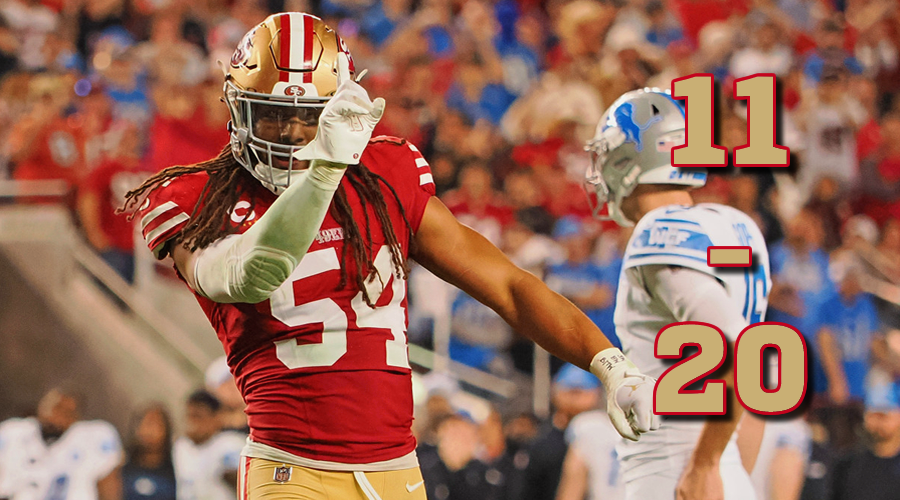
11. Fred Warner
If there’s one other position that could be argued for there being as big a gap between numbers one and two, linebacker comes to mind. Due to the emergence of Zack Baun as a versatile chess-piece under Vic Fangio in Philadelphia, I won’t declare it quite as such, but Fred has been the gold standard for the last four years now. The ability to elude blocks, the range in coverage, and his instincts in both facets of the game are about as good as I’ve ever seen, even if he’s not the same thumper we’ve seen at the top of the league in generations prior. For as much as the 49ers defense dropped off overall and the banged-up foot Warner played through, his PFF grade only decreased by one point (89.2) compared to the incredible bar he had previously set. For the season, he was tied for eighth with 53 defensive stops (constituting a tackle that results in a positive play for the season, based on down and distance), he recorded two interceptions, of which he took one back to the house, and forced four more fumbles.
12. A.J. Brown
I do believe there’s a small gap between the premier duo of former LSU teammates Ja’Marr Chase and Justin Jefferson to the rest of the wide receiver world, but A.J. to me has established himself as the pretty clear number three. A big reason for that has been his progression he’s shown since coming to Philadelphia. He can still turn a slant or crosser into a chunk gain, as among players with more than 50 catches, he was number one in average YAC above expectation (2.4). But he’s become a more complete route-runner, just finishing 0.01 points off in terms of hitting three yards per route run. Even more glaringly, he’s continued to become more sure-handed, not dropping a single pass this past season, and he was able to haul in 60% of his contested targets (15 of 25), as more of a jump-ball target down the field.
13. Chris Jones
Now at 31 years, could we see a slight decline from Jones, after having made an All-Pro team in all but one of the past seven seasons (in which he missed a month? That’s a possibility, although the rest of the Chiefs defense around him has turned itself into one of the league’s top units, after years of relying on him to make the big play in those high-leverage moments. Other than when they were clearly outmatched in the Super Bowl, I didn’t really see any of that, and his numbers don’t indicate how well he played once again last year. Since 2018, Jones has averaged 69 QB pressures and earned pass-rush grades of at least 89 every year. Plus, then he’s actually turned up his level of play during the postseason when you take everything into account.
14. Lane Johnson
A legit challenger has established himself at the right tackle position with the very next spot, but I couldn’t place anyone above Johnson with the insane track record he’s put together. Outside of a truly slight down year in 2023 – which was heavily tied to an offense that lacked answers in the passing game – Lane has been nearly flawless over the past four seasons, not allowing a single sack in three of those. In terms of total pressures, he surrendered the lowest tally (10) among tackles with 500+ snaps in pass-pro last year. He also helped pave the way for Saquon Barkley, setting a new high-mark in terms of all-time rushing yards in one season (2504), while earning a run-blocking grade of 80+ for the first time since 2019.
15. Penei Sewell
As I just mentioned, even though I didn’t think it was fair to put anyone above Lane Johnson at the tackle position right now, but when the Lions selected him seventh overall in 2021, I thought Sewell had a good chance of challenging for the top spot for the next decade. Once he settled in at right tackle, he just continued to improve, as one of the most feared pullers out to the corner, someone who can uproot D-tackles on down-blocks, but also a more technically sound pass-protector, with the clamps and anchor to really lock down edge rushers. For the second year in a row, Sewell earned an elite PFF run-blocking grade (90.5) while only allowing one sack.
16. Nick Bosa
I don’t believe anyone currently belongs in a tier with Myles Garrett and Micah Parsons, and Nick simply isn’t quite that level of freakish athlete, but he’s been about as consistent as it gets, if you take out his one almost entirely missed sophomore season. He sets a firm edge in the run game and really takes advantage of these wider alignments, converting speed-to-power or hitting the patented Bosa two-handed swipe. This past year, he finished sixth among NFL edge defenders in total pressures (69) despite missing three weeks and not playing in many positive game scripts. If you compare his production per rush opportunities with sack- and co-pressure-leader Trey Hendrickson, Bosa actually just outpaced him. He would have also been right there with anyone but Garrett in tackles for loss (15), considering the missed time, plus then he added one more interception, a fumble forced and recovered each.
17. Joe Burrow
Although Burrow did attempt 68 more passes than any other QB in the league during the last regular season, he was also number one in completions (460), yards (4918) and touchdowns (43). And that was with an aggressive style of play, as only one other quarterback on average came as close to the first-down marker on his overall attempts (1.5 yards short of it), while remaining very consistent with a success rate of 53.2% (behind only Jared Goff). While I don’t view wins as an actual QB stat, I didn’t include Joe in MVP discussions after missing out on the playoffs – as horrendous as his defense was. Because even though only Lamar Jackson was credited with a higher PFF passing grade (92.9), the reason I personally see a small step down from him to the top three signal-callers already mentioned, is that he doesn’t quite have as talented an arm and has never finished with anything better than a 19.4% pressure-to-sack conversion rate.
18. Jalen Carter
Even if the distinction between one- and three-technique in your standard even front defense isn’t as meaningful nowadays with all these hybrid fronts, there’s a very real path for Carter overtaking Chris Jones as the top dog at the latter spot. He wasn’t as incredibly efficient a pass-rusher as he was during his rookie season, in large part because he simply played a higher share of those snaps, but also received a lot more attention, being doubled at around a 60% rate. When he faced single blocks, he was among the most dangerous D-tackles in the sport, racking up 53 total pressures (tied for ninth among his position). He also logged 12 TFLs, forced a pair of fumbles and batted down six passes at the line of scrimmage. Most important for the Eagles, he even elevated his performance in the postseason, contributing back-to-back pressures that ended up stopping the final Rams drive in the Divisional Round, which proved to be by far their toughest test to their rings.
19. Kyle Hamilton
In terms of true versatility in the defensive lineup, I don’t believe anyone can quite match what Hamilton has been for the Ravens since they drafted him in the first round three years ago. When I think of his best fit, it’s him wreaking havoc around the line of scrimmage as a big nickel or robber in dropback settings. Logging 26 QB pressures on just 82 pass-rush snaps over the past two seasons combined is a piece of this, but he’s contributed 71 total defensive stops across that stretch. And yet, this past season, when Baltimore had to sit a couple of struggling veteran safeties, he was equally valuable operating in the deep half or the post, helping limit explosive plays and allow the defense to turn itself into an elite unit metrics-wise over the second half. That’s how he also earned his highest overall PFF grade yet (90.1).
20. Tristan Wirfs
If Penei Sewell has become the main young challenger for Lane Johnson at right tackle, Wirfs has probably already just edged out San Francisco’s Trent Williams, who’s simply missed more time with injuries. Across his first five seasons, he only missed one month in 2022, before actually flipping sides without any real growing pains, and he’s been as important to the Bucs’ success across that time as any other player on the roster. This is an elite athlete for the position, who has really mastered his craft in spite of challenging requirements, with a switch at quarterback and his actual spot on the field. This past year, he didn’t get charged with a single sack and just one QB hit (along with 11 hurries) – and that was on well over 600 pass-blocking snaps.
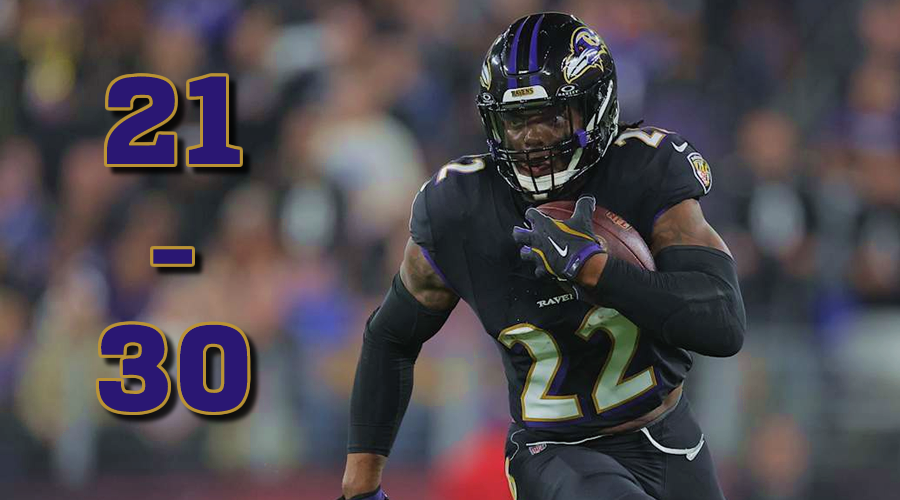
21. Derrick Henry
King Henry continues to defy the process of aging at his position. Having turned 31 years at the start of the calendar year, it marked the fourth season of his career in which he averaged (well) over 100 rushing yards per game, and the third in which he led the league in touchdowns on the ground (18). He may not bring the same kind of short-area twitch or highlight-reel moves as Saquon Barkley, but his combination of size, power and long speed is up there with anyone in the history of the game. Just looking at this past regular season, Henry eluded 11 more tackles (81) than any other NFL running back, and he also led the way in what Next Gen Stats calls “rushing yards over expected” at 1.77 yards per attempt. That came against defenses that put 8+ players in the box on a third of snaps he was handed the ball for.
22. T.J. Watt
I haven’t placed T.J. lower than 14th on this list since 2020, and I already know Steelers fans aren’t going to be happy with me – for good reason, you can argue. He was just 0.1 points off Myles Garrett for the highest overall PFF grade among all defensive players last season (92.2), earning elite marks against both the run and pass. He’s now posted at least 19 tackles for loss in four of the past five seasons – and that was when he missed seven games in 2022. And he just led the league with six forced fumbles, before landing the biggest average annual value deal (41 million) for a non-quarterback this offseason. Yet, for as many big plays as he once again provided, among defenders with 200+ pass-rush snaps, he was only tied for 80th in pass-rush productivity, which measures pressures per opportunity.
23. Trent Williams
As I just outlined, with the continued improvements he’s shown in his second season at left tackle, Tristan Wirfs has earned the right to outrank Trent on this list. In five years as a Niner, he’s basically missed exactly one full season, with at least two games in each (ten in 2024). On 381 pass-blocking snaps last year, he was still only responsible for one sack and 16 other pressures. And he only allowed his QB to be brought down two additional times over the previous three seasons, surrendering any type of pressure on just under 5% of his snaps in pass-pro. Last year was the first time over that period of time where he didn’t also post an elite PFF grade blocking for the run.
24. Maxx Crosby
Whenever there’s a discussion about the elite edge defenders in the NFL, Crosby seems to be missing – wrongly so. While I did mention that line of demarcation from the Garrett/Parsons duo, the Raiders standout has put together a resume that matches up with just about anyone else. Between 2021 and ’23, he racked up 276 total pressures and a massive 156 combined defensive stops. Both those rank first among defensive linemen, by quite a margin. That’s obviously connected to more opportunities, but for him to now have played at least 95% of defensive snaps when available these last three years – and the intensity he showcases – is a testament to his conditioning and drive. Even last year, he was still tied for sixth in tackles for loss (17) despite missing five weeks.
25. Bijan Robinson
While Saquon Barkley and Derrick Henry were driving engines for title contenders, Bijan somewhat quietly produced at a similarly high rate in his second season with the Falcons, who didn’t control their own playoff destiny coming into week 18. He certainly benefitted from a fairly healthy environment as a runner himself, but he was still fifth in percentage of his total output coming “over what’s expected” (48.3%). Yet, despite that heavier workload, Bijan posted the highest rushing success rate at the position (60.2%) and only fumbled once all year long. Individually, he only trailed King Henry with 70 missed tackles forced during the regular season, and largely eliminated focus drops that bothered him as a rookie (just two on 63 catchable passes).
26. George Kittle
Although new challengers to the throne have emerged, with the recent decline of Travis Kelce nearing the end of his career, it belongs to Kittle right now. This past season, he led all tight-ends and wide receivers with a 73.4% success rate on passes his way, and he nearly gained half an extra half a yard extra time he ran a route compared to everyone else at his position (2.62 YRR). That was while only dropping 2.5 of catchable targets, hauling in just over 70% of his contested opportunities, and then averaging 6.6 yards after the catch (second among TEs with 50+ targets). That alone would probably make him TE1, but then also only Minnesota’s Josh Oliver received a higher run-blocking grade among tight-ends with any meaningful playing time.
27. Derek Stingley Jr.
For as much as we think about Houston’s premier edge rush duo and generally what DeMeco Ryans along with DC Matt Burke have done with this defense, a huge reason for their recent success has been their secondary. Last year, they finished only 0.1% percent off Philadelphia at the top of the table in terms of dropback success rate allowed (41.6%). Among cornerbacks who were targeted 30+ times, no one surrendered a lower completion rate (45.8) or passer rating (47.0) than Stingley. And yet, for as much as he limited offenses from having success throwing his way, he was also tied for fifth among all defensive players in picks (five) and second in PBUs (18), as a true play-maker when you throw up 50-50 balls his direction.
28. Creed Humphrey
Similar to Dexter Lawrence at nose-tackle, in terms of the guys lining up across from him at the pivot, Creed has separated himself from the rest of the league, now with Frank Ragnow having announced his retirement. Among centers with 300+ snaps played, Humphrey received the highest overall PFF grade (92.8) now for the third time in four seasons as a pro. He didn’t give up a single sack and just seven other pressures on just over 700 snaps in protection, while grading out as an elite run-blocker as well, and only being penalized once(!). People always talk about Travis Kelce as Patrick Mahomes’ partner in crime, but the guy snapping the ball to him on every single play has arguably become even more integral to Kansas City’s success during this era.
29. Ceedee Lamb
Even for me, Ceedee has sort of become “out of sight, out of mind” this offseason, considering he ended up getting hurt towards the end of a lost Cowboys season. Yet, he actually only missed the last couple of weeks and still finished top ten in both receptions (101) and yards (1194), despite catching about half his passes from Cooper Rush. Removed from the pure volume numbers, he was able to haul in an impressive 58.1% of his contested targets and finished top ten in differential of yards after the catch between expectation and reality (2.2). The one major issue for him was that he led the NFL with 11 drops. I expect a significant uptick in efficiency with Dak Prescott back at the helm.
30. Trey McBride
While he doesn’t grade out quite as well as a run-blocker (63.4 PFF grade in that regard) in comparison to George Kittle, McBride is right up there with him in terms of a big-bodied pass-catcher, who can turn a routine catch into a chunk play by running through or hurdling over a defender in his path. If you added the six missing targets between McBride and rookie Brock Bowers (who led the position in both catches and yards), the Cardinals TE would basically have identical numbers, while already having churned out two more first downs and forced ten(!) additional missed tackles (14). He also only dropped two passes and didn’t fumble once all year long, while his weirdly low red-zone output is more of a combination of different factors outside of his control, when you look at his numbers with contact at the catch-point (63.9% success rate since 2023).
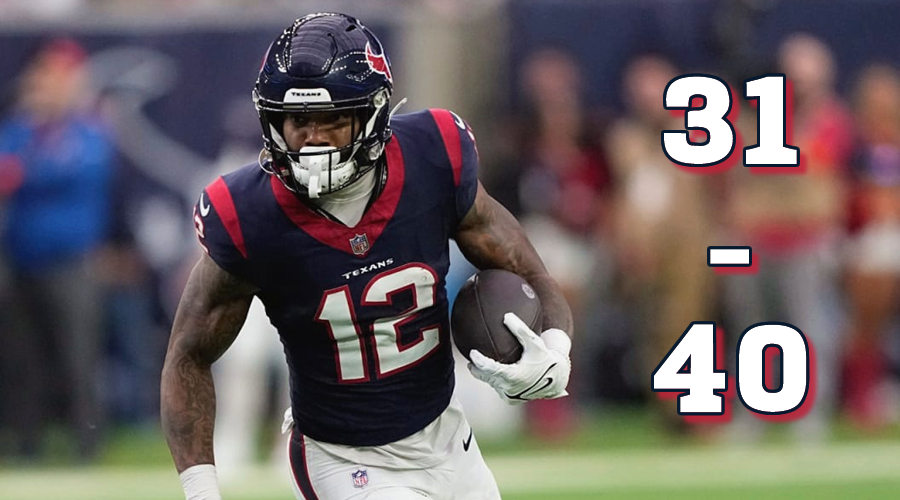
31. Nico Collins
Unlike the largely well-established top-four receivers we’ve already discussed, Nico only started pushing towards that group in 2023, and some people still may not consider him quite at that level, after missing five weeks this past year. Over these two seasons, he’s averaged 85.3 yards per game, and barely dropped from second (3.10) to third in yards per route run (2.87) in the latter one of those. Very much like A.J. Brown, you’re not going to wall him off and stop him on a slant route, yet then he can also run away from his man down the post, if left in solo coverage. He just hauled in 60% of his contested targets (9 of 15), and while he couldn’t duplicate his crazy missed tackles forced number (21) from ’23, he secured 13 of his 19 deep targets (20+ yards).
32. Will Anderson Jr.
Switching over to his Texans teammate on the opposite side of the ball, Anderson was going to have to deliver immediate returns for his team to be justified in the draft capital they invested in him when they picked him and quarterback C.J. Stroud back-to-back just two years ago. He certainly has, going from winning Defensive Rookie of the Year to actually improving all of his numbers across the board (11 sacks, 16 TFLs, two PBUs, a fumble forced and recovered each), immediately becoming a borderline top-tier edge-setter. While his regular season production as a pass-rusher isn’t quite up there with the game’s elite, he regularly just caves in one side of the protection with his speed-to-power maneuvers, and he’s been a menace in all but one of his four playoff outings.
33. Cam Heyward
The utter dominance of the now-36-year-old Cam Heyward has been somewhat overshadowed by teammate T.J. Watt, but absolutely shouldn’t be. Taking out an injury-riddled 2023 season, he has otherwise been a top-five player at his position for the last eight years. In this most recent one, he was the highest-graded interior defensive lineman in PFF’s database (90.3), leading the group in total defensive stops (44) and being tied for fourth in QB pressures (56). He’s just a man amongst boys, owning the point of attack against the run and riding guards into the lap of opposing quarterbacks on the regular.
34. Trey Hendrickson
Recently, Hendrickson has been more in the news for his training camp holdout over a (validated) contract dispute. The reason for it – along with the way the Bengals have generally handled themselves in these discussions – is that he’ll turn 31 years old this season and commands at least close to top dollar, since that’s what his production would dictate. Not only did Hendrickson lead the league with his second straight season of 17.5 sacks, but he was also tied with Myles Garrett for the highest tally of total pressures (83), and that’s the only name he also trailed in TFLs (19).
35. Chris Lindstrom
Personally, I don’t quite hold Lindstrom’s name in the same regard as I did Zack Martin and Marshal Yanda before that, but it’s pretty tough to deny that he’s become the man with the crown at his position. 2024 marked the third straight year with him earning the highest PFF grade overall among guards (93.5), anchoring an offensive line that blocked for the league’s top-ranked rushing success rate (47.3%). For his career, Lindstrom himself has also only allowed his quarterback to be hit or sacked on 1.2% of his snaps his pass-protection, which he’s been responsible for.
36. Brock Bowers
I tried to find the right balance here between not losing my mind over what Bowers showed immediately as a pro and backing the idea of him becoming an All-Pro at his position for the next several years. Not only did he set a new benchmark for receiving yards for a rookie tight-end (1194) and obliterated the previous record in catches (112), but he also led his position overall in both categories straight away. He was never going to be a big-time in-line blocker (as he spent just over 60% of snaps detached from the formation), but he already came down with a rate of passes thrown up between bodies and has room to look more like the tackle-breaking machine he was previously at Georgia, as he continues to build out his body.
37. Brian Branch
When Branch fell to the second round of the 2023 draft, him being “just a nickel” and maybe not being a top-tier athlete were really the only two reasons mentioned. He has clearly proven that the NFL messed that situation up, but also that he can be a valuable asset playing deep safety, as he basically spent the exact same amount of snaps there as he did in the slot this past season. He’s an eraser on the back-end, capable of separating intended targets from the ball. Hauling in four interceptions was great for him, but Branch actually posted elite marks in both run defense and as a pass-rusher as well, according to PFF.
38. Zack Baun
As mentioned with Fred Warner at #11, the only reason I didn’t want to say the gap between him and the rest of the linebacker world is massive right now is because of what Baun showed in his first full season playing primarily off the ball. He was the only guy at his position with an elite PFF grade (90.1) and posted eight more “defensive stops” than any other player in the league (69). He did so in service of the number one defense in success rate allowed (39.9%), and only T.J. Watt – who of course gets a lot more opportunities to strip the quarterback – forced more fumbles than Baun last season (five). Baun’s ability to shoot gaps in the run game, drop off the line of scrimmage, and involve himself in various pressure looks makes him a queen on Vic Fangio’s chess board.
39. Jahmyr Gibbs
For as prevalent as the one-two punch between Gibbs and David Montgomery was during the former’s rookie season, once he had that backfield to himself, the efficiency didn’t really drop off, and it became clear that “Sonic” could become a superstar when given the opportunities. Not only did Gibbs lead all skill-position players in total touchdowns from scrimmage (20), but he was one of only three running backs – along with Saquon Barkley and Derrick Henry – with at least 40 runs of 10+ yards – and he did so despite finishing just outside the top-ten in total carries (250). He also averaged 9.9 yards per catch despite being utilized quite heavily in the passing game (52 grabs for 517 yards). His ability to change gears and ridicule pursuit angles is a joy to watch.
40. Sauce Gardner
Although I feel justified in ranking Derek Stingley Jr. over Sauce in my draft rankings three years ago, both teams clearly are happy with their decisions, and they consequently made them the two highest-graded corners in NFL history (at 30 million per year). The Jets’ two-time first-team All-Pro may have posted the same type of interception total (only three so far), but since 2022, he leads all cornerbacks with a 91.9 PFF coverage grade and 43 forced incompletions. And he has now limited opposing quarterbacks to just one touchdown in each of his first three seasons as a pro. I’m looking forward to seeing how he fares in a likely more man-coverage-heavy scheme under Aaron Glenn.
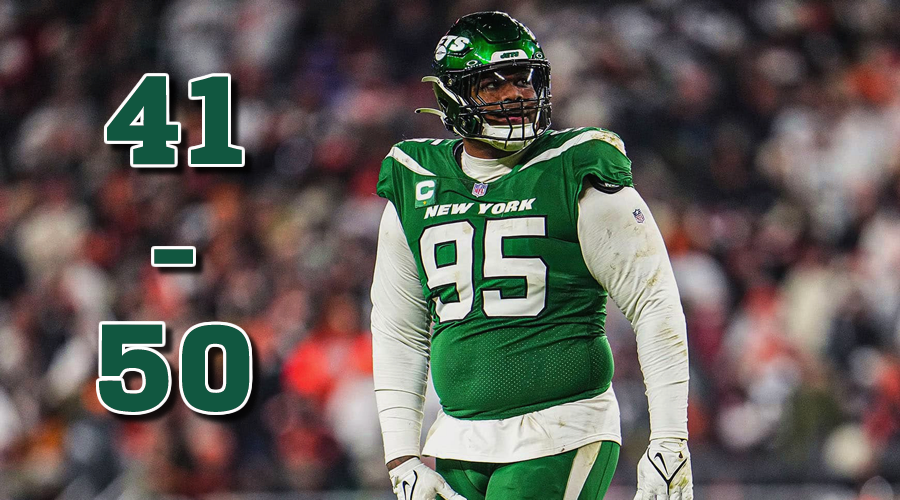
41. Quinnen Williams
Moving up to the Jets front, their previous regime already locked up “Q” two years ago, after he had just posted career-highs in both sacks and tackles for loss (12 each). He’s come half a sack short of matching that mark over the past two seasons combined, but he only trailed Chris Jones for the most total QB pressures across that span (124). His run defense did fall off in 2024, but that was heavily tied to not having a shade nose next to him that was able to hold his ground and free up Williams as a penetration-style player.
42. Matthew Stafford
2024 wasn’t a standout campaign in respect to Stafford’s career statistically, but he was able to turn around a 1-4 start to the Rams season and came as close to halting the Eagles’ run at their Lombardi Trophy. Analytically, he finished almost perfectly average as the 15th quarterback in EPA per play, but if you include those two postseason contests, he still ended up with a more than solid 24 TD-vs.-8 INT line. What has to be considered here is that for a large stretch of the regular season, when his interior O-line was being shuffled around, he was regularly pressured, and that was with one of the lowest percentages that PFF credited him with some responsibility for (5.8%).
43. Justin Herbert
The battle for my title as QB5 was a tightly contested one, as Herbert put together a stronger overall season, but obviously didn’t nearly match Stafford in his one playoff performance, tossing four picks against a Texans defense that simply overwhelmed an attack so heavily reliant on the quarterback just being perfect – and he certainly wasn’t. During the regular season, he was tied for fourth in big-time-throw rate (6.3%) and had only thrown three INTs, compared to his 25 total touchdowns. That was while being “supported” by the 27th-ranked rushing success rate and rookie Ladd McConkey being easily his most reliable target.
44. Nnamdi Madubuike
While Madubuike only posted half of his previous sack total in 2024 (6.5), he was still tied for fourth in total QB pressures (56) among interior D-linemen, and trailed his own career-high in TFLs by just one (11). It took a while for the Ravens to really find their groove as a defense, with Zach Orr taking over play-calling and some personnel decisions on the back-end about midway through last year. Nnamdi’s steady remained a key component throughout however, and along with how much heat the put on quarterbacks, him rarely leaving the field was reflected in opponents hitting pretty clearly the lowest success rate on the ground against Baltimore (31.5%).
45. Puka Nacua
It’s easy to poke holes into how Puka matches up with the top of the league’s wide receiver crop, since he doesn’t show big-time speed or separation ability, but he’s been about as productive as anyone at the position through his first two seasons, averaging 6.6 catches for 88.5 yards per game. No other player at the position quite hit three yards per route run last season – Puka sat at 3.56 YRR. I was shocked to find out that he actually only hauled in 40% of his contested targets, but part of that is how willing Matt Stafford is to give him chances in traffic, and I’d like to have a measure on passes that forced him to lay out in order to secure the ball. He also did finish top-ten in average yards after the catch (6.6) among WRs with 50+ targets.
46. Trent McDuffie
Outside of Chris Jones, McDuffie has turned himself into clearly the most integral piece to the Chiefs defense, in particular when it comes to what he allows DC Steve Spagnuolo to do on the back-end matchup-wise. He was penalized a lot more regularly (nine during the regular season) as primarily an outside corner, but the fact he can be isolated against true alpha wideouts, fight off bigger bodies inside to create stops in the run/screen game, and even how efficient he’s been as an occasional blitzer (23 pressures across 76 pass-rush snaps since 2023) speaks to how valuable he’s been to that unit. He also just had his best season as a tackler yet (8.1% miss rate).
47. Xavier McKinney
If you go back and try to figure out how the Packers defense finished fourth in EPA per play last season, a lot of it revolved around quality rookie contributions, but much more so the impact McKinney made as an air traffic controller on the back-end. Opposing quarterbacks finished with a passer rating of just 56.4 when they threw the ball with the star safety as the primary defender in coverage, not being charged for a single touchdown as the next-closest man, while hauling in eight picks. And yet, despite lining up deep as much as he did, Xavier only missed 5.7% of tackles he attempted. Other than picks (three), all those numbers quietly were VERY similar the previous year with the Giants by the way, who consequently fell off as a unit with his departure.
48. Jayden Daniels
For as good as the 2024 quarterback draft class has looked as a whole, Jayden has already massively exceeded my expectations as one of the two guys I had late first-round grades on (along with a couple of top-ten names). Washington immediately reaped the benefits, as they rode his ability to keep the chains moving with key third- and fourth-down conversions all the way to the NFC Championship game. He accounted for 31 touchdowns, had the lowest turnover-worthy play among all NFL quarterbacks (1.5%), and recorded nearly 200 yards more as a scrambler (595) than anyone else in the league, while only Lamar Jackson forced more missed tackles (40). The piece I feel best about compared to his college evaluation is how he handled the pass-rush, yet only Caleb Williams, Baker Mayfield and Aaron Rodgers finished with higher pressure-to-sack conversion rates (22.2%).
49. Tyler Linderbaum
Whereas Creed Humphrey has created a gap to the rest of the NFL’s centers, Linderbaum’s resume over his first three seasons isn’t *that* far off and clearly makes him number two for me. Across that time, Baltimore has been the number one offense in rushing success rate (46.4%) and Lamar Jackson came ever so close to winning back-to-back MVP awards. Individually, Linderbaum didn’t get charged with a single sack in protection and posted an 82.5 PFF run-blocking grade. His ability to get to the front-side shoulder of shades or be weaponized on the move has helped diversify their scheme during this stretch.
50. Drake London
In a league that has become so pass-centric and hypes up the guys coming down with those targets, I feel like London is an often-forgotten name among the game’s best. In his first three seasons, he has increased his yardage total consistently and just posted career-highs across the board (100 catches for 1271 yards and nine TDs). Drake earned an elite PFF receiving grade (90.1), while only Ja’Marr Chase and Amon-Ra St. Brown gained more first downs through the air, with a passer rating just over 130 when targeted. Plus, for as much as he can play bully-ball and post up down the field, as he finished behind only Terry McLaurin with 22 contested catches, he actually does a lot of damage from the slot (39% rate in 2024) with how quickly he creates leverage advantages for himself.
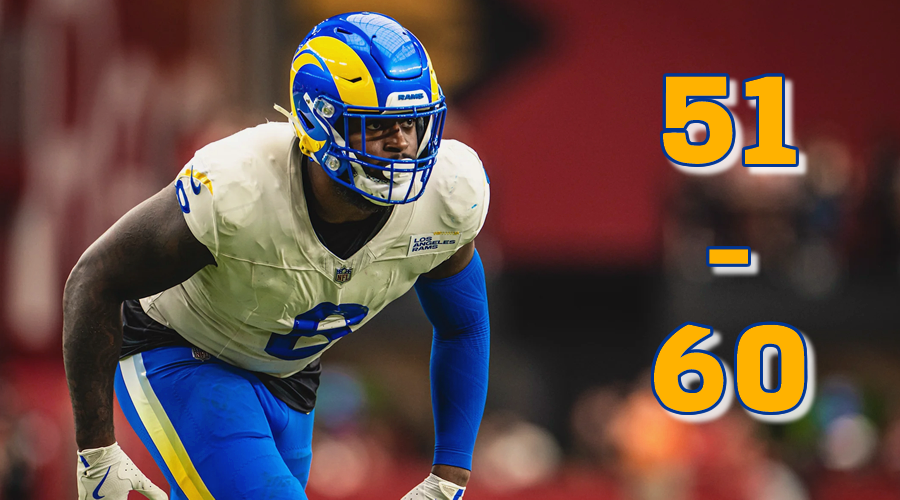
51. Jared Verse
Not too far behind Jayden Daniels with his sensational debut campaign is the reigning DEFENSIVE Rookie of the Year. The numbers aren’t as staggering as his counterpart’s, but Verse had several moments of physically dominating NFL tackles straight away, and he was an absolute menace in their two playoff outings. While he somehow only registered 4.5 sacks, the rookie actually finished fourth among all defensive players with 77 overall pressures, and he also posted 11 tackles for loss. He headlines a potentially big-time young Rams defensive line.
52. Leonard Williams
Following a couple of strong years to start his NFL career with the Jets as the former sixth overall pick, “Big Cat Williams” became more of a defensive lineman with solid numbers but not the same type of palpable impact on games maybe, moving on to the other New York team and now Seattle. This past season might’ve been his best as a pro however, as his presence was felt repeatedly for a strong Seahawks D. He finished behind only Cam Heyward, Dexter Lawrence and Chris Jones for highest PFF grade among interior D-linemen (87.1), while being tied for second in defensive stops (41) and sixth in QB pressures (55). Plus, he added a 92-yard pick-six.
53. Christian Gonzalez
Without wanting to bury his draft classmate, the fact that Washington picked Emmanuel Forbes – who now is battling to even make an NFL roster – over Gonzo a couple of years ago was wild at the time and becomes more glaring by the day. This guy looked like a potential shutdown corner almost right away as a rookie, before heading for injured reserve a month in. The Patriots D massively dropped off last season, but this young man looked even better individually. Gonzalez limited opposing quarterbacks to a passer rating of just 70.5 when targeted, with two TDs and INTs responsible for each. He also posted an excellent 7.8% missed-tackle rate.
54. Derwin James
While he never quite matched the hype around him following his rookie season, Derwin has established himself as one of the best, most versatile safeties in the league, and he should now have some stability again after years of changes in defensive scheme and what was asked of him. This past year, he was one of only a handful of players to earn PFF grades of at least 75 in run defense, coverage, rushing the passer and tackling. Looking at his pass-rush productivity in particular, he was basically right there with Aidan Hutchinson on a fulminant start to last season (14.4), as one of only two defensive backs to hit double-digits in that metric.
55. Zach Allen
This is one of the fairly rare examples of a player who was good at his previous stop and the football community thought they had a pretty clear picture of what he is, but then he came into a situation with better defensive play-calling and surrounding pieces, and he was able to exponentially improve his performance. This past year, Allen basically never left the field (89% of snaps), and while his individual numbers rose, more importantly, the Broncos defense turned itself into the best in the league by many metrics. Although he did have nearly 100 extra opportunities, Allen actually finished one point ahead of Chris Jones for the most QB pressures among interior D-linemen (75), and he was second in TFLs (15).
56. Jessie Bates III
Somewhat oddly, after Bates was considered one of the most impactful free agency additions last offseason, his name was rarely ever brought up in year two with the Falcons, even though his counting numbers were equally impressive. He accounted for four interceptions and forced fumbles each (including a pick-six), along with ten more passes broken up. Atlanta’s defense was a below-average unit by almost all measures, but that doesn’t negate his contributions by any means. If these guys can finally put some real hit on QBs, there’ll be even more opportunities to make plays on the ball for their standout safety.
57. Jordan Mailata
Even if I believe the guy on the opposite end of the line from Mailata is actually the best tackle for Philadelphia themselves even, that only underlines the dominance of that unit as a whole. Their stalwart on the blindside was the highest-ranked offensive lineman in PFF’s database last season (95.8). The former rugby player has made gigantic strides technically under the guidance of O-line mastermind Jeff Stoutland, as a wall to get around in protection and a road-grader at the point of attack for Saquon Barkley to run behind.
58. Rashawn Slater
To the surprise of some I’d think, Slater actually was the name to finish second behind Mailata among NFL tackles in overall PFF grade (91.1). After looking like a perennial All-Pro candidate through his first 19 starts, a torn biceps cost him most of his sophomore campaign, and he didn’t quite look the same the year after. That’s why seeing him elevate his level of play again this past season was so encouraging, as he was also tied for sixth in ESPN’s run-block win rate (79%) among tackles. The only reason I couldn’t place him any higher is that he – and rookie Joe Alt on the right side – had their worst showings in the Wildcard Round against Houston’s big-time edge duo.
59. C.J. Stroud
I can’t act like Stroud lived up to the lofty expectations he set as a rookie, because he regressed in basically every single statistic of relevance. And yet, I remain confident in him being a high-end franchise quarterback for the next decade, even if he may never quite enter that elite tier at the top of the food chain. For as much as people hyped up their WR trio, he barely ever had it entirely at his disposal, the play sequencing under Bobby Slowik made me scratch my head numerous times, and there were routine mishaps up front. The main objectives for Stroud heading into next season will be to regain trust in a hopefully less leaky protection and remaining calm in order for his accuracy not to suffer. I will say that his big-time throw (4.3%) and turnover-worthy play rate (2.8%) did remain almost perfectly steady.
60. Amon-Ra St. Brown
This dude is a living, breathing first down. Only Ja’Marr Chase moved the chains more often from the WR position last season (73), and those two missing ones came on 34 fewer targets. Amon-Ra led all of them by securing 81.6% of his targets overall and only dropped one pass on 116 opportunities last season. OC Ben Johnson was a master at opening up the middle of the field for him, but this guy came down with plenty of tough grabs in traffic, hauling in exactly two-thirds of his contested targets (20 of 30). The fact that he’s so heavily tied to the slot and isn’t quite the same dynamic athlete is what he isn’t quite in that second tier of receivers for me personally.

61. Antoine Winfield Jr.
As the Bucs defense has continued to stray further away from what they were when they won the Super Bowl in the 2020/21 season, they’ve become more heavily reliant on the development of some young D-linemen and Winfield being a play-making machine – who wasn’t available for two months last year. Even when available, he didn’t nearly pack the stat sheet as extensively as he did in a special 2023 season, with a scoop-and-score being the only takeaway he was involved in altogether. He also received easily his worst grade in coverage from PFF (50.3). Still, you’re talking about someone who creates havoc all over the field and who has now missed less than 10% of tackles he attempted each of the past three seasons.
62. Gregory Rosseau
When I posted a video about some “under-the-radar studs” across the NFL at the start of December, Rosseau was one of the names I discussed. He’s turned himself into one of the premier strong-side D-ends, when it comes to lining up over tight-ends and shutting down the front-side of run calls despite getting combo-blocked. As a pass-rusher, his combination of length, strength and flexibility makes him a nightmare to handle. Last year, he finished 12th among all NFL defenders in total pressures (63) and tied for ninth with 16 tackles for loss, plus he added three forced fumbles, despite sitting out that meaningless week 18 game.
63. Josh Hines-Allen
After receiving his big second contract from the Jaguars last offseason, Hines-Allen’s standard counting numbers were basically cut in half, as part of the second-worst defense metrically league-wide. He still actually posted identical production as a pass-rusher to Rosseau and actually a slightly better PFF run-defense grade (70.1), although I would argue the former takes on a tougher job of controlling the point of attack of those calls regularly. That’s why I gave the former the nod, even though I believe the high-end contribution getting after the QB could flip things in Josh’s favor again quickly.
64. Christian Benford
I don’t know if it’s because he’s a sixth-round pick from Villanova or because he plays in a Bills defense that is generally known for their high rate of zone coverage, but Benford simply isn’t getting the recognition he deserves. Now, he doesn’t travel with certain matchups, and that *is* how Sean McDermott and Bobby Babich generally like to operate, but they did dial up their man rate on third downs, and you can’t really argue with this man’s resume last year. Benford was responsible for a Passer rating of just 72.3, surrendering only 279 yards on 584 snaps and 51 targets, which put him at an NFL-low 0.48 yards per coverage snap.
65. Landon Dickerson
66. Daiyan Henley
Consider I was a big fan of Henley’s draft evaluation two years ago and outlined him as a breakout candidate for the 2024 season, I’ve been closely tracking his development. He took major strides in his first full campaign as a starter, with his range, ability to elude blocks, rally and tackle for a Chargers defense under Jesse Minter, which relied on a lot of zone coverage. While there’s room to improve his 11.9% missed-tackle rate, he did log 147 total stops, including seven for loss. In the passing game, he recorded a pressure on every fifth pass-rush opportunity (13 on 65) and logged PBUs along with a pick.
67. Jonathan Greenard
Looking at Minnesota’s defensive lineup, you may be wondering how they finished as the number two unit in EPA per play last season (-0.091). Coordinator Brian Flores continuously re-inventing his scheme and play-calling is a big reason for it, but if there was one individual contributor I believe ascends that, it’d be Greenard. For as many free rushers as Flores has typically been able to create, this is the guy who can consistently win his one-on-one matchups on key downs. In his first year as a Viking, he trailed only Myles Garrett and Trey Hendrickson with 80 total QB pressures. He was also tied for fourth with 18 tackles for loss and forced four fumbles.
68. Danielle Hunter
Right behind Greenard is the name who was involved in almost a player swap, you can call it, as he and Hunter were traded places as free agents. While the move to go younger and cheaper made sense for Minnesota, there’s no denying the latter built a highly formidable edge duo with Will Anderson Jr. in Houston. Even though the pressure numbers weren’t quite as high as his counterpart on a lower usage rate, with 150 total fewer snaps, Hunter led the NFL in how ESPN measures pass-rush win rate (26%) and was tied for sixth league-wide in tackles for loss (17).
69. Tyler Smith
Following a so-so season at left tackle – where I always believe he’d have his struggles long-term – Smith looked like a perennial All-Pro candidate once he moved one spot inside the following year, arguably outclassing a no-doubt Hall of Famer in Zack Martin over at right guard. As the Cowboys O-line took a step back collectively, Tyler may have inched the wrong way ever so slightly himself but proved his value by jumping back out to the blindside when needed in a couple of games. Overall, he finished 2024 in the top ten by ESPN’s pass-block (96%) and run-block win rate (74%) each.
70. Christian Darrisaw
While Minnesota’s tackle duo may not be as revered as the Eagles’ or maybe even Chargers’, when they have those two guys healthy, they’re at least firmly in the debate for number two in that regard. Unfortunately, Darrisaw’s ten missed games last year have now doubled his previous total through three seasons, and you can actively follow the drop-off in offensive efficiency when he isn’t in the lineup. He has now posted pass-blocking efficiency marks of at least 97% in all but his rookie season in 2021, and he actually graded out better as a run-blocker in limited time last year (82.3 grade by PFF).

71. Dion Dawkins
Although the pressure numbers and penalty total aren’t up there with the elite at his position, on a down-to-down consistency protecting a quarterback like Josh Allen, who tries to maximize what’s available on pure dropbacks, he clearly performs better than those metrics would indicate. And I don’t quite understand how Dawkins doesn’t grade out as a better run-blocker, considering the success Buffalo had on the ground last year especially. His combination of length and strength, with a deadly snatch-trap technique to lock up pass-rushers, and how he can steer edge defenders off track at the end of his reach, makes the big man one of the toughest challenges to face.
72. Jeffery Simmons
Next, we have a pair of interior D-linemen from the AFC South, who have been putting in work for several years by now. Looking at Pro Football Focus’ database as an objective measure, Simmons earned a slightly lower overall grade (80.4) while posting basically perfectly even production on a per-snap basis, as he finished with 41 defensive stops (tied for second-most among the IDL) and 45 total pressures (tied for 15th), in four extra games. His physical presence has always given Tennessee’s front a certain feel, but I’m impressed with his block deconstruction and continued attention towards becoming a playmaker.
73. DeForest Buckner
As I just referenced, Buckner was right there with Simmons in his percentage of defensive stops per snap (5.7%) and pressure per pass-rush opportunity (10.5%). If you go by ESPN’s metrics in the passing game, he was actually tied with Chris Jones for first among D-tackles in win rate (16%). He wins more with his length and has a history of adding value with his ability to bat down passes at the line. The consistency DeFo has shown through nine seasons matches up with that, and this was actually his first time he didn’t log at least 750 snaps between San Francisco and Indy.
74. Quinyon Mitchell
Sticking with the idea of first-round picks immediately hitting their stride in the pros, we’ve reached three straight rookies in the countdown across the next six names. I gave the nod to Mitchell among those, because even though his contributors were less substantial numbers-wise by nature, his impact was clearly felt as the top corner for the number one defense in dropback success rate against (41.5%), which helped Philadelphia win the Super Bowl. For as many two-high looks as they started out of him, Mitchell’s ability in quarters coverage to hang with speedy wideouts when he ended up isolated with them, so their safeties could aggressively drive forward, was a key ingredient to that unit.
75. Minkah Fitzpatrick
As Cam Heyward arguably had a career year and T.J. Watt maybe slightly dipped on a snap-to-snap basis, but delivered his usual amount of big-time plays, their safety on the back-end saw a more drastic decline. Across 27 games these past two seasons, he has only logged one interception and seven PBUs, but more importantly, his TD total surrendered jumped from zero to five in 2024. He has remained one of the scarier dudes to separate targets from the football in his vicinity however, and only missed 8.3% of attempted tackles since 2022. Considering there seemed to be some disengagement from the rest of the Steelers organization, I’m interested to see if he can bounce back under Anthony Weaver in Miami.
76. Josh Jacobs
Similar to Nelson, Jacobs immediately looked like a future star at the running back position when he arrived in Oakland at the time, and really should’ve been named Offensive Rookie of the Year. Across five seasons with the Raiders, he averaged 1400 yards from scrimmage and nine touchdowns. This past year in Green Bay, he added nearly 300 extra yards and reached the end zone a career-high 16 times, while helping transform the Packers’ run game into a more diverse approach, with a heavier focus on gap concepts. Individually, he forced the fourth in total missed tackles (67) and finished third in percentage of his rushing output being “over expected” based on how the play was blocked (48.8%).
77. Quenton Nelson
Many draft evaluators were willing to quickly crown Nelson as a future Hall of Fame guard based on his tape at Notre Dame, and he immediately looked like he was on track for that level of career, being named first-team All-Pro in each of his first three seasons with the Colts. Requiring foot surgery the following year cost him the only four starts of his career, he did slightly dip alongside the team struggling to solve the quarterback situation since 2021. I thought this past season was his most consistent one since then, which was backed up by making second-team All-Pro and coming just 0.3 points off logging run- and pass-blocking grades of 80+ each from PFF.
78. Malik Nabers
One of those dynamic pass-catchers Quinyon Mitchell was matched up against to some extent in their two meetings was the Giants’ new all-time rookie record holder in receptions (109). That however speaks to how much they prioritized getting the ball to Nabers, as he ended up as one of only six pass-catchers to account for at least 40% of his team’s share of air yards (40.9%), and you could tell that this offense struggling to get going at all when they didn’t involve him early on. Looked at the advanced numbers, “Leek” posted 19 missed tackles forced, and his contested-catch rate of 46.2 was solid, although significantly sunk by the amount of borderline uncatchable passes his way. The only true blemish was his eight drops.
79. Brian Thomas Jr.
Now, as we transition to Malik Nabers’ former teammate at LSU, after going to a Jaguars team with more known commodities at receiver at least, and being the 23rd overall pick, it took a while for that previous coaching staff to design plays and gameplans to feature Thomas extensively. His ability to just run by people, combined with the way he can contort his 6’3”, nearly 210-pound frame, did make him a problem to defend right away though. BTJ finished sixth among all WRs in yards per route run (2.45), he hauled in exactly half of his contested targets (8 of 16), and averaged 6.6 yards after the catch.
80. Jaylon Johnson
How quickly people like to forget about players who don’t jump out on the stat sheet or the big screen. Johnson certainly didn’t have the same kind of brilliant season in coverage last year as he did in 2023, when he was tied for second among cornerbacks with 4.8 yards per target allowed, and one touchdown compared to four interceptions. Although his TDs were doubled and his INTs cut in half (two each), his resume overall was more than respectable, and he was able to halve his penalty total (down to three). That’s particularly noteworthy considering Chicago’s pass-rush didn’t nearly put pressure on opposing quarterbacks as early, asking their corners to hold up behind it longer.
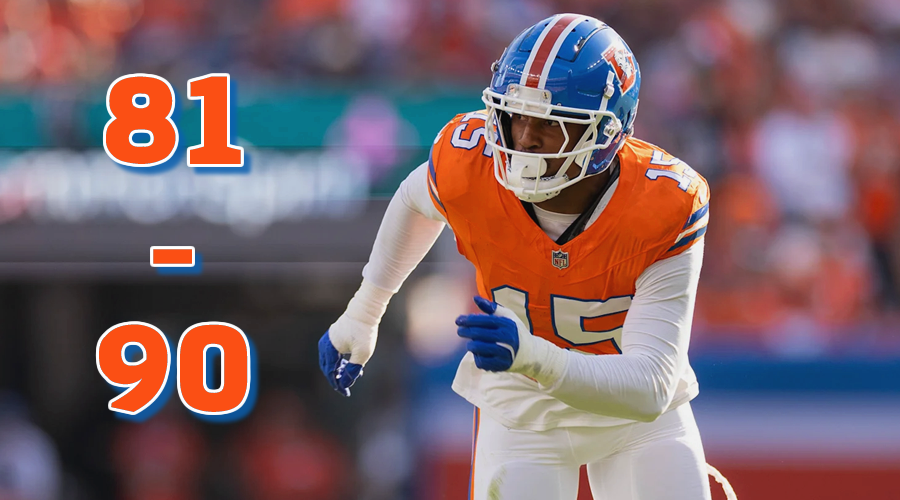
81. Nik Bonitto
Although Patrick Surtain II ultimately won the Defensive Player of the Year trophy, Bonitto ironically was a legit contender and arguably the team’s front-runner in the race at some point, thanks to how he was able to fill the box score. Only Trey Hendrickson and Myles Garrett posted more sacks last year (13.5) than him, and he was tied for ninth in tackles for loss (16). He also forced a pair of fumbles, batted down four passes, had a pick-six and a scoop-and-score. So for the league’s top defense, this was the guy who routinely was involved on big plays, while his combination of speed and bend off the edge made him a nightmare matchup for offensive tackles.
82. Laremy Tunsil
Trading away a franchise left tackle on the merits of a massive down season for the Texans O-line overall, which he was arguably the one bright spot amongst, paired with “lacking leadership qualities” was already highly questionable for me at the time, but watching other players in the official video talk about this guy with reverence, was a great reminder. Apart from coming 0.2% short in his second season as a pro, Tunsil has posted pass-blocking efficiencies of at least 97% every year since he got drafted in 2016. He also just received the highest PFF run-blocking grade of his career (72.7). The one hangup with him of course have been penalties, getting flagged a total of 96 times across 125 career starts, with 19(!) this past season.
83. Kerby Joseph
For as banged up as 2024 the Lions defense continued to become, the biggest reason for their ability to retain that level of competence, to where they still finished top-eight in DVOA, success rate and EPA per play, was their safety play. I’ve already waxed poetic about Brian Branch, but Joseph was arguably equally impressive, with his combination of range, aggressiveness to drive on throws, and his ball-skills. Not only did he lead the league with nine interceptions (compared to only two touchdowns responsible for in coverage), but he was the highest-graded non-edge defender in PFF’s database this past year (91.3), and only missed 5.6% of tackles he attempted.
84. Budda Baker
Sticking with the safety position, Baker certainly hasn’t made headlines with his highlight reel of interceptions, as he has only collected seven total in eight years as a pro. Throughout his tenure in Arizona, he has been one of the most fun kamikaze players in the league however. The way he’d drop down into the box during the quarterback’s cadence and shut down early down runs last season in particular was pretty crazy to watch. Not only did he lead all non-linebackers with 55 defensive stops, but I loved this little tidbit from Robert Mays of The Athletic. Two defensive backs last season logged more than his ten tackles for loss. Those players lined up 8+ yards off the line of scrimmage on one and four percent of their snaps respectively – Budda was at least 66.5%.
85. Denzel Ward
While the Lions’ secondary was able to overcome injuries amongst it and the rest of their defense for the most part, Cleveland largely cratered more so based on limited pass-rush help from anyone not named Myles Garrett, very little support from their offense, and just a collectively drop in quality of play amongst itself. Ward was certainly not excluded from it, as he was charged with 635 yards on 71 targets, but that is largely tainted by a 93-yard touchdown against the Broncos, where he came fingertips short of breaking up a seam shot that was almost impossible to defend, squeezing inside in a Tampa-2 assignment as the field-side CB. Ward did lead the NFL with 19 pass break-ups, to go with a pair of picks, as he was getting tested more regularly.
86. Jordan Love
I posted a video about both Love and C.J. Stroud as “young princes” of the NFL last January, after they both put together standout performances in Wildcard Round blowout wins. Unfortunately, due to different reasons, they both took a step back in 2024, where the worry for Stroud could be scar tissue operating behind leaky protections, while with Love, the calibration of risk-taking as a decision-maker was worrisome. After finishing with a two-to-one rate in his first season as a starter, Love had the exact same number of big-time throws as turnover-worthy plays (17) this past year. I do still very believe in the talent as a passer though, and he actually improved his pressure-to-sack conversion rate (8.9%), which made him one of only three quarterbacks with a mark in the single digits.
87. Quincy Williams
Unlike a pair of players who saw their level of play take a step back individually, for Williams, his defense’s decline was much more prevalent. The Jets dropped from third all to the 21st in EPA per play as a unit due to multiple factors, but the biggest one being how they get pushed around up front on early down runs especially. That obviously made the job tougher for their linebackers, but Quincy was able to shine with his short-area burst to beat blockers to the spot regardless. He finished third league-wide with 60 defensive stops, after leading the league with 80 the year prior, plus he forced four fumbles (tied for fourth league-wide) and recovered three more himself (tied for first among defenders).
88. Mark Andrews
As Lamar Jackson put together his best season as a pocket passer, Andrews became a less integral piece of the puzzle, but did reach the end zone a career-high 11 times and save his best performance for crunch time in key matchups. While this is certainly connected to who threw him the ball, no tight-end had a higher passer rating when targeted than him (140.9). Andrews hauled in three quarters of his contested targets (9 of 12), and while we all remember the massive drop to end their Divisional Round game at Buffalo, he only let two other balls slip through his hands throughout the rest of the season.
89. Roquan Smith
Seeing some of the previous AP teams and offseason balloting, it’s become pretty clear to me through the years that voters either don’t closely watch or at least truly grasp linebacker play across the NFL. That’s my disclaimer to say that Roquan certainly didn’t live up to his usual standard this past season, in particular when it comes to how he handled himself when opposing play-callers specifically targeted him in coverage, having to match wide receivers on the run. Nonetheless, he has now logged over 150 total tackles in each of the past four seasons, and he’s been named first-team All-Pro in the latter three of those. Once Baltimore figured out their best safety pairing and settled in with a new DC, those issues in the pass game became less prevalent, and 2024 as a whole, opponents hit pretty clearly the lowest success rate on the ground against this defense (31.5%).
90. Garrett Wilson
When the Jets selected Sauce Gardner and Garrett Wilson with their pair of top-ten picks in 2022, they instantly added two guys who would challenge each other throughout practices, produced on gamedays, and consequently made sure they both would be around for a long time with contract extensions this offseason. The latter has now averaged just under 1100 receiving yards with lackluster quarterback play throughout his three-year career. His movement skills shine in the ability to separate, extend for passes, and elude defenders with the ball in his hands, as he led the NFL with 25 missed tackles forced after the catch this past season.

91. Byron Murphy Jr.
For a player who has logged his level of ball-production over the latter four of his six seasons in the league, along with having proved he can excel inside and out in complex defensive schemes, Murphy has received fairly little attention. This past year, he was tied for third in interceptions (six), along with breaking up 14 more passes. If you’re operating in a defense that run as many zone blitzes as Minnesota does under Brian Flores and then asks you to line up in different spots when you do man up on third downs, you’re going to give up your fair share as a corner, but Murphy more than made up for it when given chance to see and make plays on the ball.
92. Ed Oliver
If you try to relate the Bills’ defensive success in the regular season throughout the years to some of their struggles in January, when they ultimately found themselves in shootouts again, the biggest takeaway for me has been their lack of individual difference-makers, up front especially. We’re starting to see a shift in that, with the previously mentioned Gregory Rosseau and this top-ten pick from 2019. Oliver is the disruptor amongst it, with his ability to penetrate the backfield on run calls but then also make quarterbacks uncomfortable as part of their “cage-rush” approach. He was basically right at one pressure every tenth pass-rush snap and forced three fumbles.
93. Terry McLaurin
If not for missing a couple of games as a rookie, McLaurin would probably be on pace for potentially matching the key feat of the next player on my list, as he has gone over 1000 receiving yards each of the past five seasons. He has done so in spite of a myriad of poor quarterbacks, who have all relied on the possibility of just throw the ball up to number 17. Being on the opposite end of Offensive Rookie of the Year Jayden Daniel’s throws, McLaurin not only led all NFL wide receivers with 24 contested catches, but he did so with a 70.6% success rate in those situations. Also, only Green Bay’s Jayden Reed had a higher passer rating when targeted (on at least 50 looks his way) – 134.5.
94. Mike Evans
While it took him until the final offensive play of the Bucs’ regular season, Evans of course became the first wide receiver in NFL history to finish his first eleven(!) years as a pro with 1000+ yards through the air. That’s a monumental feat, which should one day get him into the Hall of Fame, even if you may think he only ever was a top 3-5 guy at the position in one of those seasons. For as much as he plays up to his size, now having hauled in more than half of his contested targets for seven straight years (and he went over 60% in four of those), Big Mike has “reduced” inside as a quality power slot more recently and still finds ways to create advantages before the ball arrives there, as he just posted a career-best mark of 2.52 yards per route run.
95. Kevin Dotson
You may have thought of Dotson as an aberration, showing up in lists like this and grading out as one of the best guards in the league, when the Rams were one of the most effective rushing teams in 2023, but by all means, this guy is meant to stay. He just finished top-ten among all NFL offensive linemen in PFF run-blocking grade (83.6), after an even better mark in his first year in L.A., and he was only penalized twice in each of those. His power to help create vertical displacement has been a key element to their duo concept-centric approach.
96. Jonathan Taylor
Although seven running backs were selected within the first 66 picks of the 2020 draft – and almost all at least seemed to have their moment for a year – Taylor clearly remains supreme among those. After leading the league with nearly 2200 yards and 20 touchdowns from scrimmage in his second season, he was held back by injuries the following two, before flashing his big-play ability again last year. Somewhat quietly, he finished fourth league-wide in total rushing yards (1431) despite missing three weeks and up-and-down quarterback play in Indianapolis. If they can get some level of stability from that position, as they fill in a couple of spots on the interior O-line with homegrown talent, JT could go off again. The one thing he needs to clean up – and this was his major issue at Wisconsin – is ball-security, as he fumbled four times.
97. Travis Kelce
We can blame a lack of cohesiveness by their wide receivers, poor play at left tackles, and even Patrick Mahomes himself in some respects for the continued drop-off by Kansas City’s aerial attack. Yet, I’d say it’s most closely associated with the aging of Kelce, who simply wasn’t able to shake off man-coverage or add yardage after the catch at nearly his usual rate last season especially. His IQ to find/create space against zone shells and help move the chains does still show up quite regularly. If you include the playoffs, he was still only two yards off the 1000 mark, and he did sit out the regular season finale, since his team had already clinched the AFC’s number one seed. And even if you take out January (and the start of February), he led all TEs with 22 third-down conversions.
98. Quinn Meinerz
For as much as I’ve praised the Broncos defense at different points here and how rookie QB Bo Nix was able to prove people wrong as last season went along, the unit that simply isn’t nearly discussed enough is their O-line. We could talk about multiple names along it, but the key in my opinion, is how they operate collectively, although I single out Meinerz here, as the best of the bunch. In 2024, he finished third among all interior linemen in ESPN’s pass-block win rate (97%), only allowing one sack and 12 total pressures, while having been one of the top road graders on the ground for the last couple of years now.
99. Bucky Irving
The Bucs rookie running back was another player I broke down in my video on “under-the-radar” studs in the latter parts of this past season. Although the fourth-round pick found himself firmly behind Rachaad White to start off, he took over the reins as their featured back over the second half of the year. He became the only guy at his position with 50+ carries last season to average better than four yards AFTER contact per carry (4.03). He also forced a missed tackle on 30% of his touches (76 across 254 touches), adding nearly 400 more yards as largely a checkdown and screen option. For a young player, his pacing of runs involving pullers and manipulating second-level defenders really stood out to me.
100. Geno Smith
There were four other quarterbacks I could’ve closed out this list with, and the case for Geno on the surface is probably the toughest one. He didn’t win Super Bowl MVP like Jalen Hurts, throw for 41 touchdowns like Baker Mayfield, finish behind only the two league MVP front-runners in EPA per play like Jared Goff, or even impress in a passing offense that put more of the onus on the QB like Brock Purdy. What the Seahawks-turned-Raiders signal-caller has proven to me since becoming a starter three years ago however, is that he’s willing to stand tough in the pocket, be a courageous decision-maker down the field (to his dismay in some cases), and deliver big-time throws. While playing behind an O-line that would constantly have breakdowns, he led the NFL with an 81.8% on-target rate of his passes and yards per scramble (10.7) among guys with more than 10 such carries.
The next 25 names:
Osa Odighizuwa
Aaron Brewer
Khalil Mack
Julian Love
David Njoku
D.K. Metcalf
Milton Williams
Charvarius Ward
Brian Burns
Jalen Hurts
Kobe Turner
DeVonta Smith
Tee Higgins
Jalen Ramsey
Baker Mayfield
Zach Sieler
Ladd McConkey
Marlon Humphrey
Brandon Jones
Andrew Van Ginkel
Brock Purdy
Joe Thuney
Zach Tom
Montez Sweat
Jared Goff
 Halil's Real Footballtalk