
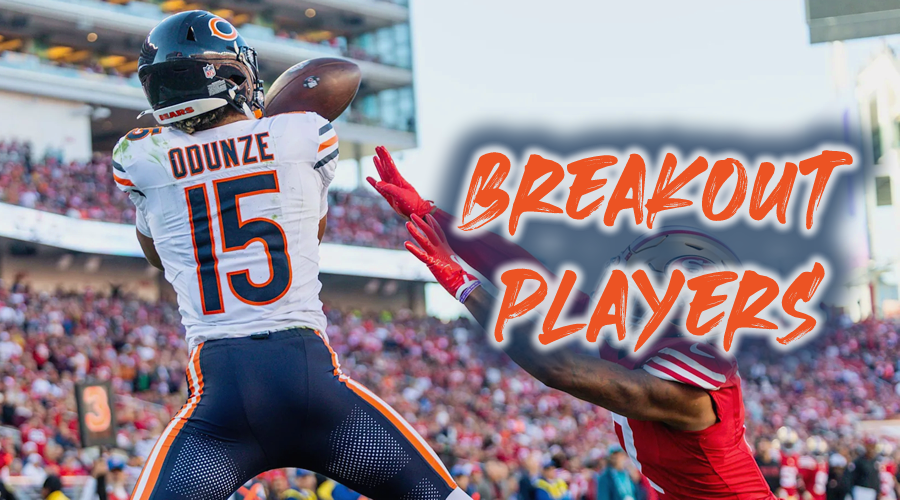
These last two months have been loaded with video content, discussing basically every single offseason move made by all 32 teams and, most recently, going through one burning question for each of them. So now it’s time for one of my favorite projects in written form every year – breakout candidates. Split up into offense and then defense next week, we’re looking at seven players on each side of the ball, coming off their rookie or second season, who I project to make a leap in 2026.
Since it’s tough to set the guidelines for what would qualify a “breakout” for the purposes of this exercise, I’m relying mostly on statistical metrics that the players in question haven’t reached yet – no 1000-yard rushers or receivers, players that have scored double-digit touchdowns, earned a Pro Bowl/All-Pro nominations or are just generally considered one of the better performers at their respective positions already. I also generally stay away from players who have barely seen action in the pros yet. That makes names like Vikings quarterback J.J. McCarthy and Steelers offensive tackle Troy Fautanu ineligible, for example.
Chase Brown, Khalil Shakir and Cam Jurgens all delivered on the lofty expectations I set for them last July, while Anthony Richardson is someone I’m still rooting for to reach his sky-high potential. Here’s this year’s list:

Quarterback – Drake Maye, Patriots
Originally one of the top-five quarterback recruits in the country, Maye initially took a redshirt with the Tarheels before putting together one of the most illustrious two-year stretches in ACC history, combining for over 9100 total passing and rushing yards, with 86 touchdowns vs. 16 interceptions. Personally, I viewed him as the clear number two quarterback prospect in the 2024 draft class, in a tier with USC’s Caleb Williams, with a massive drop-off to the rest of the class. Considering Jayden Daniels ended up winning Offensive Rookie of the Year with Washington, that gap wasn’t justified in retrospect. Yet, I feel justified in my faith of Drake and I believe a case can be made that he showed the skills to be a true franchise QB as much as anyone in that class. Although I thought concerns about his immediate readiness to start were overblown, the Patriots’ initial plan was to give him time to develop behind veteran Jacoby Brissett. That was thrown overboard once they lost four straight games following a pretty shocking week one win at Cincinnati. Maye only ended up going 3-and-9 as a starter, but completed 66.6% of his passes for nearly 2300 yards and a 15 TD-to-10 INT ratio, and to the surprise of people who didn’t pay as close attention to him in college, he ran for over 400 yards and two scores on 54 carries. Those numbers are made significantly more impressive by the level of difficulty he was operating under, considering their issues in protection, and arguably the weakest wide receiver groups in the NFL, killing the guy throwing them the ball with pivotal drops and not being able to secure targets through contact.
Statistically, Drake individually made up the exact line of demarcation between positive and just negative EPA per play (26th among QBs with 300+ dropbacks), but he was right in the middle of the pack (17th) in dropback success rate (47.5%). That mark was tied with the Chargers’ Justin Herbert, for reference. One of the main criticisms about him coming out of UNC was the lack of consistent accuracy, as a result of mechanical inefficiencies. When I wrote about him among then-rookies and second-year quarterbacks (LINK !!) back in November, through six starts in the pros, Maye ranked third behind only Tua Tagovailoa and Geno Smith in what pro-football-reference labels as “on-target rate” of his passes (80.7%). That number dropped a little bit until the season concluded (76.2%). Part of that was him sort of guiding the ball to a spot at times, instead of actually letting it rip, as well as letting his arm follow through to the opposite hip-pocket, like oldschool coaches used to teach, but as a result you saw some passes nose-dive on him, short of the intended target. Other than a couple of deep touchdowns to Kayshon Boutte up the right sideline, the numbers for Drake outside the numbers 10+ yards beyond the line of scrimmage are pretty rough. Now, I absolutely don’t want to take all the onus off the quarterback here, but based on what I saw on tape, I think that much more so is a reflection of the wide receiver talent on that roster. There were several “on-purpose” misses deeper down the field because his guys weren’t in a favorable spot. In the dropback game, they ran fairly elementary passing concepts – double slants, stick, spacing, salem (hitch + dig wrapped over top). Drake was very willing to hammer away with free-access throws on quick in-breakers against a safety playing with an extensive cushion for example, but there were also some beautiful tear-drops on fades into the boundary and when required, he showed no qualms about trying to hit tight-window throws, such as whistling the ball past the ear-hole of a widening hook defender or a few awesome seam balls just over the helmet of a trailing linebacker. Along with that, they’d run these heavy play-action concepts with basically two routes in the pattern, such as a deep post and an over route in front of it, where you’re trying to put the single-high safety in conflict, only the corners were typically able to stick to the hip-pocket of those potential targets. The one guy Drake was actually comfortable with anticipating throws and letting the ball go prior to the break was veteran tight-end Hunter Henry, whom he’d pepper in the quick game. As a result, the guy who had led the FBS in what Pro Football Focus labels as “big-time throws” the previous two seasons finished with only 14 BTTs compared to 16 turnover-worthy plays (while the percentage rates were just tilted towards the former being higher by 0.2%).
Although the numbers for the offense run by Maye compared to veteran Jacoby Brissett, who started off the season, weren’t drastically different, he at least provided a spark with his play-making ability. He stands strong inside the pocket and delivers throws with pressure closing in on him. His front-shoulder remains pointed downfield as he climbs the pocket before flipping the ball out to his outlet in the flats, if he doesn’t like what he sees otherwise. And when he does have to retreat, he pedals away from rushers and can create plenty of velocity without a clean platform to release from. Overall, he was pressured on 37.4% of his dropbacks as a rookie. Although some of his brightest moments came when evading bodies in the pocket and creating outside of it, his ultimate 21.5% pressure-to-sack conversion rate isn’t great. Yet, considering he was right at average with a time-to-throw of 2.82 seconds, how frequently he was heated up by the defense made life pretty difficult for him. Part of that was the amount of screen passes they ended up throwing, in order to slow down the pass-rush at least to some degree, which Maye drawing in aggressive D-linemen was a key piece in setting up. When you go to PFF’s measurement of pressures with some responsibility on the quarterback (compared to his protection), Drake was right there at 14.3% with reigning Offensive Rookie of the Year and the pick right before him, Jayden Daniels. Even more impressive, he was actually the slightly more efficient scrambler, gaining 407 yards on 45 such attempts. He can quickly punish rushers off the edge not aiming at his outside hip, with his sudden burst to get around them or wiggle himself out of the grasp of D-linemen. Adding in the nine extra designed carries (mostly sneaks), he finished with 12 missed tackles forced and he averaged a massive 3.81 yards after contact – that number is right there with any player in the league. You rarely see defenders actually take him to the ground with force, rather than getting shoved out of bounds or tripped up on an angle, with that strong lower body to slide off glancing shots. The one thing he’ll need to clean up however, is doing a better job protecting the ball with bodies around him, as he fumbled nine times in 12 starts (six lost).
I understand that the analytical case for Maye making a jump in year two isn’t the strongest, but if he can become a little more consistent with his release, paired with what he can provide on secondary-reaction plays, I believe the future is very bright. The main reason for optimism aside from the individual talent is the support system now around him, with steadier edges of the O-line, one of the best offensive play-callers of the 21st century in Josh McDaniels providing easier solutions, and then they added so much more explosiveness to their skill-position group on day two of the draft in particular, with Ohio State RB TreVeyon Henderson and Washington State WR Kyle Williams. There are several moving pieces with this completely overhauled coaching staff and having to figure out the lineup around Drake, that he may not fully break through until 2026, but I want to get ahead on someone I believe will be a legit franchise QB.

Running back – Tyjae Spears, Titans
I typically struggle with limiting myself to one or two running backs when I put together these lists every year, and even though there were a handful of candidates I would’ve liked to talk/write about, none of them have truly shown they can be true difference-makers at the NFL level and/or are in a situation where they’ll receive the opportunities for what would qualify as a “breakout season”. Nonetheless, I settled on Spears here, as he was one of my draft crushes two years ago. In his redshirt junior year at Tulane, his 1581 yards and 19 touchdowns rushing finished second only to program legend Matt Forte. Unlike his predecessor, the eventual third-round pick didn’t step into a prominent role straight away, as he originally backed up Derrick Henry and then incoming free agent Tony Pollard this past season. The fact Tennessee invested a top-100 pick in him tells you about in how high a regard this previous regime must have held him, considering we learned in the lead-up to that draft that he’s dealing with major cartilage loss in his knee, to the point that he doesn’t have an ACL. Now however, he’ll need to prove himself to a newly constructed front office and a coaching staff that didn’t feature him extensively in 2024. As a rookie, Spears touched the ball 152 times for 838 yards and three touchdowns, flashing his big-time potential. Last year, he missed five weeks due to a combination of ankle and hamstring issues, along with a concussion, while not really ever looking like himself. Thankfully, he did show promise down the stretch, averaging 87 yards from scrimmage and reaching the end zone four times in his final three games played.
What I’ve always appreciated about Spears, despite his explosive ability, was his toughness and willingness to work through congested areas between the tackles as a runner. He really presses the front-side on zone concepts before cutting those up. When defenders on the edge don’t fully commit to the outside, he’ll occasionally add in a little burst as he widens his track before slicing underneath his blocker, as that player does have to cut off the corner. He efficiently navigates around “speed-bumps” as one of his blockers is in a slightly different spot than he expects or a defender tries to slide off one of his teammates to establish first contact, often paired with a tight swipe-down to knock down their reach. Yet, he clearly has the speed to capture the edge and the curvilinear acceleration to actually turn up the sideline before pursuit catches up to him. Spears is capable of sharply changing direction as he takes counter hand-offs or same-side shotgun runs, as well as pivot off the outside foot as he sees a linebacker try to shoot the gap with a puller wrapping around. Visually, it’s very pleasing to watch him make these dramatic cuts with his upper and lower body not pointed in the same direction, as required. You see dynamic jump-cuts to cover ground laterally after approaching the line of scrimmage with square shoulders, but then he rapidly gets his cleats back into the ground to link it to the next move, whether he’s getting back downhill or has to swerve away from someone trying to leverage themselves in the gap. The way Spears can make a free man in the backfield miss is up there with the best in the entire league as you go through the tape. And you see a natural instinct to pull different body parts away from reaching arms or bodies on the ground. Having said that, he’s too eager to cut runs all the way back and cross the face of a strafing backside defender or bounce out wide when there’s traffic on something like counter, which is designed to hit inside but there’s no clear gap his blockers were able to open up for him.
While the third-year Titan isn’t going to just drive the pile if he gets hit around the line of scrimmage, he showcases impressive indirect contact balance when blockers are bumped into him and he’s able to stay upright, but also slip through a loose wrap around the line without really being forced to break stride. Even as he’s being wrapped up, he’ll kind of wiggle himself out of the arms of converging defenders and find soft spots to churn forward through for additional yardage. And what I love about watching him navigate those tackling situations is that the ball always seems to be pinned against his body, where even if someone grabs that carrying arm, it doesn’t feel like there’s real danger of him getting stripped. He has only fumbled twice across 266 career touches in the pros, and his one last year actually was a dropped reverse pitch to a receiver (which they recovered). Now, for as fun as it is to see Spears elevate over top of the pile and reach the ball over the goal line, he does take a handful of violent shots, where his body is flailing and it’s not on purpose that he goes airborne as multiple defenders collide with him. Transitioning to the passing game, this guy’s abruptness also shows up when he’s square as he releases through the line of scrimmage and then makes that sharp transition, breaking 90 degrees either direction on option routes. He has soft hands and excellent spatial awareness. Regularly, he’ll come to a sudden stop and dip underneath a defender closing in on him after securing checkdowns. When he’s given opportunities to catch the ball in space, Spears will keep defenders trying to corral him off balance by high-stepping and throwing in head-fakes. He can be a dangerous weapon in the screen game with how he weaves away from safeties or even cuts all the way across the grain occasionally. If asked to stay in protection, he finds a good balance between urgency to cut off the angle for blitzers off the slot or a safety already buzzing up from depth, but then being able to stay square and not overextend as he strikes them. He’ll have some issues truly halting the momentum of hard-charging linebackers, but he has a few excellent reps where he takes out their legs on cut-blocks. And he’s fully willing to put his body on the line and clean up on spilling rushers, as help is required.
As I referenced in the intro for Spears, while I don’t see a set-up where he snatches RB1 duties away from Tony Pollard, I do see a path for them splitting touches much more evenly. The seventh-year veteran touched the ball over 300 times each of the past two seasons, when we know he’s always been most efficient as part of a one-two-punch (thinking back to the explosive element he provided alongside Ezekiel Elliott in Dallas). Considering he’s never been a plus pass-protector and this group wants to sub him off in defined dropback settings anyway, that alone should provide Tyjae more opportunities now fully healthy for a full season, hopefully. Added to that, paying up for former Steelers left tackle Dan Moore Jr. to flip their first-round pick from last year in J.C. Latham over back to the right side, and plugging in veteran guard Kevin Zeitler, this O-line should provide more space for whoever is carrying the ball. If a couple of the young talents can step up among their receiving corp for first overall selection Cam Ward at quarterback and they create softer box counts, that’ll only highlight the make-you-miss ability of someone like Spears even more so, in more of a spread-out attack. And if they’re a more competitive squad altogether, that would increase the available carries, operating from more positive game scripts.

Wide receiver – Rome Odunze, Bears
A four-star recruit for the University of Washington in 2020, Odunze had a rather slow start to his college career until now-Falcons quarterback Michael Penix Jr. arrived a couple of years later, and those two started to play some sweet music together. As a redshirt junior, he led the country with 1640 yards on 92 catches and scored 14 total touchdowns, making him a first-team All-American. As part of one of the better WR trios at the top of last year’s draft, he was selected last among those names but still ninth overall to Chicago, after they already made USC quarterback Caleb Williams the first overall pick. As a rookie, for an underwhelming offense based on expectations, Rome quietly caught 54 of his 101 targets for 734 yards and three touchdowns (along with 37 first downs). Overall, he played 84% of offensive snaps, lining up on the perimeter for nearly two-thirds of those, and a vast amount of passes his way – particularly down the field – weren’t placed to where he could actually get his hands on it. You can certainly blame Caleb for several of those, but poor spacing and overall design in their concepts, questionable protection plans that didn’t allow the fellow rookie to release from a clean platform and a general lack of detail, where the timing of the break wasn’t in sync with the QB getting to the top of his drop, contributed in this. Odunze finished with a lackluster 1.18 yards per route run, only hitting the 1.5-mark in five of 17 weeks. Part of that is his average depth of target (ADOT) being 14.8 yards per, but eight of his 12 targets 20+ yards past the line of scrimmage being deemed uncatchable, while 37.5% of his total looks came short of 10 yards. With Ben Johnson coming over from Detroit, with his history of maximizing the talent at his disposal and what he’ll be able to do for Caleb, providing advantageous looks and simply allowing him to play with more confidence.
Rome is an easy accelerator out of his stance. He may not be able to access that truly elite top gear, but he quickly gets near his maximum velocity and rarely allows defenders to impede his progress early on in the route. When trying to set up rubs or how he releases out of stacks/bunches along with his teammates, he understands how to hesitate off the line and allow traffic to develop for him to come free, such as on drags. He’s very fluid, being able to kind of disengage his upper from his lower body to create separation out of flat breaks off the vertical push. Because he has that higher center of gravity, he’s not going to change directions quite the same way as some of these shifty receivers below six feet that you see across the league, but he can abruptly come to a stop on hitches and curls as well as sitting down crossers between zone defenders. You see him step onto the corner’s toes before breaking across his face to the post effectively, and he’s consistently friendly to his quarterback, not allowing ancillary zone defenders to undercut his breaks. Odunze really understands how to manipulate defenders in off-coverage with his body language, adding in a slight change of tempo, tilting the wrong way, or on double-moves like a corner-post, even peaking back for a split-second at times. Now, despite all the success he had in college as a vertical target, I never labelled him as a speedster. So if he wants to ratchet up that facet of his game again, especially considering how poor his rookie QB was with ball-placement on deep passes outside the numbers, he has room to grow with stacking his man on vertical routes. Due to the poor spacing in Chicago’s dropback concepts, there were several instances of the rookie wideout showing his intelligence and feel for presenting himself an option outside the rhythm of the play design. Then you’d see him drift towards green grass in accordance with how zone defenders disperse and/or react to the quarterback’s movement. That included a few nice moments where he realized he can’t sit down over the middle, which was occupied by a linebacker, and go behind him before the safeties could converge.
Along with how successful Rome was on basically the entire route tree at Washington, one of the main drawing points about his draft profile was his tremendous body control and ball-skills. He consistently frames and plucks passes off his frame, and the ball typically sticks to those large mitts. That’s why it was kind of odd to see him drop five passes as a rookie (8.5% of catchable targets). Watching all of those back, one of them legitimately slipped through his hands, while another one was just off his fingertips, and on the rest, he was forced to contort his body in nearly impossible ways – which he more than made up for by securing several such targets. Something I described in my draft profile on him last year was not just how well he tracked the ball in college, but the way he’d crank his neck around and maintain focus on awkward arrivals to finish catches. His coordination to adjust to passes mid-air and tap both feet in bounds showed up a couple of times as well. Something Odunze excelled at in college was finishing catches through contact. He carried that over to the NFL, hauling in 13 of 18 on contested targets (72.2% success rate), being able to use his body as a shield, and quickly ripping the ball away from the defender closing in on him. Having said that, while he was able to create positive yardage after the catch, turning his shoulders away from contact and stretching his long frame forward, I wouldn’t say he has dynamic start-and-stop ability with the ball in his hands – he only forced four missed tackles and averaged 4.8 yards after the catch. Plus, he fumbled twice. Lastly, I was impressed with how well Rome has handled himself as a blocker in the pros so far. He does an excellent job of sliding in front of and snatching the shoulder plate of defensive backs as a blocker. Rarely does he allow his hands to slide outside the frame of defenders and make himself susceptible to getting flagged – only once in 2024. The Bears used a lot of super-condensed sets early in the year, where he’d be on the hip of his tight-end or a fellow receiver, and occasionally he was even asked to seal backside edge defenders or pin them inside on toss plays his direction. However, I probably actually like him best as a blocker when he’s in space, identifies the biggest threat, and shows the suddenness to adjust and take care of DBs, especially in the screen game.
Projecting Odunze’s production to ascend in his second season is not only a bet on his individual talent but also the health of Chicago’s offense entirely. This past year, Caleb never felt comfortable behind a crumbling O-line, reading out poorly designed and taught passing concepts, where often times his feet weren’t married to the timing of someone like Rome breaking towards the middle of the field deep. With a completely overhauled veteran interior-three up front and Ben Johnson providing a whole different level of ingenuity as one of the premier play-callers in the game, I expect substantial improvements. And although the Bears have continued to add to their skill-position group, the second-year receiver brings such a well-rounded skill-set that he should be a fixture in two-wide receiver sets and be the beneficiary of a vast majority of his targets actually being catchable.
Wide receiver – Ricky Pearsall, 49ers
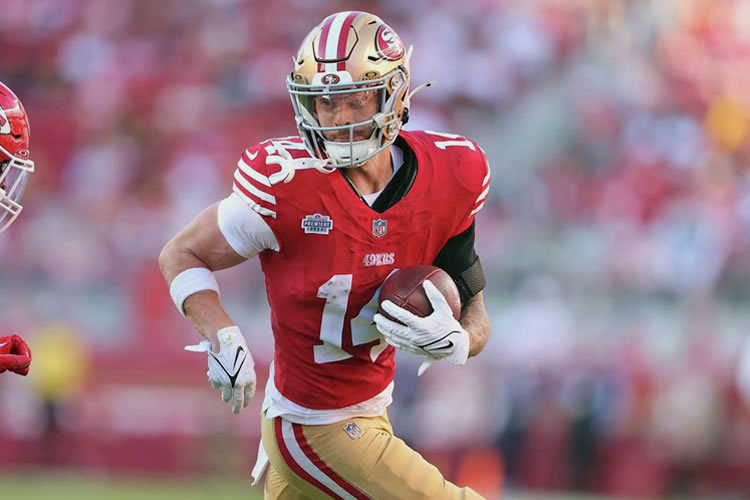
Although he was never the most productive college receiver, Pearsall hung around for a while and even had some good stretches playing with Jayden Daniels at Arizona State, after going there as a three-star recruit in 2019. After transferring to Florida three years later, he turned a combined 109 touches into 1800 yards and 11 scores throughout a pair of seasons in The Swamp. He followed up an impressive week of practice at the Senior Bowl with an excellent all-around combine showing. San Francisco head coach Kyle Shanahan probably had already fallen in love with the crisp route-running and attention to detail in his game. So his strong pre-draft process emboldened them to select him at the end of the first round (31st overall). Due to ultimately handing Brandon Aiyuk a four-year, 120-million-dollar contract and the rest of their most commonly associated 21 personnel grouping being slated for a combined 55.8 million total, it was also tough to see a path for the rookie to earn opportunities in-line with what you’d typically correlate with a first-rounder. Literally getting shot in the chest as a victim in an armed robbery nine days(!) prior to his first NFL game certainly made the start to his pro career more challenging. He ended up playing in the final 11 games of his rookie season, logging 67.5% of offensive snaps across those. Of his 46 targets, he hauled in 31 for exactly 400 yards and three touchdowns, along with turning three carries into 45 more yards. That included an odd three-week stretch, where he was largely deployed as a vertical clear-out element, only being targeted three times combined.
The first thing that stood out to me about Pearsall – and it continued to show up – was his burst from five to ten yards after slow-playing his release momentarily, to get on top of defensive backs. He routinely would put isolated defenders in coverage on his back-hip and provided a dimension that was missing at that stage of the calendar for the Niners with Brandon Aiyuk and a sluggish Deebo Samuel. Working out of the slot against zone looks, he’d elude overhang defenders or safeties on the edge of the box, and then put safeties on their heels when they have to pick him up, pushing at them. That speed was also deployed horizontally on some deep over routes. At the same, he understands when to pace himself, coming off the ball slowly and sitting down as defenders disperse. Where he was utilized most however, were these option routes, whips and returns, often times off motion. This guy has super oily hips to whip his body around and come flat without any excess steps or execute challenge breaks. Working over the middle of the field on digs/deep in-cuts, he consistently curls down just a little bit to avoid being undercut. Officially, Brock Purdy threw interceptions when targeting the rookie, but I’d only put one on him, where he got a little lazy by bending inside as the Lions’ Kerby Joseph raced up from the high post to step in front of the pass. Ricky is quite the craftsman as a route-runner against isolated coverage, with change of tempo and deceptive body language. You see him purposefully slightly drift outside before breaking to the sideline, where the defender just as he’s about to get even, anticipates him going across his face, or peak back to really sell the fade before snapping off deep curls and comebacks. On the negative side, he did get thrown off significantly by one-handed stabs at the line a few times. I’d like to see him become more physical against tight coverage at the break-point, slightly pushing off or swiping by the defender in order to cleanly get off contact. Too often, you see him get walled off by DBs who play with leverage to where he intends to break towards. Later in the year, I did see him use the momentum of defenders stacked over him against them with a slight throw-by as he got to the top of his route, and he was able to create separation that way.
Looking at the statistical profile following a shortened debut campaign, Pearsall only averaged 1.31 yards per route run. However, that’s in part because 45.7% of his targets came short of 10 yards, and while he was asked to run deep a lot to create space underneath, the ball only went his way 20+ yards downfield six times – and he secured half of those looks for 91 yards. Of the 32 targets he actually got his hands only, he only dropped one. On those limited opportunities down the field, he displayed great focus down the field with the ball hanging up in the air and the defender given a chance to catch back up, in turn also clouding the catch-point. So for a more slender receiver, hauling in five of nine contested targets (55.6%) is definitely a positive sign. That brings us to the area of his game that I was actually underwhelmed by – what he did after the catch. You’d expect the elusive movement skills as a route-runner to translate in that area, but Ricky didn’t log a single missed tackle on 34 touches. If a defender was able to get a solid initial wrap on him, he was typically stopped in his tracks. Where he did damage in that capacity was when he was able to pluck the ball on the run, go across the field and turn up the sideline. His speed was utilized a handful of fly sweeps and reverses – once also with a passing option tagged on from what I saw. On the flipside, he put in good work as a blocker, earning a solid 62.2 run-blocking grade from PFF. This guy takes excellent angles in accordance to his alignment to cut off angles for defenders and initiates contact with their inside pec to wall them off when runs hit between the tackles. He had great success down the field, coming to balance and sliding in front of safeties. He’s willing to dive inside for someone on the edge of the box from condensed alignments and allows the runner to go off-tackle typically. Although the lack of size and play strength does show up at times in that regard, when he can’t quite get to the correct shoulder or peels back inside, and someone in pursuit is able to go through him.
There are a lot of questions around the 49ers as a whole, coming off a disappointing 6-and-11 season. A myriad of injuries played a huge part in their demise, while the defensive front was pushed around more than we’ve ever seen in the Kyle Shanahan era, and for the first time since he’s had any respectable quarterback play, it didn’t feel like they were the ones dictating terms to opponents. As they’ve continued to transition away from their play-action staples off the wide zone run game – and a healthy Christian McCaffrey may reverse that trend to some degree at least – having passing options who can create separation on pure dropbacks has become more of a priority. That’s why they were willing to trade away Deebo Samuel, after investing that first-round pick in Ricky last year. With Aiyuk hopefully back sooner rather than later, providing him free releases in his sophomore campaign and a full offseason to build chemistry with his quarterback, the production over the last couple of weeks of his rookie year could be a sign of things to come.
Tight-end – Brenton Strange, Jaguars
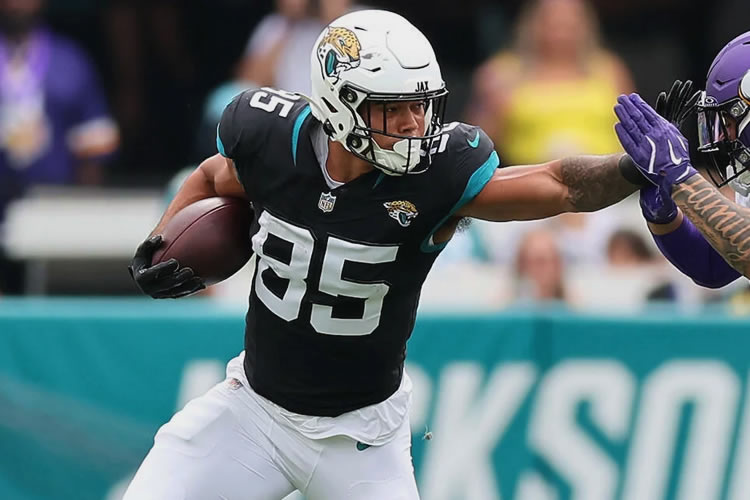
Despite being a top-500 overall recruit in 2018, who increased his production all four years at Penn State, due to the talent coming through the program at the same position, Strange wasn’t necessarily viewed as a high-end prospect at the end of his college career. However, his 1.57 ten-yard split and both jumps he posted at the combine were in the 82nd percentile or better for tight-ends, as an illustration of the explosiveness he displayed into contact as a blocker and into his routes. That’s why there was some late buzz in the process about how he may sneak into day two. Seeing Jacksonville call his name at the end of round two (61st overall) was still quite a surprise, based on some of the other prospects selected in that range. Considering Evan Engram was coming off a career year at the time, the fact he actually bested those numbers in 2023, finishing fourth among ALL players in total receptions (114) for nearly 1000 yards, while the rookie caught just five passes, didn’t indicate the greatest start to his pro career. However, while the veteran was only available for nine weeks and his per-game production slightly dipped this past season, the now-sophomore hauled in 40 of his 53 targets for just over 400 yards and a pair of touchdowns, and rarely left the lineup when he was the top option available. With Liam Coen coming over after coordinating the Bucs to a top-six finish in both DVOA and EPA per play last season, improvement for this unit overall should be in store, and now with the veteran TE having moved on from Denver, Strange is poised for another big jump heading into year three.
Even though he certainly flashed potential as a receiver, I was more intrigued by Strange when the ball didn’t go his way with the Nittany Lions. At just 22 years old, he presented a dense, powerful frame and made it clear that he was out for blood as a blocker. He comes out of his stance really low and explosively, to legitimately create horizontal displacement against defensive ends. Strange does an excellent job of centering his blocks, keeping his hands and lower body connected, and even if there’s not a whole lot of initial momentum, he’s able to re-accelerate his feet and drive opponents against their will or even plant them into the turf. He’s authoritative with turning bodies on the second level and riding them into the scrum. The only thing to criticize in that area is that he simply gets a little too aggressive at times, really churning his legs through the target, and he gets himself into trouble with his momentum being too far out in front, which skilled defenders can punish by pulling him aside/forward. There’s still room to optimize his initial footwork and hand-placement on base-blocks, but he’s improved plenty compared to his college tape. A lot of times, Jacksonville came out in Ace Duo sets, where Strange was lined up next to fellow TE Luke Farrell and either helped secure the C-gap defender on quick combos or immediately climbed to someone on the edge of the box and negated them from impacting the play. When detached from the formation, I really like what I saw from him on stalk-blocks on perimeter plays and screens, squaring up and occupying defensive backs to grant his teammates room to operate, where he’s sturdy enough to swallow the charge of a safety barreling down from depth. The same is true once one of those guys catches the ball on a routine pass play, and he can help spring them loose. After being flagged five times on just over 300 snaps as a primary blocker his rookie season, that number was reduced to just three on nearly twice the playing time. Funnily enough, I thought he was actually quite passive in straight-up pass-protection if he’s simply lined up on the hip of one of his tackles. However, him securing the edge on different versions of play-action, at times sifting across the formation, was a definitive plus. And yet, he only spent just over 40% of his snaps in-line, with a slightly higher rate in the slot and 13.4% of his usage being split out wide.
Considering I noted that he won’t stress defenses with his long speed based on my college evaluation, I was surprised by the potential Strange showed to hurt opponents if they don’t crowd his runways vertically or horizontally. He routinely deploys swim moves or stutters and nods one way to avoid jams early on in his stems. And then he carries his speed through these rounded cuts on crossers and benders really well. In college, he ran a fairly simplistic route-tree, but his ability to whip his body around on stick or short out routes after pushing up a couple of steps now make him an easy target on combinations that put the flat defender in conflict or his man isn’t playing with outside leverage. Strange is generally able to sit down in the chair to execute sharper cuts than I saw in college. Plus, he uses his frame very well to lean into and nudge off defenders in tight coverage. It’s against off-coverage that he sometimes tries to work in a little too much of a shoulder-shake as opponents slide in front of him, allowing them to get into his chest and impede him. Yet, he’s quick to work up to depth and curl up over the middle for the quarterback to hit him against zone shells, turn and pierce upfield. He immediately gets his head around off chips and delayed releases to be an outlet in case the pocket is being heated up. And his smarts show up when he’s responsible for just “getting in the way” of trailing defenders various rub plays. After a few bad drops back in 2021, he now frames the ball very well and allows his body to guide him into good positions as his eyes are locked in on the passes traveling through the air. So far, he has only dropped two passes in his young career, and I saw multiple full-extension grabs where the ball didn’t arrive on the easiest angles, or he had to dive for them. And I don’t have any insight in the PFF database if they counted those as “contested targets”, but I also saw several grabs over the middle of the field, with a defender racing up and coming over his back. His arms being barely over 31 inches will always limit his catch-radius and I wouldn’t say he has the quickest hands if passes come in hot over his head. After the catch, there’s no messing around. Strange has a few nice moments of stopping and swiping by defenders who come in too hot. Last season, he finished with nine missed tackles forced on 40 receptions, spinning out of the grasp of a few DBs, people sliding off his powerful quads and he consistently finished his runs with authority behind his pads, churning forward as he’s being wrapped. That’s why the Jags targeted him on a lot of these underneath routes, as a check-down option or even throwing him a couple of bubble screens – 40 of his 54 targets came short of 10 yards of depth.
It’s all there as you look at Strange to project a Pro Bowl-level season for him now as the clear TE1 in year three. So far, quarterbacks have logged passer ratings above 100 in both his seasons as a pro, and he improved his yards-per-route-run mark by more than a full yard compared to be marginal playing time as a rookie, up to 1.49 YRR. Plus, I thought going through a bunch of his snaps where the ball didn’t go his way, there were several opportunities to hit him coming open for big plays. Hopefully now having a full season with Trevor Lawrence under center, even with weaponry they’ve added at receiver around him these last two years, I believe there’ll be plenty of opportunities for the tight-end to thrive in Liam Coen’s offense, who just helped Cade Otton put up a career-highs across the board in his one season as OC in Tampa Bay.

Offensive tackle – J.C. Latham, Titans
Despite coming to Tuscaloosa as the number one offensive tackle recruit in 2021, Latham was a backup as a true freshman before becoming a fixture on the right end for all 13 games each, earning first-team All-SEC and second-team All-American accolades in the latter one of those. With an even stronger resume for Notre Dame’s Joe Alt, he became the first OT off the board with the fifth overall selection for the Chargers, but it only took one other pick before Latham heard his name called by Tennessee, as the second of six guys at that position to make it in the top 20. Funnily enough, while Alt was selected with the intention of being moved from left to right tackle in L.A., the exact opposite was the case for the Titans, despite not truly being settled on either side of the line. Considering new head coach Brian Callahan brought along his father Bill, who is largely considered one of the best offensive line coaches around the league, that transition wasn’t regarded as much of an experiment, even though J.C. never logged a single snap on the left side for Alabama as still only a 21-year-old. Still, while looking at the numbers – seven sacks allowed and ten accepted penalties against – you can say he had a pretty rough rookie season, there were definitely bright flashes. He was only flagged twice on live plays, being called for eight false starts. Three of those came when trying to get a jump on last year’s sack leader Trey Hendrickson and once hooking him, by the way. As a 17-game starter, he helped Tennessee average 4.1 yards per carry (just below-average league-wide). There was visible improvement in his technique as a pass-protector, and he recovered three key fumbles.
Considering the transformation the Bengals made in terms of their run game under Callahan previously, it wasn’t surprising to see the Titans call 227 gap- compared to 153 zone-blocking concepts. Looking at the rushing direction map, according to PFF, Tennessee had the most success hitting runs into the left B-gap, between Latham and fellow first-round pick Peter Skoronski (5.1 yards per attempt). And overall, they averaged two more runs to the left side of the center compared to the right. The displacement the rookie provided was a big reason for that. He comes out of his stance with excellent leverage, rolls his hips through the contact, and is able to create momentum to drive edge defenders off the ball on the front-side. He packs the vigor in his mitts to take advantage of D-ends slanting across his face and riding them out of the gap, opening up substantial cutback lanes. On combination blocks, he bumps three-techniques over to the opposite hip of the guard next to him, and even if he doesn’t have that momentum into contact with more of a runway as he climbs to the second level, he’s able to take linebackers off course. At the same time, he has loose enough hips to get his base around and take care of backside seals, and he was very effective on these second-level wall-offs on reverses and certain screen designs. Latham also showcased impressive initial burst out to the corner and then just pushes around smaller defenders, along with being flexible enough to pin them inside if they try to side-step him. On a negative note, he can be a little lazy with his hand on backside base-blocks, and overall could still use some refinement into contact, especially blocking down or attaching to combos. At different moments, there can either be a little bit of a wind-up with his strike, he’ll duck his head occasionally or his footwork simply isn’t optimized. And the biggest thing I thought was still missing from him in that regard, is truly snatching up defenders and gaining firm control of them in order to enforce his will on them.
Pass-protection was clearly the weaker area of his game as a rookie. Along with the seven sacks Latham was responsible for, PFF also “credited” him with 11 more QB hits and 29 hurries across 660 such snaps. Still, he had 12 games with two or fewer pressures allowed, while in the other contests they sort of came in bunches, when they were forced into a lot of “true pass sets” against Chicago in their season-opener, Jacksonville and both Houston matchups. Part of this was due to him having to rewire his brain and flip his feet on the left side, but Latham never had the quickest first kick to gain ground without prying open his shoulders in his pass sets. He has to be a little more intent on protecting his inside shoulder as rushers apply force on that pec, and he’s overly reliant on his two-handed punch at this point, while carrying his mitts low and wide, which he more so catches edge rushers with anyway, particularly off chips or lining up as nine-techniques. Now, if he does connect with that strike, he typically takes opponents past the apex of their rush and doesn’t provide them an angle to flatten to the quarterback. He displays an incredibly strong core and ability to stay in control of reps where he’s caught in compromised positions. There are several reps where it seems like his opponent may have the upper hand and is about to turn the corner, but Latham ends up putting him into the ground. I definitely believe he improved in that early phase of the interaction and his ability to gather his feet after choking off the angle, redirect and ride edge defenders trying to cross his face into the scrum, allowed him to negate that advantage those guys might have working the opposite way of the tackle’s initial movement. I also saw him flash a fake stab with the outside hand a few times later in the year, in order to force rushers to declare and then be able to land his paws into the chest. J.C. is a smooth lateral slider to take care of wide alignments on quick-rhythm passing plays and RPOs, and he has strong hands to take over slanting/twisting rushers or even guys lined up in the B-gap on the occasional full-line slide, as well as the quads to slow down the charge of spiking D-tackles.
Although Latham obviously had his struggles in pass-pro, the numbers for all of their guys up front ended up looking even worse thanks to the horrendous pocket presence Will Levis put on display. He’d constantly slide into pressures/sacks and create favorable angles for opposing rushers, which put his blockers into challenging positions. His pressure-to-sack conversion rate was nearly double that of first overall pick Cam Ward (15.9%) in his final season at Miami. With how much more proficient the quick game should be for them to take heat off the O-line and hopefully generally being a more effective offense down-to-down, that should make life easier on that group up front. Even though I don’t agree with the valuation of the individual player Dan Moore Jr., being handed a four-year, 82-million-dollar contract as a free agent in an inflated offensive line market, in theory his addition should represent an improvement at both tackle spots for Tennessee, with J.C. moving back over to his more natural side. Trusting his position coach to continue to mold a gem like him, the sky is the limit for this young man.

Interior O-line – Tanor Bortolini, Colts
After a slow start through his first two years in Madison, Bortolini showed his versatility in 2022, when he started ten games split between all three interior spots. The following season, he took over for Joe Tippman at the pivot in all 12 games and was recognized as an honorable mention All-Big Ten performer. Although he showed improvements throughout the week, you could tell he was at a power disadvantage for most of his time at the Senior Bowl. Yet, he followed that up with a historic combine performance, where he was tied for the second-best 40 time among the offensive line (4.94), the fastest time ever in the three-cone drill for a center (7.16) and the third-best short shuttle ever (4.28), along with above-average marks in both the jumps. Thanks to that, the Colts – typically very intent on targeting RAS darlings – selected him in the fourth round to back up Ryan Kelly at center. With the veteran only playing in ten games, the former Badger was able to fill in quite a bit (351 offensive snaps). Across eight games as a rookie, he posted an overall PFF grade of 65.1, not being charged with a single sack and finishing in the 85th percentile of negatively graded run-blocking plays, according to their tracking. Maybe most impressive, considering the murderous row of interior D-linemen he faced – Pittsburgh, Tennessee, Buffalo, Detroit and the Jets – he was only penalized once. With a full offseason as the designated starter, since they allowed Kelly to move on to Minnesota, and hopefully more stability from the quarterback position, Bortolini could be in line to impress with his combination of athleticism and how quickly he’s been able to handle the physicality of the pro game.
First and foremost, it looked to me like Bortolini bulked up a little bit from where he was in the pre-draft process to his first NFL action. As part of zone concepts, he arrives with his hands under the rib-cage/arm-pit of 2i-/2-technique and drives his legs relentlessly to create lateral movement on double-teams. When that D-lineman is aligned to the backside of the play-design, Bortolini steps with the foot closer to his guard responsible for him and lends a help-hand before climbing to the backer. For still a pretty young player, I thought his IQ and feel for these different combination blocks, when to stay thick, overtake and peel off, really shined. And he’s fully capable of getting to the play-side shoulder of the MIKE straight-up across from him, immediately getting horizontal to hang with wide zone call. I was very impressed with his dexterity and body control to keep his mitts connected and shield defensive linemen who may have the strength advantage, to where it opens up a lane off his backside. Although it’d be unfair to claim a day three pick heading into his second season could be an upgrade over a four-time Pro Bowler, Bortolini may actually expand the diversity of the Colts’ rushing attack. Not only can they weaponize his mobility by using him as a puller, but his quickness to get flat down the line and take care of back-blocks against defenders in the B-gap and not allow them to trail one of his pulling guards, enables them to play around even more with angles on gap concepts. He’s not going to move bigger interior defenders against their will, but he does enough on those to make them work. I’d say he has room to attack the near-shoulder and slightly turn the body of D-tackles shaded on him or the guard next to him on down-blocks, in order to deny them the ability to work over the top and scrape from the backside. You do have to have his athleticism on pin-and-pull concepts, where he can get all the way around his tight-end, locate and take out a linebacker or safety. Now, the thing that bothers me the most about Bortolini on tape is how often he ends up on the turf. Most of the great offensive linemen throughout the history of the game have been able to find ways to stay on their feet. Having said that, you rarely see him just whiff on clog up a rushing lane, but rather it happens later in the play-clock when it has little bearing on the end outcome.
The numbers for Bortolini in the passing game were excellent – no sacks, just two QB hits and five other pressures allowed across 211 pass-blocking snaps. He carries his hands at his mid-section and packs a tight punch, and particularly on these half-line slides towards the three-technique, where as that guy tries to cross the guard’s face, there’s number 60 hitting them in the chest, to largely neutralize him. On the majority of snaps, he’s the one connecting with one hand into the frame of the guy across from him, and generally, what O-line coaches will appreciate about how he gains control of rushers is that his thumbs are nearly pointed out to the sideline and he clutches all the cloth he can when he engages with them, holding where the officials don’t see and/or call it. Bortolini displays tremendous react-and-response paired with the lateral agility to deal with stunts and counter moves. He smoothly transitions on interior twists, working in concert with his guards and seemingly never allowing either rusher to squeeze through the A-gap between them. He is so poised when having to pick up delayed blitzers from the second level or someone looping across all the way from the edge, and if he is occasionally unoccupied altogether, this guy is looking for work and helps mess up different games he’s not involved in. When a linebacker is walked down over him at the snap, he’ll punch and re-set in case that guy still drops out. I saw a couple of powerful nose-tackles move Bortolini off the spot and open up a direct lane to the quarterback with a hefty club against the side of his shoulder-pad, yet the rookie was typically able to recover and guide those guys past the quarterback, when he was left on an island in pass-pro. When those guys tried to go straight through his chest, they’d often win the initial interaction, but the crafty center would hang in there, with the flexibility to get all his cleats into the turf and re-anchor, to keep his quarterback clean.
So going through his film and analytical profile, I thought it was interesting that he actually graded out better on gap runs (76th percentile among the IOL) than what he showed on zone concepts, considering how impressively he handled himself on all the different tags based on the defensive fronts they were facing. Meanwhile, a little bit of extra mass definitely showed up in his ability to deal with powerful interior rushers, to at least absorb their force and not grant them a direct path to his quarterback with his skilled hands and mobility in his lower half. Maybe most impressive about his rookie campaign however, is that he was only penalized once – and that was in his debut against a ferocious Steelers front. At this point, this quarterback battle in Indy is very much in the air, but with how this run game heated up later in the season, spear-headed by Jonathan Taylor, and the skill-position talent surrounding whoever is tasked with executing this operation under Shane Steichen, this unit almost has to take a step forward, and the guy snapping the ball on every single play could become a noteworthy name in the O-line sphere at least.
Others on my radar:
QB Caleb Williams, Bears
QB Michael Penix Jr., Falcons
RB Roschon Johnson, Bears
RB Ray Davis, Bills
WR Cedric Tillman, Browns
WR Malik Washington, Dolphins
TE Ben Sinnott, Commanders
TE Ja’Tavion Sanders, Panthers
OT Paris Johnson Jr., Cardinals
OT Olu Fashanu, Jets
IOL Tyler Steen, Eagles
IOL Jackson Powers-Johnson, Raiders
IOL Christian Mahogany, Lions
 Halil's Real Footballtalk
Pingback: Second- and third-year breakout candidates for the 2025 NFL season – Defense edition: | Halil's Real Footballtalk
Pingback: Second- and third-year breakout candidates for the 2025 NFL season – Defense edition: – Lifestyle . . . Defiant
Pingback: What does success look like for your favorite NFL team in 2025? | Halil's Real Footballtalk
Pingback: What does success look like for your favorite NFL team in 2025? – Lifestyle . . . Defiant
Pingback: Predicting the entire 2025 NFL season: | Halil's Real Footballtalk
Pingback: Predicting the entire 2025 NFL season: – Lifestyle . . . Defiant
Pingback: Discrete developments for surprise NFL playoff teams (2025): | Halil's Real Footballtalk
Pingback: Discrete developments for surprise NFL playoff teams (2025): – Lifestyle . . . Defiant