

It’s that time of the year again. Players across the NFL have voted for their peers and created a list of the top 100 among those – and so did I. As always, I have to mention the fundamental issue with how the official list is put together, considering each participant only lists their first 20 names, which encourages some biases for teammates. Players at the end of the ranking would otherwise not make the cut.
Once again, this list is about the 100 best players in the league, regardless of position, heading into 2024 – not judging their play last season exclusively but also not turning this into an actual projection exercise. Some of them are easier to measure and there is probably some inclination towards those who affect the game significantly through multiple avenues. However, you will only find 11 quarterbacks among these names. And specifically on that topic, I tried to isolate the player from the situation, which is why some MVP candidates may not have made their way onto the list, even if their numbers would suggest that they should be.
Please note that players like Aaron Rodgers, Kirk Cousins, Nick Chubb, Jaelan Phillips and Dre Greenlaw were not eligible in this discussion, considering we don’t fully know their availability and effectiveness for this upcoming season. I also didn’t feel comfortable ranking Cooper Kupp or Nick Bolton, who each played about half a season in 2023, but once again I’m not quite sure where they stand health-wise.
Here it is:

1. Patrick Mahomes
A case can be made here for a different player to top the list rather than Mahomes for the fifth time in the last six years. The numbers would suggest that I should, as the Chiefs had their most challenging season offensively since he became the starter in Kansas City. And yet, when everything was on the line, he stepped up and played his best football down the road, posting an EPA per play mark (0.288) on pair with his MVP seasons against the toughest competition en route to his third Super Bowl trophy. Adding context to the situation, constantly dealing with pressure off both edges and no reliable pass-catchers made his job significantly harder. He had an NFL-high 39 passes dropped. Adjusting his completion rate for those, he was tied for the second-highest percentage (79.3%) among quarterbacks. And Pat did a lot to marginalize those issues out at tackle, as for the fourth straight season, he finished with a top-two mark in pressure-to-sack conversion rate (11.2%).
2. Myles Garrett
This guy has been an All-Pro each of the past four seasons, but he ascended to the top of the food chain among edge defenders this past year, when he finally won his first Defensive Player of the Year trophy. Pro Football Focus agreed, as they made him the highest-ranked defensive player in the league (94.0) and he finished with easily the best win rate as a pass rusher (27.5%). That’s despite being doubled-teamed at the second-highest rate overall (29%). Defensive coordinator Jim Schwartz unlocked that entire unit, leading them a number one ranking in EPA per play (-0.155). For Myles specifically, he really weaponized him on designated dropbacks, with the way he’d move him along the line and allowed him to attack from multiple angles, crossing up interior blockers and landing euro-step moves as if he was on a basketball court.
3. Justin Jefferson
You can argue that Jettas shouldn’t even be the top-ranked wide receiver, as Tyreek Hill led the position in receiving yards, first downs and touchdowns. Yet, based on the statistics, he might’ve most effective season yet. If you ,look the numbers he logged over the nine games he started and extrapolated it over a full 17-game slate, he would’ve finished with 125 catches for 1978 yards (which would’ve broken the single-season receiving record) and 9(.5) touchdowns. His 2.91 yards per route run was actually the highest mark of his career (third in that metric across the league) and he only dropped one pass. Jefferson is elite at all three levels of the field, he can win outside or from the slot, against man or zone. The difference between him and the guy I have right behind him is that he can beat press-man coverage on the backside of the formation and even when defenses try to bracket him, his route isn’t dead.
4. Tyreek Hill
Like I just mentioned, you can make a pretty strong case for Tyreek being the top skill-position player in the NFL today. I mean, he just led all pass-catchers in receiving yards (1799), first downs (83) and touchdowns through the air (13) last season. However, while the Dolphins do make it a priority to build their passing game around Tyreek as the key cog to their offense, the efficiency metrics are off the charts with him as well, with his 3.82 yards per route run being 0.72 better than any other player in the league – that’s the same gap between number two and 21. Of course, his speed to win one-on-one and how it has encouraged quarterback Tua Tagovailoa to push the ball down the field, even outside the numbers, is huge. Still, it’s the gravity he has on any football field he steps on and how he affects the picture with the way Mike McDaniel uses him as a movable piece, before and at the snap, where if given a runway to put DBs on their heels, they’re at his mercy.
5. Micah Parsons
It’s rare to see a defensive player enter the league and immediately be one the best in the game. And yet, that’s Micah has proven to be, with last year’s third place actually being the worst finish for DPOY across those three seasons. He led the NFL with 103 total QB pressures – and he did so on only the 18th-most pass-rush snaps (513), giving him the highest mark in terms of pass-rush productivity (12.6) league-wide. To make that even more impressive, the 35% double-team rate he faced was easily the highest of any edge rusher out there. It’s tough to imagine that he may even get better in the next few years, but he’s already shown so much improvement in the way he converts speed to power, the way he can defeat the hands of blockers, read and take advantage of their pass-sets against him. So considering he’s also a really strong run defender at 245 pounds, the sky is the limit.
6. Josh Allen
There’s been a lot of debate about who QB2 across the NFL is heading into 2024 and the general hierarchy after Patrick Mahomes, but to me the guy who has been closest to an annual contender for the top spot has been Josh Allen. This past season, a lot of people made a big deal of the turnovers and hero-ball moments he still, but I’d argue nobody is as important to their team’s success and creates more game-changing plays than this guy. He led the NFL with 44 total touchdowns and he finished third in EPA per play (0.193). He also had trumped Mahomes for the lowest sack rate in the NFL (4.0%) and the best pressure-to-sack conversion rate (10.3%). So the idea of him not being able to keep his offense on schedule when there is chaos, is just absurd. He can put on that superman cape, but is very happy to deliver routine plays, and only one other quarterback led more than Allen’s four game-winning drives.
7. Lamar Jackson
Purely looking at the statistics, when Lamar won his first MVP back in 2019, that would appear as a much more impressive individual season. However, when you watch him play every single week, the way he was able to control games – largely from within the pocket – actually felt more meaningful. In fact, his ability to sense pressure from multiple angles and navigate that condensed space with subtle movements is up there with the very best in the game. He contributed 4500 total yards and 29 touchdowns despite sitting out the regular season finale, since he had already wrapped up the AFC’s number one seed for his team with 13 wins. Once again, not a single skill-position player for Baltimore contributed 1000 yards, but they still finished fourth in points per game (28.4) and Lamar’s presence was a key factor for yet another number-one-ranked rushing attack.
8. Christian McCaffrey
Putting the reigning Offensive Player of the Year down at number eight and feeding further into the negative bias towards running backs isn’t something I’m happy about, but this speaks to the number of true superstars we have in the NFL and you’ll see how massive the gap between him and the next-closest player at his position is here. McCaffrey just led the NFL with 2023 scrimmage yards – nearly 200 more than the next-closest player. His 114 first downs gained were number one and he was tied for a league-high 21 touchdowns. Yet, for all the accumulation stats, he’s was also highly efficient with his touches, as he finished behind only Dolphins rookie Devon Achane – who was in a stratosphere of his own – with an average of 1.32 rushing yards over expected, while running against the heaviest boxes across the NFL. Meanwhile, San Francisco’s ability to play five-out and not really lose anything when their running back by name is split out wide, is a huge feather in CMac’s cap and if you actually leave him one-on-one with a linebacker, he can run right by that guy. He also didn’t drop a single pass last year.
9. Chris Jones
Last year, I said that the Rams’ Aaron Donald has been dethroned for the first time in nearly a decade for the title of best defensive tackle on the planet. Donald actually beat him out again in a few statistical categories, but with the three-time Defensive Player of the Year deciding to hang up his cleats, Jones still owns the top spot. So he “only” logged the second-most QB pressures among interior D-linemen (75 – two fewer than when he led the position in 2022), but he did so on only the 16th-most pass-rush snaps (482) and being tied for the highest double-team rate (72%) in the league. He’s arguably the best closer on the defensive line today – inside or out – and he may have played at the highest level when needed most, taking over that AFC Championship game at Baltimore and delivering several key plays in their Super Bowl comeback against the 49ers, including the pressure on their opponents’ final offensive plays, which led to an errant throw on what would’ve otherwise been a touchdown to start overtime.
10. Trent Williams
Trent may be at the start of a slight decline – which is insane to say for a guy heading into his 15th season as a pro – but he still was just 0.2 off the highest overall PFF grade award to offensive linemen (92.6), including the playoffs. He didn’t allow a single sack across 561 pass-blocking snaps and helped pave the way for the league’s leading rusher. The only issue is that he was penalized at least nine times each of the past five seasons. Nevertheless, having an ass-kicker like him at left tackle combined with the way head coach Kyle Shanahan can marginalize personnel limitations up front, has covered up for the fact that the other four names on the O-line have not been particularly inspiring. We saw what happened when a couple of them were isolated in key moments of the Super Bowl, but the Niners still finished in a tier of their own in terms of DVOA (31.8%) and EPA per play (0.179), and Williams represents that physicality they play with on that – and really both – sides of the ball.

11. T.J. Watt
Being one of the most impactful defenders in football on an annual basis simply lays in the Watt family. T.J. was “only” tied for seventh with 86 total pressures, but for the third time in seven seasons with the Steelers, he led the league with 19 sacks. That matches his total in terms of tackles for loss, while being involved on seven fumbles and scoring a touchdown off an interception, where he actually read the quarterback’s eyes playing off the ball and understood where the pass was going based on the play set-up in impressive fashion. So he made a strong case for winning his second Defensive Player of the Year trophy as the runner-up. Having said all of that, Watt has enjoyed the benefit of consistently playing along one of the best all-around defensive fronts in the league, and while he has shined the brightest among those, his double-team rate of 14% last season was less than half of what the actual winner Myles Garrett. Nevertheless, he’s been one of the biggest game-wreckers and splash-play producers on the defensive side basically since his second year in the league.
12. Nick Bosa
On the surface, Bosa did take a slight step back from his Defensive Player of the Year season in 2022, not receiving any votes this past year. However, his importance on that 49ers D may have been higher than ever, with the heavy rotation of edge rushers across from him and how he stepped up once the playoffs rolled around. Adding in the postseason, Bosa racked up the most pressures across NFL defenders (122). That’s despite being doubled-teamed at the third-highest rate (26%) across the league. I wrote about the fact that he needed some help from the guys around him in my big Super Bowl preview with how little they produced while Nick put up 27 pressures across those three final contests. San Francisco’s run defense was another piece in question down the stretch, but that’s not based on number 97, who added in 16 TFLs and posted his highest PFF run defense grade (81.9) since being drafted.
13. Maxx Crosby
Even with me having Crosby up here at number 13, I feel like I and the public especially are still underrating this dude. There are guys who may be a little more refined or have a go-to move that hits at a higher rate to get those clean wins, but I don’t think there’s another player offensive tackles across the NFL hate facing more than Mad Maxx. You just know this guy is going to give you hell for four quarters and he rarely comes off the field, leading all defensive linemen with 1080 regular season snaps last season. He finished within ten pressures (94) of the league lead despite playing on a defense without a lot of marquee names and led all non-linebackers with 58 defensive stops. Crosby is going to bury his hands into the chest of blockers and test their anchor, but then he’ll throw in a spin move a few times per game that still seems to catch opponents off balance. At the same time, he’s a hard-nosed edge setter, who was tied for a league-high 23 tackles for loss and received the highest PFF run-defense grade for any defensive lineman (92.7).
14. Penei Sewell
That 2021 draft class will always have a special place in my heart and I fell in love with Penei Sewell and Ja’Marr Chase – who is next up – as my top-ranked players behind only Jaguars QB Trevor Lawrence that year. He immediately was an above-average starter as a rookie, despite being asked to switch sides and has since transformed himself into the best right tackle in the game. In 2023, he finished just ahead of San Francisco’s Trent Williams with for the highest overall PFF grade among offensive linemen (92.8), looking at the regular and postseason. Across nearly 800 snaps in pass-protection, he only gave up one sack, and he’s actually an even better run-blocker, who will take edge defenders for a ride on the front-side of concepts, but his athletic tools and the way he can get to extended landmarks allow Detroit to be the league’s most diverse unit in that regard.
15. Ja’Marr Chase
I do believe there’s a certain drop-off from the tier of Justin Jefferson and Tyreek Hill, but I still landed on Chase as my WR3 and I can see a path where he ascends to the top of that list this season. Despite only having a healthy Joe Burrow throwing him the ball for about one month and ranking 66th among 80 wide receivers with 50+ targets in average depth of target (9.1 yards), he finished ahead of Mike Evans for 12th in receiving yards per game (76.0 YPG). In fact, only six players in NFL history have accumulated a higher total through their first three seasons in the league and that’s with six games missed over that stretch. Chase can win on a vertical plane on the outside, he’s one of the most dynamic weapons after the catch we have in the sport and something I’m looking forward to this season is the potential of him getting extensive work in the slot.
16. Fred Warner
When you think about a modern-day linebacker, Fred Warner is the name that comes to mind. His ability to process information and the quick burst he provides make him one of the league’s best run defenders and he really unlocks San Francisco pass D with his range and instincts. He was the only player at his position to finish with PFF grades above 80 in run-defense, coverage and pass-rushing last season (if you include the playoffs), logging a 90.0 mark overall. This past season under Steve Wilks they were a more traditional unit in terms basing everything out of nickel personnel, not running a lot of stunts and using basic cover-three and -four on the back-end. That did allow Warner to snatch four interceptions (tied for most among linebackers), but we’ve seen former play-callers use him as a chess-piece by mugging the A-gap and then somehow still carrying a slot receiver zooming right up the seams.
17. Dexter Lawrence
It was a rough fall back down to earth for the Giants, going from a surprise playoff team that won a Wildcard game to picking sixth overall in the draft yet again. Having said that, they did have one truly elite player, who has now played his position arguably as well as anybody in the league. At a time where nose-tackles are low-snap players who don’t receive a lot of attention for the dirty work they put in, Sexy Dexy is putting that group back on the map. Only Defensive Player of the Year Myles Garrett received a higher PFF grade among defenders at 92.9. We know that he’s a premiere run stuffer in the NFL and by the grades, might’ve enjoyed his best season in that area, but the G-Men actually take him off for some early downs these days, because of his impact in dropback situations. Looking at interior defensive linemen specifically, only recently retired Aaron Donald finished with a higher pass-rush win rate (20.2%). That’s despite a 71% double-team rate on those, which was just one percentage point behind the high mark.
18. Patrick Surtain
The title for CB1 across the NFL isn’t as heavily discussed as about a decade ago, when the term “shutdown/island corner” was thrown around between the game’s best. Defenses running a lot more match zone coverages in particular is part in that, but also just not as many names being on the forefront for that group. I believe there’s a clear duo battling for bragging right, and I gave Surtain the nod based on the fact that he faces the toughest job – being isolated on the backside of the formation – at a higher rate than his counterpart. For his young career, he’s surrendered an average of 6.3 yards per target in coverage and been highly effective at getting pass-catchers to the ground, allowing three yards after the catch on those. Considering they ran single-high stuff on well over 60% of snaps last season and he’s regularly facing the opposing team’s top receiver, those numbers are actually elevated. He’s also been an incredibly consistent tackles, only missing between 7.7 and 8.0% of attempts in his three seasons as a pro.
19. Sauce Gardner
Sauce is the 1B here in this battle and you can make a strong case based on the numbers that those two names should be swapped. In each of his first two seasons, he’s received an elite PFF coverage grade, finishing first and second (90.8) respectively among corners. After leading the league with 20 PBUs along with his two interceptions compared to just 46 receptions allowed in year one, opposing quarterbacks avoided the All-Pro corner a little more last season, but he still only surrendered an average of six yards when he was targeted, with one touchdown to his name in each. Plus, adding context to those – one was a miscommunication in zone coverage at the goal-line and the other a long score that was put on him, because he fell off to a seam route, where he nearly broke up the pass anyway. You may argue that Sauce’s job isn’t as difficult as the one for other top-flight corners who are put on island, due to how much zone-coverage the Jets like to run with him locked to the left side, but on nearly 350 snaps in man so far, he’s only allowed 13 completions for 129 yards on 40 such targets.
20. Quinnen Williams
Continuing our conversation on Jets defenders, the guy that stirs the drink up front for them is Big Q. Williams’ traditional numbers were down slightly from his 2022 season, with only 5.5 compared to 12 sacks, but he yet again posted double-digit tackles for loss, batted down three passes at the line, logged a safety and hauled in a ricochet interception. More importantly, as you look at the PFF database, he finished with a top-ten pass-rush win rate among all defensive players last season (19.5%) and looking at the interior in particular, his 70 QB pressures ranked third on just the 21st-most pass-rush snaps. Williams has one of the quickest first steps for a penetrating role, but then he’ll overpower guards and he has a great feel for how to get wins late in the down, as he takes advantage of poor weight-distribution by his opponents.
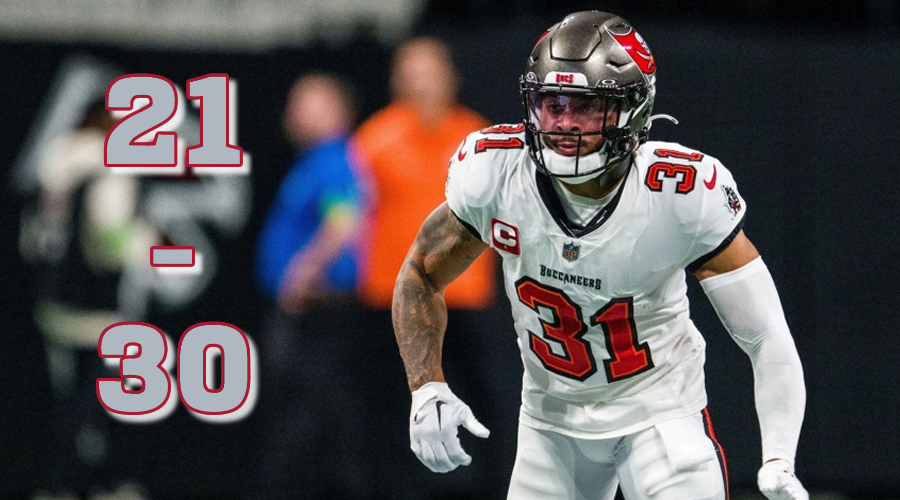
21. Antoine Winfield Jr.
Never did I take the Pro Bowl and its voting process less serious than when Winfield didn’t make the ballot. Of course, he did ultimately – and rightfully – get named a first-team All-Pro, as the numbers and tape would suggest. While the Falcons’ Jessie Bates III and the Ravens’ Kyle Hamilton were tied for first in total passes defensed (17), Winfield finished only two behind those in that regard, along with being tied for first among all defenders with six fumbles forced and four recovered respectively, along with adding six sacks and TFLs each. He made truly game-changing plays on a weekly basis, include a couple of punch-outs right at the goal-line to save touchdowns, and received the highest PFF grade among all defensive backs (91.5). He can play the high post, but also has the IQ to drive on routes in front of him in split-safety looks, he’ll run the alley with a purpose, and he was a highly effective blitzer, finishing second to only Minnesota’s Josh Metellus in terms of DBs with 18 QB pressures on about half as many pass-rush snaps (55).
22. Roquan Smith
Similar to Fred Warner on the 49ers, Roquan is the glue that holds the entire Ravens defense together. It may not reflect in the statistical profile all the time or appear obvious to the casual observer watching the broadcast, but when you put on the tape, you feel his impact. His ability to clean up behind the chaos Baltimore creates up front, his ability to take away multiple options in coverage, but most glaringly, how he unlocked running mate Patrick Queen in this attack style of role alongside him and the development he’s shown since Smith arrives there really stands out. In two straight years now he’s defended nine passes (three interceptions among those) and he’s always up near the top in terms of total tackles, but he also highly consistent at bringing people to the ground, with a miss rate below 5% in three straight years now. I described his impact on the Ravens’ turnaround defensively last year and now with a full season in the middle of that unit, he helped them finish number one in DVOA (-23.3%) and points allowed (16.5 PPG).
23. Joe Burrow
Having Burrow down as QB4 and outside the top-20 may come across as a hot take based on where he’s found himself on various lists throughout this offseason. However, we did only get one healthy month of him this past season, after he was one of the worst passers over the first month, and we still don’t fully know if the hand injury that ultimately knocked him out for the rest of the year will affect him going forward. What we do know is that he’s one of the smartest, most cerebral quarterbacks in the game today. He allows you to really spread the field, force the defense to declare what they’re doing and he’s tremendous at finding solutions with near optimal ball-placement to help out his pass-catchers. Taking his two full seasons in Cincinnati, only Patrick Mahomes, Josh Allen and the San Francisco QBs rank ahead of him in EPA per play (0.175).
24. A.J. Brown
Our perception of what kind of receiver Brown is has really shifted from his days in Tennessee, where he was largely a run-after-catch specialist and someone they tried to hit on a lot of big crossers off play-action. Since his rookie season, he’s now hauled in just over 50% of his contested catch opportunities, making his mark as a downfield ball-winner for Philadelphia. And this past season, I thought he was his complete self yet, being able to win on the outside as a route-runner and make big plays with the ball in the air or in his hands. Starting in week three, he put together six consecutive games of 125+ receiving yards, before the entire Eagles offense seemingly combusted, and since the start of 2022, only Tyreek Hill and Ceedee Lamb have racked up more yardage through the air.
25. Jessie Bates III
It’s rare to see a safety cash in as a free agent the way Bates did and immediately become an even bigger impact player than prior. Statistically, the Falcons certainly benefitted from a lackluster schedule in terms of the quarterbacks they faced, but having this guy roaming on the back-end made those opponents look even more pedestrian, along with elevating the pieces around him. Bates’ six interceptions ranked third in the NFL. He also added 11 more passes broken up and only one other defensive back racked up more than his 89 solo tackles, yet only missed 7.7% of his attempts. His IQ to identify route-combination and position himself to make plays on the ball is elite, yet he also doesn’t mind sticking his face in the fan and bring down much bigger ball-carriers to great effect.
26. Kyle Hamilton
I struggle to even label Hamilton a safety, because Antoine Winfield Jr. does find himself touching nearly every blade of grass throughout a game with his level of activity, while Jessie Bates plays the position in a more traditional sense. Baltimore’s second-year standout spent 250+ snaps deep, in the box and in the slot, where he logged just over 400 and could really impact all facets of the game. Hamilton was tied with Bates among all safeties across the league with 17 passes defensed, including four picks. There wasn’t another player in the NFL who made quarterbacks look worse when they targeted him, as they combined for a passer rating of just 38.4 and only gained 2.6 yards on average when going his direction. That included only one touchdown across 63 targets. With that being said, Hamilton shockingly may have been even more impressive rushing the passer however, receiving a PFF grade of 92.7 in that facet, logging better than a pressure on every third opportunities (14 on 37 such snaps).
27. Ceedee Lamb
I did mention that A.J. Brown finished just behind Lamb in terms of receiving yards over the past two seasons combined (3108). Yet, understanding their roles and the presence of the division rival on the field, I do think it’s fair to prefer the alpha X receiver, who has produced this way on an offense more geared to winning on the ground. Nevertheless, this should not take away from the quality of Ceedee’s play, especially in 2023, when the Cowboys started moving him around and he played outside a lot more as well (41.8%). Not only did he set career-highs across the traditional statistics, including an NFL-high 175 receptions, but he also put up his best marks in yards per route run (2.78), drop rate (3.3%) and missed tackles forced after the catch (20). With Dallas funneling their offense through him, his quarterback also emerged as an MVP candidate.
28. Travis Kelce
There was certainly a time early on last season, where I didn’t think Kelce would reign supreme at his position and find his name up here. Yet, when the Chiefs needed him most, he once again looked like one of the effective pass-catchers across the league, leading all players with 32 catches for 355 yards on 37 targets over four playoff games. There’s no denying that he’s lost a step – at least until he suddenly reached his highest speed of the year at the end of the Super Bowl – but what makes Travis so special is the way he can manipulate defenders in man-coverage and just exploit any vacated space when you play zone, along with his ability to find secondary windows once Mahomes starts moving around. Plus, Cleveland’s David Njoku was the only tight-end to force more missed tackles after the catch than Kelce (17).
29. George Kittle
If there was a battle for the title as TE1 – as the main competitor in this regard over the last several years – Kittle has built the strongest case for dethroning Travis Kelce. While the latter doesn’t operate as the de-facto X receiver as often anymore to challenge defenses, I would still argue that their roles are quite different. Kittle has consistently been one of the standout blockers at the position, logging PFF run-blocking grades above 70 in all but one of the last six seasons, and he’s a been key for the Niners being one of the most effective teams on the ground over that stretch. At the same time, he’s one of the most dangerous weapons through the air, capable of running away from linebackers and then dragging bodies along with him once the ball is in his hands. This past season, his 2.22 yards per route was tops among tight-ends and he led the position with 7.3 yards after the catch on average.
30. Tristan Wirfs
We already knew Wirfs was one of the best offensive tackles in the game coming into 2023, but he added to his worth by making a seamless transition to the left side and allowing the Bucs to get their best five guys out there. Unfortunately, what they had on the interior still wasn’t overly inspiring and they once again were one of the least effective rushing teams in the league, but nobody expected them to finish eighth in EPA per play (0.055) as an offense overall. Baker Mayfield’s resurrection was obviously a major factor in that ascent, but being able to trust his blindside helped massively. Wirfs finished the year with a PFF pass-blocking grade of 86.1, which ranked second among NFL tackles with 100+ such snaps and he didn’t have a live-ball penalty called against him all season long.

31. Josh Hines-Allen
I outlined then-Josh Allen as one of the “under-the-radar stars” three weeks into last season, because I thought he had taken his game to the next level, and he proved me right by maintaining that throughout the year. With 17.5 sacks, that ranked Hines-Allen – who has recently adapted the first part of his last name to honor his family – behind only the Steelers’ T.J. Watt. And he finished fifth with 90 total pressures, while being tied for the 18th-most pass-rush snaps. As I showed in that video, several of the snaps where he didn’t actually get home, he still affected the quarterback and forced errant throws, which at times ended up in the hands of his teammates. That combined with his best campaign as a run defender I thought, allowed him to elevate Jacksonville to the tenth-best defensive unit in DVOA (-4.2%).
32. Jaylon Johnson
For anybody who’s followed Johnson’s career going back to his day at Utah, they know that last season was not a flash in the pan but rather continued growth to his All-Pro status, as one of the most fundamentally sound, smart and competitive guys in the perimeter. He just finished tied for second among cornerbacks with 4.8 yards per target and he was fifth among all defensive players with a passer rating responsible for of 50.9. Pro Football Focus made him their highest-ranked corner in their system as well (90.8). Along with the trade for Montez Sweat, the key to Chicago’s rise on defense over the latter half of the season was Matt Eberflus taking back over play-calling, where they became great communicators under the umbrella of their cover-three principles. Johnson routinely was tasked with MEG (“man everywhere he goes”) assignments on the backside of the formation, but while he officially only spent 101 snaps in man-coverage, he only allowed 32 yards across those.
33. C.J. Stroud
We’ve had some great quarterback seasons in the past, but what Stroud was able to do was sort of unprecedented, in terms of how much he was under control pretty much from the jump. He simultaneously led the NFL with 273.9 passing yards per game but also had the lowest interception rate (1.0%), and was one of only five quarterbacks to log a passer rating of at least 100. They rose just inside the top half of the league in EPA per play as an offense after ranking dead-last the year prior, and that’s with still one of the least effective rushing attacks across the league. His ball-placement was superb, he was highly aggressive at creating big plays – leading the NFL with an average of 9.1 air yards – and to the surprise of many who evaluated him as a draft prospect, he was able to create a ton of plays off schedule.
34. Matthew Stafford
It was a really tough call between Stroud and Stafford for who I’d put as the fifth-best quarterback in the NFL. Because while this is based on who I’d take for the 2024 season, I largely base my opinions around the information we currently have rather than actually predicting what will happen. Based on this past year alone, it’s tough to come up with five names who were better at playing the position. No other quarterback in the NFL (with 200+ dropbacks) had a better rate between big-time throws (6.3%) and turnover-worthy plays (1.9%), including the playoffs. And Stafford finished fourth in PFF passing grade (86.0). He can obviously kill defenses with papercuts, as Cooper Kupp or now also Puka Nacua running option routes, but watching this guy sling it down the field off their more vertically-oriented run game was so much fun.
35. Davante Adams
This is Davante’s lowest ranking since 2020. Over the following three seasons, he averaged 113 catches for just under 1500 yards and just over 14 touchdowns. Anybody who has watched Netflix’s “Receiver” series is familiar with how frustrated the perennial All-Pro became last season and as someone who traded for him in fantasy, I can tell you that there were several missed opportunities due to the quarterback not going his way or flat-out missing his top wideout. Watching Adams on tape, I don’t see much of a drop-off, especially considering his game has never been built raw physical gifts but rather his ability to manipulate defenders on the release, the attention to detail at setting up his breaks, creating favorable positioning and haul in passes even with defenders on his hip.
36. Trent McDuffie
Kansas City emerged as the second-best scoring defenses (17.3 points per game) across the NFL last season, in large part thanks to the way they were able to plaster receivers with their defensive backs. Now-former teammate L’Jarius Sneed may have had a slightly more impressive statistical profile while matching up with the opposing team’s top wide receiver at a higher rate, but McDuffie offers greater versatility, spending over 200 snaps in the box, 300 outside and well over 400 in the slot. He can get in the face of receivers and bother them in press-man-coverage, which he once again proved in a Super Bowl performance worthy of MVP consideration, but his spatial awareness and film-studying habits when in zone duty are equally impressive. Along with a quality edge-setter in the run game, he was one of the more effective blitzers out of the slot in 2023 (16 pressures on 56 pass-rush snaps) and was tied for third among all NFL defenders with five fumbles forced.
37. Aidan Hutchinson
If not for Sauce Gardner being a legitimate All-Pro corner right away and football analysis being at a point where we can recognize great coverage seasons, Hutchinson would’ve won Defensive Rookie of the Year, as he actually beat out the actual winner with his three interceptions. This past season, he still picked off a pass and batted down another seven, but was more focused on actual getting to the passer. His 101 total QB pressure last season ranked second to only the Cowboys’ Micah Parsons. Now, he did so on the second-most pass-rush snaps as well (624), but he did have the sixth-best win rate in that regard (21.3%). So he barely left the field for Detroit, his motor is running hot all the time and he was highly successful at beating the guys in front of him, with only one game in which he didn’t reach at least five pressures according to PFF’s database.
38. Justin Madubuike
Chris Jones and until this past season Aaron Donald receive a lot of the recognition among defensive tackles, but you can argue that Madubuike was the most disruptive player at his position in 2023. I was a big fan of what he could become coming out of Texas A&M and outlined him as a breakout candidate coming into the season prior – which wasn’t wrong by any means, but he has now risen to a different tier. Madubuike finished tied for the third-highest mark in tackles for loss (12) and the most sacks (13) among the interior D-line, while his 33 QB hits was only topped by T.J. Watt and Nick Bosa. Yet, I would argue his impact went beyond those numbers, as the guy who consistently affected the offensive backfield and set the table for Baltimore finishing as the top-ranked defense in DVOA (-23.3%).
39. Minkah Fitzpatrick
This has been one of my favorite players to watch regardless of position pretty much since he emerged as a freshman under Nick Saban at Alabama. If you were putting together a defensive back for the modern game, I have a tough time seeing anybody but Minkah. He started out as almost a pure nickel in Miami, but once he was traded to Pittsburgh, they started to move him around the way he wanted to be, because of the way he can affect games in so many ways. You can’t blindly air out fades on the outside to his side in two-deep looks, sending guys down the seam against him as a post defender is a death sentence and if you ask him to charge up the alley, he’s typically to set the tone on contact. Coming into last season, only two players had more than Fitzpatrick’s 17 interceptions since 2019 and he’s recently become a more reliable tackler as well.
40. L’Jarius Sneed
As I already mentioned, there’s an argument to be made for Sneed to be even higher if we purely evaluated his 2023 season. My ranking is probably slightly affected by the change of scenery in a new scheme with Tennessee and some worry about his knee, considering how willing Kansas City was to move him following what should’ve been recognized as an All-Pro season. Nonetheless, he was bullying receivers at the line and stuck to them like glue for the majority of games. He was targeted exactly 100 times – with a lot of those in press-man alignment – but he only allowed 51 of those to be completed for less than 500 yards and not a single touchdown. That had him tied for second among all cornerbacks with 4.8 yards per target, while he broke up 14 passes himself.

41. Lane Johnson
This is one of the most impressive pass-protecting tackles of all time when you look at the numbers. Until week nine of this past season, Johnson hadn’t allowed a sack in nearly three calendar years, along with just 22 total pressures across 1100 pass-blocking snaps between 2021 and ’22. Seeing opponents log 35 this past year alone feels almost impossible. However, I would argue a lot of that had to do with the predictability of Philly’s offense and how their quarterback operated within it, as Jalen Hurts held onto the ball for an average 3.13 seconds. Meanwhile, this past season, Johnson actually led the NFL in ESPN’s run-block win rate among tackles at 82% despite a lacking of variety in terms of the concepts they were calling, making the job easier on defenders for how to encounter those battles.
42. Trey Hendrickson
I don’t believe Hendrickson quite belongs in the elite tier of edge rushers, but based on the statistics, he was part of that group this past season. Only Pittsburgh’s T.J. Watt had more than his 17.5 sacks and he finished third in pass-rush productivity (11.2). He’s one of the best in the game at using his hands to create favorable angles, he offers a broad rush package, which he throws at opponents repeatedly, and he’s excellent at disengage as he gets close to the quarterback, with strong triceps to push blockers aside. I believe he’s an underrated run defender, who is technically sound deconstructing blocks – which allowed him to finish tied for tenth in the NFL with 16 TFLs – and the fact that those D-ends in Cincinnati can drop into coverage a couple of times per game allows coordinator Lou Anarumo to change up their looks a little bit.
43. Danielle Hunter
To think that Hunter will only turn 30 midway through this upcoming season feels insane thinking back to when he came out of LSU as a raw 20-year old back in 2015. It didn’t take long for him to prove my unproven eye at that time wrong and turn himself into one of the best pass-rushers in the game. After missing one-and-a-half seasons with what appeared to be a career-threating back injury, he’s returned to the top of the rankings, with only five players in the NFL having racked up more than his 156 total pressures over the past two years combined. He’s always been one of the more unorthodox guys in that regard but challenges offensive tackles with that myriad of things he can throw at them. Being set up with one-on-ones as part of Brian Flores’ cover-zero heavy approach definitely helps, but that usually also means that the ball should come out quickly, plus Hunter was tied for a league-high 23 tackles for loss.
44. Justin Herbert
I’m not sure if there’s a player in the NFL where there’s a bigger discrepancy between what casual fans – along with TV hosts trying to attract attention – and tape nerds like me believe he is. This is the lowest Herbert has ranked for me personally since, largely because I can’t deny that he just got to work with what I believe is one of the better pure dropback game designers in Kellen Moore and his talent could still not be maximized. Now, this situation still requires context, with the injuries to their wide receivers, how inefficient their run game was and some of the issues we saw in protection. When L.A. has had full firepower, we’ve seen how explosive they can be through the air with a guy like this, yet it’s how he covers up problem areas that actually is even more valuable. Herbert has finished top-ten in pressure-to-sack conversion rate each of his four seasons in the NFL.
45. Jordan Love
Considering how the Chargers will build their attack more around the run game under Jim Harbaugh and Greg Roman, I can see Jordan Love actually putting up more impressive numbers this upcoming season and the form he was in over the latter half of this past year has earned the respect of putting him in this stratosphere already. Some of the fade-away throws and play-extension stuff he put on the highlight reel looked so much like the guy he replaced in Green Bay, but it’s the routine stuff and learning throughout games that really made a difference down the road. Love finished behind only Dak Prescott with 32 passing touchdowns compared to 11 interceptions, and he ranked fifth in EPA per play (0.156). On top of that, when he did have to make something happen with his legs, he averaged 8.5 yards per scramble.
46. Mike Evans
While we’ve probably gotten to the point where Mike Evans is largely considered a future Hall of Famer, his name is rarely mentioned when talking about the best receivers in the league. Still, many people have taken his greatness for granted, with ten straight seasons of 1000+ yards through the air to start his career. This past year, he was also tied for a league-high 13 receiving touchdowns as one of the premiere downfield targets, with his 15.0-yard average depth of target only being topped by glorified cardio guys who stretch the field with their presence and don’t even register half of the actual production of Big Mike. He was one of only seven receivers with a team target share of over 40%, yet was able to actually create separation as a route-runner. At the same time, since the inception of contested catches in PFF’s database, only once in eight seasons did Evans not haul in more than 50% of those passes for a season – often well above that mark.
47. Brandon Aiyuk
As I described in my detailed Super Bowl 58 preview, one of the big differences between the 49ers offense last season compared to prior ones, is the presence of a true difference-making X receiver, who can win his matchup on the backside of the formation at a high rate, as the defense has to commit additional resources to the field and/or against the run. Aiyuk was a demon against single-high defenses, who encouraged his quarterback to actually push the ball deep outside the numbers but then also got open with the way he could snap off routes. He finished behind only the Steelers’ George Pickens with 17.9 yards per reception. To underline his effectiveness in a more impressive fashion – Aiyuk finished seventh in yards through the air (1342) despite only being 36th(!) in targets (105). And he was one of only three wide receivers to crack the three-yard mark in terms of yards per route (along with Tyreek Hill and Nico Collins).
48. Mark Andrews
Discussing the best tight-ends and fantasy options ahead of the 2024 season, Andrews has sort of become the forgotten man after missing the second half of last year and not looking like himself when he returned in limited capacity for the playoffs. Taking out week 11, when he got his ankle twisted at the end of the opening drive, Andrews was on pace for just under 1000 yards and 11 touchdowns through the air – which would’ve been his second-best season yet. To illustrate how successful that connection between the eventual league MVP Lamar Jackson and his tight-end was yet again – among the 125 NFL players with 50+ targets, Andrews led the way with a passer rating of 133.5 when the ball went his way. He can stretch the seam, elevate over bodies for catches in traffic and quickly picks up additional yardage with the ball tucked away.
49. DeForest Buckner
The Colts have not been a true difference-maker defense since DeForest Buckner was traded there in 2020, but he’s been a steady presence on the interior for them throughout that time and they’ve been a respectable unit throughout, despite personnel issues on the perimeter and simplicity in coverage with Gus Bradley as the one remaining Seattle-3 truther. DeFo has logged at least seven sacks and double-digit tackles for loss in all four years in Indianapolis. There’s a pretty sizable disparity between PFF and ESPN’s advanced metrics, where he finished fifth among the IDL with a 17% pass-rush win rate whilst getting double-teamed on 66% of those snaps last season. Plus, he added seven bat-downs at the line and had a scoop-and-score on a play where he initially got the strip-sack.
50. Christian Wilkins
Full transparency – I thought Wilkins was in store for an even bigger 2023 season, going from a defensive system that asked him to play more gap-control, read and work off blocks, compared to being allowed to attack more Vic Fangio. Unfortunately, that entire unit never quite lived up to expectations due to several injuries at every level and disputes around how the available should be used. Having said that, we have enough proof through five seasons in Miami to feel confident about the impact Wilkins is about to make on the Raiders, as one of the most useful D-linemen across the league. He did put up a career-best nine sacks and has now racked up 36 TFLs over the past three seasons combined. He didn’t quite lead interior defenders in total stops like he did in 2023 (55), but he nearly had the same amount of stops as solo tackles and almost doubled his previous high in total QB pressures (58) on basically the same number of opportunities.

51. Dak Prescott
It feels crazy to put the MVP runner-up just outside the top-50 and by no means do I want to be labelled a Dak hater, since I’ve had to learn my lesson a few years ago, when I was still of the belief the most effective Cowboys offense would be built on the ground game. He just led the NFL with 36 passing touchdowns and led the number one scoring team (29.9 points per game) despite arguably their least efficient rushing attacks since he got to Dallas (outside of 2020, when he got hurt). He also finished second in EPA per play (0.245), dropback success rate (52.6%) and passer rating (105.9). The one issue – and once again, I don’t want to simplify things here – is how Dak and the Cowboys as a whole can’t step up in their biggest matchups, getting knocked out in the Wildcard Round at home, with a touchdown thrown to the opponent before they got on the board themselves at the end of the first half.
52. Trevor Lawrence
I just released an extensive video on Lawrence and his new contract a couple of weeks ago, where I go into detail about the things he does well, some of the structural and personnel issues around him and what that deal actual looks like for the future of the franchise. In summary, they had the most runs stuffed for no or negative yardage, their O-line was an absolute mess and I had a lot of questions about their spacing and conceptual make-up. And yet, here Jacksonville was at 8-3 before they lost six of their final seven games, after Trevor had his ankle twisted – which he battled through without missing any time. He has logged 35 big-time throws each of the past two seasons and without wanting to take away from the video breakdown, because the structure of his new deal is a big piece of it, I think this is absolutely a go to build around long-term.
53. Christian Darrisaw
With the quarterbacks out of the way, we’ll shorten the analysis a little bit here. Darrisaw immediately looked like a franchise left tackle once he was inserted in the lineup three years ago and he’s been rock-solid ever since. The sack totals are a little higher than you’d like to see, but last season he earned the third-highest pass-blocking grade from Pro Football Focus (85.3) among all offensive linemen with 100+ such snaps and he’s only been flagged a total of 13 times across nearly 2500 total snaps in Minnesota. Plus, just a year ago he received an elite PFF run-blocking grade (90.2) on top of it.
54. Zack Martin
Speaking of the offensive lines, we’ve got the Cowboys guards back-to-back here and I gave the slight nod to the veteran. The level of consistent dominance Martin has displayed screams “first-ballot Hall of Famer”. This past year was the first time he’s been responsible for 20+ sacks and there are other guards competing with him for the top spot these days, but he’s still a stalwart up front for Dallas. There are only three interior O-linemen who posted a higher run-block win rate according to ESPN’s advanced metrics and Martin hasn’t been penalized more than twice in a year since 2015 – that’s on just under 1000 snaps played per season.
55. Tyler Smith
I had that internal debate about potentially unseating Martin with his teammate here, but ultimately decided against it because of how often the second-year man was still flagged (11 times). Having said that, you take some of those moments of over-aggression and suboptimal technique for the impact blocking he provides. Smith regularly provides significant displacement in the run game, especially when he’s allowed to arrive on an angle to ride defenders down the line, and his base in pass-pro is among the strongest in the game, with only one sack and two more QB hits allowed across more than 600 pass-blocking snaps in 2023. The way he neutralized Eagles standout rookie Jalen Carter really stood out to me in their meetings.
56. Derrick Henry
With only Christian McCaffrey facing eight plus defenders in the box at a higher rate last season (35.4%), the odds were once again stacked against “The King” in terms of the resources defenses have tried to throw at him. And yet, he leads the NFL in rushing yards (7209) and touchdowns since 2019 (70), with half a season missed among those. Last season specifically, the totals weren’t quite up to the insane standard he’s set due to the issue Tennessee was dealing with up front all year long, but if you isolate what Henry did after contact, he finished behind only McCaffrey once again with 930 yards and he was right there in terms of average (3.32 yards). Him going downhill with the slashing ability of Lamar Jackson on option plays will be a nightmare for defenses.
57. Saquon Barkley
If there’s a running back I could buy stock in – probably in terms of drafting him in fantasy and placing early season props – I would invest in Saquon, who has produced massively in New York despite how poor that offense has largely been. While the yards after contact and missed tackle forced rates aren’t quite as high as you’d expect for a talent like him, largely because his offensive line wasn’t good enough to provide him that head of steam and opportunities in the open field, looking at Next Gen Stats’ database, he was right there with explosive rookies Bijan Robinson and Jahmyr Gibbs in terms of his average yards over expectation (0.39). Now behind that Philly O-line, I wouldn’t be shocked if he led the league in rushing.
58. Frank Ragnow
Some concerns around Ragnow’s long-term health have been brought up this offseason, considering he’s been battling through significant bruises the last few years, but there’s no denying he’s one of the best, most critical centers in the game. With him in the lineup, the Lions are one of the most effective offenses on the ground and through the air (top-eight in EPA and success rate for both). Ragnow himself was Pro Football Focus’ highest-graded center across the NFL last season (88.8), including the playoffs, and he was also only penalized once. He’s one of the savviest blockers you’re going to see with how he releases in the screen game and re-locates leverage points in pass-pro. Since 2020, he’s only given up two sacks and 44 total pressures across just under 2000 snaps in that regard.
59. Laremy Tunsil
There were questions about the trade package Houston gave up for Tunsil back in 2018, especially once they moved on from their quarterback and were entering a massive overhaul, but he has been a mainstay on the left side to help them through some tough times until looking like a real contender again coming into this season. He’s been one of the premiere blindside protectors, with PFF pass-blocking grade of 85+ in the four of five seasons where he’s logged 200+ such snaps. Last year, the Cowboys’ Tyron Smith was the only offensive lineman overall to receive a higher PB grade than Tunsil (85.4). His only major fault has been false start penalties throughout his time in Houston.
60. Chris Lindstrom
Lindstrom is the one other name who could argue for the title of best guard in the game and Pro Football Focus would argue so, as he earned the highest overall grade at the position last season (87.6). And this certainly isn’t his fault alone, as there were several individual missed assignments and the benefit for defenses knowing that outside zone was coming, that turned Atlanta from the most successful unit on those to below-average. Still, it has to be pointed that not even the second-team All-Pro was omitted from those. Nevertheless, he remains one of the best zone-blockers and pass-protectors across the league. He been responsible for only 24 total pressures on 1123 pass-blocking snaps since the start of 2022.
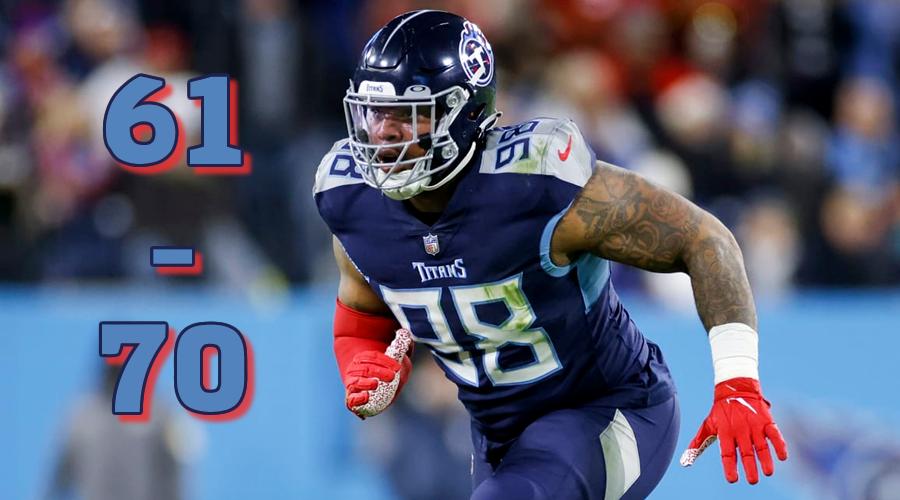
61. Jeffery Simmons
Simmons was one of the harder players to rank on this list, because I know which kind of player he is and has been. Based on last season alone, you could slide him down a few more spots, but projecting for 2024, I may look silly for not having higher. New DC Dennard Wilson brings over that defense they ran in Baltimore and his numbers may skyrocket similarly to what we saw from Justin Madubuike. This guy is a beast in the run game, he has a knack for getting his hands up with swat down passes and your guards better get all their cleats in the ground when he’s attacking their chest, because you know that bull-rush and off that potentially the push-pull are coming. Based on the pressures per pass-rush snap, I was actually surprised to learn that Simmons just posted the highest pass-rush productivity of his career (7.2).
62. Creed Humphrey
This is one of the players who was just completely overthought during the 2021 draft process and has since just been an elite center who hasn’t missed a single game of the 61 he’s been for in Kansas City, including the postseason. Across those (4100 combined snaps), he has only surrendered 49 total pressures and been flagged a total of 16 times. He’s super crafty with finding angles and using torque to get defenders turned in the run game, the way he can engage his core and lower makes him tough to put in disadvantages as a protector and I love watching him take out targets on screens. This past year, he finished behind only the guy playing to his left hip in Joe Thuney among interior offensive linemen across the league with his 98% pass-block win rate, according to ESPN.
63. Jaire Alexander
The 72.8 PFF coverage grade he posted last season was the lowest of his career and it was the first time he was responsible for a passer rating above 100, but that speaks more to the high level he’s performed at. The story with Alexander recently has been have been injuries and questionable usage under their former defensive coordinator. We don’t know exactly what the new man in charge Jeff Hafley will do from a schematic perspective, but based on his time in college, a higher rate of single-high structures and cater to the strengths of his players. If you put Jaire on an island, he’s been one of the best at mirror-and-matching routes and he’s one of the great aggravators in the league.
64. Jalen Ramsey
Ramsey may have missed the initial seven weeks of his debut season in Miami, but he quickly made an impact with one of his three interceptions coming in his first game, and performed up to the insanely high standard he’s set for his career. Looking at the four All-Pro cornerbacks, Jalen was right there with Chicago’s Jaylon Johnson for the best mark in terms of passer rating allowed (51.1). There were questions around his usage under former defensive coordinator Vic Fangio, since he has a long track record of being isolated in the boundary with X receivers, but he can also move into the slot in order to affect the game through more avenues. Across 90 snaps in man-coverage, Ramsey was only responsible for 28 yards.
65. Andrew Thomas
It’s fair to question if Thomas has a tendency of getting hurt more than you’d like to see, with 12 games missed over the past three seasons combined, but there’s no denying that he’s one of the best left tackles in the game when available. Since a rough rookie campaign, he’s only been flagged eight total times and surrendered a pressure on just every 28th snap in pass-protection. At the same time, what I’m most impressed with when watching him is how easy he makes some of the most challenges blocks in the run game look like. The way he can scoop three-techniques on the backside of lateral concepts or locate and flatten smaller bodies when pulling out to the corner is special.
66. Rashan Gary
Similarly to Thomas on the offensive side, Gary has been a standout on the edge defensively when healthy ever since his second season. Since the start of 2021, he has accumulated a pressure on better than every sixth opportunity he’s had (191 pressures on 1125 pass-rush snaps). That’s right on par with what Myles Garrett just did in his Defensive Player of Year campaign. And he may not be at the top of the list in terms of tackles for loss, but that’s due to the fact that running backs constantly had to cut up inside of him bench-pressing tackles and holding up the point of attack. With Gary, the problem is that he missed half of 2022 with a torn ACL and only played 53% of defensive snaps last season.
67. Quincy Williams
As you can tell, I see a pretty big gap between Fred Warner and Roquan Smith compared to the other linebackers we have across the NFL. If I had to point out the guy I enjoy watching most among the rest – and maybe even above those two – it would be Quincy Williams. Not only that, I think he impacts the game as much as anyone else. His 80 total defensive snaps were nine more than any other players across the league. His closing burst to chase down plays to the perimeter or shut down completions underneath jumps off the screen, yet he doesn’t only deliver the most splash hits but also is one of the most secure tacklers, with a miss rate below 10% each of his three years in New York. Last season, he finished behind only teammate C.J. Mosley with a PFF coverage grade of 88.7.
68. Haason Reddick
One of the wildest things to me in the NFL is that Reddick will now play on his fourth team in five seasons after being traded to the Jets earlier this offseason. Over these last four years, he has logged at least 11 sacks and tackles for loss each (fourth and seventh league-wide in those statistics overall). Since his early time in Arizona, where he was miscast as an off-ball player, he has been one of the most dangerous threats off the edge. His explosive first step, the ability to bend the corner and when he’s in range, tomahawk the ball out of the quarterback’s hand has allowed him to deliver several game-changing plays, including when he knocked out Brock Purdy in the NFC Championship game against the 49ers at the end of the 2022 season.
69. Kyren Williams
Once again, Christian McCaffrey currently exists in a tier of his own among running backs, but if there was a guy who became a true workhorse for his team and came close to that kind of level of production, it would be Kyren Williams. He actually led the league with 95.3 rushing yards per game and would’ve tied CMac’s 21 total touchdowns across a 17-game sample. He also finished just ahead of San Francisco’s reigning Offensive Player of the Year for second in PFF rushing grade (90.6) and was just below him with 3.34 yards after contact on average. Kyren is a perfect fit for L.A.’s duo-centric run game, with his ability to navigate those double-teams, lead linebackers to the wrong side and grind out tough yards. Meanwhile, he’s also a reliable pass-catcher and -protector.
70. Jonathan Taylor
When we think about individual talent, Taylor certainly finds himself above Kyren Williams, but right now I can’t quite put him above what the Rams second-year man was able to do this past season. Since leading the league with just 1800 rushing yards and 20 total touchdowns in 2021, he has only played 21 games due a high ankle sprain, a contract holdout and lastly a broken thumb. Nonetheless, he has posted just over 90 yards per game over that stretch and still averaged better than three yards after contact per carry. Considering Carson Wentz in his final season as a starter was easily the best quarterback he’s played with over these past three, I’m very excited about the idea of watching JT and Anthony Richardson now sharing this Indy backfield with how that O-line has reascended.
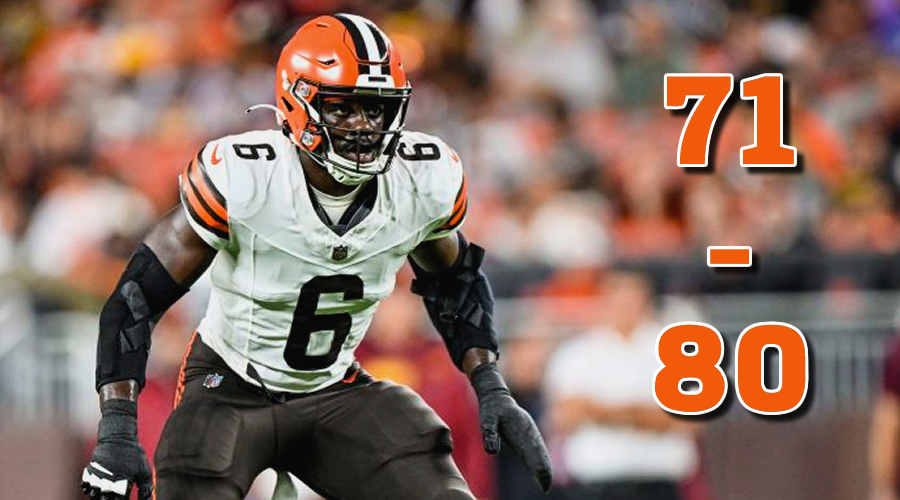
71. Jeremiah Owusu-Koramoah
Similarly to the Jets’ Quincy Williams, JOK is an undersized linebacker whose range and splash plays stand out whenever you put on that Cleveland defense, which finished top-two in several of the major statistical categories. His 20 tackles for loss were the most for anybody at his position and it ranked fourth among all NFL defenders. Combining that knack for creating negative plays with the fact that he’s missed just over 10% of attempted tackles since his rookie season make him one of the best run-and-chase players we have on the second level, with the ability to carry even slot receivers vertically and a knack for knifing through gaps as a blitzer.
72. Bijan Robinson
The 2023 season for Bijan and the Falcons offense as a whole was certainly defined by quarterback play and their questionable personnel usage under head coach Arthur Smith. Having said that, the flashes of brilliance, where he’d make a defender look foolish in the open field or blew by a linebacker on a wheel route were certainly there, and I think people kind of exaggerated a lack of high-end production. The rookie finished top-ten in scrimmage yards (1463) and fifth in yards per touch (5.4) among running backs, despite only being 21st in carries (214), as he forced a missed tackle on 24.3% of those. And he turned 30 of those into 10+ yards. Also, only Christian McCaffrey and Breece Hall added more first downs as a receiver than Bijan, despite catching the ball 0.6 yards BEHIND the line of scrimmage on average.
73. Amon-Ra St. Brown
We can discuss the value of a primary slot receiver who isn’t a major factor down the field, but all Amon-Ra has done since entering the NFL is produce. From week 11 of his rookie season onwards – when he became a fixture in the lineup, here are his per-game averages – 7.2 catches for 90.6 yards and 0.6 touchdowns. Being a target magnet in an offense without legit outside weapons for the most part definitely helps with those numbers, but he averages better than five yards after the catch for his career and since 2022, only Tyreek Hill and Ceedee Lamb have hauled in more than St. Brown’s 58 catches on third down, as their reliable chain-mover.
74. Derrick Brown
Early on in Brown’s career, there were questions if the Panthers were correct to invest a top-ten draft pick in a nose-tackle, but especially with the league’s transition to putting more defensive backs on the field, the value of that position has increased while the player has continued to develop. Brown easily led the way in ESPN’s run stop win rate metric among defensive linemen at 47% and PFF not only graded him as an elite player in that regard, but the only D-lineman with more than his 53 defensive stops was the Raiders’ Maxx Crosby on more than 100 additional snaps. Where he can transcend into that elite tier is boosting his pass-rush production, where he has 40+ pressures each of the past two years on a team largely playing from behind.
75. Jalen Carter
There’s a reason Carter was the number one prospect on my draft board last year and the favorite for Defensive Rookie of the Year until the last couple of weeks of the season – he’s an absolute freak. His combination of explosiveness, short-area quicks and power is as impressive as any interior defender we have in the game today now that Aaron Donald has retired. Only five interior D-linemen finished with a higher overall grade by Pro Football Focus and they agree with ESPN, as both had him finishing sixth among the position in pass-rush win rate, somewhere between 16 and 17.7% looking at their metrics. Having barely played over half of Philly’s defensive snaps as a rookie, I’d expect his standard numbers to be near the top of the league as well in 2024.
76. Tyler Linderbaum
For any doubters there were left about Linderbaum’s NFL prospects due to size/length concerns, he has rapidly squashed those. He was already the sixth-highest ranked center for PFF as a rookie and actually improved in his second season. Linderbaum’s movement skills to reach-block shades or get to extended landmarks has allowed Baltimore to diversify their run game portfolio and he didn’t give up a single sack along with just three hits on his quarterback across 610 pass-blocking snaps this past season, all the way up to the AFC Championship game. And in 35 career games, only once was he responsible for 3+ pressures.
77. Christian Barmore
The 2023 season was one to forget for Patriots fans, but their problems at quarterback, the lack of separators along their receiving corp and little schematic advantages they were able to create overshadowed how well their defense performed. They finished tied for fourth with the Cowboys in schedule-adjusted DVOA (-10.6%) despite losing their top edge rusher and corner fairly early on. A big reason they were able to maintain such a high level of play along with excellent coaching was the emergence of Barmore on the interior. According to ESPN’s advanced metrics, he was tied for tenth in pass-rush win rate among the interior D-line at 13%, and of his 56 total tackles, 40 resulted in defensive stops.
78. Puka Nacua
I don’t believe I ever felt dumber than when I listened back to myself calling Nacua “McVay’s new version of Robert Woods” and then not spending my final pick in every fantasy draft on the rookie receiver. He quickly showed me that I made a poor decision when he feasted on option routes in the absence of the injured Cooper Kupp, but even when the previous triple-crown winner returned, he was heavily involved in the offense, whether that was running deep crossers, winning one-on-one on the outside or taking their run game to the next level as an insert blocker. Nacua finished fourth in the NFL with 1486 receiving yards. Some of that can be explained by the extensive target share to start the season, but he continued to be highly productive as the WR1 on this offense and also ranked fourth in yards per route run (2.75).
79. Jordan Mailata
Mailata is one of the great offensive line stories we’ve had in NFL history, going from a rugby standout in his youth who had no experience with American football to an All-Pro level player in less than five years. His monstrous size and strength allow him to overwhelm defenders in the run game, but the way he can slide in front of and clamp down on pass-rushers is the more impressive piece here. Only Detroit’s Penei Sewell and San Francisco’s Trent Williams finished with higher overall PFF grades among tackles (84.8) last season, as he posted top-six marks in both run- and pass-blocking. Moreover, the only OT with a higher run-block win rate than Mailata’s 80% was his teammate on the opposite end of the line in Lane Johnson
80. Denzel Ward
While he wasn’t quite able to keep riding the developmental curve he was on after a tremendous rookie season, Ward has showcased an incredibly consistent level of play and production. In six seasons with Cleveland, he has logged multiple interceptions and double-digit PBUs every single year. The Browns have now put together arguably the league’s top cornerback trio between him, Martin Emerson and Greg Newsome, but this is still the number one guy among that crew. Ward finished last season top-ten among his position in completion percentage (48.5%), yards per target (5.1) and passer rating responsible for (56.2). That’s despite an NFL-high 71.2% of single-high coverages putting pressure on those guys in coverage.

81. Trey McBride
Although the Cardinals offense – and generally what they did schematically – is more so reserved for sickos to enjoy, I believe anybody can fall in love with what McBride put on tape in a breakout season. Sitting behind on the depth chart form about half of his first two seasons in Arizona has limited his overall production, but once he took over in weight eight and played more than two thirds of snaps in every game the rest of the way, he blew up. Over those final ten contests, he hauled in 66 of 85 targets for 655 yards and three touchdowns. For the season, he averaged 5.4 yards after the catch and among all NFL players who saw double-digit contested-catch opportunities last season, McBride finished atop the rankings by bringing in a massive rate of 73.3% of those.
82. Sam LaPorta
It’s rare to see a rookie tight-end produce right away, which makes the fact he finished top-five in receptions (86), yards (889) and touchdowns (10) that much more impressive. I thought based on his Iowa tape, he had some of the better hips and wiggle, which enabled him to separate at the break-point, pierce up the field and make things happen. What surprised even me was how dominant he was over the intermediate middle of the field and around the goal-line. He scored on two thirds of his red-zone targets (15) and while he isn’t quite up there with the aforementioned Trey McBride, LaPorta finished right behind him in that regard with a 68.4% contested catch rate among guys with 10+ such opportunities.
83. Jonathan Greenard
Defensive Rookie of the Year Will Anderson Jr. received a lot of attention for the role he played in Houston’s defensive turnaround under the guidance of head coach DeMeco Ryans and defensive coordinator Matt Burke. However, I would argue that he wasn’t even the best defensive end on his own team. Greenard finished top-ten league-wide in sacks (12.5) and tackles for loss (15). His 22% pass-rush win rate ranked sixth in ESPN’s rankings last season and from week three onwards, only three times did he not log at least three QB pressures in games he finished. While he did excel in that new role, crushing the pocket from those wider alignments, he’s one of the most skilled guys in hand-to-hand combat and I’m excited to see what he can do in Brian Flores’ system in Minnesota.
84. Keenan Allen
Like many others – even as a big Keenan Allen fan – I tend to think about him in the terms of an aging player, but that’s not giving him the credit he deserves for what he just accomplished in his 11th season as a pro. He posted the second-highest marks of his career in catches (108), yards (1243) and touchdowns (seven) despite only playing 13(!) games due to the lost year for the Chargers. For years now, playing zone-coverage against the Chargers was an invitation for Justin Herbert and Keenan to pick them apart, yet the veteran receivers is still able to consistently create separation with pristine route-running. Allen picked up just over two third-down conversions per game and even with the other receivers around him in Chicago, he’ll be key for Caleb Williams’ start as a pro.
85. Kevin Dotson
Among all the 2023 offseason moves, the Rams upgrading fifth- and sixth-round picks by the Steelers by a round each in exchange for Dotson was right there as one of my favorites. He had received PFF grades of at least 64.5 in all three seasons as a pro, even if penalties had been an issue in his final one with Pittsburgh. Still, he massively exceeded even my expectations, finishing as the second-highest ranked guard by Pro Football Focus (85.2). Dotson was instrumental in L.A.’s commitment to a more downhill-oriented rushing approach, where he and his teammates created major movement on double-teams, regularly pushing D-tackles into the laps of linebackers and opening up lanes for Kyren Williams to lead the league in rushing yards per game. He was also only penalized twice.
86. Joe Thuney
While not as dominant in the run game as the previously discussed Kevin Dotson, Thuney has been equally important for the Chiefs offense with his ability to keep Patrick Mahomes clean. Yet again, he received the highest pass-blocking grade among guards by Pro Football Focus (84.5) and the highest win rate in that regard from ESPN (99%), only surrendering two sacks on over 800 such snaps if you include the postseason. Thuney has only missed two of 131 career games and he’s only been penalized twice in each of the past two seasons, helping Kansas City win back-to-back Super Bowls.
87. Javon Hargrave
A player that was supposed to push the 49ers over the top and win a championship, but came up just short, was Javon Hargrave. While he came up a little bit short of reaching the numbers he posted in his final season in Philadelphia (11 sacks and 12 TFLs), he was a pretty consistent force on the interior of that D-line. For the third straight year now he’s logged at least 63 total pressures (including the playoffs) and only once all year did he not at least multiple ones. I wouldn’t say that he took over any games, but he arguably played his best in the Super Bowl, which is what they really brought him in for.
88. Charvarius Ward
Looking at how the 49ers defense has shifted schematically over the last couple of years, having Ward as a boundary corner and how they utilize him is the biggest difference. So with him being put in more isolated situations in quarters, you’ll see him give up some plays, but he has that short-term memory to come right back and make them himself. Now, he gave up just over 700 yards in coverage, but that was 109 targets and he broke up four more passes than any other player in the league (23) and only three players logged more interceptions (five). Also, he has now missed than less than 5% of attempted tackles in each of the past four years.
89. Matt Milano
Watching Buffalo’s defense maintain a fairly high level of play last season can to a large extent be credited to the development of Terrel Bernard to marginalize the loss of Milano at the second level, but once he was knocked out as well, you really saw issues arise for them. Previously, he had been one of the most consistent linebackers across the NFL and posted his best PFF grades in coverage and rushing the passer in 2022. Milano is a key cog in the Bills’ generally zone-centric coverage scheme, being able, squeezing down passing windows and contesting the middle of the field. Last season, he also created three takeaways on just over 200 defensive snaps.
90. Brian Burns
I would’ve liked to Burns a little higher than this, as he had previously been a steady rise since his rookie season. His sacks (tied between 2020 and ’21) and tackles for loss had increased every single year leading up to 2023 while being tied for tenth in total pressures. Unfortunately, as the Panthers fell off even further, opportunities to rush the passer whilst playing with the lead further disintegrated and the efficiency dropped. Now playing with more of a rush threat at the nose in Dexter Lawrence in New York and under a coordinator Shane Bowen, who understands who to create favorable opportunities for one of the bendiest guys around the arc, I think his production will rise again.

91. Will Anderson Jr.
Just like the Saints in 2017, Houston ended up with the Offensive and Defensive Rookie of the Year this past season – and their duo has a chance to end up being even more impactful. He was already double-teamed at one of the highest rates in the league (23%), which ranked above teammate Jonathan Greenard, speaking to the respect opposing teams already paid him That honor was well-deserved, as according to ESPN’s metrics, only Micah Parsons and Myles Garrett logged higher pass-rush win rates than the rookie (26%). Based on their numbers, Anderson also was tied for the second-highest run stop win rate (35%). So while we’ll have to see if he quite has the physical tools to ascend to that elite tier of edge defenders one day, he very much looks like the cornerstone piece the Texans traded up to number three overall for.
92. Cam Heyward
This is another longtime defensive stalwart who I felt like I listed too low, but couldn’t quite justify considering he is entering year 14, just missed extended time for the first time since 2016 and was his least effective self since then as well. He only logged two sacks, three TFLs and one pass defensed. He also only recorded 21 total pressures on just over three pass-rush snaps and posted his worst PFF grades vs. the run (67.7) and pass (64.8) each. Now, his presence on the interior as this worker bee is still crucial, as he refuses to be moved off the spot in the run game and will go right through the chest of the guy across from him on his way to the quarterback. For a player like him to only have missed 5.4% of career tackling attempts is also pretty wild.
93. Khalil Mack
On the opposite end of the spectrum, I feel like I’ve been wanting to move Mack down these rankings in recent years with the traditional statistics painting a better-looking picture than what the player is at this point, but you can’t deny the production he’s put up. Mack just finished fourth in sacks (17), third in tackles for loss (21), tied for third among all NFL defenders with five fumbles forced, and added in ten passes deflected at the line for good measure. He also finished as the seventh-highest ranked defensive player by Pro Football Focus (91.8). That’s just too good to ignore, even though I believe he obviously can’t take over games the way he did in his prime, unless he faces an exploitable matchup.
94. Amari Cooper
This is one of those guys, where the public conception of the player is based on the fact that the Raiders were willing to trade him to Dallas, who were fed up with not being able to get a contract extension done and then shipped him to Cleveland, rather than what he’s actually been able to do across those three spots. Once twice in nine seasons as a pro has Cooper failed to crack 1000 receiving yards – where he missed a couple of games in each – and he’s reached the end-zone a total of 60 times across that time. This is one of the top route-runners in the game and he was involved more down the field last season, finishing third with 17.4 yards per catch despite four different (underwhelming) quarterbacks throwing him the ball.
95. Montez Sweat
Solely based on his personal growth, Sweat just had the best year of his career, either tying or setting new career-highs in sacks (12.5), total pressures (64) and tackles for loss (14), despite having to acclimate to a new defensive system when he was traded to Chicago at the deadline. More importantly however, it’s the impact he had on this Bears defense, in combination with head coach Matt Eberflus taking back over play-calling duties. They drastically turned things around, going from the 30th-ranked unit in EPA per play over the first eight weeks all the way to fifth league-wide from that point onwards.
96. Kyle Dugger
I placed a couple of AFC East safeties back-to-back here, who present very different skill-sets and fulfill very different roles. Dugger has been one of the most fun roaming player to watch, who Bill Belichick and his successor Jerod Mayo have moved across the field as a chess-piece. He’s an excellent matchup player against tight-ends, he can drop down into the box as an extra linebacker without really losing anything and last season, he was asked to play deep a lot more, where his fluidity for a guy North of 220 pounds combined with the hitting power makes him a unique player. Over the last three years, he has been responsible for a passer rating of 82.0, picking off nine passes and missing just 8.6% of his attempted tackles.
97. Jevon Holland
Holland presents a very different profile on the back-end of the Dolphins D. For him, the key ingredients are instincts, redirection skills and flat-out range. He can contest throws outside the numbers as a deep half defender, he can make quarterbacks decline potential shots up the seams and if you ask him to drive on routes with match principles to his side, he’ll dislodge targets from the ball as they curl or break across in front of him. I get that people want to some more of those huge plays like the pick-six at the end of their first Jets game last year, but with him it’s more about the chances quarterbacks don’t take, and even though he lines up deep as much, he only missed 7.8% of his attempted tackles last season.
98. Jared Goff
There’s quite a significant gap between QB10 and Goff as the next man up. So having him this far down the list isn’t something I love, because I’ve really started to appreciate how he’s sort of transformed the way plays the position under offensive coordinator Ben Johnson. With him, I just couldn’t ignore that there is a difference to the top-ten in terms of physical tools and a few of those missed throws in the second half of the NFC title game. Nevertheless, Goff registered the eighth-best adjusted EPA per play (0.152) and the sixth-highest dropback success rate (49.7%) last year. He also had the fourth-best pressure-to-sack conversion rate (13.9%) – after finishing second in 2022 – as someone who isn’t known for his great movement skills, but gets the ball out on time and is willing to stand in there tall with pressure coming in.
99. Marshon Lattimore
Similarly to the Browns’ Denzel Ward, Lattimore hasn’t quite continued that developmental curve we projected for him based on a phenomenal rookie season, but just had arguably his best year as a pro as the alpha of an outstanding corner trio in New Orleans. He limited opposing passers to the lowest yards-per-target mark of his career (6.4 YPT) and the second-lowest passer rating (74.7), while only being responsible for one touchdown in coverage compared to his one pick. The only issue is that he’s played the same amount of games (17) as he’s missed over the past two seasons, and with the Saints drafting another corner in the second round, there were rumors around Lattimore being on the trade block.
T-100. Stefon Diggs, Nico Collins & DeVonta Smith
Closing out with a trio of wide receivers, who may not be considered clear number one options in their respective passing attacks, but have all shown that they can function as such. Diggs’ production fell off over the second half of last season, but he’s still one of the best at creating windows for himself in coverage and San Francisco’s Deebo Samuel was the only wide receiver who recorded more than his 21 forced missed tackles after the catch (including the playoffs). While Diggs may lead the Texans in targets this upcoming season, Nico Collins established himself as a highly effective primary option for C.J. Stroud in 2023, as he finished league-wide in yards per route run (3.10), especially down the field off their play-action game, catching 13 of 19 passes of 20+ yards. Meanwhile, Smitty has racked up just over 70 yards and 0.4 touchdowns per game over these past two seasons, while bringing his secure hands (5.9% career drop rate) and flair for acrobatic grabs to Philadelphia. The play-strength concerns coming out college at 170 pounds have never really shown up.
The next 30 names:

DaRon Bland
C.J. Mosley
Ed OIiver
T.J. Hockenson
Ryan Kelly
Grant Delpit
Joel Bitonio
D.K. Metcalf
Quenton Nelson
Derwin James
Patrick Queen
David Njoku
Rhamondre Stevenson
Wyatt Teller
D.J. Moore
Tyron Smith
Deebo Samuel
Josh Jacobs
Talanoa Hufanga
Demario Davis
Marlon Humphrey
Breece Hall
Garrett Wilson
Chris Olave
Kenneth Walker III
Devon Witherspoon & Riq Woolen
Marcus Williams
Drake London
Derek Stingley Jr.
Xavier McKinney
 Halil's Real Footballtalk