
It’s that time of the year again! After going through the extensive exercise of ranking the top 20+ players at every single position in the NFL today, I combined those to create a list of the 100 best in the game heading into this upcoming season, regardless of position.
The player’s list is one of my favorite things to watch every year, but the process is inherently flawed, since the voters only fill in their top-20 names and are tempted to prop up their teammates or even list themselves. Some of the guys near the bottom shouldn’t be on anybody’s top-20 ballot if they’re being objective.
What’s important to understand is that I’m trying to isolate the individual players, rather than judging their value to their respective teams or how good they may be in a specific role. So not while I bring up general statistics, but also give you background on studying the game’s best and try to draw a bow between both those worlds with some advanced metrics, in order to add context.
Before we get to the actual list, here are a few players who I considered ineligible due to missing time with injury in the past or expected to not be available for a certain amount of games in 2023 – Kyler Murray, Matthew Stafford, Alvin Kamara, Calvin Ridley, Darren Waller, Harold Landry, J.C. Jackson and Micah Hyde.
Let’s dive in now:
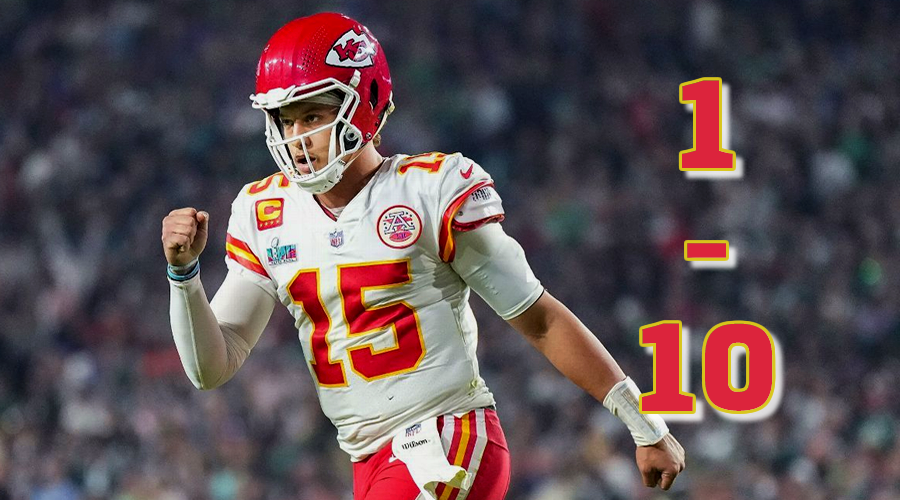
1. Patrick Mahomes
I’m feeling very similar about Mahomes as I did with Aaron Rodgers in the early 2010s, when you could really put him atop the list every single year. People – including me – will try to be fancy/different and make cases for other names, but I don’t believe you can say since this guy took over for Alex Smith in 2018, anybody has been more valuable to his team than Pat. Last season he easily had the top mark among quarterbacks in EPA per play (0.302 vs. 0.242 as the next-closest). He’s only finished worse than second once across his five seasons as a starter – and that was at third in 2020. The Houdini-like plays are what catches everybody’s eye, to where people don’t appreciate how he can dice up defenses within structure as well. Plus, his toughness and drive are off the charts, as we saw when he defeated the most-loaded roster in the league on a bummed-up ankle for his second ring.
2. Justin Jefferson
Just on the surface, Jefferson obviously led the NFL in receptions (128), yards (1809) and first downs through the air (80). You can argue his quarterback Kirk Cousins had a career year and the passing game overall was the most well-designed since Jefferson got there, but I don’t believe even more well-versed fans understand how much this guy carried that unit. Looking at yards per route run (which Jefferson finished behind only Tyreek Hill among players with 50+ targets at 2.55 per), the only Viking higher than 166th in that metric last season was T.J. Hockenson, who didn’t get traded to Minnesota until the second half of the year – and even then, his number fell off. This dude can absolutely destroy DBs in man-coverage, displays high football IQ working against zone and understands how to manipulate the safety when bracketed, his ability to evade contact as a route-runner is impeccable, yet then he also hauled in 22 of 40 contested targets.
3. Nick Bosa
It didn’t take the second overall pick from the 2019 NFL Draft very long to make his presence known in the pros, as he set what still easily is the top mark in defensive pressures by a rookie (80) since the inception of Pro Football Focus. After being lost with injury in the second week of his encore season, he’s been one of the elite edge defenders in football these last two years, ascending to apex predator status in 2022. Not only did Bosa lead the NFL with 18.5 sacks, but he also racked up 12 more QB hits than any other player in the league (48) and only Maxx Crosby recorded more than Bosa’s 19 tackles for loss. That’s even more impressive considering he played just under 70% of defensive snaps for San Francisco. And when you look at their pass-rush win rate with or without #97, it’s pretty drastic.
4. Josh Allen
The term “force of nature” I believe encapsulates best what type of player Allen is. He finished head and shoulders above the rest of the competition with his 52 big-time throws (compared to Mahomes’ 38), yet he also led the Bills in yards per rush (6.1), first downs (55) and touchdowns on the ground (seven). Early on last season, it looked like he was unstoppable, because he started getting to his checkdowns and pick apart defenses trying to take away the deep ball, but once he injured the elbow on his throwing arm, the average depth of target actually increased substantially, because without precision accuracy, the payoff wasn’t worth the risk associated with high-volume underneath passing. With that being said, he will need to take better care of the ball in the red-zone. I believe we saw a healthy Allen become more efficient in those areas again, whilst still having the most lethal arm (strength) in football and killing defenses with his legs, as his 9.4 yards per scramble was second to only Justin Fields (9.6) among QBs with 10+ attempts.
5. Travis Kelce
Something Danny Heifetz of the Ringer’s Fantasy Football Show loves to bring up – the difference between having Kelce in half-PPR formats compared to the number two tight-end (T.J. Hockenson) was the same as the difference between that guy and TE22. He’s a cheat-code in all fantasy formats, but he’s even more frustrating to deal with for defenses in real life. No pass-catcher was responsible for more first downs (78) and touchdowns (12) last season than Kelce, with 90 total, finishing second in both categories. That’s despite seeing 32 and 28 fewer targets than the respective leaders among those marks. His ability to manipulate any man-defender with body-language and untraditional movements during the route or punish any voids left in zone coverage are immaculate. The implicit chemistry between him and Mahomes is hard to even verbalize, but it’s been a huge reason Kansas City has finished top-three in third-down conversion rate each of the five years they’ve worked together.
6. Myles Garrett
With Nick Bosa missing almost all of 2020 and T.J. Watt being at full strength for half of this past season at best, you can easily make an argument that Garrett has been the best edge defender in football over the last three years. In 2022, he actually “fell” to second-team All-Pro after a couple of first-team nods, in large part because the Browns were in the bottom-quarter of the league in rushing yards average and total, which led to fewer favorable true pass-rush opportunities. However, he received the highest overall PFF grade (92.5) and pass-rush grade (93.5) among all defensive players in the NFL, along with being tied for fourth in tackles for loss (18). While I believe Garrett’s run defense is underappreciated, it’s how much more bendy he’s become and his ability to move across the line in passing situations that have made him a menace to block. That’s how he’s tied with T.J. Watt for the highest sack-per-game rate in NFL history (0.89).
7. Chris Jones
Since I just mentioned him, Myles Garrett was the only defensive player in the NFL with a higher overall PFF grade (92.3) than Jones, between week one and the Super Bowl. While I don’t believe he’ll ever be quite as dominant against the run as Aaron Donald has been, I thought he became a lot more impactful near the point of attack this past season and he was tied for seventh among all defensive players in TFLs (17). More importantly, looking at the PFF database, Jones’ 97 total pressures were 27(!) more than the next-closest interior defensive lineman, if you include the playoffs. The fact he put up the highest pass-rush win rate among interior D-linemen (20.2%) and 11 of his 15.5 sacks ended opposing drives is even more impressive considering he was double-teamed at the highest rate in the league (69%). He’s become a true closer for the league’s most dominant team. That’s how he’s moved slightly ahead of AD for now.
8. Trent Williams
The only reason Trent isn’t considered an all-time great like Joe Thomas was (yet), entering the league three years later, is that he missed 29 games between 2016 and 2019 – which the last of those he sat out entirely. In three years with the 49ers, he has been the highest-graded offensive tackle in Pro Football Focus’ database in each of those. That was the case in two other years in Washington (2013 and 2016). Williams has to be the scariest man to step in front of in the run game, where he can drive guys out to the sideline, cave in one side entirely for cutback lanes or make the knees of defenders shake when he gets out in space. Along with that, he has held opposing pass-rushers to just one sack each of the last two seasons and 61 total pressures across 1708 pass-blocking snaps these prior three years.
9. Aaron Donald
Even though Donald is coming off by far his least productive season as a pro, I could not ignore the resume of this all-time great and drop his outside the top-ten. Even if you just go by traditional statistics, his 103 sacks and 160 tackles for loss across 138 career games, that puts him into a league of his own as far interior D-linemen go. However, in four of the five seasons prior to 2022, he cracked at least 102 combined pressures, including the playoffs. Only Tamba Hali, J.J. Watt, Za’Darius Smith, Maxx Crosby and Micah Parsons have reached that number since PFF started tracking those back in 2006 – and they all only did it once each. However, that should not overshadow the type of disruption Donald creates in the run game, where his first step combined insane strength around 280 pounds constantly messes up plays. In fact, he has received an overall grade of over 90 in all nine of his seasons as a pro.
10. Joe Burrow
This guy is an absolute killer. I actually made a video on why the Bengals offense struggled during their 0-2 start to last season (LINK!!), but once they made the fundamental shift to a more 11-personnel heavy, spread approach, they became one of the most efficient offenses in the NFL (second behind only the Chiefs with 0.129 EPA per play from week six onwards). Even with Ja’Marr Chase missing some time and the supposedly improved O-line having issues in protection for stretches, Joey B was able to finish behind only Mahomes with 279.7 passing yards per game and 35 touchdowns through the air, whilst being tied for the second-lowest time-to-throw (2.5 seconds). While the Bengals were probably one mental mistake in Kansas City away from going to back-to-back Super Bowl, after beating up the Bills at their place, Burrow himself was tied with Mahomes for the highest PFF grade (92.0), just ahead of Allen (91.8), with the best big-time-throw (37) to turnover-worthy play (18) rate among the three (2.06-to-one).
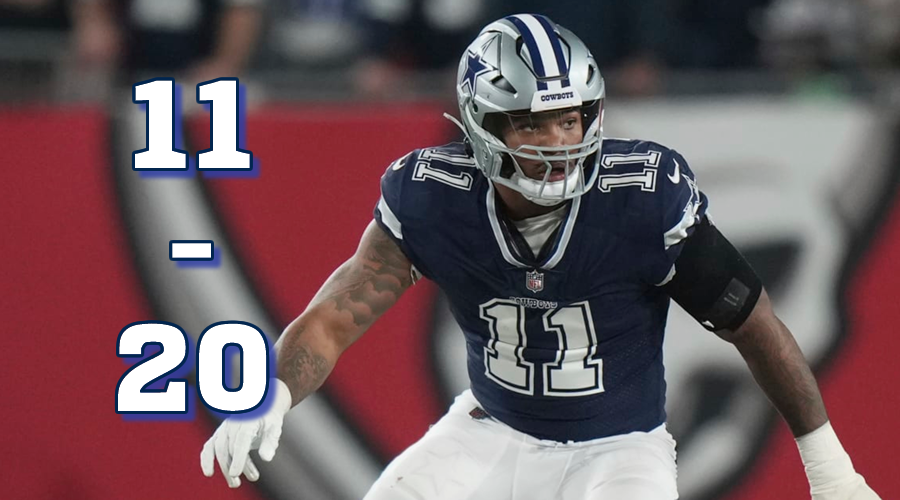
11. Micah Parsons
As Parsons has transitioned from off-ball backer all the way back to defensive end coming into 2023 – which Penn State originally recruited him as – he’s turned himself into one of the toughest guys to block in all of football. According to PFF, Micah led the NFL with 106 total pressures (across 577 pass-rush snaps) if you include the playoffs, and his 19.3% pressure rate was first as well. Not only has he made first-team All-Pro and finished second in Defensive Player of the Year voting each of his first two seasons, but he also joined Reggie White and Aldon Smith as the only three players with 13+ sacks in consecutive years to begin their careers. His speed off the edge is too much to handle for most NFL tackles, but he’s improved his ability to defeat their hands and the power he can convert that initial burst into shocks most opponents. He’s also uber-active in the run game, as somebody constantly fighting off contact and too fast to leave unblocked on the backside, while he forced three fumbles this past season.
12. Tyreek Hill
Until the last couple of weeks of the 2022 season, Hill was actually head-to-head with Justin Jefferson and if he didn’t lose QB1, he might’ve actually had those extra 100 yards he needed for the receiving crown (1710 yards). However, while those two actually shared almost the exact same target share around 40%, Tyreek was the only pass-catcher with 20+ targets to average at least three yards per route run (3.07 – about half a yard more than Jefferson). What’s crazy about that, is the fact that Miami actually didn’t set him up with a ton of run-after-catch opportunities, with hole-shots off wheel routes off motion and several deep balls chucked his way, where he actually needed to stop and work back towards the ball, making his 50% contested catch rate at 5’10” even more impressive. You watch the Ravens and Lions games – in which he put up 190 and 188 yards respectively – and this dude almost single-handedly earned them those wins, when everybody knew that’s where they were going in key spots.
13. Fred Warner
Fans of the linebacker position had the luxury of watching perennial All-Pros Luke Kuechly and Bobby Wagner during the 2010s, along with the tail-end of the Patrick Willis-NaVorro Bowman tandem. Well, since then a new alpha on the second level has separated himself from the rest of the pack in San Francisco. Fred Warner’s numbers across 86 career games are certainly impressive – 634 total tackles, four interceptions, 35 PBUs, seven forced fumbles and 30 combined sacks and QB hits. However, it’s his impact on games that you can’t express in numbers that make him truly special – how he forces running backs to redirect because of how quickly he fills on the front-side, how he splits a couple of blockers to shut down screen passes, how he’s mugged up in the A-gap and is still able to carry the slot receiver 40 yards down the seams. His play speed is absolutely insane and just watching games, his presence is constantly felt. He’s also missed just 6.2% of his attempted tackles since 2020.
14. T.J. Watt
After a monster start in week one against the Bengals, when he had a sack, QB hit, three tackles for loss and an interception, Watt suffered a torn bicep at the end of the game and ended up missing a couple of months. He never quite returned to form, but we can’t forget what kind of insane path this guy has been on. Even with that injury-plagued 2022 campaign, Watt still has the most sacks (77.5), QB hits (162), and forced fumbles (23) since entering the league in 2017. He’s capable of taking over games in a hurry, but it’s his steady presence and effort to consistently affect the run and pass game that make him one of the game’s best. Looking at his impact when Watt was on the field this past season, the Steelers defense allowed 16.9 points per game and had 3.2 sacks per game (8-1 record). Without him, it allowed 25.3 points and had just 1.1 sacks (1-6 record).
15. Patrick Surtain II
As I’ve said before, if you’re looking at the job description of a cornerback, in terms of sticking to your man and not allowing him to catch passes, I believe Surtain has ascended to the top of the list. He earned the second-highest PFF grade in coverage (86.7) to only rookie sensation Sauce Gardner and while the raw numbers for opposing quarterbacks targeting him (45-of-77 for 468 yards and four TDs vs. two INTs) don’t scream out lockdown corner to you, I believe context is needed. Unlike most teams today who either leave their guys on respective sides and/or play different variations of match-zone coverages, Pat II is legitimately isolated with the opposing team’s top outside receiver every week and the Broncos structure their defense around him. Watch his two matchups against Davante Adams last season, where he was all over the All-Pro receiver until the very last play of their overtime game, when because Josh McDaniels understood what kind of student of the game he was, they got him on a double-move off one of their staple concepts.
16. Zack Martin
I was shocked to find out Martin finished all the way down at 50th among all offensive linemen who played 100+ snaps last season in terms of PFF grade. Considering he didn’t allow a single sack, just two QB hits and 15 additional pressures on over 700 pass-blocking snaps, that had me scratching my head even more so. The reasoning behind it was a run-blocking grade of 63.7, which I just disagree with, considering he and his fellow linemen regularly placed defensive linemen in the laps of linebackers and guys never seem to disengage from him once he’s been able to latch his hands. Martin has now made first-team All-Pro six times and second-time twice, with the only year he didn’t reach either being 2020, when he played a career-low ten games (only one other time did he not reach at least 16 starts). This is an all-timer.
17. Ja’Marr Chase
After setting the NFL record for rookie receiving yards in 2021, Chase was still able to affect the 12 games he was available for in equal fashion. Seeing six more targets his way (134) and catching all of those (87), he was able to convert 50% of his targets and 77% of his receptions into either first downs or touchdowns. The amount of big plays (13 catches of 20+ yards) certainly decreased, but he was an even more reliable piece in key situations, as only Detroit’s Amon-Ra St. Brown converted more third downs per game into first downs (1.42) among pass-catchers with 50+ targets. He can run by pretty much anybody and looks even faster with the ball in his hands, but he’s worked on his craft, in order to come open at the marker and find space along the sideline for crucial grabs. And acrossed 15 total games played (including playoffs), he finished below 50 yards just once. The one issue – he led the NFL with 0.92 drops per game (11 total).
18. Davante Adams
While Adams’ yards per game decreased to “only” 89.2 last season (still top-five), he led the NFL in receiving touchdowns for the second time in his career with 14. That’s despite being part of a Raiders offense that other than him and Josh Jacobs didn’t have any consistent producers among their skill-position group. If you put in perspective how much Davante meant for that unit, he not only accounted for half of their scoring through the air, but also second behind only D.J. Moore as part of a horrible Panthers offense, in the percentage share of his team’s air yardage (41.8%). However, while he was still a chain-mover for the Silver and Black, he was used downfield more than he ever in his career, as his 10.2 yards before the catch on average was just 0.1 yard behind Tyreek Hill and his 24 receptions of 20+ yards was just one behind the Miami speedster. That included a walk-off touchdown in overtime in their second Broncos game.
19. Lane Johnson
Really to express how freaking good Lane has been over these last few years, all I need to say is that he hasn’t allowed a sack since week 11 of 2020. He’s also only allowed one QB hit, despite spending over 1100 snaps in pass-pro since then and having faced some of the top-flight pass-rushers across the league. Johnson isn’t quite up to par with the brute force of his counterpart Jordan Mailata over at left tackle or as versatile in his usage as Jason Kelce at center, but he’s able to control and steer bodies in the run game, while his guy never seems to make the tackle. Johnson is the best pure pass-protector in the game today and got the job every week for the most devastating rushing attack in the NFL, as they led the league in total yards (3040) if you include the playoffs and set a new record with 42(!) touchdowns on the ground for a season.
20. Maxx Crosby
You need convincing that Crosby is one of the premiere defensive linemen in the game or just want to have fun for the next hour? Go put on some Raiders tape and watch this man go to work – please don’t pay attention to the rest of that defense though. Somehow because he’s this big white dude, people act like Crosby isn’t an above-90th percentile athlete for the position, yet he plays harder than anybody as physically gifted as he is. He’s not the most diverse pass-rusher, but his ability to put tackles of their heels and then throw in a spin move a couple of times per game gets the job done. According to PFF, his 189 total pressures over the last two years lead all defensive players, despite being on a below-average defenses and not having any playoff games to expand that number. Yet, he’s also hyper-active in the run game, to work off blocks and track down the ball-carrier, which is how he had three more tackles for loss (22) than any other player in the NFL, along with three forced fumbles.
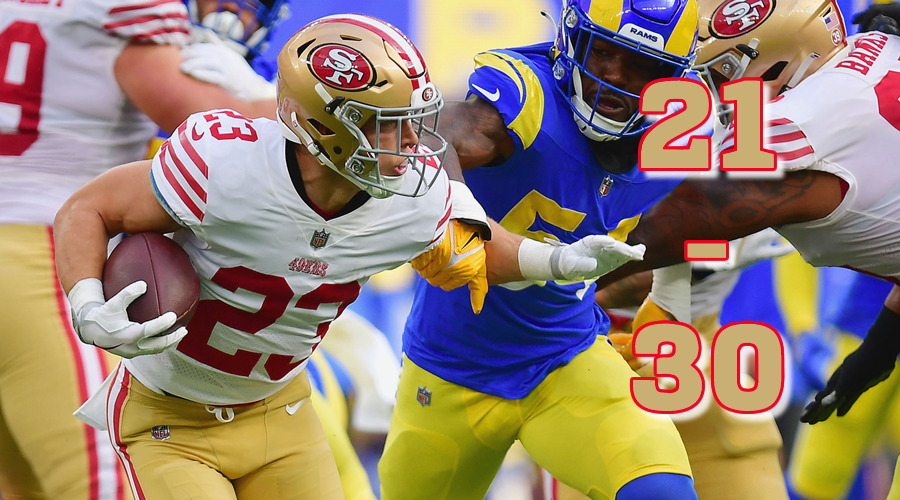
21. Christian McCaffrey
After combining for just ten games the two years prior, McCaffrey was able to finally play a full 17 plus playoffs again in 2022. However, I believe to express how insane he is on a real offense – not the Panthers, who were literally dead-last in the NFL through the first six weeks, when the star running back was still there – we have to look at what he did as a member of the 49ers. Across 14 games and 263 touches for Kyle Shanahan, CMac racked up 1509 yards and 13 touchdowns from scrimmage, plus another passing TD. You could tell he ran with a different attitude once he got to San Francisco and him as another movable piece for that skill-position group almost seems unfair. Despite seeing the second-highest target share among running backs to only Austin Ekeler, Niner QBs had a passer rating of 115.5 when going McCaffrey’s way.
22. Chris Lindstrom
With the surprising fall of Quenton Nelson and the rest of the Colts offensive line, a new challenger to the Cowboys’ Zack Martin for the title of best guard in football emerged. Lindstrom received easily the highest PFF grade among offensive linemen (95.0), in particular without another interior guy quite cracking the 90-mark. His ability to create lateral displacement on the front-side of zone concepts, get to the outside edge of defenders in order to scoop them up away from the point of attack and take linebackers for a ride when he snatches them up was a huge factor in the Falcons finishing just two yards short of second in rushing yards (2718) and just outside the top-three in terms of yards per rush (4.9), despite having very inconsistent quarterback play to keep defenses from stacking the box. And while Lindstrom isn’t put in a ton of true dropbacks, with the league’s highest rate of RPOs (28.9% of pass attempts), only allowing nine total pressures across 517 pass-blocking snaps is highly impressive.
23. Minkah Fitzpatrick
This marks the second time in three years that Minkah finds himself atop my safety rankings on one of these lists and you almost can’t deny he’s become one of the games’ greats, earning his third first-team All-Pro nod in four years with the Steelers. Even with a couple of games missed due to injury, he was tied for a league-high six interceptions, along with 11 more passes broken up. However, he’s far from a finesse free safety. This guy can be an enforcer dropping as a robber or when you try to hit seam routes/benders against him in two-high shells. 2022 marked the second straight year with a run defense grade of over 82 for him and he missed a career-low 5.0% of his tackling attempts. Other than maybe Derwin James, he’s the most useful safety, but at the same time his knack for the ball also makes him the most dangerous one.
24. Sauce Gardner
Not enough is made of how rare it is for rookie cornerbacks to even be above-average starters, much less play at an All-Pro level. However, not only did Sauce win Defensive Rookie of the Year, but the Associated Press also named him first-team for how consistent he was all season, as he was tied for the best PFF coverage grade among all defensive backs (90.0). Along with his two interceptions, he led the league with 20 more passes broken up, despite only seeing 86 targets come his way. 46 of those got completed for 452 yards and one touchdown – which was actually on him based on their rules in zone coverage, but he was labelled the next-closest defender. With as zone-heavy as the Jets defensive system is, they ask their corners to help a lot in run support and Sauce didn’t back down at all as a tackler, missing just five of 80 attempts on the year.
25. Justin Herbert
Just looking at the total numbers, not only did Herbert set the all-time record for passing yards and touchdowns through year one and two, but he’s also sixth ever in TD-to-INT ratio (2.69). This past season despite losing his All-Pro left tackle mid-way through week three, Mike Williams and Keenan Allen missing 11 combined games, the team averaging just 3.8 yards per rush and Herbert fracturing his rib cartilage in week two already, he was able to throw 26 touchdowns compared to ten picks and lead the Chargers to ten wins. He finished tied for 31st in intended air yards per pass attempt due to the restrictions of the Joe Lombardi passing game, with so many static, repetitive concepts with no vertical stretching of defenses and very limited space created for run-after-catch opportunities. Putting statistical context to the tape, which shows how many bad plays he gets L.A. out of, he put up the fifth-lowest pressure-to-sack conversion rate (14.2%).
26. Nick Chubb
Chubb “only” finished third in total rushing yards last season (1525), but he also received 37 and 47 fewer carries than numbers one and two. He led the NFL with 47 rushes of 10+ yards and had the best missed tackle forced-per-carry rate at 27.5%. Yes, he operates behind one of the best offensive lines in football, but his ability to make those big guys look good with appropriate pacing, manipulation of first- or second-level defenders and to get skinny for a nearly 230-pound back is tremendous. He squats about three times his weight, which shows up in the way he clears arm-tackles like turnstiles and is able to churn out yardage when he is actually wrapped up. The only reason he isn’t considered among the elite by everybody is his limited usage in the pass game, but he does average 6.3 yards per target for his career, despite a yards-before-catch average mark of -0.6. By the way, he just became the first running back ever to average at least five yards per carry for five straight years – which is as long as he’s been in the league.
27. Dexter Lawrence
I know nose-tackle isn’t the sexiest position for casual NFL fans, but we need to appreciate how dominant Sexy Dexy was in 2022. Only Myles Garrett received a higher PFF grade during the regular season (92.4) among all defensive players in the league and I would argue Lawrence was the most impactful player in New York’s first playoff win since 2011, as he abused the Vikings interior O-line throughout the day. Despite spending about two thirds of snaps between the guards, Lawrence finished second to only Chris Jones among interior defenders with 70 total pressures. Taking the playoffs into account, he was tied for sixth among all defensive linemen with 32 run stops, yet only missed just one of 69 tackling attempts. His ability to control guys on the inside one-on-one, swallow combos and take pass-blockers on the inside for a ride set up one of the most dominant seasons we’ve seen from a legit nose.
28. Quinnen Williams
While personnel-wise the Jets secondary experienced the biggest overhaul heading into this past year, their dramatic shift from dead-last to top-five across basically all defensive statistics can be equally connected to the ascent of Williams as a true difference-maker up front. While he had been an impactful starter his first three years with Gang Green, the former number three overall pick finally lived up to my lofty expectations for him coming out of Alabama. For the 2022 regular season, Big Q’s pressure-per-pass-rush-snap rate of 12.9% put him behind only Javon Hargrave and Chris Jones in terms of interior defensive linemen, while pro-football-reference has him tied for second with 28 QB hits. Despite only spending 270 snaps in run-defense (36th-most for his position) due to the heavy rotation New York uses, he was able to throw off plays before they could even get going with regularity and finished tied for sixth among that group with 12 tackles for loss.
29. Stefon Diggs
Even with Gabriel Davis being expected to break out in 2022 and quarterback Josh Allen banging up his elbow mid-way through the year, it didn’t really slow down Diggs’ production in in his eighth season, as he set personal highs in first downs (74) and touchdowns responsible for (11). Looking at his numbers among all wide receivers, he finished top-five in receiving yards (1429), first downs per receptions (46.8%) and passer rating when targeted (120.3). While he can still win down the field with tremendous focus and ball-skills (finished behind only Tyreek Hill and Davante Adams with six catches of 40+ yards), it’s his ability to win early in the route that have made him one of the most efficient high-volume targets across the league. With that being said, he was only tied for 18th in catches that converted third downs (16), had a career-worst contested catch rate of just 46.2% (which is still pretty damn good) and he was tied for the tenth-most drops across the league (nine).
30. Jaire Alexander
I thought following the 2020 season, Alexander had established himself as the best cornerback in the league not named Jalen Ramsey. He hasn’t always been able to show his best in defensive coordinator Joe Barry’s split-safety based coverage scheme, that led to miscommunication with passing off assignments and sort of wasted Jaire’s skills as a one-one-one player. However, as Green Bay started taking advantage of putting their CB1 in more isolated situations, their defense started to turn things around as well. Alexander finished just one interception behind the league-leading six, along with 14 PBUs. At the same time he was responsible for only two touchdowns across 82 targets, for a passer rating of 63.7. And something you really like to see is his ability to bring people down in space continuously improving, as he’s cut down his missed tackle rate each of the last four years, down to 6.7% in 2022.
31. Roquan Smith
Ever since being drafted in the top-ten back in 2018 by Chicago, Roquan has been one of the most productive off-ball linebackers in the NFL. Looking at his raw tackling numbers, nobody has created more than his 693 stops over that period of time. Much more important have been the impact plays he’s been able to produce in the run and pass game. This past season he was tied for a league-high three interceptions and 42 defensive stops among linebackers during the regular season. While he came into the league as more of a WILL who you want to keep clean to run around and make plays, he’s become so damn good at deciphering plays and getting himself to the right spots. To encapsulate Smith’s value to the Ravens defense once they traded for him, they went from 28th in EPA per play allowed through the first eight weeks without him (0.076) all the way to fifth league-wide (-0.078) from that point onwards.
32. Jalen Ramsey
Has Ramsey lost a little bit of shine from being the premiere shutdown corner in football for the prior five years or so? Sure. However, that doesn’t mean at all that he can’t be one of the most valuable pieces in the secondary now under Vic Fangio in Miami. If you look what he did in coverage over the final seven games of 2022 – once he started to look locked in again, after watching the Rams go from defending champs to one of the league’s bottom-dwellers – he held opposing quarterbacks to 18-of-34 for 276 yards and two touchdowns, whilst picking off three passes himself. Along with that, he’s been one of the elite run-defenders and tacklers at the corner spot, as he earned the second-highest PFF grade vs. the run (91.8) among all defensive players with 200+ snaps this past season and he’s never missed more than five tackles over the last five years. With his physicality, you can put him into the slot to involve himself in the run fit, yet he’s still talented enough to blanket basically anybody on the perimeter.
33. A.J. Brown
We thought we knew who A.J. Brown was during his tenure in Tennessee. As a rookie in 2018 he led all wide receivers with 8.9 yards after catch on average and he remained one of the most effective players with the ball in his hands, who was fed over the middle of the field. He still finished top-five in that category in his first season in Philadelphia (6.2), being borderline unguardable on slant routes. However, the Eagles started using him a lot more down the field and even if he didn’t gain a step on his man, they gave him chances to win through contact. He finished behind only Miami’s Jaylen Waddle in yards per target (10.3 per) among all players with 20+ targets and tied for third with six receptions of 40+ yards. He’s just not quite in the same tier among the elite receivers in terms of third downs converted, as he finished 26th in that regard (15) last season, which was actually three behind teammate DeVonta Smith.
34. Tristan Wirfs
I would argue Wirfs has been a top-two right tackle in the league each of his first three seasons as a pro. While he has been charged with three sacks respectively the latter two of those (after one as a rookie), his pass-blocking efficiency has actually increased in each of them and he’s been atop the league in 2021 and ’22, with just six total pressures across 696 snaps in pass-pro this past year. The Bucs run game has certainly fallen off since their run at the Super Bowl in 2020, as they finished dead-last in the NFL in terms of rushing yards (1308) and yards per carry (3.4) this past season. However, Wirfs’ explosiveness out of his stance and ability to roll his hips into contact were the most exciting part about his game coming out of Iowa. Now making the transition to the blind-side, we’ll see if he can build on a historic start to his career.
35. Andrew Thomas
Being part of that 2020 draft class with Wirfs, Thomas’ pro career certainly wasn’t off to the greatest start. As a rookie, he finished 64th among the 92 tackles to log at least 100 snaps in terms of PFF grade, surrendering ten sacks and 57(!) total pressures across 615 pass-blocking snaps. However, since then his grade has gone from 62.4 to 78.9 in year two and finally 90.3 this past season, when he allowed just 23 pressures across 700 snaps in pass-pro. Along with tremendous improvements in his ability to read and counter guys rushing off the edge, he’s become an elite run-blocker at the position. His ability to scoop- or hinge-block three-techniques on the backside of lateral concepts is tremendous, yet he’s also extremely well-coordinated when asked to secured targets in space. If it wasn’t for Trent Williams, he would’ve earned a first-team All-Pro nod this past season, which he should be in the running for these next several years.
36. Lamar Jackson
I truly believe the Lamar we saw over the first five weeks of last season was the best version of himself that we’ve gotten yet. Unfortunately, from that point he started trying to elevate his team by pressing for game-changing plays, as they didn’t have the horses or play-designs in the pass game to stay ahead of the competition, before he ultimately got hurt. With that being said, he did still finish top-five among quarterbacks in PFF grade (85.2) and tied for third in big-time throw rate (5.0%), whilst his turnover-worthy play rate was just slightly above the likes of Mahomes and Burrow (2.3%). Now with a new offensive coordinator in Todd Monken willing to open the field with a lot more spread-out formations and massive improvements at the wide receiver position, I could easily see Lamar compete for the second MVP trophy of his still young career.
37. Cooper Kupp
Even taking into account the final game Kupp was available for against Arizona, where he had -1 yard on three (screen) passes before getting hurt, he still finished behind only Justin Jefferson and Tyreek in receiving yards per game (90.2) and would’ve slotted in between those two if you take that game out. With the O-line getting blown up constantly when the Rams tried to run the ball and Allen Robinson’s addition in free agency turning out to be highly disappointing, Matt Stafford relied heavily on his go-to target in order to make the offense at least viable. And his drop rate of just 2.0% is significantly lower than most top-tier receiver. Let’s not forget Kupp won the triple-crown at the position just a year ago and capped off that historic campaign with a Super Bowl MVP. I don’t think he’s quite as dynamic as the elite names I’ve mentioned here, but he also led the NFL in 20+ yard receptions in that last full season he’s played.
38. Jason Kelce
You’re not going to find many people that held Kelce in higher regards just a couple of years ago than me. Between 2017 and 2019, he was a first-team All-Pro three straight years and earned the highest grade among all centers by Pro Football Focus. However, even I said that his quality of play had dropped of just a little bit the two following season and a couple of new candidates for the title of best at the position emerged. Yet, looking at the Eagles’ ascent in 2022 to the NFC’s top team, we can’t take for granted the step this guy took back up and how outstanding he was. I don’t believe there’s a smarter offensive linemen or guy among that position group with better functional athleticism out there still today. His understanding for angles, how to approach combos, aiming points and flexibility to get his body aligned accordingly are teach tape-worthy. And while his undersized frame necessitates less island-duties in pass-pro, he wasn’t responsible for a single sack or QB hit across 753 pass-blocking snaps this past year.
39. Jeffery Simmons
There may not be another player in the NFL as physically imposing as Simmons. At 6’4”, 305 pounds, he is pretty much an immovable object in the run game, yet he will gladly return the favor on passing downs and put your guards on skates when he wants to create vertical movement. Over the past two seasons, he’s tied for fourth among interior D-linemen behind only Chris Jones, Aaron Donald and Javon Hargrave with 119 total pressures across regular and postseason, despite participating in just one playoff contest, and his 13 passes batted down at the line rank second among all defensive linemen over that stretch. He was a huge reason the Titans finished 2022 as the top defense in rush EPA (-0.199) and rushing success rate (33.0%) despite playing with the second-lightest boxes (six or fewer defenders) across the NFL. And he embodies that pocket-crushing mindset Tennessee builds their defense around, whilst they force quarterbacks to decipher what’s going on in the back-end.
40. Derwin James
The term “swiss-army knife” has been used for years to describe certain players, but I’m not sure we’ve seen a versatile piece in the secondary quite like Derwin, as we’ve moved to position-less football to a certain degree. According to PFF, James spent 330 snaps in the slot, 270 at deep safety, 154 in the slot and 63 on the defensive line this past season. What he allows you to do in coverage, because of all the delayed rotations Brandon Staley and company can ask of him is unique, but he might’ve become even more valuable as a situational blitzer, as he put up a career-high four sacks and earned an elite PFF pass-rush grade (90.9) last season. He missed a career-low 4.2% of his attempted tackles (five of 120) and was tied for the third-most stops in coverage (14), meaning he was able to bring the intended target down before he could move the chains or create a positive play for the offense, in relation to down and distance.
41. Laremy Tunsil
Early on in his pro career, as talented as Tunsil has always been, the massive trade and financial compensation plus the ripple effects those had, overshadowed the player himself. However, he’s now made the Pro Bowl in three of four seasons in Houston and today, he’s clearly the best player on the team. While he’s more so an average run-blocker, he’s become one of the elite pass-protectors in football. This past season, he received the highest pass-blocking grade among all offensive linemen in the league, with just one sack and 17 total pressures across 676 pass-blocking snaps. His one remaining issue are false starts, as he was flagged for it seven times yet again this past year, along with three holding calls against him. If he can finally iron that out – and people pay some attention to the Texans again, with a rookie quarterback drawing eyes – he should be in-line for his first All-Pro nomination as well.
42. Josh Jacobs
The player who shocked the fantasy community most last season probably was Jacobs, who finished between first and third among running backs, depending on format. After people started questioning why the hell he would be handling touches in the Hall of Fame game, he went on to have a career year despite being part of a 6-11 Raiders team. Not only did Jacobs lead the NFL with 1653 rushing yards, but he also was first in missed tackles forced (90) and yards after contact (821), along with being top-three in the ratio of both those categories per attempt. He was also responsible for 12 more first downs than any other player in the league (107). He excelled in Josh McDaniels’ more gap-heavy rushing attack, where his ability to set up and take advantage of lanes with sudden bursts really stood out and then he became a load to bring down. All while adding a career-high 400 yards through the air and accounting for more than a third of the team’s scrimmage yards.
43. Justin Simmons
I’d say generally the safety position is underappreciated by today’s standards, especially considering how many different things are regularly asked of those guys. However, I don’t believe Simmons was ever really discussed as one the best defensive players across the league. The numbers and the film clearly state that he is though. Simmons was tied for a league-high six interceptions last season, after back-to-back years with five each. He has range to play center-field, but his football IQ can really shine driving on routes in split-safety looks and he can match up with different body-types in the slot. He’s also clearly worked on punching the ball out, as he forced the first three fumbles of his career in 2022. That in part allowed him to make second-team All-Pro for the third time in four seasons. I’m curious to see if he could ascend even further under new defensive coordinator Vance Joseph, as the guy to potentially clean up a lot of chaos he’ll create with a much more aggressive pressure-scheme.
44. Marlon Humphrey
Unlike his then-counterpart Marcus Peters on the opposite end of the Ravens defense, Humphrey didn’t seem to have any issues with a systematic switch from Wink Martindale to Mike McDonald, where they ran a lot more two-deep looks on early downs and picked their spots when they wanted to bring extra pressure along with man-coverage. He was able to make his third Pro Bowl in four seasons, in large part thanks to tying his career-high from 2019 with three interceptions. While he moved more exclusively to an outside role, after being their designated option in nickel packages up to that point, it had nothing to do with his tackling, as Humphrey missed just one of 72 attempts and was tied for 18th among all defensive backs in coverage stops (13). He also surprisingly earned the highest PFF pass-rush grade among all non-defensive linemen (91.5), recording six pressures on just ten rush opportunities. So by trading away Chuck Clark for peanuts and Kyle Hamilton potentially move to a more traditional safety role in year, we may see Humphrey slide inside and be deployed in that facet yet again in 2023.
45. Saquon Barkley
After tearing his ACL two games into 2020 and having a banged-up ankle for most of the following season, Saquon looked like the guy we saw coming out of Penn State again last year. He finished fifth among running backs with 1650 yards from scrimmage handling the third-most touches (352). However, I don’t even believe those numbers quite tell the story about how much the Giants relied upon their star back and the focus he received from defenses. I think the two numbers that represent that more is Daniel Jones gaining 70.9% of his rushing yards before contact (4.7 yards per) because defenses crashed on the give of option plays. Not only did he provide explosive plays despite that, but he only fumbled on one of his 352 touches last season. Saquon was tied for a league-high six drops among running backs, but that had a lot to do with the ball being flipped out to him in the backfield with a couple of defenders already converging (1.7 yards behind the LOS on average), where he took his eyes off the ball early, trying to make something out of nothing (just under six yards per).
46. Haason Reddick
While his actual breakout happened in 2020, when he transitioned to a full-time edge role, this certainly felt like a year in which Reddick took his game to another level. He’s now quietly put up at least 11 sacks and TFLs each in three straight seasons, along with 13 combined fumbles forced, being part of three different teams and schemes. Reddick finished the 2022 regular season tied with Myles Garrett for second in the league with 16 sacks (behind Nick Bosa) and tied for a league-high five fumbles forced. Including the playoffs, he also racked up the fourth-most total pressures (87) among all defensive players despite just the 25th-most opportunities to rush the passer (512). His combination of acceleration of the arc, flexibility and how proficient he’s become with his hand-usage are highly impressive, even though I don’t believe he’d be as dominant as those true alphas, if he received the same amount of attention by opponents.
47. Mark Andrews
The 2022 season for Ravens skill-position players was a bit odd. Quarterback Lamar Jackson started off really hot, but plateaued a little bit before he ultimately got hurt. So not only did Andrews catch passes from two other quarterbacks, but because of the lack of receiving talent around him, quite a few of the looks he got were towards crowded areas and he missed a couple of games on top of it. Nevertheless, the finished third among tight-ends in receiving yards (847 – second in terms of yards per game) and second at the position with 48 first downs. However, unlike many tight-ends just taking advantage of open space in coverage with stick or hook routes underneath, Andrews has always threatened defenses down the field with his presence, running a ton of seams, benders and deep over routes. According to Next Gen Stats, he was one of only two TEs with an average of over three yards of separation along with an ADOT of 10+ yards.
48. Joel Bitonio
While he hasn’t quite reached the heights of Zack Martin, Quenton Nelson until this past season and now Chris Lindstrom stepping into that spot, Bitonio has been right there as the third-best guard in football for at least a three-year period now. Over the past five seasons, he’s made second-team All-Pro three times and first-team these last latter two. In terms of PFF grades, here’s where he’s finished among guards – fourth, 13th, fifth, first and second. Whether you ask him to create vertical or horizontal displacement, kick out the end-man or wrap around as a puller, hunt down somebody in space, he’s a top-tier run-blocker up front. Along with that, he’s held opposing rushers to just eight total sacks and never more than 20 pressures across the past five seasons. And that’s despite not having missed a single start for Cleveland since 2016.
49. DeForest Buckner
We’ll get to some offensive players for the Colts soon here and why they’ve fallen off, but their defense quietly finished 13th and 14th respectively in EPA per play and DVOA. The biggest reason for still being able to hold up, despite no help from the opposite side of the ball was their play up front and in particular this 6’7”, 300-pound tower in the middle clogging up space. This guy can move across the front and create problems, where his combination of length and power regularly allow him to discard blockers late. DeFo finished behind only Christian Wilkins in terms of interior D-linemen with 47 total defensive stops and tied for fifth across that group in combined pressures (56). Going through his career resume, if you took at his PFF grades from year two onwards (three in San Francisco and Indianapolis each), just once he did not go over 79 in that regard, which was also the only time he didn’t quite crack at least 50 total pressures.
50. Creed Humphrey
I will never understand how Humphrey ended up going at the very end of the second round in the 2021 draft, as the third center off the board. I thought he was pretty clearly the top name available and remember mocking him to the Packers in the first round, who ultimately selected Josh Myers one pick before the now All-Pro Chief ended up coming off the board. He’s more than lived up to my expectations even, as he’s received the highest grade among centers by Pro Football Focus each of his two years in the pros, with a 91.3 and 89.9 respectively. He’s so insanely crafty with securing and covering up bodies in the run game and he’s very effective at latching onto targets in space on screen plays. Most importantly however, across an insane 1849 pass-blocking snaps between regular and postseason so far, all three of the sacks he’s given up came as a rookie and he’s held opponents to just 31 total pressures across those.
51. Trevor Lawrence
While Jacksonville’s 2-1 start last season was encouraging, we saw that they weren’t quite ready to play consistent football on both sides of the ball on a weekly basis, as they lost the next five straight games. However, from that point onwards, the Jags went 7-2 and their second-year quarterback was responsible for 17 touchdowns compared to only two interceptions. From week nine onwards, Lawrence was also fourth at the position in EPA per play. While he’s become a hyper-efficient machine throwing the ball, he reminded us of his special arm talent to defeat tight coverage and create explosive plays, as he was tied for third with Lamar Jackson with a big-time throw rate of 5.0% among quarterbacks with 200+ dropbacks. Looking at Jacksonville’s playoff game against the Chargers, while T-Law threw four picks in the first half, you saw that ability to shake that off, take over and will his team to victory ultimately.
52. George Kittle
The title for TE2 is tightly contested between Kittle and Mark Andrews, but due to lesser availability, the Niners standout has to settle for third place right now, even though I expect both guys to have better 2023 seasons. Kittle’s PFF grade of 84.7 was actually the worst he’s had since his rookie campaign (2017). However, for the regular season, he ranked fifth among all skill-position players seeing 20+ targets come their way with a passer rating of 127.2 when targeted and across three postseason contested, he averaged a massive 14.7 yards per target (hauling in 10 of 11 for 164 yards). While he doesn’t quite have the frame to box defenders out like some other guys at that spot, he’s consistently one of the top run-blockers among it and he’s the most dangerous once the ball is in his hands. Over the past four seasons, Kittle has hauled in at least half of his contested targets every year, with an average of 55.6%, and he’s averaged at least 6.2 yards after the catch in each of those.
53. Austin Ekeler
I’m not sure there’s ever been a player who’s led the NFL in scrimmage touchdowns in back-to-back years, who’s been discussed less than this guy. Ekeler doesn’t have the same amount of explosive plays as the top names at the position, but that’s more due to the fact the Chargers as a team finished 30th in yards per rush (3.8) and Justin Herbert was 31st in intended air yards per pass attempt (6.4). Nonetheless, he’s one of the most consistent players on the ground and through the air. Ekeler averaged one-and-half more yards (4.5) than the rest of Charger ball-carriers (3.0), with his team finishing dead-last in PFF run-blocking grade (45.7), and not only did he catch 35 more than passes than anybody else on the team but also 22 more than any other running back (107). The efficiency numbers through the air weren’t great for him, because regularly he would have the ball flipped to him on checkdowns with little space to operate, but he actually was tied for the league’s best touchdown conversion rate inside the opposing three-yard line (83.3%).
54. Matt Judon
Judon was already a Pro Bowl-level player over the latter two years of his rookie contract in Baltimore, but not to the point where anybody watching the tape held him in regards of one of the better edge rushers in football. However, he elevated his game as soon as he got to New England, despite their scheme relying a lot more on just crushing the pocket, rather than asking their guys to attack up the field from wide alignments. Over his two years under Bill Belichick and company, he ranks third in the NFL in sacks (28) and seventh in pressures (132), making the all-star game in both. He also put together back-to-back seasons with 14 tackles for loss, while missing just one of 61 tackling attempts this past year. What stands out about him is how efficient he is with getting to the ball, working the shortest arc towards the passer and crashing through the inside shoulder of tight-ends on the backside of run calls.
55. Terry McLaurin
To me, McLaurin is the most underrated receiver and one of the least appreciated players overall across the league. The fact he averages 68.0 receiving yards per game through his first four seasons is pretty insane, considering he’s caught passes from the likes of Case Keenum, Colt McCoy, Dwayne Haskins, Kyle Allen, Alex Smith on one leg, Garrett Gilbert, Taylor Heinicke, Carson Wentz and one game of Sam Howell. He’s a true alpha in terms of being able to toast elite corners – such as Jaire Alexander – his overall mindset and when the ball is up for grabs. Last season, he finished seventh in terms of contested catches overall (17) and the rate on those opportunities among WRs (65.4%) despite barely scratching the six-foot mark. And despite injuries across their receiving corp making McLaurin the guy defensive coordinators circled every week, only three receivers had a better rate of first downs per target (46.7%).
56. Jalen Hurts
You can look at so many traditional or advanced statistics and they’d all say Hurts was one of the NFL’s top-five quarterbacks in 2022 – total touchdowns accountable for (35; despite missing two weeks), QBR (66.4), EPA per play (0.213) or big-time throw to turnover-worthy play rate (4.5-to-1.8%). However, if you actually look at the tape, how simplistic offensive coordinator Shane Steichen’s demands for the quarterback was, where the focus was more on letting their incredible O-line and pass-catchers shine and made that guy under center more so a distributor, I could not quite put him up there into that stratosphere. Hurts has been a complete outlier in terms of his linear growth ever since his freshman season at Alabama basically, he’s the best power-runner at the position today, basically unstoppable in short-yardage situations, he throws beautiful go balls along the sideline and has certainly progressed mentally. Yet, I would be lying if I said that I knew he was capable of excelling in the dropback systems you see the game’s best execute.
57. Ceedee Lamb
While Ceedee hasn’t mossed DBs quite like he did at Oklahoma, he’s turned himself into one of the most effective pro receivers. Some people may argue he benefits from playing extensively in the slot and having space available to him, but he’s actually split snaps pretty evenly between inside and out these last couple of years and he had the sixth-best win rate vs. man-coverage according to PlayerProfiler in 2022 (44.9%). His yards per route run has increased all three years in Dallas (2.39 last season) and he picked up the sixth-most first downs through the air (67) this past season. Lamb has really worked on his ability to work the middle of the field and to be a chain-mover on third downs, as he was tied for seventh with Tyreek Hill in terms of third down catches leading to conversions (19). He’s become one of the niftiest route-runner across the league, displays tremendous body control and is slippery with the ball in his hands, as he was tied for fifth among WRs with 16 missed tackles forced post-catch.
58. Jonathan Allen
I remember well how I was almost by myself for having Allen as the number two prospect behind only Myles Garrett back in the 2017 draft – which that year also included Patrick Mahomes, who tops this list – but the concerns about arthritic knees have completely vanished, looking at one of the biggest bullies along the interior D-line in the game today. There seem to be a couple of snaps every week, where this guy puts a guard on skates and places him into the lap of the quarterback. That’s why he may only have 18.5 sacks over the past three (regular) seasons, but at least 47 pressures in each of those. He’s plenty disruptive against the run as well however, forcing the ball-carrier to stop in the backfield, as he’s tied for ninth league-wide with 16 tackles for loss and fourth among interior D-linemen with 32 defensive stops in the run game, all while missing just one of 66 tackles attempted.
59. Derrick Henry
Despite missing one game and not playing more than 75% of offensive snaps in any week last season, Henry led the league with 349 carries and he finished second with 1538 yards on the ground. The reason he’s this low is that his game has become far less consistent, as you see a bunch of carries stuffed – and that certainly has something to do with an O-line that started falling off – before he breaks one for a big play. However, with a 15.4% rate of missed tackles forced per rush, he’s produced less individually, and he actually led all non-quarterbacks with six fumbles this past season. With that being said, something that I don’t think people realize is that Henry was first by quite a margin in receiving yards per route run (2.08 vs. 1.67 for the next-closest) among running backs and he led all skill-position players with 11.7 yards after the catch on average. He also dropped five passes, but if you give him space on a screen pass or swing route, he can punish the defense.
60. Shaquille Leonard
Even for me to some degree, we seem to forget how damn good Shaq has been throughout his career until he was lost three games into 2022, with head and back injuries. Along with winning Defensive Rookie of the Year, he made first- and second-team All-Pro twice each across his first four seasons in Indy. Going back to 2021, when he played 16 games, along with 122 total tackles, he led the league with eight forced fumbles, was tied for the most interceptions among linebackers (four) and broke up seven additional passes. Shaq has also had double-digit pressures all four healthy years despite never rushing the passer more than 65 times, with a 22.8% success rate. So he’s a tremendous run-defender who can shoot gaps to creative negative plays and has range out to the sideline, plus then his length make him incredibly hard to throw around in passing situations, yet he’s been highly effective as a blitzer and might be the best spy against mobile quarterbacks. He’s just a playmaker.
61. Brian Burns
I’m still waiting for general NFL fans to acknowledge Burns s one of the top defensive players in the league. What helps in that is the fact he just recorded the first double-digit sack season (12.5 – tied for eighth in the NFL) of his career. However, the underlying numbers have been there for a while, as his 68 total pressures were tied for 10th in the league in 2022. You can argue that unless Von Miller is 100%, nobody features a more dangerous combination of speed and bend around the edge than this guy. At the same time, he’s improved his ability to disengage from blocks and make create negative plays in the run game, as he was tied for seventh in tackles for loss (17) last season. He actually also had the fourth-best PFF coverage grade (78.3) among edge defenders who spent 50+ snaps in pass defense, as somebody comfortable with turning and running with guys out of the backfield a few times per game.
62. Jonathan Taylor
2022 was an extremely disappointing year for anybody associated with the Colts offense. Their head-coach got fired mid-way through the year, their quarterback completely fell off and is now working in TV and their offensive line went from a dominant unit to mostly a breaking dam. Therefore, it seems forever ago since Taylor led the league in rushing yards, even though he did so just a year prior. Last season wasn’t the best for him individually, but he still averaged 4.5 yards per carry for an offense that finished 32nd in DVOA and 31st in EPA per play. And for comparison’s sake, JT finished one more missed tackle forced as a runner (42) ahead of Saquon Barkley, despite handling 121(!) fewer carries. If he can clean up the fumbles again (three last season), there’s really nothing in the way of competing for rushing crown again, with a new play-caller in Shane Steichen and a dynamic rookie quarterback in Anthony Richardson demanding attention.
63. Deebo Samuel
Because he missed three-and-a-half games and the 49ers didn’t use him as much in the backfield compared to the year prior – especially once they had acquired Christian McCaffrey – Samuel isn’t quite considered in the same stratosphere of offensive weapons as the year prior. Looking at the Next Gen Stats database, Deebo finished tied for fourth among wide receivers with an average of 3.6 yards of separation, but that was on a miniscule average depth of target at 4.3 yards. With that being said, that also plays into his insane skills with the ball in his hands, as he led all non-running backs with 8.8 yards after the catch on average and a monstrous 59 missed tackles forced across his 124 touches (including playoffs). In terms of the quick acceleration, sheer force and effort he displays with the ball in his hands, there are a still at best a handful of guys you’d want less to try bringing down.
64. Jaylen Waddle
After some people that don’t actually evaluate players, but rather just look at the numbers, falsely labelled Waddle as more of a possession slot receiver, the second-year stud reminded us that he’s one of the most explosive players at any level of football, leading all NFL players with 20+ targets at 18.1 yards per catch. Considering he finished tied for 46th with an average depth of target of just 11.8 yards makes that even more impressive. And I’m sure people have this picture of Dolphins receivers catching the ball in wide open space, but they actually were below-average in yards after the catch, because they were based a lot more around stopping receivers in windows they’ve created. According to Next Gen Stats, Waddle led all wide receivers with an average of 2.8 yards after the catch above expected, yet he also hauled in 11 of 20 targets of 20+ yards for 374 yards (and three TDs).
65. Christian Wilkins
Right now, Wilkins and Zach Sieler inside on the Dolphins’ D-line probably do the most dirty work against the run of any duo in the league. Wilkins himself led all defensive players in the NFL season with 21 runs stuffed (zero or negative yards) and 55 total defensive stops (which constitute a “failure” for the offense, in correlation with down and distance). Yet, at the same time he wouldn’t blindly try to dive for somebody’s ankles to make the play, as he missed just one of 99 tackling attempts. It was his third (of four) season(s) with 30+ pressures, but the rate of him getting home decreased in 2022 due to about 200 additional pass-rush snaps. However, that is largely based on being used as the set-up man on different games, opposing quarterbacks having solutions for DC Josh Boyer’s pressure packages, before the rush could get home, and those interior guys being taught to more so shrink the pocket. With Vic Fangio coming to town and that D-line being allowed to attack much more regularly, I’m looking forward to how Wilkins can take advantage of those opportunities.
66. Javon Hargrave
To me, Hargrave is one of those guys that affects the game more than just watching the TV copy will do justice. For the 2022 regular season, Hargrave was tied for second among interior defensive linemen with a 17% pass-rush win rate, according to ESPN, whilst his 13.3% rate of pressures per pass-rush snap actually put him just ahead of Chris Jones for first in that category among interior defenders (that flips if you include the postseason). With how many five-down linemen the Eagles used to crush the pocket from all directions, Hargrave’s ability to walk guys backwards consistently was a key factor in them easily leading the NFL with 77 total sacks through the Super Bowl. In the meantime, Hargrave early on in his career was known as a great run-stopping nose, which he still is very impactful at, with 19 tackles for loss over the past two seasons, while only missing three of 126 attempted stops.
67. Penei Sewell
Thinking back to the 2021 draft, there were two players who sat out the entire season prior (due to COVID) but were so damn good that I put them as the next names up after Trevor Lawrence in terms of my final big board – Ja’Marr Chase and Sewell. While the latter didn’t quite take the league by storm like the record-setting rookie receiver, once he switched over to the right side mid-way through his debut campaign and then all of last season, he’s been a stalwart for the Lions offense. As he’s gotten more patient in his pass-sets to rely on getting to his landmarks with light feet but tremendous anchor-strength, he’s become a wall to get around in that regard, whilst being an explosive run-blocker who eliminates space to defenders, who can widen the B-gap on the front-side or dig defensive tackles out of the lane. Sewell received the fourth-highest run-blocking grade among tackles (83.0) and allowed just two sacks across 663 pass-blocking snaps this past season. The one thing he needs to clean up? – 20 total flags thrown against him through two years.
68. Christian Darrisaw
Darrisaw is another name I was extremely high on in that 2021 draft, as I saw the difference between Penei Sewell and Rashawn Slater about the same as Slater to Darrisaw (my 13th overall prospect). While he only played in 12 games as a rookie, after a couple of learning moments at the start of the year, he looked like a franchise left tackle from that point onwards. In his encore season, Darrisaw received the second-best PFF grade among tackles (90.4), behind only San Francisco’s Trent Williams, with the third-best mark in run-blocking and the eighth-best in pass-blocking respectively. His ability to latch and sustain blocks on wide zone concepts and how he constantly forces pass-rushers to find a secondary escape route really stand out. He was also only called for one hold and a false start each as the only two penalties he’s been charged with all regular season. The only concern with Darrisaw is that he’s missed eight combined games due to injury across his first two seasons in the league.
69. Matt Milano
I’m glad to see Milano finally get his flowers and be named first-team All-Pro his first time this past season. He’s been a clean-up artist for that otherwise highly aggressive Bills front and has created a lot more negative plays himself recently, with 27 TFLs over the last two years combined. Not only was Milano tied for a league-high three interceptions among LBs, but he also wasn’t responsible for any touchdowns in coverage and was just 0.5 off the lowest passer rating surrendered by anybody at that spot (62.6). We can argue the benefits and disadvantages of the two respective positions and the types of targets coming their way in the pass game, but to put that mark into perspective – that was basically the exact same as All-Pro cornerback Sauce Gardner. However, even as we go back a little bit and looking at the three seasons prior, he actually held opposing quarterbacks to 4.5 yards or less per target in all of them. He may not quite have the same range Tremaine Edmunds did next to him, but Milano’s ability to squeeze down passing windows has been key to Buffalo’s zone-heavy coverage scheme.
70. Rashan Gary
As somebody who held a 50-to-1 ticket for Gary to win Defensive Player of the Year – along with one that I cashed on Nick Bosa – I can tell you that he was off to an incredible start last season, with 38 total pressures across the first nine weeks and 204 pass-rush snaps. That rate of pressures in relation to rush opportunities of 18.6% would actually put him all the way at number one, above the elite names at the top, in terms of efficiency. Outside of the Raiders’ Maxx Crosby and maybe Bosa, if you want to count him as such, Gary is right up there as a premiere power-rusher, with the explosion off the ball to force tackles to open their hips, but the shock in his hands to use that momentum against them and condense the corner. That’s along with setting one of the most physical edges in the run game you’ll see and regularly discarding tight-ends like they’re nothing. With a ten-month recovery period from his torn ACL heading into a contract year, I’d expect him to be ready to go.
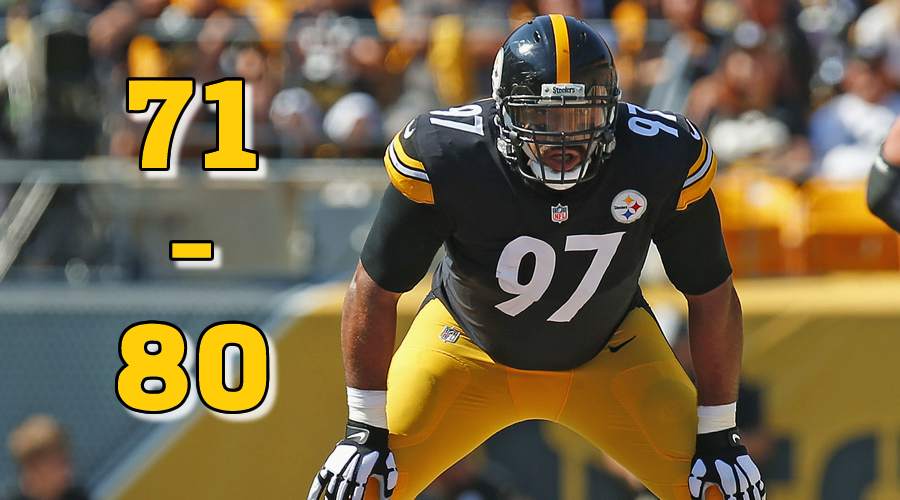
71. Cam Heyward
The picture burnt into my brain about Cam last season was how he absolutely man-handled Bengals rookie guard Cordell Volson in the season-opener. You put anybody not ready in front of this guy and he will physically overwhelm them with that grown-man strength. Heyward has been wearing that hard-hat for the Steelers for more than a decade now and been one of the most consistent forces on the interior D-line. Among his position group, he’s tied for fourth behind only Chris Jones, Aaron Donald and Javon Hargrave with 119 total pressures across regular and postseason, despite only appearing in one playoff contest. And he’s also fourth in terms of defensive stops in the run game (63). He can create traffic by standing up single blockers, two-gap near the point of attack, free up his teammates on twists or win one-on-one in passing situations, as a relentless pocket-pusher.
72. D.K. Metcalf
In a league that constantly is getting smaller – in particular at the wide receiver position – Metcalf is as close to your traditional X receiver as you’re going to find at 6’4” and 235 pounds. If he’s in any type of isolated coverage on the outside, Metcalf will throw off his corner and win on slant routes, before becoming a rolling train with the ball in his hands. He may never win on the most diverse route-tree, but he has the speed to win down the sideline and then he’s become a lot more efficient with bending off either foot on rounded cuts or stop his momentum and work back towards the quarterback. D.K. can box out defenders down the field and I’m not sure there’s a receiver more unbothered by a safety barreling down on him as he makes the grab. That’s how he led the NFL with 24 contested catches last season, casting a 51.5% win rate in those situations.
73. Talanoa Hufanga
Among a defense filled with studs, it’s kind of insane that Hufanga was able to stand out as much as anybody not named Nick Bosa. The energy he played with and the intimidation factor he had on opponents was palpable. He was able to fill the stat sheet in a major way – four passes intercepted and nine more broken up, tied for fourth among safeties with 30 total defensive stops and forced a couple of fumbles. He also cut down his missed-tackle rate to a solid 7.6%, which is particularly impressive if you put it into context with Hufanga constantly playing with his hair on fire and pursuing the ball at 100 MPH. Aesthetically and mind-set wise he reminds you of Steelers Hall of Famer Troy Polamalu, yet he didn’t play near the line of scrimmage as much as you’d think in that system, since according to PFF, Hufanga spent 56.7% of snaps as a deep safety last season.
74. Darius Slay
Slay’s game has aged like fine wine and he’s become an integral piece in Philly’s defensive scheme under formerly Jonathan Gannon, where they were playing a ton of quarters or cover-six and he was playing quasi-man but having to do so from off-alignment, where his film study and ability to anticipate routes really stood out. He’s now logged three interceptions in back-to-back years, to put his total all the way up to 20 since 2017, along with 14 PBUs last season. Very impressive for a corner, he missed just three of 58 attempted tackles, regularly bringing down guys in the flats one-on-one. Thanks to his football IQ and play-making skills, he was a major factor in Philadelphia finishing number one in dropback EPA (-0.087) this past season, along with flirting with historic numbers in terms of sacks, as they could stick in zone-coverage and rarely brought extra pressure.
75. Von Miller
I’ll be honest – I was too low on Von a year ago, when I had him 88th overall, due to very little impact for most of the regular season, before he turned it on down the stretch for the Rams Super Bowl run. I thought he was a great addition to a young room of defensive linemen in Buffalo, but did not expect him to be the clear alpha among it and that his injury would be as detrimental to the team’s success – which is why he actually moved up in these rankings, despite landing on IR a month before Christmas. He finished sixth league-wide in pass-rush win rate (23%), according to ESPN, with 45 pressures across slightly over 300 pass-rush snaps last season. Despite being limited to 11 games with the Bills, Miller has now been able to reach double-digit tackles for loss every year he’s been active for, other than when he was lost nine games into the 2013 season. His ability to bend around the corner is still elite and he was super-active near the point of attack vs. the run.
76. Frank Ragnow
A somewhat surprising first-round pick to casual fans back in 2018, Ragnow was one of my personal favorites in that draft and pretty much right away as a pro, whilst being the literal “center”-piece for Detroit’s turn-around up front. His understanding for aiming points, grip strength and effort have made him one of the NFL’s premiere blockers on the ground in what has become a diverse scheme. Other than his rookie season, Ragnow has earned a run-blocking grade above 78 in each of the following four. One of my absolute favorite things to watch on the All-22 is him releasing and hunting some poor DB in screen game. And his ability to counter the hands and quickly gain control of interior rushers have kept the A-gaps clean for the Lions. While he only appeared in four games of 2021, across the 1385 pass-blocking snaps these past three years combined, Ragnow has allowed just one sack and two additional hits on his quarterback.
77. Joey Bosa
This seems pretty low for Bosa, because even though we think of him as a guy who’s rarely available, taking out his debut season, when he held out for a better contract and still won Defensive Rookie of the Year, only once over the following five seasons did he miss more than four games prior to 2022. We think of Joey as this guy who’s made a living off expert hand-usage, with the patented two-handed swipe, but we forget how good he is at playing with extension and disengaging from blocks, which is how he’s racked up 76 tackles for loss across 84 career games. And he may have never gone over 12.5 sacks in a season, but looking at his pressure-per-rush opportunity rate of 15.0%, he’s right up there with the very best in the game over that extended sample size. His little brother Nick has certainly overshadowed him, but we’ve seen Joey take over games and if he can play a full 17 weeks this year, he’ll be key for the Chargers to take the next step.
78. Aaron Rodgers
There’s no mystery around this – 2022 was a definite drop-off for Rodgers from winning consecutive MVP trophies. After leading the NFL in EPA per play in both those years, he fell all the way to just 21st last season (0.039). However, there seems to be a misnomer about Rodgers declining physically or refusing to push the ball down the field. Somehow people are acting like Rodgers was some checkdown king in 2022, when in fact he finished behind only Josh Allen in big-time throw rate (5.7%), among quarterbacks with 200+ dropbacks. The problem is that a lot of the shots he took down the field came on early downs, when he saw opportunities to hit isolated targets streaking vertically, rather than testing tight windows in coverage. However, that was in large part due to missing chemistry with his young pass-catchers – which you can blame him in part for, among other shortcomings. With that being said, he still finished second in on-target rate of his passes (80.6%) and while the mobility is declining a little bit, his arm is still special. A change of scenery now in New York could reinvigorate him.
79. A.J. Terrell
Going through the statistics, I was surprised to see Terrell actually having played 14 games last season, because he pulled a hamstring early on in one of those, missed three weeks and just never quite felt like himself. Going back to 2021, on 86 targets his way, not only did he defend 19 of those (three INTs), but he allowed exactly half of those to be completed, with just 4.8 yards per target and three touchdowns, despite constantly being asked to shadow the opposing team’s top receiver. The numbers certainly got worse, in particular being responsible for twice as many touchdowns, but the difference wasn’t drastic. We’ll have to see how his deployment under new DC Ryan Nielsen will change, but for what he’s been asked to do, Terrell has been absolutely tremendous as a natural cover talent.
80. Nick Bolton
Other than Fred Warner and Roquan Smith, you can argue Bolton played as well as any off-ball linebacker in the NFL last season, not just based on the counting numbers. He did finish second in both solo (108) and total tackles (180), along with snatching a couple of interceptions and forcing a fumble. However, I thought his ability to ID keys and beat blockers to the spot along with the lack of any of fear turned him into one of the premiere run-stoppers at the position, while his improvements in coverage have also impressed me. According to pro-football-reference, he’s only missed 3.6 percent of his tackling attempts through two seasons. Bolton was the best defensive player in the Super Bowl, not only because he delivered that momentum-changing scoop-and-score, but also because he was the key to slowing down Jalen Hurts as a runner, thanks to his ability to track the ball and find opportunities shoot into the backfield
81. Tony Pollard
As a Tony Pollard truther, who said he should be the primary ball-handler in Dallas and told you to draft him in fantasy football last year again, I feel reaffirmed in my belief in him after putting up career-highs across the board. He finished 12th in scrimmage yards (1378) and tied for sixth in touchdowns (12) among running backs despite being 21st in total touches (232). For a couple of years now, Pollard was held back by Ezekiel Elliott handling the majority of touches and the explanation for many people was that Zeke was a better power runner. Well, last season among players with 100+ carries, this guy led everybody with 2.6 yards after contact on average, and he didn’t fumble once, compared to Zeke picking up that bad tendency. That’s along with finishing second among RBs in yards per catch (9.5) and turning 46.2% of his touches in the pass game into first downs.
82. D.J. Reader
Looking at the defensive numbers against the run for Cincinnati, the difference between Reader being on the field or not is truly glaring. Through the first two weeks, they were tied for fourth in rushing success rate (33.3%). Weeks three through nine – when Reader was hurt – they were tied for 24th in that regard. From the following game all the way until the AFC Championship, they ascended back to seventh across the league. His ability to not get reach-blocked on the front-side and force cutbacks goes beyond numbers, yet he also has the core strength to stack-and-shed blockers, thanks to which he finished seventh among all defensive players across the league with a 10.9% run stop rate, according to Pro Football Focus. At the same time, he registered a pressure on a career-best 10% of his pass-rush snaps, as somebody very capable of working the depth of the pocket.
83. Rashawn Slater
Being lost mid-way through the third game of the 2022 season with a torn bicep has made people forget how outstanding Slater was right away as a rookie. According to the AP, he was the best left tackle in football not named Trent Williams and the film matches that. His pass-blocking efficiency of 97.9 in year one actually put him just above Trent, while having to handle a massive 752 pass-blocking snaps, across which he held opposing rushers to 26 combined pressures. In very limited action this past season, he was actually off to an even better start, with just three pressures on 113 such snaps, and he spotted the fourth-highest PFF run-blocking grade (88.0) if you look at tackles who played 100+ snaps. There’s no secret why Justin Herbert’s numbers fell off without Slater protecting his blind-side and not only will a change to Kellen Moore at offensive coordinator make the QB’s job easier, but I’m also looking forward to seeing how he might utilize the mobility of his left tackle by diversifying the rushing attack.
84. Kevin Byard
Other than the Broncos’ Justin Simmons, I don’t think there’s been a more impactful safety in the league than Byard since entering the league in 2016. With four more interceptions last season, that puts his total over the past six seasons is now at an insane 27(!), along with another 59 passes broken up. Even more impressive – he has never missed a single game throughout his seven-year career. Since we’re at the number seven, that’s also were his name was listed in Pro Football Focus’ database in overall grade, among safeties who played at least 300 snaps last season. That may actually be low, understanding the variety of ways defensive coordinator Shane Bowen has been able to deploy him and considering he has missed just 3.0% of his attempted tackles over the past two seasons.
85. Jaelan Phillips
One of the big themes around the 2021 NFL Draft was that it didn’t include any premiere edge defenders. Not only did I think that was overblown in the first place, but Micah Parsons has also ended up converting back to the edge and I actually had Phillips one spot ahead of the former Penn State linebacker inside my top-ten overall prospects. So far through two seasons with the Dolphins, he may have only recorded 15.5 sacks, but I believe this is about to become one of the true superstar defenders across the NFL. In 2022, he earned an elite PFF pass-rush grade (90.1), being tied for the seventh-most total pressures (77) and being tied for fourth in ESPN’s pass-rush win rate (24%). From December onwards, he was among the most disruptive defenders in football, with a variety of different ways he can win the pass game. Plus, he’s added 17 tackles for loss over his two years in Miami.
86. Dallas Goedert
I truly believe that when on the field, Goedert is right behind that second tier of George Kittle and Mark Andrews (with Travis Kelce in his own league obviously) as far as tight-ends go. He finished third among all wide receivers and TEs with 20+ targets last season in yards per target (10.2 per) and average yards after catch (7.6). Most impressive however is Goedert’s insane first down per catch ratio of 58.0%. Travis Kelce and Jaylen Waddle were tied for second with 51.3%. He’s not quite on that same level in terms of working the intermediate areas of the field, but in terms of attacking vertically and gaining yardage with the ball in his hands, he’s as good as just about anybody at the position. The only reason he’s not up there among these rankings overall is how susceptible he’s been to injuries, having missed either two or five games in all but his rookie campaign in 2018.
87. Joe Thuney
It’s rare to see offensive linemen leave New England – at least it was throughout the tenure of position coach Dante Scarnecchia being there – and actually improve at a different spot. Thuney was already a Pro Bowl-level player in the latter couple of five years with the Pats, but he’s arguably been the top guard across the AFC since coming to Kansas City two years ago. Since then, he’s received the highest PFF pass-blocking grade in each of those seasons among all guards who played 200+ snaps last season (90.5 and 88.9 respectively), allowing just one sack each. He’s more so a positional run-blocker and the guy who pins down-linemen whilst his teammates crush people on the fly, but his consistency is off the charts. Last season he was called for a false start and holding just once each as the only flags against him and 2022 was the first year he missed a single game or start across his seven seasons in the league.
88. Wyatt Teller
This is a name I thought had the potential to turn himself into a starter with the Bills as a fifth-round pick in 2018 and he got some action late in the year, but the Browns realized that as well and traded a couple of day three picks for him shortly before the upcoming season. After a so-so debut campaign in Cleveland, he put together one of the most dominant run-blocking seasons we’ve seen from a guard in 2020, leading all offensive linemen with a grade in that regard of 93.6 from Pro Football Focus. Their database would make you believe he’s declined these past two seasons, but when I put on the tape, he’s still burying defensive ends on kickouts and opening up massive lanes by displacing interior linemen horizontally. Plus, his pass-blocking efficiency has been extremely steady, finishing between 96.9 and 97.7 in all four years with the Browns.
89. Trey Hendrickson
After seeing sporadic usage the first three years of his rookie contract as a pick just outside the top-100, Hendrickson broke out in a major way in 2020, earning himself a big contract with Cincinnati. He’s one of those under-the-radar stars to me, who doesn’t appeal to general fans because his game isn’t overly flashy, relying heavily on power and advanced hand-usage, but if you check the numbers, you realize he’s been one of the most consistent defensive ends in the league. Over these last three years, his 35.5 rank fourth and his 186 pressures fifth across the NFL. His 30 tackles for loss over that stretch are also pretty high up there, as a reliable edge-setter who understands when he can disengage from blocks, and while his pressure numbers were down a little bit this past season, he batted down a career-high three passes and forced three fumbles for the second straight year.
90. Antoine Winfield Jr.
Similar to his father and three-time Pro Bowler Antoine Winfield Sr., who was one of the better DBs in the league for about a decade and became one of the first guys to really excel in the “nickel” role, Junior has been somewhat underappreciated as a young standout player. While he hasn’t been a huge ball-hawk in terms of his four interceptions across 42 career games, his yards per target in coverage (7.3 in 2022) has improved all three years. At the same time, he’s one of the best at running the alley and is more than fine with having to drop down into the box and stick his nose in the fan. This past season, he put up a career-high seven tackles for loss total, while only missing two of 82 attempts. And he earned the highest pass-rush grade among safeties (91.4), with four sacks and six additional QB hits across 38 pass-rush snaps. So he’s a perfect fit for Todd Bowles’ blitz-heavy scheme.
91. Quenton Nelson
As I mentioned with Jonathan Taylor already, anybody associated with the Colts offense in 2022 had a really bad year. The most surprising among those was Quenton Nelson, who was on a Hall of Fame arc through his first three years in the league and was challenging for the title as best guard in the NFL in his second season already, starting his career with three straight first-team All-Pro nominations before going down to second-team in 2021. Throughout Indy’s otherwise dominant O-line, there were missed assignments and poor communication this past year. Big Q himself allowed defenders to “win the gap” more than I had ever seen and he was late to transition against twists and games on multiple occasions. After holding opponents to just four sacks across 2521 pass-blocking snaps prior up to 2022, he surrendered five sacks that season alone and a career-high 31 total pressures (720 PB snaps). I’d be shocked if he doesn’t return closer to that early-career form this year however.
92. Jaycee Horn
After looking like a young star in very limited time as a rookie, Horn was lost three games in with a torn Achilles. He surprisingly played at a very high level across 13 games in his encore season, when he intercepted three passes and broken up seven more. He held opponents to a 55.0% completion rate, just 3.7 yards after the catch on average and one total touchdown – So even when he did allow a little bit of room for receivers to catch the ball, he was able to bring them down quickly. Only Tariq Woolen and James Bradberry allowed lower passer ratings among defenders with over 50 targets last season (62.4) altogether. And his 10.2% missed tackle rate isn’t bad for a corner either. So with a full offseason under defensive coordinator in Ejiro Evero – who just helped Patrick Surtain turned into an All-Pro cprner – where he’s healthy heading into the year, I expect him to continue to rise among a position with a lot of young studs.
93. Trevon Diggs
As expected, Diggs could not keep up with the insane pace of interceptions he set in 2021. His pick total dropped from eleven to three, along with 14 more PBUs. However, his yards per target (7.9) and touchdowns allowed (three) actually decreased slightly and he’s worked extremely hard on being a more reliable tackler, missing just one 60 attempts all of last season. He also cut down his accepted penalty total to just four worth 16 yards. So being part of a defense under coordinator Dan Quinn, there will plays that he gives up, just because wide receivers have the advantage one-on-one, in particular with how the rules are set up. However, Diggs competitiveness to hang in there and actively locate the ball in order to make plays on it, makes him one of the most valuable contributors at the position.
94. Rhamondre Stevenson
The book on Stevenson coming out of Oklahoma a couple of years ago was that he was a very powerful runner with excellent pass-protection skills. And while he’s finished fourth (2.7 yards) and tied for ninth in average yards after contact (2.1 yards per) across the league, he’s been much more than just a banger inside. He has that initial burst that allowed the Patriots to get him out to the corner on toss plays with regularity and for a 230+ pound back, he has incredibly nimble feet to make those subtle adjustments to his running path depending on the post-snap movements along the front-seven. Despite finishing tied for 16th in total carries (210), his 16 runs of 15+ yards were the fourth-most league-wide. Stevenson’s 69 receptions were also fourth among the position and only Austin Ekeler – who caught 40(!) extra balls – had more missed tackles forced (21) after the catch last season.
95. Jordan Poyer
This guy has been the epitome of the term “safety”, as a player who excels at limiting big plays and taking care of his assignments, as that entire Bills defense runs through him and Micah Hyde on the back-end. However, he’s become a ball-hawk recently on top of it, with nine combined interceptions over the last two years. While Buffalo heavily relies on zone coverage, Poyer’s ability to trigger on routes in his vicinity in accordance with spacing and phase of the pattern make a big difference. This past season, he was charged with the lowest passer rating allowed among safeties (60.1) and a career-low 4.7 yards per target. On top of that, he missed just three of 66 tackling attempts, holding opposing pass-catchers to just 3.1 yards after the catch on average when he did see passes completed against him as the next-closest coverage defender.
96. T.J. Hockenson
With George Kittle and Mark Andrews both missing some time as that second tier behind Travis Kelce, Hockenson took full advantage of that opportunity and finished behind only Kelce with a career-high 914 receiving yards. What’s impressive about that is the fact he was traded in-division from Detroit to Minnesota seven games into the year and immediately became the secondary target to Justin Jefferson among that attack. His ability to find open space against zone coverage, but also win balls through contact made him highly effective, after the Vikings had gotten very little out of their tight-end position upon his arrival. Not only did he finish behind only Kelce with 17 third-down catches that resulted in conversion, but he also actually led all TEs with 19 contested catches last season, with an impressive 57.6% rate. As he continues to work in that outside zone-based scheme, he’ll be a valuable contributor in the run game as well.
97. Tariq Woolen
One of the finalists for Defensive Rookie of the Year, Woolen immediately stood out to me as a steal in the fifth round purely based on his combination of insane athletic profile and competitive mindset. However, he was able to immediately translate that potential onto the NFL field. He was tied for the league-lead with six interceptions, with actually a lower completion percentage allowed (51.5%) than the ultimate winner of the award Sauce Gardner and altogether the lowest passer rating league-wide with 20+ targets (48.7). His speed to run with anybody down the sideline and the length to disrupt the catch-point as well as extend his range as a flat-defender in cover-two to his side are apparent, but I was so impressed with the short-area burst to drive on routes in front of him playing off in quarters. With a top-five pick at the opposite corner spot added, I’m interested to see how much more man Seattle will be in and how many chances Woolen gets to make plays on the ball.
98. Aaron Jones
Because he’s barely cracked 1000 rush attempts through his first six years in Green Bay and the fact another Aaron in that backfield along with him has received all the attention in the past, Jones isn’t regularly considered one of the top backs in football. However, in terms of efficiency, he’s on a historical pace, as only Nick Chubb has averaged more than his 5.1 yards per carry since Jim Brown hung up his cleats. Last season, he actually finished first among all 24 running backs who handled 200+ rushing attempts last season with 5.3 yards per – the second time in his career of doing so. Not only that, but he’s also averaged 403.8 receiving yards across his four years as a full-time starter for the Packers. While he may not possess true break-away speed, Jones’ short-area acceleration is top-tier and he has almost odd contact balance, where he’s side-stepping a tackle without his body actually pointing towards the direction he’s moving, in order to limit surface area and be able to re-gain his balance.
99. Kyle Dugger
Dugger has become one of those names who’s been playing extremely well, but is rarely ever mentioned. That may change if Dugger can repeat his 2022 season, when he really filled the stat sheet – three interceptions, eight PBUs, five tackles for loss and led the NFL with three(!) defensive touchdowns. In fact, only two other defenders scored twice even. Along with his presence roaming the underneath areas in coverage and his ability to match up with big-bodied pass-catchers, he’s been very effective when utilized as a blitzer, illustrated by 11 pressures on just 36 pass-rush snaps last season. And then of course at 6’2” and 220 pounds, not only can Dugger be a legit plus-one in the box and mismatch against slot receivers in the run game, but also only missed a solid 8.2% of his attempted tackles.
100. Amon-Ra St. Brown
If you look at the last 17 games St. Brown has started and finished from the last month of 2021 onwards, he’s been as productive as any receiver in the league. Across those, he’s hauled in 126 of 161 targets for 1450 yards and nine touchdowns. I understand he’s primarily a slot receiver (68.8% of career snaps spent there), but he’s been a machine from that spot. His ability to kill defenses with paper-cuts as he mid-points zone defenders, but also consistently is able to create separation at the top of routes is masterful. His 23 third downs converted last season was only two behind the league leader in that category in Justin Jefferson, despite missing basically two-and-a-half games. And his yards per route run mark (2.40 per) was tied for seventh among all pass-catchers with Cooper Kupp and Stefon Diggs. Now entering his third season, we need to see him put it all together for a full 17/18 consecutive weeks and possibly more.
The next 30 names:
DeMario Davis
Tyson Campbell
David Long Jr.
Marcus Williams
D.J. Moore
Jessie Bates
Chris Olave
Garrett Wilson
Ryan Ramczyk
Jimmie Ward
DaRon Payne
Jevon Holland
Za’Darius Smith
David Njoku
Chauncey Gardner-Johnson
Vita Vea
Ronnie Stanley
Josh Allen (JAX)
Dre Greenlaw
Geno Smith
Budda Baker
Elgton Jenkins
James Bradberry
Lavonte David
Quincy Williams
Jonah Jackson
Amari Cooper
Kenny Clark
DeVonta Smith

