
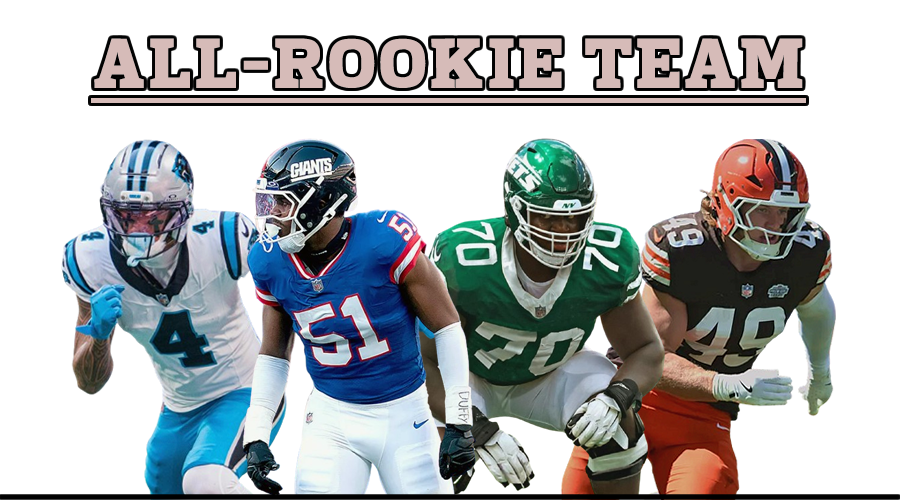
The NFL playoffs just kicked off with a thrilling Wildcard weekend, which I probably couldn’t even summarize in comprehensive enough fashion for an article. Instead, this is the time for me to reflect on the regular season and this rookie class in particular.
What I did here is put together a full offense and defense, along with six backups each, basically at every position, and a foursome of special teamers. Based on trying to put the best 11 players out there, I opted for 12 personnel (meaning one running back and two tight-ends) on offense and nickel personnel (five defensive backs) on defense.
Please bear in mind that this is purely based on the regular season, and while I’ll mention it specifically on a few occasions, I considered rookies who played 200+ snaps.
Let’s introduce the squad:
Offense:
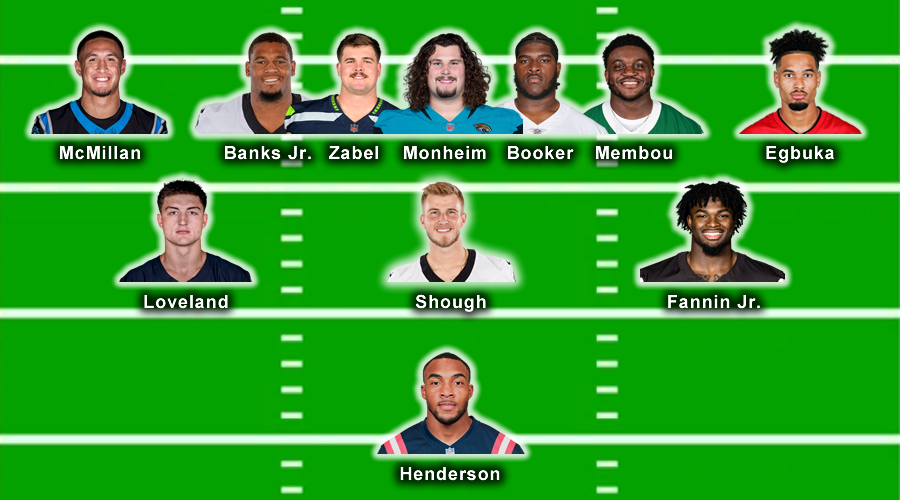
QB Tyler Shough, Saints
RB TreVeyon Henderson, Patriots
X Tetairoa McMillan, Panthers
Z Emeka Egbuka, Buccaneers
Y Colston Loveland, Bears
F Harold Fannin Jr., Browns
LT Kelvin Banks Jr., Saints
LG Grey Zabel, Seahawks
C Jonah Monheim, Jaguars
RG Tyler Booker, Cowboys
RT Armand Membou, Jets
Key backups: QB Jaxson Dart (Giants), RB Quinshon Judkins (Browns), WR Luther Burden III (Bears), TE Tyler Warren (Colts), OT Will Campbell (Patriots) & IOL Tate Ratledge (Lions)
If you had asked me to put together a pre-season version of this team, there were two extremely obvious candidates for the offensive backfield – first overall pick Cam Ward for Tennessee and sixth overall pick Ashton Jeanty for Las Vegas. While both had a case to make it as backups, ultimately they both just missed out. Instead, I went with the Shough, who had to sit on the bench for the first half of the year, but ended up as the only quarterback from the 2025 class to finish with a winning record in year one (5-4). He accounted for 13 touchdowns compared to six interceptions, and even if he didn’t show great “escapability” (8.7% sack rate), when he did decide to take off, he was fairly effective as more of a straight-line runner (16.9 yards per game). Although you could argue for the Giants’ Jaxson Dart having better raw numbers, Shough did lead three game-winning drives, playing the position in a very cerebral way already, working through progressions with pace and showcasing excellent accuracy, especially down the field. Behind/Next to him is the most explosive first-year running back. Among nine rookies with 100+ carries, Henderson posted the second-highest rate of 10+ yard runs (10.0%), and the only name ahead of him (Washington’s Jacory Croskey-Merritt) fumbled four times compared to one for TreVeyon (just once). In terms of yards after contact as runners, we had the same top two, and while Henderson finished about 200 scrimmage yards behind Jeanty overall (1132), he did so averaging 1.2 extra yards per touch. Quinshon Judkins did get the nod as my backup RB, thanks to the engine he was to keep a struggling Browns offense afloat, tying Jeanty in total first downs gained (57) on 65 fewer opportunities.
In terms of the receiving corp, I went with two wide receivers and tight-ends, as numbers three to six in aerial yardage were actually labelled as “TEs”. McMillan and Egbuka led the way with 1014 and 938 respectively. The latter winning Offensive Rookie of the Year almost felt like a foregone conclusion at midseason, yet then he only averaged 32.6 yards and didn’t reach the end zone once over the final eight weeks (six beforehand). Regardless of his involvement down the stretch, it doesn’t take away from the savvy and level of detail in his routes. That race for the award probably was decided towards T-Mac thanks to his consistency all year, despite some ups and downs from his quarterback. He cracked 60+ yards in ten games and reached the end zone once more than his NFC South rival (seven). What stood out about him was the quick development of his footwork at the level, how he could reduce his height to be efficient at the break-point, yet then maximize it in order to secure imperfect ball-placement. The one thing that’s a little disappointing for both rookie receivers – they were only right around a 30% contested catch rate. As for the two tight-ends, Loveland and Fannin shone in quite different areas and were also deployed rather differently. I chose the Bears standout as my more traditional in-line Y, because he was easily the best run-blocker among the three names in consideration (68.6 PFF grade), yet if I wanted to put three WRs on the field, he’s shown that he’s absolutely capable of lining up as the single receiver on the backside and winning one-on-one. He actually finished behind only his teammate Luther Burden III in yards per route run (1.86) among all rookies with 20+ targets, he only dropped one pass, and even though this list is based on the regular season, Loveland posting a higher receiving total (137 yards) than Travis Kelce’s best playoff game ever, in his first such opportunity, just illustrates what he’s capable of as a super flexible separator. Fannin functions as more of a movement “F” type, since he’s much more effective off the ball, motioning him before and at the snap to give him running starts and allow his yards-after-catch skills shine. I would’ve even liked to run 13 personnel with this group, because Tyler Warren was on pace for winning OPOY midway through the year, and is nearly every bit as deserving as the two guys who actually made the starting lineup, having outproduced them in catches (76) and total yardage (817). Yet the other two were hauled in right around half of their contested targets compared to Warren’s 39.1% rate, and the separator for Fannin – he had more than four times as many missed tackles forced (22), as someone who’d routinely shake off defenders.
As far as the offensive line goes, it was pretty easy to settle on my two tackles and guards, respectively. Although New England’s Will Campbell is a very deserving swing tackle, as the first of these three off the board, the other two also more than repaid their teams for making them top ten picks, as they both started all 17 games (while Campbell missed four with injury), and just out-graded the former as the top three rookie OTs in PFF’s database. Banks solidified the Saints’ O-line on the blindside, leading all first-year linemen in total snaps (1055). His explosiveness into contact stood out on a few occasions in opening up the front-side on run calls, and he held opponents to five sacks despite the heavy workload. Membou did equally well on the right end of the Jets’ front. For him, the ability to latch and sustain for a more zone-centric rushing attack was a defined positive, while his nine combined sacks and QB hits were even better than his counterpart’s, especially considering the volatility for New York’s passers, who too often held onto the ball or ran themselves into sacks. At guard, Tyler Booker was not only the best rookie run-blocker for my money, but Pro Football Focus agrees, as he’s the only name graded higher in that regard than Banks (76.8). His ability to create movement at the point of attack or open up additional gaps as a puller really helped kick Klayton Adams’s ground attack into a different gear. And yet, I would argue Zabel was even more crucial in the elevation of Seattle’s offense altogether. His athleticism could really shine in their zone-heavy run game, and even if you take into consideration how much they moved the pocket when their quarterback pulled the ball off that action – only one rookie with 300+ pass-blocking snaps surrendered fewer pressures (24) than the Seahawks’ left guard, and he did it on nearly 200 additional opportunities (553). The center spot wasn’t as obvious in one way. Detroit’s Tate Ratledge had a solid case if I just picked the three best interior linemen, but since the Lions actually decided just before the season that they’d flip him and a veteran for snapping duties, I decided to prioritize the spirit of the exercise and name Jonah Monheim instead. He was the only one of the bunch to start multiple games at the pivot and performed pretty well for Jacksonville on just over 200 snaps, allowing his QB to be hit just once and not getting penalized at all.
Defense:
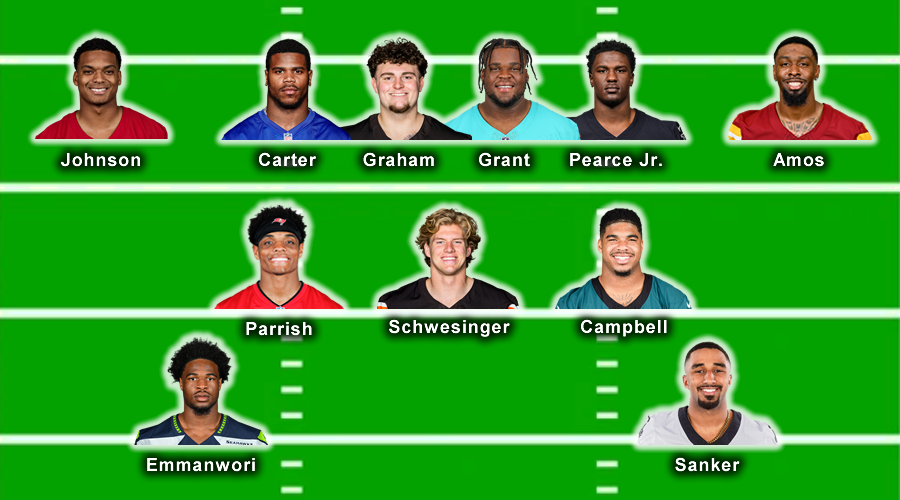
EDGE Abdul Carter, Giants
3T Mason Graham, Browns
1T Kenneth Grant, Dolphins
EDGE James Pearce Jr., Falcons
LB Carson Schwesinger, Browns
LB Jihaad Campbell, Eagles
CB Will Johnson, Cardinals
CB Trey Amos, Commanders
NB Jacob Parrish, Buccaneers
SAF Nick Emmanwori, Seahawks
SAF Jonas Sanker, Saints
Key backups: EDGE Donovan Ezeiruaku (Cowboys), IDL Deone Walker (Bills), LB Teddye Buchanan (Ravens), CB Quincy Riley (Saints), SAF Xavier Watts (Falcons) & FLEX Jalon Walker (Falcons)
Starting off with the defensive line, three of four selections came pretty easily to me. Due to a couple of bad flags drawn and sitting at half a sack until the start of December, Carter didn’t live up to the status of the third overall pick on the surface, but he was easily the top edge rusher of the class. He led all rookies with 66 total pressures, compared to Pearce’s 45 for second. His ability to capture the corner with his tremendous burst could really pop as he continued to improve his timing for defeating the tackle’s outside hand, and he pulled off some nice cross-face moves off that, but I loved most when he’d unleash a deadly spin move over interior blockers. Meanwhile, Atlanta put a lot of weight on the latter, when they traded their 2026 first-round pick (plus a seventh-rounder) to move back up 20 spots into the first round for him. Yet, he was the only rookie to hit double-digit sacks, to lead the way for a Falcons D that finished second overall, after being bottom-dwellers in that metric for about a decade. He was more of a pure speed ball off the edge, but then surprised with his ability to convert that into power at times, and his closing burst allowed him to hunt down guys outside the pocket regularly. Neither playing graded out particularly well against the run in year one, but even more glaring – Carter missed over 20% and Pearce nearly 30% of their respective tackles attempted. Graham, as my penetration-style interior D-lineman was an obvious choice, easily leading the position group in PFF grade among guys with 200+ defensive snaps (68.7), he was 12 clear of anyone in defensive stops (32) – constituting a positive tackle for the defense based on down and distance – and he was tied for third among all rookies with 36 QB pressures. He was a perfect fit for Jim Schwartz’s attacking front, regularly throwing off plays early. My toughest decision was probably for that shade nose tackle, since you can absolutely make a case for Buffalo’s Deone Walker. However, with him and *the other* Michigan D-tackle Grant having the same total of defensive stops (20) and the latter logging 13 additional QB pressures on about 100 extra pass-rush opportunities, the differentiator for me was how these players developed over the course of the season. The latter only hit the quarterback once over the final two months, while Grant has been incredibly steady over that stretch. His core strength and body control to deal with double-teams and slide off contact are impeccable. I will mention here that nobody along the IDL flashed more on a limited sample size than Arizona’s Walter Nolen.
The duo on the second level of this defense might be as strong as any position group for this team, certainly if you take out the offensive line. Schwesinger rightfully seems to have locked up Defensive Rookie of the Year. Behind the chaos Graham, the actual Defensive Player of the Year Myles Garrett and company created, this guy cleaned it all up. Although his two interceptions came off a tipped pass and being right in the passing lane for the other, his range to stop run plays from the backside and track down quarterbacks in space was on display all year. And yet, most impressive for him was his quick trigger to knife through gaps and blow up screen passes. He easily led all rookies with 54 defensive stops – a whopping 22 clear of his Browns teammate Mason Graham. Campbell, on the other hand, was plugged into a Super Bowl-winning defense that would be without a key starter in Nakobe Dean in the middle for the first half of the season. And yet, while the Eagles were dealing with a problematic number two outside corner spot, they didn’t miss much of a beat, with that “replacement” player earning the highest PFF grade of any rookie defender (76.2). Just like Schwesinger, Campbell recorded a QB pressure basically on every fourth pass-rush snap (14 on 57 opportunities), for a Philly D that would regularly put their linebackers at the line of scrimmage and keep you guessing if they’d drop out. Still, his most impressive moments actually came in space. Outside of an off-schedule 72-yard touchdown, where Tampa Bay’s running back got a step on him after turning a simple flat route vertically, he held opposing passers to just 0.54 yards per coverage snap, and no first-year backer with 200+ snaps registered a lower missed-tackle rate (7.3%).
In terms of my trio at corner, I did end up with two primary outside guys, but the star of the show is Jacob Parrish at nickel. Although there are rookies who have made more splash plays and racked up numbers that jump out, you can make a solid case that this has been at least one of the two most consistently excellent first-year players on that side of the ball. Due to the nature of the Bucs’ fire-zone heavy defensive scheme, opposing offenses having that extra space to attack with one fewer defender in coverage, and the “next closest” being charged with a completion surrendered, even if he did his job correctly, Parrish’s numbers in that regard appear sub-par, especially with how they fell off as a unit following a strong start. Yet, if you filter by man-coverage (98 snaps), he was responsible for a passer rating of just 69.3. More importantly, you constantly felt his presence around the line scrimmage, disrupting perimeter screens and also filling the C-/D-gap when moved to the edge of the box. Only if you consider Seattle’s Nick Emmanwori here as a primary slot defender, did any defensive back log more defensive stops (30, compared to Parrish’s 28). As far as the perimeter guys, Johnson was off to an excellent start through his first six games, but ended up missing a month and took a step back the rest of the way. He failed to grab an interception, but I was impressed with his ability to attack forward in coverage, and he did still hold quarterbacks to under a yard per coverage snap (403 on 449 such snaps). Amos finished just above that mark and unfortunately missed the final seven weeks. His missed-tackle percentage was actually slightly higher than Johnson’s (20%), but I do commend him for how much of the primary coverage responsibility he took on against the likes of Malik Nabers, Drake London, Jaxon Smith-Njigba and others, while only drawing two flags. You can also see his absence in the numbers for Washington, as their man-coverage rate dropped by about seven percent from week ten onwards (from top-five to league-average).
Now, even though I just talked glowingly about my primary slot defender, Emmanwori being officially listed as a safety helps me just in getting the top 11 players on the graphic, since he may come in a very different body type, but almost exclusively operated there and allowed the Seahawks to run their (big) nickel personnel at the second-highest rate in the NFL. You can argue that his role, at least in terms of alignment, was fairly narrow as a rookie, but not having to match offensive personnel groupings differently, made that unit that much more malleable overall. Seattle finished number one in basically every meaningful metric against the run (-0.208 EPA per rush), and their efficiency actually went up when facing multi-tight-end sets, thanks to Emmanwori’s physicality to squeeze those guys into the action and condense lanes. He limited opposing quarterbacks to 6.4 yards per target, missed just 9.5% of his attempted tackles, and posted 18 pressures on just 64 opportunities. Sanker’s deployment looked vastly different. According to PFF, no other rookie defender logged more snaps at “free safety” (649). Based on their tracking, that solely means lining up deep, but New Orleans did actually use middle-of-the-field closed structures as much as anyone but Cleveland (at just over 60%). Sanker’s ability to ID the action from depth, get a beat on throws and range out to the numbers, was a huge asset in how the Saints wanted to operate. He got his two interceptions in that mold, and on 525 coverage snaps, he was only charged with 185 yards as the primary defender. Only one rookie with 100+ coverage snaps was responsible for a lower passer rating (62.9) – and that guy did it on more than 300 fewer. His one area to clean it is being a more reliable tackler (17.9%), although being the last line of defense with a lot of space to command certainly contributes to that.
Xavier Watts being two clear of all other rookies in interceptions (five) and Jalon Walker producing a pressure on better than every tenth pass-rush snap (29 total) speaks to the quality of Atlanta’s draft class, as both ended up as strong honorable mentions for me.
Special teams:
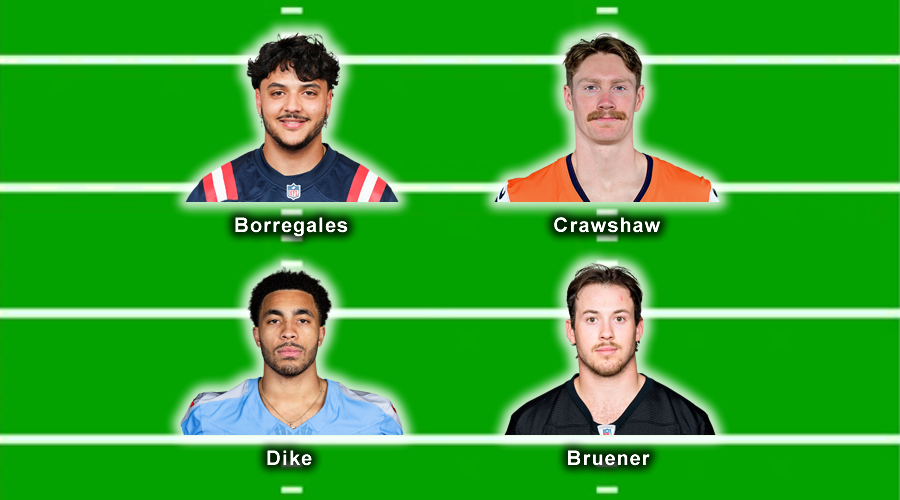
K Andres Borregales, Patriots
P Jeremy Crawshaw, Broncos
RS Chimere Dike, Titans
ST Carson Bruener, Steelers
Three of the four special teams spots I was able to fill in without really thinking (of course, I did go through the stats anyway), but the last one I had to dig in for a little more.
Only three rookie kickers even attempted more than 15 kicks. Baltimore’s Tyler Loop was basically on par with Borregales in terms of extra points (both missing two, with 53 total makes for the latter) and actually converted a slightly higher rate of field goals (88.2 vs. 84.4%), but he did miss that 44-yarder in Pittsburgh in the regular season finale, which cost the Ravens a trip to the playoffs. More importantly, he only hit one of four tries of 50+ yards, while Borregales was perfect on his four attempts, for New England number two-ranked scoring offense.
At punter, there was even less competition for Crawshaw, as the Saints’ Kai Kroeger was the only other rookie even taking on those duties this season. And the former beat out his counterpart across the board gross (47.6) and net yards per punt (41.1), yards per return (10.6), and fair catches forced (23). For context, all of those numbers also rank at least top 15 among 26 players with 50+ attempts, and he’s tied for third in that last category, which was critical for a Denver team with an offense that had its quiet stretches, and often times relied on winning the field position battle.
Dike is as obvious a selection for return specialist as I can ever remember, and he’d also be my pick for first-team All-Pro, across the NFL as a whole. He was tied with New England’s Marcus Jones for a league-best 17.3 yards per punt return and two touchdowns through that avenue. The difference is that while that guy didn’t take on any duties on kickoffs, Dike finished second to only the Cowboys’ Kavontae Turpin in return yardage off those, with a solid 25.2-yard average. In fact, he led *all players* in all-purpose yards (2427 – about 400 receiving over the final 11 weeks), and at least neither of his two muffs on 85 total kicks resulted in a turnover.
Finally, three names jumped out to me in a different capacity on special teams – the Rams’ Shaun Dolac, the Ravens’ Keondre Jackson and the Steelers’ Carson Bruener. Not unexpectedly, the latter among those was the only guy that actually got drafted this past April, and he still had to wait until the seventh round. The reason I ultimately went with Bruener is that he collectively logged the most snaps across the four key units (285 – kick and punt return, as well as coverage), but more importantly, was involved on the most total tackles (21) while being the only one among that trio to not miss a single such attempt. He was also PFF’s highest graded special teamer with 100+ snaps overall (91.3).
 Halil's Real Footballtalk