
Now with every NFL team having played double-digit games, I thought it was time to reflect on the current state of the league when it comes to quarterback play, by ranking and bucketing all 32 starters, as I ultimately settled on eight different categories.
For this exercise, I chose the players who have been fixtures in the lineup for multiple contests and largely are expected to be in those roles for the rest of the season. That means you won’t see names like Joe Burrow, Mac Jones, Kyler Murray and Spencer Rattler, who other than Burrow of course, would probably all end up around the top of the “starters with defined limitations” tier.
This is how I have everyone stacked up:
MVP front-runners:
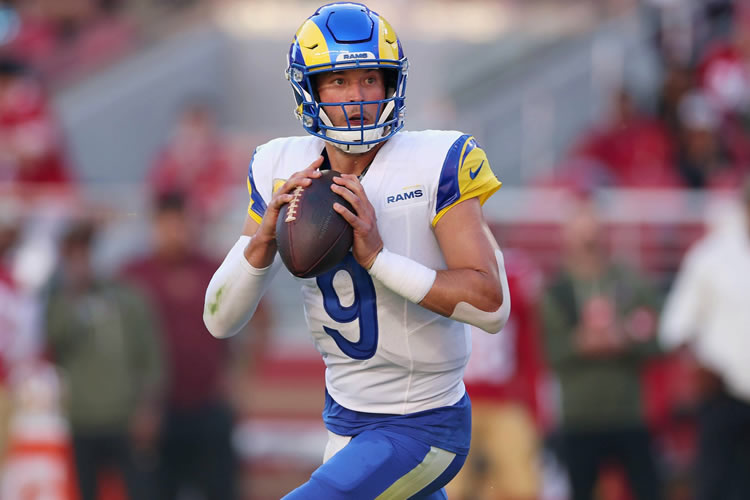
Not only are these the top three names on betting markets for the MVP trophy, but they were also my top three candidates for the honor a couple of weeks ago, when I handed out midseason awards. While the supporting cast may be of different quality, I would say that all three have quality offensive play-callers, but have managed to elevate their supporting casts in meaningful ways, to where their units all rank top-seven in expected and actual points added.
1. Matthew Stafford
Although I personally hold a betting ticket for number two on this list to actually win the award, I would love to see Stafford finally get the recognition he deserves in year 17. Regardless of what you think of his career resume and his place in NFL history, it’s hard to ignore that he’s currently playing at the highest level we’ve ever seen from him, after all the speculation about his back costing him pretty much all offseason activities. Aside from him leading the league in passing first downs (88) and touchdowns (27), compared to only two interceptions, despite having already had his bye week, you can feel the stranglehold he and Sean McVay have over defenses. His ability to move zone defenders with his eyes, not even have to look at his intended targets at times with these no-look passes into the windows he’s actively opened up, and the ability to layer throws is second to none. Where he’s taken his game to a higher plane, are how he’s mastered navigating the pocket with subtle movements and truly exhausting progressions, for as much as he and Puka Nacua pick apart zone structures, and Davante Adams is a cheat-code one-on-one in the red zone. That’s why L.A. ranks only behind the Colts when it comes to offensive DVOA, who have the clear favorite for Offensive Player of the Year at running back.
2. Drake Maye
Now, if I had to choose one quarterback for the next 10-15 years, it’s hard to go with anyone but Maye right now – even if you may call that premature. A rather soft schedule has certainly helped elevate the numbers, even though I’d say it’s that’s more about the offenses they’ve faced along the way, but there’s so much tangible evidence of qualities you need to succeed at this level. All eligibles are live at all points, even if they’re supposed to simply clear out coverage, he’s tremendous at lofting passes over the second level of the defense and he’s been the most accurate deep ball thrower in the league, hitting 22 of 40 targets of 20+ yards (with six TDs and no INTs). Plus, he’s become elite at extending plays, in and out of the pocket, as his passer rating actually goes up on dropbacks of over 2.5 seconds (113.4). That’s all the more impressive considering that until just last two weeks ago only the Raiders had a less efficient early down run game (now up to 28th with -0.181 EPA per rush). The one major flaw with Drake at this point is how he’s allowing pressures to convert sacks at the highest rate of anyone near the top of this list (22.9%). Yet, what I’d add to that point is how many of these he takes on third downs – which costs them some field positioning rather than it kills drives – and even, that they rarely cost them significant yardage, as 14 of 36 have been for two yards or less.
3. Josh Allen
Third in this tier is the guy who tapped into “human highlight reel” mode again this past Sunday, accounting for six total touchdowns after a pair of bad picks early on, to overcome his defense getting gashed on the ground once again – a topic I extensively covered in a video last week. That style of play isn’t representative of what the rest of his season has looked like, as he’s still just outside the top-ten in big-time-throw percentage (4.7%) among quarterbacks with 200+ dropbacks, but also has the second-lowest turnover-worthy play rate (1.6%) for that group. So even though they’ve relied more heavily on James Cook, averaging nearly 100 rushing yards per game, the fact that Josh can access either one of these worlds, where he’s protecting the ball in positive gamescripts, but then also put on the Superman cape, when his team needs him to, is what makes him so special. Similarly to Maye, Josh being on pace for his highest pressure-to-sack conversion rate (16.5%) is what has the reigning MVP firmly in third place for me, yet I’m curious if we see him shoulder more of the load going forward again, as he’s back up to second in QB rushing yards (351), behind only the Jets’ Justin Fields, who has been of a glorified running back this season.
Borderline elite:
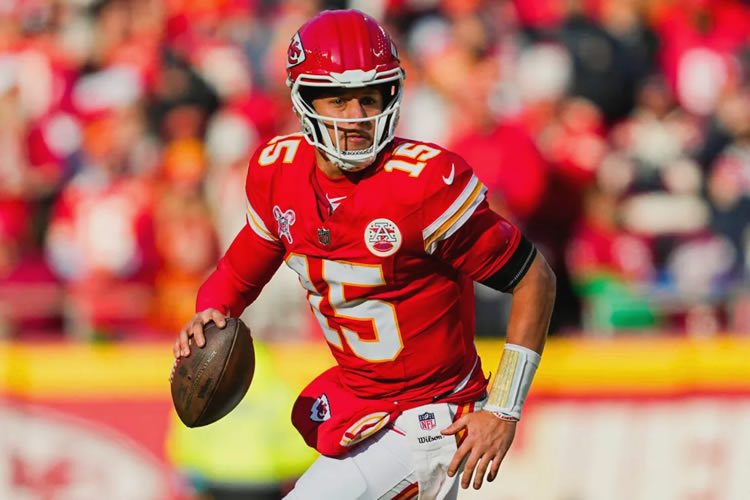
The second threesome of quarterbacks is only a slight notch down, in part because their team’s success is slightly lesser, but more importantly, they’ve all shown at least certain flaws individually. Nonetheless, they are the drivers of the success of those respective offenses, providing a baseline of expectation, which would be crucial for any team you put them on.
4. Patrick Mahomes
It’s been a long time since Mahomes’ name showed up anywhere but the top tier, and you can make an argument that a break between the first and next three names isn’t totally necessary, but I did think some differentiation was appropriate here. Now, for anyone wanting to push him down any further than this based on the fact that the Chiefs are currently sitting at 5-5, at risk of missing the playoffs and not making it back to the AFC title game for the first time in the Mahomes era, they need to judge his individual play more than the overall team result. Although we can call some of last year’s regular season fluky, this has been regression to the mean swinging back in a brutal way, going from a perfect 11-0 record in one-possession games to a 0-5 resume so far. Pat has missed an atypical number of deep shots this year, to where simply referring to a lack of chemistry with some of these guys towards the bottom of the depth chart isn’t enough anymore. Having said that, no other player at the position has excelled in such a complete sense, whether he’s playing within or out of structure, threatening every blade of grass, even though truly excelling when attacking the intermediate middle of the field (10-19 yards between the hashes – 155.9 passer rating). He’s the only quarterback with positive EPA per dropback when pressure (+0.199), which ranks ninth for qualified passers on *all* dropbacks. Plus, he leads the league with 28.6 scramble yards per game.
5. Lamar Jackson
The sample size for Lamar is significantly smaller than any of these other guys, having only played in seven games. The fact that the Ravens are “only” 4-3 across those is more of a reflection on the quality times they’ve faced in their losses, at Buffalo, against Detroit and at Kansas City. With that being said, he’s coming off his worst performance individually this past Sunday at Cleveland, even though they were able to overcome a six-point deficit in the fourth quarter. A curious discrepancy, considering Baltimore’s biggest issue offensively in struggles these past two weeks has been about them settling for field goals in the red zone (only three touchdowns on nine such trips combined), despite having moved the ball decently well against two good defenses, is that Jackson still leads the NFL in touchdown percentage (8.7%). His legs haven’t been nearly as big a factor and he’s run into the arms of defenders around the line of scrimmage frequently, as only Tennessee’s Cam Ward has registered a higher pressure-to-sack conversion rate (25.6%). Holding onto the ball, to where an unblocked Myles Garrett from the backside of rollout protections a couple of times last week, will do that to you. His ability to change up arm angles and the awareness of every eligible target deep into the play-clock are as good as anyone’s – he simply needs to be more willing again to rip throws against tight coverage. When not pressured and having more than 2.5 seconds, he’s posted an absurd 0.660 EPA per dropback, which is right up there with anyone at the position.
6. Justin Herbert
Similarly to Lamar, this is necessarily the week to praise the efforts of Herbert, after the Chargers got blown out 35-6 at Jacksonville, and he had by far his worst showing of the season. As of this moment, we’ve simply reached a breaking point with this Chargers offensive line. If you allow a pressure rate of 50% on dropbacks without blitzes and you have a 23% rushing success rate to complement the quarterback, you’ve basically dialed up the difficulty level to max setting. Only the Jets’ Justin Fields has been pressured on a higher rate of dropbacks (42.7%) despite only being slightly above average in time-to-throw. Herbert does rank 17th in EPA per dropback (0.083) and has thrown nine interceptions, but he’s actually posted the third-lowest turnover-worthy play rate (1.7%). While he’s averaging a career-best 10.4 yards per scramble, his running backs have cracked 4.1 yards per carry just twice(!) in 11 games, and yet he’s the main reason the Chargers have converted third downs at the second-highest rate across the NFL as a whole (45.8%). I published a video after the first three weeks of this season about how Justin has become less robotic in his approach and has become more dangerous once the initial play breaks down. Some of his best moments have come after shaking off a sack, keeping his eyes downfield, and finding one of his receivers late in the down for a chunk gain.
Franchise quarterbacks:

The names in this third tier have never quite reached the heights we’ve seen from the top six, but they’ve proven that you want to build around them and can reach high levels of success. All three of them have piloted top-five offenses in either of these past two seasons and have lived up to the standards they’ve previously set. None of them have the same athletic tools as QB2-to-5, however.
7. Dak Prescott
Since I mentioned the levels of success these guys have reached, Dak has certainly been the closest to receiving any major accolades in the pros, finishing as the MVP runner-up in 2023 (although by a significant margin). And yet, I would argue he’s played as well this season as he ever has, outside of their trip to Denver, when his own defenses got absolutely shredded, but he also threw a pair of bad picks. That other side of the ball being the worst in the league outside of Cincinnati until past week, has put a lot of pressure on Dak and company to light up the scoreboard. They have, for the most part, as only Indianapolis has averaged more points per game (29.6 PPG), but let’s hope these new additions on defense will prove to at least make them a group that can provide *some* resistance. When Dallas has been able to find success on the ground in this newly imagined Klayton Adams offense, and now that they use play-action and motion at least at an NFL-average rate, Dak has been outstanding. His mental fortitude to go through progressions with great pace, maintain solid posture as he hitches into throws, and then rip throws into narrow windows in zone coverage, is a joy to watch. That in combination a true perimeter receiver like George Pickens, who can win quickly against man on slant and stop routes, paired with Ceedee Lamb, makes them a problem to match up with.
8. Jordan Love
Since I’ve referenced it multiple times now, I do have to admit that Love, now having moved into first place for EPA per dropback (0.285), doesn’t feel totally right anecdotally, considering some of the issues the Packers have had to move the ball efficiently. The regression of the run game has been prevalent, but scoring 13 points or less in all three of their losses (at Cleveland, vs. Carolina and vs. Philadelphia) isn’t acceptable for what they’re capable of – and Love has had a hand in those struggles, particularly with missing deep shots. The bottom line of 15 touchdowns vs. only three interceptions looks great, but PFF has actually “credited” him with ten turnover-worthy plays. Although the problem with those is more so how glaring it is to watch him throw passes up for grabs down the field, against double-coverage at times. With all that in mind, his down-to-down consistency from the pocket is some of the best league-wide, and there are two areas that it really manifests in – Green Bay has been elite in the quick game, thanks to Jordan posting the second-highest completion percentage on dropbacks of 2.5 seconds or less (81.3%) and even if he’s typically not a big scrambler, not only has he been more willing to use his legs this year, but more importantly, he rarely allows pressure to turn into sacks (13.7%).
9. Baker Mayfield
Thirdly, Baker comes in a rather different profile than the two names immediately ahead of him. While Prescott and Love are more prototypical cerebral, calm pocket passers, his game can feel a little more erratic, since he brings more fire to the table, which he’s happy to let out visually after a big play. We’re running the risk of making too much of an excuse for him if we say that three of their four losses have come across the past four games, is largely due to the injuries they’ve been dealing with, especially on offense, but the Bucs QB deserves a lot of credit for keeping them afloat. Prior to that stretch, he was rightfully atop the MVP hierarchy, and still deserves to be mentioned, accounting for 256 total yards per game and 18 touchdowns compared to only three INTs. Mayfield has been a premier deep passer, as nobody has a better resume of 18 big-time throws (18) vs. only one turnover-worthy play on throws of 20+ air yards, where he’s going to punish a safety being flat-footed or opening too far one direction without hesitation. The one thing I need to mention here – he’s gone too far with overestimating his athleticism again. Scrambling became a weapon for him last season (eighth in yards of scrambles this season – 188), but the early-season success has largely proven to not be sustainable, running himself into too many sacks and putting the ball on the ground (tied for second-most fumbles – seven).
Plus starters:

In this first match of more than three names, we find more variety. A couple of them have recently ascended based on their play this season, some have been labelled as “system quarterbacks” in the past, which speaks more to the level they’ve executed within that infrastructure around them, and the last two you can argue have shown more fluctuation, largely in relation to the protection that’s been provided to them.
10. Sam Darnold
Let’s get this one out of the way. If you had asked me to put together a list like this a week ago, I would’ve probably had Darnold two spots higher, and I did have him as an honorable mention for my midseason MVP nomination. However, I can’t just ignore four interceptions in that huge NFC West clash at the Rams’ house, where on the latter two it certainly felt as if he was short-circuiting. That version of still in there somewhere, and if he feels like he needs to press, that can happen in a big spot, as we saw at the end of last season. Having said that, he proved himself as a starter with the Vikings and had previously performed like an MVP candidate in Seattle, as he came into the weekend at number one in EPA per dropback (0.337). The explosive ability he has injected into this offense under OC Klint Kubiak has more than outweighed the negatives, as he’s still first in big-time-throw percentage (7.6%) compared to middle of the pack in turnover-worthy play rate (3.2%). That aggressive mindset being encouraged by the coaching staff and a superstar like Jaxon Smith-Njigba being on the receiving end, has manifested itself in an NFL-high nine completions of 40+ yards. Sam has threaded the needle with numerous pinpoint throws, and his pocket navigation hasn’t received the attention it deserves.
11. Jared Goff
Goff is certainly one of those guys who has been labelled a “system quarterback” in the past, but you can’t really argue with the results, as the Lions are on track for finishing as a top-eight offense in EPA per play for the fourth straight season. While he’s not simply a product of his environment, we have felt the quarterback not quite be as in tune with this attack, orchestrated by John Morton and now Dan Campbell himself, compared to how unstoppable they’ve felt for the better part of the Ben Johnson era in Detroit. Relying heavily on play-action (29.9% – fifth-highest rate among qualified QBs), the occasional trick-play, and just putting the ball in the hands of their skill-position talent in space, has of course, made Jared’s job easier. He has nearly 100 extra yards after the catch than any other quarterback in the league, while already having had his bye week. In no way is that inherently a bad thing, but we did also just see his accuracy suffer when challenged with inclement conditions outside a dome. Nonetheless, his ability to see the entire field, stand strong inside the pocket and deliver big-boy throws in the face of pressure, is what continues to earn my respect. He ranks number one on dropbacks of under 2.5 seconds (0.456 EPA/play) and when kept clean (0.523).
12. Brock Purdy
Purdy has easily spent the least time on an actual NFL field this season among the names discussed until the second-to-last tier. He’s only started three games so far, winning a tight window up in Seattle as their opener, losing to the Jaguars in a game they dominated in large part statistically, outside losing the turnover battle 4-0, and then blowing out the Cardinals at their building. Brock has certainly had a hand in keeping the first two tighter than they may have needed to be, as three of his four picks so far have looked pretty ugly, either flat-out missing or allowing shallow zone defenders to get their hands on passes supposed to go over their heads. At the same time, the down-to-down consistency of the Niners with him at the helm, provides an incredibly high floor, averaging a success rate of 51.4%, which goes up about another 5% on dropbacks specifically, since it took them a while to get the run game cranked up. He may not be a pinpoint passer, but he gets the ball where it needs to go over and over again. This Niners coaching staff deserves a load of credit for holding things together on both sides of the ball, and Kyle Shanahan has elevated plenty of lesser quarterbacks, but this is the best one he’s had, in large part because he can quickly make decisions, but also offers that quickness and ability to extend outside the pocket.
13. Daniel Jones
Speaking of the idea of a quarterback being defined by the offensive infrastructure, rarely has there been a better example than the difference in 2024 and ’25 Daniel Jones. Outside of Brian Daboll’s first season as the head coach in New York, when they won their lone playoff game together, this has been a fringe starter with obvious warts, who the Giants were happy to move on from last season. After beating out Anthony Richardson in a reportedly “close battle”, my expectations for Jones were fairly low, due to the catastrophic plays – and turnovers more specifically – he’s continued to have throughout his career. That side of him has certainly bobbled over these past two weeks, with seven total giveaways and nine turnover-worthy plays over that stretch, according to PFF. The latter is the same number as big-time throws he’s been credited with, speaking to the idea that he’s benefited massively from being able to hit open targets and stride and allowing them to do the work for him. Shane Steichen deserves a lot of credit for his designs in the run game, and this offensive line has been kicking ass, but the consistency of DJ in executing this offense has led the way for an NFL-high 32.1 points per game. This is a strong, tough guy who trusts the concept, has routinely hit timing-based throws on the outside, but also allows his receivers to maximize YAC over the middle of the field. Being just one percent off the top mark in on-target rate of his throws (79.0%) has made them a nearly unstoppable play-action and RPO attack.
14. Caleb Williams
Watching that NFC North clash between the Bears and Vikings, seeing both of these second-year quarterbacks airmail deep shots was frustrating, of course. That’s been the most disappointing area of Caleb’s game in particular, even if he’s had quite a few impressive throws into the bucket. The main difference between him and J.J. McCarthy is not only that he didn’t spray as many balls in the short to intermediate area, but his superpower was a huge asset to the offense and field position in general – sack avoidance. Dan Pizzuta of the 33rd Team posted an interesting graph last week, with “creation time” and pressure-to-sack percentage on either axis, where Williams was in a stratosphere of his own. Some of these rockets he’s launched after wiggling out of potential negative plays have bailed out the Chicago’s offense in a big way, which shows up in his big-time throw skyrocketing when pressured (7.7% – compared to 3.3% when kept clean), while his turnover-worthy play rate remains fairly steady (2.8 vs. 2.0%). Having said that, the Ben Johnson has decided to take the ball out of his quarterback’s hands at times, due to how much more effective the Bears have been on the ground since coming out of their early bye week, but even then, being tied for a league-high five game-winning drives and helping a team that’s allowing 26.4 points per game (26th in the league), field a 7-3 record at this point, is an impressive resume.
15. C.J. Stroud
Lastly, I kind of struggled to put Stroud at the bottom of this group, because of how high my hopes have been for him since that outstanding rookie season, and the fight he showed especially down the stretch last year, despite major flaws in terms of play-designs and the results of poor protection plans, combined with bad execution, as well as injuries to their receiving corp. Unfortunately, we haven’t seen any improvements of note in those regards, at least until recently, as he was pressured on at least 31.5% of dropbacks against the four quality defensive fronts he’s faced (Rams, Jaguars, Seahawks and Broncos). That last matchup also led to him getting knocked out with a concussion and missing these past two weeks. Even more harmful has been their inability to find success on the ground (with a league-worst 32.9% rushing success rate), especially with how awful they’ve been in short-yardage situations. Now, C.J. absolutely shouldn’t be absolved of any blame, as he’s simply not been accurate enough on an every-down basis, and some of the scar tissue he built up in crumbling pockets has shown up again in bad decisions. However, when we’ve seen him be protected and allowed to scan the field, he’s shown flashes of what he was as a rookie, and the Texans offense has at least been league-average by most metrics, despite being this one-dimensional. So I still have hope we get back to that version of the now-third-year signal-caller as the pieces around him are starting to come together.
Established veterans:
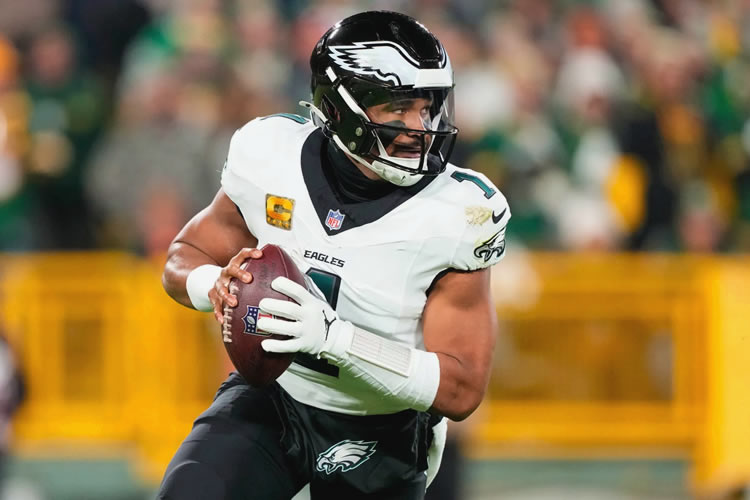
You can make a case for these three quarterbacks deserving to be in a tier above – especially if you look at more traditional statistics – but we’ve seen all of their offenses look borderline unfunctional for certain matchups or halves, where they didn’t seem capable of overcoming some things defenses threw at them schematically or when they found themselves in a lot of defined dropback situations. Having said that, each of them has established himself as the leader of those groups.
16. Jalen Hurts
I already know I’ll have the whole city of Philadelphia come after me for having their prince and Super Bowl MVP smack-dead in the middle of the pack. And statistically, the case for him ranking significantly higher is a pretty easy one to make, accounting for 22 total touchdowns compared to only one interception, while having the Eagles atop the NFC at 8-2. Thankfully, we have advanced metrics and, more importantly, our eyes, to contextualize his performance. Jalen ranks 14th in EPA per dropback (0.141) and 21st in success rate (46.4%) among those 31 qualified passers. He’s still generally a very accurate vertical passer outside the numbers, if he has one of those two star receivers isolated, and he’s delivered a QB-high 28 first downs as a rusher, even if about half of them come off the push. However, there are two ways he can just drive you crazy as you watch this offense. You can make some argument that his risk-averse style of play has its benefits for such an overpowering roster, but his unwillingness to test standard-sized windows in zone coverage, and because his eyes start out in the wrong place at times, he’s quick to drop them if he doesn’t like what he’s seeing or there’s any type of pressure. Only Chicago’s Caleb Williams has a higher time-to-throw this season (3.18 seconds), yet Hurts has taken ten additional sacks with better pass-protection. The bottom line is that this offense should never go entire halves without scoring any points or even completing a single pass with what may still be the premier combination of O-line and skill-position talent.
17. Trevor Lawrence
While I obviously won’t argue that Jacksonville has the same level of infrastructure around their quarterback, even if it may have been more promising coming into the season, Lawrence has had a similarly up-and-down season as Hurts, although the valleys have been more pronounced, with some catastrophic moments to his name. Only Tua Tagovailoa has been tagged with more turnover-worthy plays (17) in one additional game, yet he’s also only tied for 22nd in big-time throws (nine). Now, I will give him some grace here, as even the pieces we expected to be key figures, haven’t been there for him in one way or another. For as much higher as the floor has been for the run game – failing to hit at least 86 rushing yards just once – the guys on the receiving end of his passes haven’t come close to living up to expectations. A promising young tight-end in Brenton Strange has missed more than half the time, Travis Hunter’s debut campaign was cut short when he finally settled into the WR role, and Brian Thomas Jr. had a 15% drop rate, along with not even trying to secure targets in traffic, before being unavailable these last two weeks. Part of that, of course, have been some of the hospital balls Trevor has served up for his receivers to get punished for, and he’s currently 27th in EPA per dropback. Still, his rushing capability has been key in the red zone (five TDs), and he just put together his performance of the season against the Chargers this past Sunday, where he saw the field as well as he has all year.
18. Aaron Rodgers
You could make an argument that the definition of this next tier would fit pretty well for Rodgers, describing him as a “starter with defined limitations”, since we’re talking about a 41-year-old quarterback whose athleticism has largely vanished since tearing his Achilles in his Jets debut two years ago, and he wants to operate in a very narrow way. I thought placing him just above that made sense since the Steelers have a completely average offense despite an even more limited combination of pieces around the veteran QB. For the occasional big play running after the catch or coming down with one of the numerous contested targets thrown up to him in the red zone, D.K. Metcalf brings a rather limited skill-set, Pat Freiermuth is the only reliable target outside of that, along with the running backs catching a bunch of checkdowns – which Rodgers is happy to take routinely, to a fault – they’re a perfectly average rushing team and so is their O-line altogether apart from Zach Frazier at center, which you’ve seen them getting overwhelmed whenever they face a quality pass-rush. Regardless of the limitations that provides for the offensive construction, Aaron does choose this style of play to a large degree, as he’s number one among quarterbacks with 200+ dropbacks in the percentage of those lasting 2.5 seconds or less until the ball is released (54.4%), and he consequently is dead-last in average depth of target (6.4 yards). Nevertheless, there’s been the occasional reminder of the big-time arm we once used to gush about, and there’s benefit to keeping the ball out of harm’s way, when that defense has changed games in certain spots.
Starters with defined limitations:

This is the point where fans and analysts get frustrated with a lot of the signal-callers listed below. They may have their bright moments, but the pendulum can easily swing the opposite way, and they may hold back their respective offenses at times. For as varied as the team success may be, it’s more so the product of their environment altogether than what these guys are truly responsible for. To be fully clear – this doesn’t mean that their teams would do equally well if you swapped one of them out for someone else, but if you took a league-average offense, you’d probably find yourself in a similar place.
19. Bo Nix
We’ve reached a weird point with Bo. I had him in a tier with Jayden Daniels, significantly behind Caleb Williams and Drake Maye in that 2023 draft class, he was able to put together a strong rookie season after a shaky start, seemed to have regressed again early in his sophomore campaign, but has delivered late in games to help a very good Broncos team win nine of their first eleven games. And I understand #BroncosCountry wanting to hype up the leader of their team for taking down the two sides that met in Super Bowl 59, en route to a league-best 9-2 record, since he has delivered when needed most, with an equally top-ranked five game-winning drives. The counter I would provide to that is the fact that his inconsistency from down to down has largely put them in those positions, where they’ve needed points late. Only rookies Cam Ward and Dillon Gabriel currently have a lower dropback success rate among qualified QBs (42.2%). For the growth he showed throughout his debut campaign, the continued principle to follow has been that their pass game has been better the more they’ve taken post-snap decision-making off Bo’s plate mentally. While it’s not inherently a bad approach, it is telling that only Tua Tagovailoa has a higher percentage of his dropbacks involving some type of play-action or a screen pass (43.8%). While his sack avoidance has been key, Denver’s quarterback has enjoyed the highest pass-blocking efficiency in the league (90.0%), yet even if plenty of drops have contributed to their struggles, Bo has completed just 42.1% of his passes of 10+ yards, with ten touchdowns compared to eight interceptions. This defense being on a historic pace remains the true story.
20. Bryce Young
Young on the other hand hasn’t benefitted from a strong defense backing him up for the better of the season, yet when that side has delivered, so has he typically, and somehow the Panthers are now back above .500. The reason a lot of people are quicker to disregard him as a viable long-term NFL starter revolves around his stature, which has proven to cap his ceiling, but hasn’t kept him from being a productive pro since he was re-inserted into the lineup out of necessity for the latter half of 2024, after he was initially benched for Andy Dalton. I mean, for as little as I pay attention to raw yardage, this guy did just beat Carolina’s all-time single-game passing record (448 yards) in a comeback win over the Falcons, who had previously allowed an NFL-low 162.3 yards through the air on average. His arm talent may not allow him to truly threaten all areas of the field, but when he can operate in rhythm, his timing and touch can really shine. At the same time, while he can look “small” in collapsing pockets, he has shown that he’s willing to stand in and take a hit when necessary, and he does have the suddenness to escape and create out of structure, as he ranks tenth in pressure-to-sack conversion rate (15.0%) and 13th in passer rating on dropbacks of more than 2.5 seconds (88.2). Having a legit alpha target to beat one-on-one coverage in rookie Tetairoa McMillan will be pivotal in if this team can truly make a run at a playoff spot, as well as Bryce’s personal development, since the receiving of this receiving corp has really struggled to create separation and/or catch the ball.
21. Jacoby Brissett
As I tweeted out on Sunday – Brissett setting a new all-time record for completions in a game (47) in a 19-point loss is objectively hilarious. That’s not to make fun of a quarterback who I’ve had a lot of respect for throughout his career, whether he surprisingly had to jump in as the QB3 in his rookie season with the Patriots, how he continued to battle behind a bad Colts O-line that had just sent Andrew Luck into early retirement, or even helping the Browns be an above-average offense in his one season for Cleveland. Once again, he was asked to step in for Kyler Murray, dealing with a dubious foot injury, and the offense he’s quarterbacking has objectively been better with the backup running the show. Their success rate since week six onwards has increased from 39.9 to 45.4%, which would be tied 12th across the NFL for the full season. This is a big, sturdy pocket passer who will hang in the pocket to allow concepts to develop, and has the arm strength to fire into small windows, especially when offensive coordinator Drew Petzing has tapped into these big play-action calls. Obviously, he doesn’t offer the same level of “escapability” as Kyler does, but he understands how to feature their top pass-catchers. He’s hitting timing-based routes on the outside to Marvin Harrison Jr., Trey McBride is eating over the middle of the field, and when necessary, even Michael Wilson is catching 15 passes for 185 yards as the number one last week.
22. Joe Flacco
We’ve seen two different versions of Flacco this season – the one who ranked dead-last among quarterbacks with 100+ dropbacks through the first month with Cleveland in EPA per dropback (-0.291), and the one who ranks 12th since in that metric with Cincinnati (+0.173). That pretty clearly makes him highly reliant on his surroundings at this stage of his career. Unlike Aaron Rodgers, he never had any real athletic ability to speak of, and he just named Comeback Player of the Year two seasons ago, when he helped those Browns make the playoffs after getting off his couch. What he still does have is that big arm that made him a mid-first-round pick out of Delaware all the way back in 2008. The NFL has outpaced his prototype these days as the tall, statuesque passer, to where he’s been more of a bridge starter since his days in Baltimore. Yet, he’s sort of revived anemic offenses in two of the past three seasons. Some of the early excitement has now worn off, but he’s at least been able to pepper Ja’Marr Chase with targets and given Tee Higgins chances to make plays on the ball down the field. Joe was immediately thrown into the starting lineup once he got to Cincinnati. He’s thrown for a massive 290.6 yards per game and 12 touchdowns vs. only three interceptions across those five games, and the Bengals have averaged 32.8 points per game until getting held to 12 this past Sunday. They previously felt anemic with Jake Browning at the helm.
23. Tua Tagovailoa
Very similarly to the Bryce Young conversation, I’m sure there are plenty of people who have jumped between being ready to write off but then also buy back into this former Alabama quarterback, based on how his season has unfolded. Unlike what we’ve seen in Carolina, where just last year, Adam Thielen was the most reliable target in the pass game – and they were happy to trade him back to Minnesota for basically a day three pick swap – the Dolphins have done pretty much everything to make Tua look good. They brought in Mike McDaniel to specifically designed an offense suited to his strengths, and while they haven’t prioritized bolstering the offensive line necessarily, they’ve surrounded him with the fastest group of skill-position, to complement a style of play that would mitigate the impact of those guys up front. In terms of the raw and advanced numbers, that plan of attack has reached peaks none of these other guys directly ahead of Tua have ever sniffed, but it also creates a situation where the QB is highly reliant on his situation. That’s fine in a broad sense, as long as the play-caller is on the forefront of offensive innovation, but every year we see defenses eventually create blueprints that lead to massive drop-offs. Tua is masterful at making quick decisions, being accurate in the short to intermediate area, stopping his receivers in windows and allowing this catch-and-shoot style attack to run smoothly. When their NFL-high 46.2% rate of play-action and screens combined hits a wall, he simply lacks the physical profile or ability to play big in more defined dropback settings.
24. Geno Smith
I’ll pour one out for the Geno fanbase here, after two really fun years as the starter in Seattle, before I and many other made excuses for him being put in a situation that made it impossible for him succeed in last year, as he was being pressured at one of the highest rates behind a horrendous offensive line (37.4%), which led to a complete overhaul of the Seahawks offense, including them shipping the veteran QB to Las Vegas. Now, after I was pretty interested in what the Raiders might look like on that side of the ball, with hopefully continued growth by a young O-line and Chip Kelly coming back to the pros from Ohio State, in order to pull the strings. That whole experiment has been so much worse than even their biggest detractors could’ve probably ever imagined. Smith’s pressure rate (35.3%) isn’t significantly lower, among running backs with 100+ carries, no one has been hit at or behind the line of scrimmage at or behind the line of scrimmage than their supposed superstar sixth overall pick Ashton Jeanty (53.0%), the only established wide receiver on the roster at all in Jakobi Meyers wanted to get out from the very start, and while Brock Bowers has been spectacular in a couple of games, he’s barely been healthy or even available otherwise. With all that in mind, Geno being a big-game hunter, has further compounded their issues, as he’s been overaggressive in his decision-making to make up for how stagnant they’ve felt, and held onto the ball too often with the walls closing in around him.
Too young to judge:
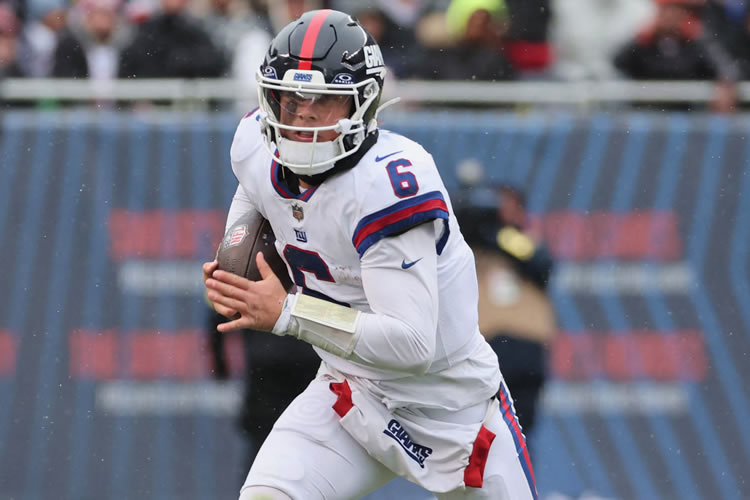
These next five guys are all either rookies or second-year player who barely saw the field in their debut seasons. I understand that the gap between the top and bottom name within the group is pretty wide as you look at their individual numbers, but I’m not willing to rush to judgement about any of them. We find very different offensive infrastructures around them, partially fired their respective play-callers and head coaches having been fired at different points, and it’s tough to truly evaluate where they stand with a look to the future, because we simply don’t have a big enough sample size to understand how they’ll adapt to NFL defenses and in which areas they may grow.
25. Jaxson Dart
Looking at the promise he’s shown and the statistical resume Dart has put together across seven career starts, this may not feel like a fair judgment, and you could easily move him up three spots. In terms of how I constructed these tiers, this made a lot more sense, saying that we have no clear picture of what this quarterback is. His two wins have come in surprise fashion against the Chargers and Eagles, who shot themselves in the foot multiple times, and they’ve lost three games by double-digits, yet at the same time, I don’t want to label him as someone “with limitations”, when we can’t really outline those right now. What we can pretty definitely say is that he was a significant upgrade over veteran Russell Wilson for this Giants offense, because he could bail them out for poor protection and has provided a floor as a rusher. Recently fired head coach Brian Daboll encouraging him to bang his head into tacklers with as many designed runs late in games that were out of reach, has led to him missing the last one-and-a-half games with a concussion, for as valuable as that component has been for the rookie. On the flipside – and we’ll see how much Mike Kafka alters their approach – so much of what Dart’s had success with is running RPOs, and either hitting the primary target or getting into creation mode. That has led to him finding someone having snuck behind the defense late in the clock for an explosive play, but also the third-highest pressure-to-sack conversion rate (23.6%) and according to PFF’s charting, there’s a wide gap between him and the rest of the league when it comes to the percentage of pressures with the QB having some responsibility (42.1%). Also, considering how much he thrived in Lane Kiffin’s system at Ole Miss, which relied on a very limited amount of pass concepts that were dressed up differently, you have to wonder how he’ll respond once NFL defenses hone in on those designs.
26. Michael Penix Jr.
This is the most frustrating name of the bunch, as we unfortunately won’t get any answers or even further points of information to base our opinions on, as Penix will reportedly require ACL surgery. Aside from once again questioning the approach the Falcons took with the construction of this quarterback room, that also includes Kirk Cousins with 100 million dollars guaranteed as part of his contract, and the long-term health of someone who’ll be 26 years old before having started what amounts to a full NFL regular season with his extensive medical record, the on-field results have been pretty shaky. For this season alone, he currently ranks exactly 18th among qualified passers in both EPA per dropback and success rate. When OC Zac Robinson provides defined reads for him and he can rip power throws in rhythm from the pocket, that bazooka attached to his left shoulder jumps off the tape. Yet, his brain can sort of short-circuit against fairly routine coverage rotations, he ends up spraying throws because he doesn’t have a second pitch off the fastball, and he’s never been much of a creative play-maker off script. Atlanta operating this heavily out of the pistol and not being able to truly marry the run with the play-action game has been disappointing, and construction-wise, I expected more than 9.8% of his pass attempts to go for 20+ yards. So until he comes back next season and shows he’s added more variety to his game, to fully take advantage of this talented skill-position group, this is where Penix belongs.
27. Cam Ward
It’s been a show of horrors for the number one overall pick from this past April. Based on all the numbers, you could easily argue for putting Ward at the bottom of the list. He’s thrown six touchdowns compared to 12 giveaways, he’s taken an NFL-high 41 sacks, he’s ahead of only Minnesota’s J.J. McCarthy in both passer rating and QBR, he’s second-to-last in success rate (40.5%) and dead-last in EPA per dropback (-0.180). Plus, the one win he’s led the Titans to against Arizona involved a pick he threw being directly fumbled back to the offense, along with an opposing player dropping what would’ve been the touchdown that put the nail in the coffin just before the goal-line. And yet, I would raise you that his supporting cast has been even worse. Only the Raiders have posted a lower EPA per rush (-0.185), Cam has been pressured at a top-ten rate of his dropbacks (37.6%), his head coach rightfully was the first one fired based on his complete mismanagement of game situations, and his only veteran receiver of any note in Calvin Ridley, hasn’t even played half of the offensive snaps, across which he dropped 15% of his catchable targets and failed to haul in contested opportunities. Ward absolutely can’t afford to drift as deep in the pocket as he presently does, and he’s been way too careless with ignoring ancillary zone defenders on attempts late in the down, but I viewed him as a potential franchise-altering signal-caller coming out of Miami, and he’s flashed tremendous arm talent and creation ability. I simply hope he doesn’t build up too much lasting scar tissue in this offense that we simply can’t fairly evaluate him in this season.
28. Tyler Shough
The smallest sample size of this group is the smallest for this second-round pick, who lost the battle for the starting job in New Orleans to Spencer Rattler, which the rookie has yet to prove to me that he’s actually better than. I understand the idea of needing to see what you have in a 26-year-old player you invested pretty significant draft capital into, and these two quarterbacks were actually the names I highlighted as “my guys” for their respective draft classes, but coming out of the bye at 2-8, I’m curious about what Shough would have to show this franchise to not be in the QB market next offseason. If we go back to the 200+ dropback parameter we’ve applied for this exercise, he would rank bottom-four in both success rate (41.5%) and EPA per dropback (-0.056). PFF has been a lot kinder to him based on their tracking, crediting him with four big-time throws compared to only one turnover-worthy play, as the other interception of his came on a throw right on the money, which was ripped out by Bucs safety Antoine Winfield Jr. The two things I felt very good about him with coming out of college – he has a live arm, which opens up the entire field, and when he takes off occasionally, he has impressive straight-line speed. He’s been money on these timing-based throws and making quick decisions on space-style concepts, along with hitting Chris Olave in stride on a couple of deep bombs. On the flipside, his mechanics can break down beyond the timing of the play, and due to his extensive injury history throughout a lengthy time in college, he’s become somewhat allergic to contact.
29. J.J. McCarthy
As you look through all these statistical measures I just mentioned with Cam Ward, if you expand the search just ever so slightly, since McCarthy sits at just 166 total dropbacks, he rivals for the worst spot for all of them. He’s at the bottom of the pile in passer rating, QBR, EPA per dropback (-0.243), completion percentage (52.9%), on-target rate of his throws (59.9%) and turnover-worthy play rate (6.1%). The discourse around him has become rather toxic, as it would be foolish to write off a player who was labelled a developmental prospect coming out of Michigan, who is won’t turn 23 years old until the conclusion of his de facto rookie season. Seeing him tap into a different version of himself late in games, especially his two matchups with the Bears, to battle back into matchups, is certainly encouraging, and he certainly has talents athletically and as a thrower that made him enticing. Yet, saying anything other than J.J. having been one of the worst quarterbacks in the league on a down-to-down basis is blind fandom. His feet can be all over the place, leading to bad sprays, he has yet to develop more clubs in his bag to access the appropriate throws, and too often he simply puts the ball in harm’s way. I don’t want go back and look at the decisions this franchise made with 20-20 vision at this point, but rather see what this developmental curve looks like, but unless we see drastic improvement, this bet Minnesota made at quarterback, with the offensive infrastructure they’ve built up, and competing for the NFC’s top seed in the regular season finale last year, isn’t going to pay off.
Placeholders:

We’ve reached the bottom of the pile. None of these three names has any real future with their current franchises, as they either are reserved to a backup role, their own team owners have openly criticized them, or they’re being tested to see if they should even be fixtures on the roster in a backup capacity, once they work on a different plan this upcoming offseason. The latter two have yet to show that they can orchestrate even functional NFL offenses altogether.
30. Marcus Mariota
Should I feel bad about putting Mariota all the way down here? Over the past two seasons, he’s basically tied with Washington’s starter and reigning Offensive Rookie of the Year Jayden Daniels in EPA per play (0.174). So, putting him below some of these youngsters who haven’t even proven they can survive at the NFL level may feel far-fetched. What I would say is that he’s the definition of “placeholder”, once again being called upon to fill in for Daniels now, and I don’t see any team ever going into a season with him as the designated starter anymore, largely based on him basically quitting on the Falcons in the latter portions of the 2023 season. As for what he’s done as the Commanders backup, I do think this context needed for his success this year in particular – we need to give OC Kliff Kingsbury a lot of credit for the easy opportunities he’s provided in their RPO and screen game, off their up-tempo approach, and he did benefit from facing the Raiders and Dolphins in two of his five starts, along with putting up garbage-time numbers in a non-competitive matchup with the Lions. Only Seattle’s Sam Darnold has actually received a higher big-time throw percentage from PFF (7.2%), but he has also turned the ball over seven times. He didn’t have a bad game in Madrid this past Sunday, but then on the very first snap of overtime, he reminded us what he’s “capable of”, with these catastrophic plays that almost leave you speechless.
31. Justin Fields
Back in August, the two quarterbacks I highlighted as targets in your fantasy football drafts were Drake Maye and Fields – who almost find themselves at the exact opposite ends of the spectrum as my number two and second-to-last ranked names. At the time, my argument for the latter was that you need to differentiate between how he’s performing at the position and how he can produce points in a “non-real” sense. For as promising as Fields’ start with the Jets has been, he has regressed again individually, and the Jets offense basically has started to look like Navy. It’s not all the quarterback’s fault, as they don’t have anyone they can rely upon in the receiving game as long as Garrett Wilson is sidelined, and their offensive line is significantly better at run- than pass-blocking, but of course, also the warts of the guy under center. The fact that New York lacks a second player who can create separation with any type of consistency, in combination with a quarterback who has never developed the anticipation required to succeed at the highest level, and the pass-rush being able to get home by that time, makes it almost impossible to move the ball through the air. Fields has been pressured on an NFL-high 43.0% of his dropbacks, but he’s also tied for the third-longest time to throw (3.09 seconds), and he’s much more of a scrambler than a creator. His speed, including on designed carries, currently is the biggest asset for this unit that largely feels broken.
32. Dillon Gabriel
Although we just got the announcement of Shedeur Sanders taking over the starting quarterback job Cleveland based on Gabriel being in concussion protocol, and they may choose to see what they’ve got in him, it doesn’t feel right to judge the former on one half he’s played out of necessity, without taking any first-team reps in practice – for as much as that was overblown to excuse a horrendous debut. That doesn’t change the fact that Gabriel hasn’t looked at all like a legit NFL player even – I didn’t specify for starter. I don’t want to be mean to the guy, but after seeing him getting nominated for Rookie of the Week following his performance in a loss to the Jets, I feel like it’s my duty to say that he’s been so much worse than the box score would indicate, as you see seven touchdowns compared to only two interceptions. The amount of throws that aren’t even close to being catchable, how small he feels inside the pocket, and the innate instinct to dump the ball of short as we get deeper into the play-clock make him hard to watch. Even when kept clean, he’s posted an astoundingly bad one-to-seven ratio of big-time throws vs. turnover-worthy plays, his longest completed pass in terms of air yardage was just 22 yards, and his average depth of target on passes of more than 2.5 seconds is nearly a full yard lower than anyone else in the league. The number that is most representative however – the only quarterback with 200+ dropbacks who has posted a lower success rate over the last two years is his teammate, who has missed the entire season with a double-torn Achilles, in Deshaun Watson.
 Halil's Real Footballtalk