
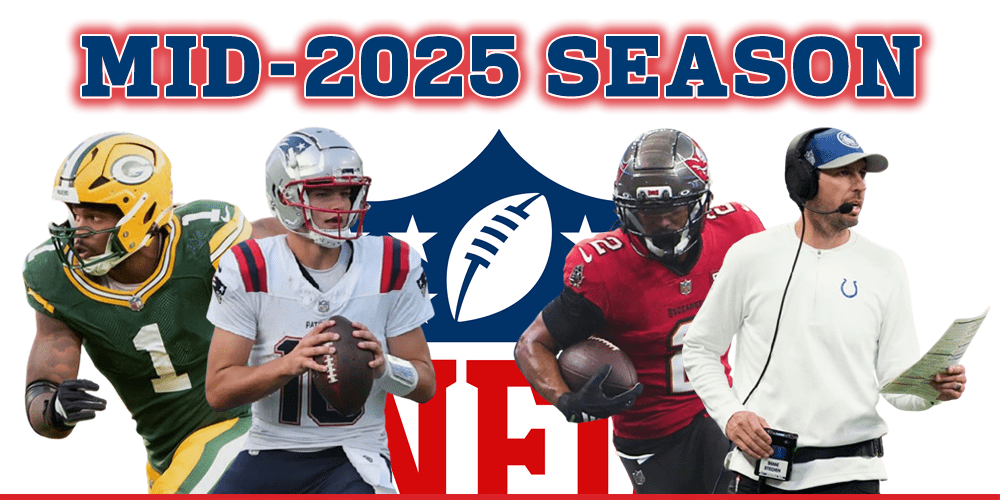
With the NFL having adopted an 18-week format, this marks the exact midpoint of this season, and it’s time to hand out awards. I will go through each of them, presenting my top three candidates, before I finish up with my All-Pro teams.
Compared to my full-season predictions back in late August, there are no projections to these nominations, but rather just how I would vote for each award if the season ended today. So you will see some players show up, who won’t actually win any of these awards or be named All-Pro most likely because they’re currently injured and will miss the rest of the year in some cases.
Let’s get into them:

MVP:
1. Drake Maye
2. Matthew Stafford
3. Josh Allen
This is one of the closer MVP races at the midpoint of a season that I can remember, at least in terms of the number of candidates as part of the discussion. The reason I gave Maye the nod here in his breakout sophomore year is how much of the responsibility he’s bearing for the Patriots’ 7-2 start. Something I brought up in an article on the most important statistics following week six was the discrepancy between New England being dead-last in rush EPA on first and second down combined, compared to their quarterback leading the way in that metric on third- and fourth-down dropbacks. They now rank just ahead at 31st as an early-down rushing team and Drake is still first among QBs with 100+ such late-down dropbacks. He’s done this with Kayshon Boutte catching a team-high five of 19 total touchdowns accounted for (compared to four interceptions), and the Pats have also been more of a middle-of-the-road defense by most numbers. While he could still improve on not allowing pressures to convert into sacks, only Justin Herbert and Cam Ward have been pressured more often (124 times), and a lot of those sacks come on third downs, when drives would end anyway otherwise. Maye can hit his back-foot and rip throws into tight windows, but his pocket navigation and the way he creates space for himself to release the ball cleanly really stand out. Nobody has been more accurate throwing the deep ball (20 of 28), and only Patrick Mahomes has gained more yards on scrambles (269).
Stafford is a close second in this discussion, largely based on the fact that his supporting cast and play-calling advantages provided by Sean McVay are more meaningful. Nonetheless, his raw stats are even better, leading the league in passing yards per game (268.4) and total touchdowns through the air (21), compared to only two picks. If you give him any type of zone coverage and he has enough protection, he will pick opponents apart by finding soft spots, manipulating defenders with his eyes – at times no-looking throws – and having all the clubs in his bag to deliver the ball on the money. And now, with Davante Adams added to the lineup, trying to man up against those receivers will also be taken advantage of, connecting with him on a few back-shoulder fades and killing DBs in the red zone. And L.A. could easily be undefeated at this point, or at the very least, you can’t blame their two losses on the quarterback. In Philadelphia, the offense had set up a potential game-winning field goal that was blocked, and then against the 49ers in that week five Thursday Night game, they had a run stuffed on fourth-and-short in overtime. To my initial point however, while the Rams aren’t particularly explosive on the ground, they do lead the league with a 48% rushing success rate. And by all meaningful metrics, they’re fielding a top-five defense up to this point.
Finally, I will put the actual MVP favorite at number three personally, although this speaks more to the quality of the two names above him. Allen has led the Bills to a 6-2 record with marquee wins over the Ravens in the opening Sunday Night game and against the Chiefs this past week, when he set the team’s franchise record for completing percentage (88.5%) along with setting a new high mark for any quarterback in NFL history, scoring his 78th total rushing TD. The first of those numbers speaks to how much more efficient a style he has chosen to adapt, where he’s actually tied for 17th in what PFF labels “big-time throws” (10), but he’s also tied for the lowest turnover-worthy play rate in the league (1.0%). Now, the two reasons I wouldn’t hand Allen his second straight MVP trophy if the season ended today – firstly, he’s on pace for the highest pressure-to-sack conversion rate of his career (19.3%), despite largely being provided very good protection. And secondly, the team isn’t asking him to wear the superhero cape nearly as much as previously. Although there’s quite a significant gap to the Colts, Buffalo ranks in EPA per rush, and if you take out that wild week one comeback, he’s only been asked to drop back just under 31 times per game, as James Cook leads the league with 108.4 rushing yards per contest. Plus, Drake Maye did outperform and beat him head-to-head at home.
Honorable mentions: Justin Herbert, Patrick Mahomes & Sam Darnold

(Non-QB) Offensive Player of the Year:
1. Jonathan Taylor
2. Jaxon Smith-Njigba
3. Christian McCaffrey
While I wouldn’t say there’s the same volume of candidates for OPOY, there are some pretty strong candidates in the top three as well. The gap number one previously had to the rest of the field did shrink a little bit on Sunday, when Taylor was held to easily a season-low 57 scrimmage yards. He had previously led the league with just over 150 per game and still has reached the end zone four times more than any other skill-position player in the league (14). Pittsburgh crowding the line of scrimmage with bodies and putting the Colts in negative gamescript throughout the afternoon did illustrate how you can somewhat mitigate the impact of a running back compared to a wide receiver, who can still be productive despite coverage being tilted his direction or being bracketed. Having said that, JT has been the driving force for an Indy offense that is still laps the field as the only one to score on better than half of their drives (57.6%). His ability to pace his runs to maximize the impact of combination blocks and his ability to hit jump-cuts in order to find alternative routes or make a linebacker be wrong as he leverages blocks, is excellent. Plus, then not only does he have the burst and contact balance to slide off wraps, but he actually has the long speed to routinely finish explosive runs in the paint. He’s also on pace for his productive year as a receiver (24.2 yards per game). The one thing I will say here – despite of how often they’ve played with the lead and been able to ride Taylor, he has only faced 8+ defenders in the box on 21.7% of his carries (24th among 42 RBs with 50+ carries).
Obviously, a wide receiver will always be more productive on his touches, but for Smith-Njigba to average 16.3 yards per catch despite being targeted 79 times (and catching 58 of these) is pretty wild. He has 117 more receiving yards than number two (Ja’Marr Chase) despite having played a game less. When someone says “the whole passing game is centered around X player”, I typically roll my eyes, because that’s simply not how offenses are structured, rather than making the quarterback work through progressions, but with JSN, I think you can actually label it that way. If you think of the four wide receiver spots you may have in three-by-one sets, he has been productive from each of those alignments. He can line up in the slot, adjust his stem and pace his routes or settle down against zone coverage, but where he’s taken massive strides is his ability to go out wide and win in isolated situations. The release game he’s developed, the foot- and head-fakes to create softer edges in one-on-one coverage for himself, are truly immaculate. Plus, then he can tilt or lean a certain way before getting to the top of his route and create significant separation out of his breaks. Smith-Njigba has always been masterful at tracking the ball over his head on challenging angles, as well as the art of winning with late hands. That’s what’s helped him turn into an elite deep threat, hauling in 11 of 15 targets of 20+ yard air yards, and he’s logged two extra 40+ receptions than anyone else (five). Overall, he has posted 4.41 yards per route run – that would be more than half a yard better than the highest mark posted by a player with 20+ targets since PFF started tracking this 20(!) years ago.
For as tremendously productive as Jonathan Taylor has been on the ground, McCaffrey has actually recorded just 100 additional yards from scrimmage on 45(!) extra touches. Now, his efficiency as a runner has been vastly lower, averaging just 3.5 yards per carry on the year (compared to 5.7 for Taylor). However, it’s been much tougher sledding for the Niners superstar. He’s only averaged 1.15 before contact every time the ball has been handed off to him, and 67.4% of his production on the ground has come *after* he’s been touched first, which of course is even more impactful considering he on average, has more than half a yard extra to build up momentum compared to his counterpart. Even more staggering – and why he absolutely should be considered as part of this big three – CMac has basically been the Niners’ top receiving option over the course of a season that has been marked by injuries to that group, bringing in names that weren’t even on the practice squad by week one out of necessity. Watching him run as hard as he did after dealing with yet another injury that marred his 2024 campaign is inspiring, but seeing Kyle Shanahan move him around the formation constantly and truly asking him to run routes like a wide receiver to win one-on-one against defensive backs on key third downs, is what separates him from anyone else at the position. McCaffrey is tied for fifth in first downs picked up on the ground, but also tenth through the air.
Honorable mentions: Puka Nacua & Bijan Robinson
Defensive Player of the Year:
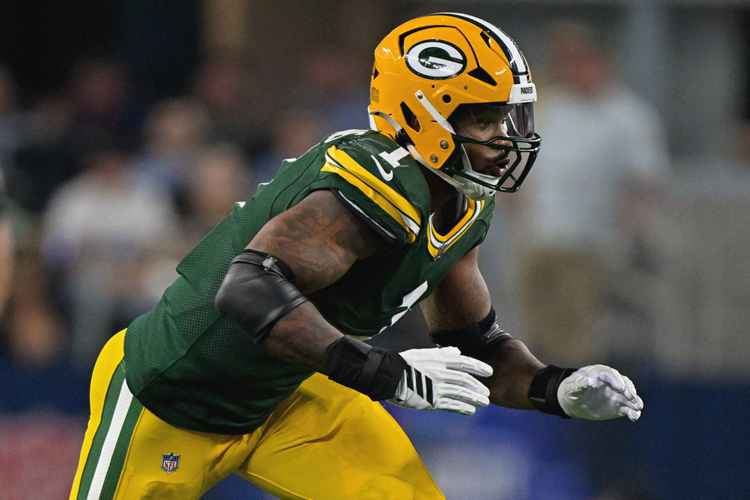
1. Micah Parsons
2. Myles Garrett
3. Aidan Hutchinson
There are certainly some other names that deserve to be mentioned, but I would say there’s a pretty clear trio on the opposite side of the ball currently. I gave the nod to Micah Parsons here, because not only does he edge out number two in QB pressures per game (43 in eight contests), but his impact has directly manifested in more overall team success. When you compare him to what he was as a pass-rusher during his rookie season, continuing his move back from a part-time off-ball role, he used to rely so heavily on just his speed to win the corner. His repertoire of moves and ways he can win is so much more varied now. When he gets off the ball with good timing, he can still just circle around tackles, but he has more hand-combats and is more precise with those in order to stay on track, he’s become so much better at converting speed-to-power when he gets opponents to sell out for the outside rush, but then he can also go the opposite way, attacking their chest before working around them as they lean into contact. PFF released an article last week, where other than a hybrid D-lineman for the Packers, no player labelled as an “EDGE” had been double-teamed at a higher rate (59.9%), and he’s even triple(!)-teamed on 11.2% of pass-rush snaps, where some teams have basically done everything possible to not let him ruin games late, after he terrorized their quarterback – see his three-sack performance at Arizona. So his presence makes everyone else’s job easier, creating one-on-ones for them, including being asked to spike into blockers and create chaos as a mugged-up interior rusher.
Now, if I were looking for more of a traditional defensive end for even fronts, Myles Garrett continues to be the prototype, after setting a new record for most sacks by any player before turning 30 years old (108.5), which was one of his five on the day against the Patriots – and yet, the Browns lost by three scores. So that’s where he and Micah differ, as his incredible efforts haven’t led to many wins. Still, I don’t want to punish Myles for the lackluster performance of his team overall, and especially their quarterback situation holding back a defense that has shown what they’re capable of in spots. Even with the lack of support from the other side of the ball, Cleveland ranks fifth in EPA per play and third in success rate (40.6%). Garrett has been the most pivotal figure in their success, leading the NFL in tackles for loss (15) and being just one off the top mark in sacks (ten), while having played one fewer game than Brian Burns as the lone name ahead of him. That’s despite barely ranking behind Parsons in double-team rate (59.3%) and also being chipped at the second-highest percentage league-wide (25.8%). And what differentiates him from a lot of these more speed-based edge rushers who base their approach off that ability to win the outside shoulder, is that Myles can actually use the fact he’s getting bumped inside to his advantage, as he simply dips under tackles and takes a more direct approach to the quarterback. His flexibility at that size, also enables him to make some crazy plays in the run game, of eluding blocks altogether, along with having the length and strength to stack-and-shed.
Finally, I do have to give Aidan Hutchinson his flowers, since statistically, he has the strongest case of anybody for this award. Despite having already had his bye week, he has eight more QB pressures than any other defender in the league (55) and he’s also tied for first with four forced fumbles, all while being the only name to get chipped at a higher rate than Garrett (27.6%), even if there’s a drop compared to how often he’s getting truly doubled. He’s not as strong as the two guys I have ahead of him, but Hutch is excellent at using the rip move to stay on the arc, he’s definitely improved at angling his rush through the chest of tackles getting too tall in their pass sets, and he packs a wicked spin move to keep those opponents off balance. This is done in service of a defense that quietly ranks behind only the Seahawks and Texans in schedule-adjusted DVOA. I do have to point out that he’s had the most opportunities to rush (302), and I would argue he’s the least impactful run defender among this trio – he’s only logged 12 total defensive stops (which constitutes a tackle resulting in a positive outcome for his unit based on down and distance) and he’s missed a massive 37.5% of his attempted tackles. Neither Micah nor Myles has failed to finish one yet.
Honorable mentions: Nik Bonitto, Will Anderson Jr. & Devin Lloyd
Offensive Rookie of the Year:

1. Emeka Egbuka
2. Tyler Warren
3. Quinshon Judkins
There have been plenty of fun offensive skill-position players coming out of this rookie class, while the few quarterbacks that have seen extended action have largely disappointed (outside of Jaxson Dart). However, I’d say that none of those have quite made the transition to the pros look as easy as Egbuka has. This guy immediately stepped onto an NFL field and has been a three-level threat for one of the most explosive aerial attacks in the league. The former Buckeye ranks 12th in receiving yards (562) despite only playing in 6.5 games so far and recently battling through a banged-up hamstring. He’s not been a big-time contested-catch or yards-after-catch weapon, but the savvy he’s shown at this stage of his career already, and how much more effective he’s been down the field than many people anticipated, who wanted to label him as a primary slot receiver, has been highly impressive. Among players with 50+ targets on the season, only the Bears’ Rome Odunze has had a higher average depth of target than Egbuka (13.9), yet Baker Mayfield has registered a passer rating of 114.2 when going his way, and it actually goes up on passes of 20+ air yards (138.2). While he’s shown a capacity to move the chains settling down against zone coverage from the slot, the Bucs’ rookie sensation has excelled at throwing false indicators at defensive backs in his route, nodding one way before breaking away from them, and he’s been masterful at attacking their blind spots in order to create openings for the ball.
Now, for as impressive as Egbuka has been, there’s typically a more extensive transition period at the tight-end spot, yet Warren has arguably been a top-three player at the position through the first half of 2025. While he’s had an extra game to boost his numbers, he’s only 44 yards behind his top competition for the award (518 yards), with the Panthers’ Tetairoa McMillan sandwiched between the two, and he’s caught the most passes of the bunch (42 of 55 targets). His usage has been very different, however. While those two wide receivers I just mentioned have done lot of damage as route-runners who can get open down the field, Warren has continued his dominance *after* the catch, which made him so fun to watch at Penn State last year already. Shane Steichen has found a bunch of ways to put the ball in the hands of his rookie in space, whether he’s sliced across the formation into the flats off play-action or they’ve hit him underneath on delayed releases after helping with chips, and he’s been a load to bring down for defenses once he’s built up a head of steam. Tucker Kraft of the Packers – who unfortunately just suffered a season-ending torn ACL – is the only TE with 15+ targets who has posted a higher YAC/reception mark (7.5). The one blemish on his resume have been his five drops, but even though he’s only been used in-line on 41.4% of his snaps, for a player that needed to refine his skills in that area, posting a PFF run-blocking grade of 64.5 so far is pretty solid.
Picking a third name here was tough, since McMillan I already brought up as being highly productive, Grey Zabel headlines a deep group of excellent rookie linemen, Ashton Jeanty in Las Vegas has been very effective individually if you divorce from the poor blocking he’s worked with, and Cam Skattebo deserve a mention before moving to the background, for the attitude he gave the Giants with his hard-nosed running style before suffering that gruesome dislocated ankle. I ended up going with a different running back, who most likely has no shot of actually winning the award, based on the murky legal situation that delayed the start to his pro career, but has been the lone bright spot on the Browns since joining the squad. Judkins ranks just outside the top ten in rushing yards per game (69.4), and he’s reached the end zone five times despite being taken out of a couple of contests based on his team quickly falling behind. He’s done an excellent job of bleeding out gap concepts involving pullers and blowing through angles tackles, yet then presses the front-side in order to set up cutbacks against undisciplined defenses, while being a mature decision-maker who embraces contact around the line of scrimmage. Among 23 running backs with 100+ carries up to this point, here are the only four names the rookie ranks behind in average yards after contact (3.69) – Jonathan Taylor, Javonte Williams, Bijan Robinson and Rico Dowdle. He’s not going to make a lot of people miss, but his violent rushing style has a cumulative effect on the defense, he has enough long speed to go the distance if they mess up an assignment, and maybe most importantly, he has yet to put the ball on the ground.
Honorable mentions: Tetairoa McMillan, Grey Zabel, Ashton Jeanty & Cam Skattebo
Defensive Rookie of the Year:
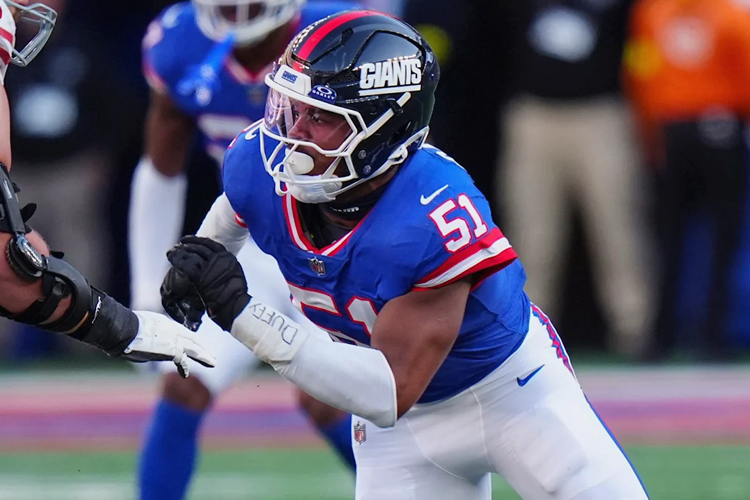
1. Abdul Carter
2. Carson Schwesinger
3. Jihaad Campbell
Considering there was only one other pure defensive player drafted inside the top ten this past April (Mason Graham; not counting Travis Hunter), and even most names beyond that point were more so considered developmental prospects, including several defensive tackles, the fact that Carter was an overwhelming favorite for DROY wasn’t surprising – and he’s held pretty steady. Although joining the Giants wasn’t expected to set him up with a bunch of opportunities to rush the passer while playing with the lead, I did have high expectations for their defense and the front in particular, now with four names drafted in the top half of first rounds. As part of a deep rotation, the rookie has “only” played 70% of defensive snaps leading up to this point, but they’ve smartly kept him fresh from primary passing situations. That’s how he tops the class with 266 pass-rush snaps (and only two other rookies have gone over 200), but even though he only sits at half a sack, he has logged ten more total pressures than any of his competitors (32). Looking at true pass sets (eliminated screens and play-action), he’s been the most effective rookie rusher, posting an 18.6% win rate. While he hasn’t graded out particularly well in run defense, I expect Carter to continue to improve in that regard, after transitioning to a full-time on-ball role just last year, and although they’ve tapped into that avenue (73 snaps off the ball), I believe DC Shane Bowen will only continue to deploy the third overall pick more frequently as a spinner over the center and stand-up rusher from various alignments.
Schwesinger dropped several spots in terms of betting odds for this award last week, based on suffering a high-ankle sprain that could cost him extensive time, but that doesn’t mean he doesn’t deserve to rank this highly when we actually evaluate what he’s done up to this point. Since I already brought up his name, D-tackle Mason Graham, who Cleveland selected fifth overall, as part of the trade-back with the Jaguars, has lived up to his draft status with some bright flashes, but the guy they targeted at the top of round two has been an impact starter from the very start. Schwesinger has logged at least 84.5% of defensive snaps in all eight games and leads the team with 64 combined tackles. His range on the second level to shut down perimeter runs, his short-area burst to shoot gaps and the suddenness to elude climbing linemen have allowed the Browns to hold opponents to the lowest rushing success rate league-wide (32.1%). The former UCLA walk-on leads all rookies with 22 defensive stops, and he’s posted a solid 9.4% missed-tackle rate. He has blown up multiple screens, his ability to mirror backs and tight-ends in Cleveland’s defense being heavily structured around single-high safety looks, has been a definitive plus, and he got his first interception off my MVP front-runner Drake Maye, who thought he could fit the ball past him playing underneath.
This is more so a 2A and 2B situation with this duo of linebackers right behind Abdul Carter, as you can make a solid argument that Jihaad Campbell has been the better all-around player through the first half of their rookie campaigns. He has ten fewer defensive stops than Schwesinger (12), but he’s had no issues working off blocks, he’s only missed two of 46 attempted tackles, he’s logged nine QB pressures on just 44 pass-rush snaps, and although he was “credited” with a 72-yard touchdown by Bucky Irving, where he was technically matched up with the running back in the flats, but he took off up the sideline late in the down, he’s been a steady presence in coverage, allowing just 5.2 yards on his other targets. His ability to run the pole in Tampa-2 in particular has been marvelous to watch, where even when having to carry wide receivers up the seams, he has been able to hang stride-for-stride with them – an area where his length only further accentuates that. Campbell has also logged triple-digit snaps on the edge, where he and Zack Baun have been interchangeable with their responsibilities of dropping down to the line late in order to change up the front structure, and then dropping off regularly. Pro Football Focus has credited him with the highest overall grade of any rookie defender with 100+ snaps (83.1). The Eagles D has simply been more of an average compared to how Schwesinger has helped elevate the Browns.
Honorable mentions: Jacob Parrish, Nick Emmanwori & Andrew Mukuba
Protector of the Year:
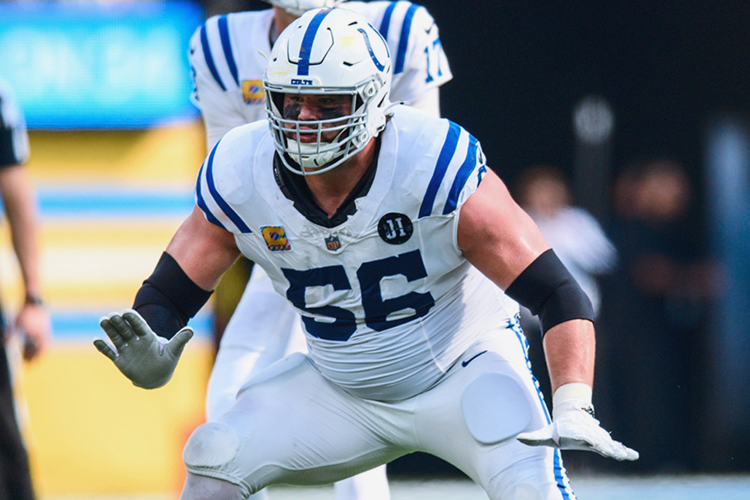
1. Quenton Nelson
2. Penei Sewell
3. Creed Humphrey
With offensive linemen, it’s tough to fully put into words what makes them standout players, where it doesn’t sound like a general scouting report – which I’ve written up coming out of college for all three of these names, and have discussed at different points how they’ve developed at the pro level, by highlighting them as part of film breakdowns. “Unfortunately”, there’s not a whole lot to say about any of them, since they basically all looked like some of the top performers at the three different spots along the front. I already mentioned Quenton Nelson having been a weapon as a puller for Indy’s diverse run game, both creating lines inside on kickouts or killing smaller defenders out on the corner. Penei Sewell has yet to allow a sack and just one hit on his quarterback, while being a bully at the point of attack in the run game. And Creed Humphrey has been the most efficient pass-protector in the entire league among starters, with just three total pressures on nearly 400 such snaps. After putting down these three names, I went over to PFF’s database and wasn’t surprised at all to find that these literally are the three top-ranked linemen in the sport, with any meaningful playing time – and each of them has only been penalized once.
Comeback Player of the Year:

1. Christian McCaffrey
2. Aidan Hutchinson
3. Dak Prescott
I’ll continue to pay very little attention to this award until they truly clarify its guidelines AND the voters adhere to them. You can read up on McCaffrey and Hutchinson as my number three choices for Offensive and Defensive Player of the Year respectively. Dak, meanwhile, has been one of the premier old-school pocket passers in the league again this season, showcasing a great combination of exhausting progressions with advanced pace and being willing to test tight windows in the coverage, helping the Cowboys score nearly 30 points per game, which their defense not being able to create stops has unfortunately mitigated.
Coach of the Year:

1. Shane Steichen
2. Kyle Shanahan
3. Mike Vrabel
In terms of looking at the betting favorites and to some degree how this award is being voted for, I have long been frustrated by the fact that this is such a narrative-driven topic, which favor coaches of bad teams who can take turn things around quickly and take advantage of a weak schedule for their new team, rather than crediting the “best coaches” overall. Steichen actually sits somewhere in the middle between these two sides, as the Colts were 8-9 last season and expectations were fairly low, especially after naming Giants outcast Daniel Jones the starting quarterback. Yet, that has proven to be one of the most impactful decisions across the NFL, as it has helped them to get off to a 7-2 start, and if the season ended today, the AFC playoffs would run through Indianapolis. They lead the league with 32.2 points per game and are still easily number one when it comes to scoring percentage of drives (57.6%) – no other team is above 50%. Steichen is directly responsible for their unprecedented success, as the one calling plays and creating advantageous looks on a weekly basis, with a varied run game that weaponizes the mobility of their interior O-line, and routinely produces receivers running into open space, while slotting all of them beautifully into their appropriate role. Until they mind-bogglingly turned the ball over six(!) times at Pittsburgh this past Sunday, and their quarterback looked more like the frantic version of what he used to be in New York, they only had four total giveaways. Indy has been a juggernaut, beating down most of their opportunities, with an NFL-best +12.1 point differential on average, in part because he’s given veteran DC Lou Anarumo a lot of freedom, in comparison to their previously antiquated defensive principles.
Shahan at number two much more so fits the category of coaches consistently helping their team stay highly competitive, and in this case, doing so despite a myriad of injuries. Let’s just run through those real quick – Brandon Aiyuk has yet to become available, George Kittle had a stint on injured reserve, Brock Purdy has played in just two games, Nick Bosa had one extra week, Fred Warner was lost to IR in mid-October, and now first-round pick Mykel Williams just tore his ACL. So basically, other than Christian McCaffrey going down again, they will have missed all of their most pivotal figures for extended stretches. And yet, here they sit firmly in the playoff picture at 6-3, with marquee wins. They won at Seattle in the season opener, they beat the Rams in L.A. on a short week as 8.5-point underdogs due to how incredibly banged up they were, and they flipped the script on the Falcons on Sunday Night a couple of weeks ago, when they won by ten after Atlanta had just looked dominant in beating the Bills by the same margin previously. For as much as we should applaud Mac Jones for how excellent he’s been since stepping in under center, there’s a reason he signed this offseason for 4.2 million dollars annually this and next year, and now people are questioning if San Francisco made a mistake handing Brock Purdy a substantial contract. Even with questions around this O-line and not being able to create push in the ground for large stretches, Kyle has done a great job of creating favorable angles with late motion to find more success on the ground recently, he’s constructed a more effective true dropback offense, regularly from under center, either providing positive leverage against man or challenging shallow zone defenders with their spacing. They rank sixth in total success rate as a unit (48.2%).
Finally, Vrabel certainly came in more in the mold of a coach of an overachieving team, as he took over the franchise he used to be a key player for, and they’re one more win away from already doubling last year’s tally, currently sitting at 7-2, tied with those Colts for the league’s top record. Now, the two reasons he’s “only” third in this ranking for me are that the Patriots have definitely benefitted from a soft schedule through the first half of their schedule, with their opponents combining for a 27-and-49 record, and a lot of their success has been driven by my pick for MVP in Drake Maye. He also doesn’t bear the play-calling responsibility either of the two offensive-oriented coaches ahead of him do. With that being said, Vrabel does deserve plenty of praise for the way he’s steered the ship. New England has fielded a top-seven scoring offense (26.3 PPG) and defense (18.8 PPG), and while they did take care of business against bottom feeders Tennessee and Cleveland, never leaving doubt once we got to halftime in those contests, they’ve found ways to win some tight affairs, including on the road, where they’ve managed games well. Losing to the Raiders at home back in week one seems like a blimp on the radar at this point, and the only other loss they’ve suffered came when they turned the ball over five times against the Steelers. That’s the one thing you can maybe blame on the head coach, relying on their veteran running backs despite their fumbling issues. Otherwise, it’s been a very clean operation, and you can feel the relationships Vrabel has built up with players throughout their roster, which lacks a whole lot of top-end talent.
Honorable mentions: Sean McVay & Mike Macdonald
Assistant Coach of the Year:

1. Klint Kubiak
2. Chris Shula
3. Tony Sparano Jr.
I didn’t specifically outline “assistant” coach of the year in my full-season predictions, because the vast number of total candidates, since this isn’t reserved for coordinators, makes it tough to single out certain names in a projection sense, but I do want to give some guys credit here for their contributions so far. First up is the man orchestrating the most explosive passing attack in the league and also maybe the most surprising side of the ball based on pre-season expectations. I’ll be first to admit that I was questioning the construction of Seattle’s offense and the decision to move on from Geno Smith in particular, in favor of Sam Darnold – although I did state that Minnesota should’ve brought back the latter, even after two bad showings to end the year. Generally, I do like how Klint Kubiak wants to run his group, but while I thought they’d rely heavily on outside zone and condensing formations, without any truly established perimeter receiving options, they’ve been more varied than I would’ve anticipated. Now, they do run the ball at the second-highest rate league-wide (50.33%), in large part because they’ve been playing with the lead for the majority of the time, and they call quite a few two- or three-man concepts off heavy play-action. However, they are so much more vertically oriented through the air, allowing Darnold to show off his arm talent with aggressive throws, Jaxon Smith-Njigba has been a revelation with the growth he’s shown as a receiver they can build the pass game around thanks to his alignment versatility, and while they’ve been in plenty of multi-tight-end sets, the threat of those big bodies has more so served their ability to catch opposing defense in base looks. Seattle leads the league with 40 plays of 20+ yards and they rank fourth in offensive DVOA.
My name on the defensive side of the ball is one I haven’t really brought up at any point this season in longer-winded discussions – Chris Shula. Don’t look now, but along Matthew Stafford being a strong runner-up for the MVP trophy for me, this Rams D ranks number one in the NFL when it comes to EPA per play, second in actual points per game (15.9 PPG), and they’re third when taking schedule into account as part of the DVOA metric. Personally, I had some high hopes for this group, because I thought the line had a chance to be dominant, and I liked some of the ways their coordinator could mask limitations the back seven had personnel-wise. The first of those pieces has certainly materialized, as Jared Verse, Kobe Turner, Byron Young and Braden Fiske have all recorded at least 20 QB pressures, and they’re tied for the third-most sacks in the league. What even I couldn’t have anticipated is some of the names behind that not only being serviceable, but actually standing out. Their linebackers have routinely been in the right positions, with Nate Landman having a couple of key punch-outs already, Kam Curl and Quentin Lake both had cases for my All-Pro teams, as a reflection of their team’s excellent gameplanning and route anticipation, and while he certainly hasn’t been a plus player, even former first-round bust Emmanuel Forbes has at least not killed them for being pushed into a starting role in five of eight games. And a big reason opposing quarterbacks haven’t found easy answers against them is their deep rolodex of coverages, ranking between seventh in and 23rd in cover-zero, -one, -two, -three, -four, -six and two-man.
The one non-coordinator I chose to highlight here is the coach of the best offensive line and arguably unit entirely in Sparano. I already named Steichen Steichen as my midseason pick for Coach of the Year, but the most important piece of their offensive success has been the combination of those five guys up front. Before we get to how good that group has been up to this point, we have to go back to its construction back in the offseason. Minnesota signed two of its starters on the interior from last year for a combined 26.5 million dollars of average annual value. Then-rookie center Tanor Bortolini had some bright moments in his pro debut, and I outlined him as a young breakout candidate back in early July. Yet, I don’t think anyone could’ve envisioned him legitimately being a top-three center in the league by his second season. Meanwhile, Matt Goncalves at right guard has received PFF run- and pass-blocking grades of at least 63.7, with just one performance that I’d label sub-par. Now, this is coming off the worst showing of this offense altogether in Pittsburgh, where whichever tackle Indy didn’t give chip-help was taken advantage of. Steichen absolutely has found ways to take pressure off the O-line with their RPOs and play-action, with a 32.7% rate of dropbacks involving some kind of run-fake (tied for the second-highest rate among QBs with 200+ dropbacks). Yet, Daniel Jones had only been sacked nine total times heading into this past weekend, and he’s still only being pressured at the seventh-lowest rate among starters (33.6%). Along with those protection plans, Sparano has been integral in orchestrating a rushing attack that has really taken advantage of the mobility of their interior O-line, and has fully tapped into the weaponry of Quenton Nelson as a puller.
Honorable mentions: Klayton Adams, Lou Anarumo & Kelvin Sheppard
All-Pro teams:

1st team:
QB Drake Maye, Patriots
RB Jonathan Taylor, Colts
WR Jaxon Smith-Njigba, Seahawks
WR Puka Nacua, Rams
WR Ja’Marr Chase, Bengals
TE Tucker Kraft, Packers
LT Tristan Wirfs, Buccaneers
LG Quenton Nelson, Colts
C Creed Humphrey, Chiefs
RG Quinn Meinerz, Broncos
RT Penei Sewell, Lions
EDGE Micah Parsons, Packers
IDL Jeffery Simmons, Titans
IDL DeForest Buckner, Colts
EDGE Myles Garrett, Browns
LB Fred Warner, 49ers
LB Devin Lloyd, Jaguars
CB Quinyon Mitchell, Eagles
CB Pat Surtain II, Broncos
NB Cooper DeJean, Eagles
SAF Kyle Hamilton, Ravens
SAF Derwin James Jr., Chargers
K Brandon Aubrey
P Jack Fox, Lions
RS Marvin Mims, Broncos
ST Rayshawn Jenkins, Browns

2nd team:
QB Matthew Stafford, Rams
RB Christian McCaffrey, 49ers
WR Justin Jefferson, Vikings
WR George Pickens, Cowboys
WR Emeka Egbuka, Buccaneers
TE Trey McBride, Cardinals
LT Garrett Bolles, Broncos
LG Damien Lewis, Panthers
C Tanor Bortolini, Colts
RG Kevin Dotson, Rams
RT Lane Johnson, Eagles
EDGE Aidan Hutchinson, Lions
IDL Maliek Collins, Browns
IDL Derrick Brown, Panthers
EDGE Will Anderson Jr., Texans
LB Jack Campbell, Lions
LB Carson Schwesinger, Browns
CB Nate Wiggins, Ravens
CB Jamel Dean, Buccaneers
NB Trent McDuffie, Chiefs
SAF Antoine Winfield Jr., Buccaneers
SAF Kamren Curl, Rams
K Eddy Pineiro, 49ers
P Jake Bailey, Dolphins
RS Chimere Dike, Titans
ST Luke Gifford, 49ers
 Halil's Real Footballtalk
Pingback: NFL quarterback rankings heading into week 12: | Halil's Real Footballtalk
Pingback: NFL quarterback rankings heading into week 12: – Lifestyle . . . Defiant