

We are here. 284 total games have been played between the regular season and playoffs, 30 teams have been eliminated and two more remain, battling for the right to hoist the Lombardi Trophy this upcoming Sunday.
With how things played out, we get a rematch of Super Bowl LVII from two years ago, when the Chiefs beat the Eagles 38-35 in Glendale, Arizona. The Eagles took the regular season battle in week 11 of the following season. Now, they are set to square off again, with a lot of the same faces but especially on Philadelphia’s side, they come in with two new coordinators and a superstar in running back Saquon Barkley.
One side is going for the first three-peat in NFL history, while the other one is trying to get revenge and stand up to another dynasty, just like they did against the Patriots seven years ago.
Kansas City’s only legitimate loss outside of week 18, when they were resting starters since they had already clinched the AFC’s number one seed, came to the Bills. Although they weren’t dominating opponents and ranked just outside the top-ten in overall point (+59), they routinely were able to come out on top of tight battles, even if some might argue that a few favorable calls at least aided them along the way. Still, they were in control throughout their Divisional Round affair against the Texans and were able to avenge that one meaningful defeat when they once again hosted Buffalo in the Championship game.
Philadelphia in the meantime needed a good month to find their groove, as they started off the season only 2-and-2 before winning 10 straight games and all but one of their final 13. Only the Lions ended up with a better point differential (+160) and with those guys losing in the Divisional Round, the NFC more or less went through Philadelphia. In no way would I say the Eagles were particularly convincing against the Packers or Rams, but Saquon delivered multiple break-away runs, the defense stepped up in key moments and they won the turnover battle six-nothing across those two games. Then, in the conference title game, they arguably had their most complete showing against Washington, who previously beat them in walk-off fashion in week 16, and pulled away from them in the second half.
I want to first break down how the two representatives want to operate on both sides of the ball, some of the ways they could attack each other schematically, present a couple X-factors for each team and then give my prediction for the final score, including my pick for Super Bowl MVP.
Let’s dive into this massive showdown:
Chiefs offense vs. Eagles defense:
CHIEFS O:

By no means has the 2024/25 season been a return to the explosive nature we saw from the Chiefs offense when Patrick Mahomes first came onto the scene. Through the regular season, Kansas City’s 5.1 yards per play is another 0.4 yards lesser than the worst mark they set last year with their star quarterback, which was the same difference to their previous low (5.9) since 2018. That ranked them 21st among NFL clubs.
However, they did finish ninth in expected points added per play (EPA – 0.071) and excluding that meaningless week 18 contest, only twice failed to at least score 19 points in their other 16 games. That’s in large part thanks to finishing top-three in both third- (48.5%) and fourth-down conversion rate (70.6%), being able to methodically move the ball with very few negative plays, Andy Reid having phenomenal designs situationally and Mahomes’ expertise at extending in key moments. They were also tied for fourth – with Philadelphia actually – only turning the ball over 14 times all year, and when they finally needed to against the Bills in AFC title game, they scored over 30 points for the first time.
Run game:
Looking at what the Chiefs have done on the ground this season, they have consistently gained positive yardage and have stretches of being able to move the ball as a pretty balanced attack (just one percent of the league average in terms of run play rate at 42.1%) but it certainly leaves things to be desired. To put some statistics to this – according to Next Gen Stats, Kansas City had an NFL-low 12.7% of their runs stuffed and they finished eighth in rushing success rate (43.6%), but their longest carry all season went for 34 yards and their running backs posted an average of -0.4 yards “over” expectation (based on blocking). Isiah Pacheco hasn’t looked the same since coming back from injury, after he delivered some explosive plays on the ground the last couple of years, while Kareem Hunt still runs the ball with a certain violence himself to churn forward, but lacks the juice to actually get to the open field, much less take advantage of opportunities when they do present themselves. To a certain degree, that also correlates with their choices of run concepts. Two years ago in particular and during their late run in 2023-24, we saw a higher rate of gap schemes and using pullers, which can pop for chunk plays. This season inside zone has their primary call of choice, which pretty consistently will create enough space to gain yardage, but like “duo” – which presents similar-looking blocking surface, only with more of a vertical nature to its double-teams – unless you have a special talent to spot and explode through voided gaps, don’t necessarily present the same big-play threat. That’s combined with the fact that they’ve reverted to being more of a shotgun-based offense altogether. This year, only 38.3% of running back carries have come from under center, which forces their momentum to go laterally for the handoff.
Where I felt like they’ve been most effective moving the ball on the ground is when they’ve incorporated some kind of counter element, whether that’s pulling the backside guard and tackle to change gap assignments for opponents post-snap or same-side runs from the shotgun as a tendency-breaker, as defenses are typically designed to slant towards the natural flow of cross-face handoffs out of those set-ups. What that choice of style does incorporate – along with the RPO game that I’ll get to in the next paragraph – is how Patrick Mahomes can have his hand in alerting to smoke/bubble screens either as part of the actual play-design or if the pre-snap look dictates this being a positive outcome (box count, leverage, etc.). The Chiefs gave called the fourth-most screen passes league-wide (83), but they’ve only averaged 4.9 yards per attempt on those, if you include the playoffs. That number is a full yard worse than his previous low over the last five years (2023), as they lack the yards-after-catch specialist to create easy yardage on those. An element that we’ve seen become a key factor down the stretch for KC though are Mahomes’ legs. In big games, Andy Reid unleashes his star quarterback as a runner and always packs a few specialty plays. They’ve used these full-house backfield sets, draw up a unique version of a motion packaged with a run call or tied in some kind of other oddity. Especially in the low red-zone, they’ve been the only offense to effectively convert on shovel options, but they also present more unscouted looks in that are of the field than anybody else. We just heard Bills defensive end Gregory Rosseau say they called played plays in the AFC Championship that he “didn’t see in any of the breakdowns he watched”.
Pass game:
Similarly to the way they approach running the football, we’ve steadily seen Kansas City go away from hunting for explosives in favor of being uber-efficient in the passing game. The biggest indication of that is how they’ve approached run-pass-options. Nobody threw the ball more often on RPOs during the regular season than Mahomes (97), yet he was just seventh in yards off those. Watching the route tags and combinations they pair their run calls with, they force you to cover a lot of space horizontally and because of how flexible Pat is with different arm slots to still get pace on the ball, they can just chip away with tight-window throws. For them it’s really more so about replacing conflict defenders who are forced to move forward or sideways due to the flow of the play with spot-up routes and stuff that allows you to gain positive yardage than creating opportunities for big plays on those, where you might tag a glance route on the backside, since the Chiefs don’t have that YAC monster for those.
Due to the nature of how they operate through the air and how their receiving corp is constructed, opponents have been more willing to challenge those skill-position pieces around Pat as much as ever. The Chiefs have faced man-coverage on the sixth-highest rate of any team in the league (31.5%), in particular cover-one (27.5% – third-most), since that enables defenses to use that extra defender down low to bracket especially Travis Kelce. Those numbers are pretty interesting however in combination with only three offenses being blitzed at a lower rate (23.6%). So again, this approach is not based on wanting to heat up the quarterback and force him to make quicker decisions, but rather because that guy has proven time and time again that he’ll pick apart static zone looks, while his ability to slide up and around the pocket has routinely moved bodies in a way that creates openings even if the initial distribution has everyone covered. As an answer to those, Reid and company have a bunch of rub plays to create problems for the tight-man coverage opponents want to play and they have a fundamental understanding for match principles, isolating individual defenders and making it nearly impossible to take care of their assignment. That final third-down play to secure a trip to the Super Bowl comes to mind. And of course, Mahomes will quickly punish opponents for turning their backs on him with nobody spying him as well as being a master at finding voided rush lanes if you don’t compress the pocket around him. He’s gained just under 400 yards on 47 scrambles this season. The one area in which he has objectively been less than his usual standard is his ability to avoid sacks, as he’s been pretty much dead-average in pressure-to-sack conversion rate (17.0%) with his time-to-throw going up significantly when under heat. Having a four-man rotation at left tackle certainly played its part in this and Kelce entering the twilight of his career, as the typical answer on third downs and when extending plays, but there are just more negatives that end up killing drives.
Re-watching every third-and-7+ for Kansas City, they used some kind of motion on basically every one of those snaps, either to change the distribution of eligible targets to either side or to create stacks in order to make it tougher for defenders in man-/match-coverage to stick with their assignments. Regularly, the ultimate goal was to hit one of their receivers underneath on a shallow crosser while using ancillary routes to pull away coverage or rub defenders responsible for who they intended to go to – with rookie Xavier Worthy having assumed that Rashee Rice role. The two other ways they wanted to attack zone shells with where either these deep hook routes over the middle after clearing space with a vertical stretch or sail routes sort of settling before the corner to that side could come off the wideout or a different flat defender could sink underneath it. Of course, where it becomes dangerous if you can’t crush the pocket around Mahomes but rather he has time to slide around and buy time, Kelce still has the spatial awareness and mental fortitude to find secondary windows or detach from his defender with the ultimate trust of his quarterback about as well as anybody we’ve ever seen. I did think when opposing defenses got into face of these receivers and challenged them with tight man-coverage, they generally struggled to create separation. In particular, you rarely see those guys on the perimeter be able to stack and get on top of corners to where Pat can lay the ball out in front of them. If anything, he’s throwing up back-shoulder or jump balls to DeAndre Hopkins in those isolated matchups. The reason I specified the distance of 7+ yards is that including all 19 games for Kansas City, they easily are number one with +0.62 EPA per play on third downs when needing 3-6 yards, while they drop to exactly ZERO in that metric when they’ve dropped back beyond that number.
EAGLES D:

As we look at the side they’ll be facing, Philadelphia’s defense made drastic improvements compared to 2023, when it felt like they were missing a clear direction and clear areas opponents were able to attack. With the arrival of long-time veteran coordinator Vic Fangio, they have become such a more well-orchestrated, cohesive unit, that prided themselves on limiting explosives – surrendering an NFL-low 41 plays of 20+ yards – and getting opponents off the field, as they finished top-two in both yards and points allowed per drive, along with third in third-down percentage (35.5%).
While they may not have posted a crazy number of sacks or takeaways, which are often associated with high-end defensive performances, looking at this on a per-play-basis, they actually allowed half a yard less (5.1 YPP) every team their opponents snapped the ball. That includes top-three EPA marks against both the run and pass, and the number one spot in schedule-adjusted DVOA, showing improvements all three levels of the unit thanks to a combination of key player acquisitions (draft and free agency), but also individual development and deploying your personnel in ways that maximizes their skill-set.
Run game:
As we look at the structure of Philadelphia’s defense, their personnel usage is a major indication of what DC Vic Fangio believes in. On 80.8% of snaps during the regular season, they were in nickel, meaning four defensive linemen, two linebackers and five defensive backs – that was third-most in the league. Meanwhile, they were down at 28th in usage of base (14.5%) and 22nd in dime (3.9%) where you’d sub one more linebacker off for a DB. Tied to that is the fact that their base-structure heavily revolves around having two safeties lined up deep at the snap. As a result, only the Bills had a lower percentage of runs against them with 8+ defenders in the box (7.5%). The idea here is to force opponents to opt for the less-efficient option of running the ball on early downs and limit the potential for explosive gains through the air. Yet, still they finished in the top-five in both average yards allowed on first (5.1) and second down (4.5). The quickness of their defensive line to establish themselves in their gap and then the level of activity to disengage from blocks, including their linebackers, has been pivotal in that regard. And even when they do spill runs to the perimeter, both of their starting outside corners in Darius Slay and Quinyon Mitchell have only missed six tackles each, including the postseason.
A change-up to how Philadelphia generally operates up front however Fangio’s new twist on the 40 front – something that he used as the Bears’ defensive play-caller back in 2018 against the Jared Goff-led Rams, which would lay the blueprint for how the Patriots put a stranglehold on that offense in the upcoming Super Bowl. The principle of that surface was to put four defensive linemen between the tackles along with typically two outside linebackers funneling runs into those bigger bodies. Where the Eagles differentiate themselves from those traditional looks is that they still largely are based out of nickel personnel, but take what generally is an off-ball linebacker in Zack Baun and walk him down to the first level. They line him up over the tight-end or shift the rest of the front away from him to change up blocking angles when the quarterback has already started his cadence a lot of times. Altogether, Baun has logged 160 snaps (of his 1150 total) on the defensive line, according to PFF. On top of that, rookie slot defender Cooper DeJean offers the type of physicality to be involved in their run fits if opponents condense the formation or put extra bodies into the backfield. Another benefit to this hybrid approach is that you now have face two guys adept at dropping into coverage muddying up looks for offense. Whether it’s making clean decisions on RPOs or peeling them into a window where you’d otherwise be able to throw a pass over their head, at the very least it creates indecision for the quarterback. DeJean is also an absolute screen-killer, who against Washington in the NFC Championship showcased that he can balance out a numbers advantage in favor of the offense by crashing through a blocking receiver and getting first contact on the recipient. Next Gen Stats doesn’t categorize for screens to fully encapsulate how good Philly has been collectively against all these different variations, but if we look at passes of less than 10 air yards, no team has surrendered less than their 4.6 yards per play.
Pass game:
In terms of coverage distributions, it’s pretty clear what Philly wants to do on the back-end. No team in the NFL has called either cover-four and -six (a variation of quarters to one side and cover-two to the other side) at a higher rate (37.1% combined). Meanwhile, they finished in the teens in terms of league-wide rankings in all the other categories other than straight-up cover-two, which even the team at 31 called three times as much as them (1.1%). So Fangio’s plan is to match routes to the wide side of the field especially and then cloud the other way if he believes there’s a legitimate weapon at that X spot, who would otherwise be isolated on the back-side of the formation. Comparing those numbers to the postseason, they actually leaned even more into living in nickel and their coverage menu other than against the Rams, when they dialed up the amount of man they called in that snow game. As I mentioned at the top, the general philosophy behind this may be rooted in playing top-down on routes and following a numbers-based rule system in order to not get caught out of position based on how the pattern disperses, but they tightly match routes rather than just sit back in soft zone shells.
For the regular season, the Eagles finished 28th in blitz rate (21.8%) while being just below-average in percentage of stunts up front (15.7%). In particular on third downs, you see a ton of straight four-man rushes, where opponents have longer distances to cover and they believe they tackle pass-catchers before they can get to the marker. And even when they do bring five or more rushers, they rarely pair that with true man-coverage, but rather excel at distributing the remaining pieces in a way that doesn’t present easy solutions or large windows between zone defenders. How well that unit tackles is a major factor in why they choose to play this way, while the table is set by not allowing opponents to stay ahead of the sticks. Zack Baun once again being someone very comfortable with lining up on the edge or mugged up inside adds some versatility to the looks they present, because as a former outside backer understands how to reduce his frame and attack from different angles, but then they can also send someone else from off the ball and drop #53 into that momentarily voided area to force quarterbacks to pull down the ball, if they don’t throw it right to him. With all that being said, I will mention that Fangio has coached cover-one heavy units before and this season he’s used that call primarily with one safety cutting off routes from the passing strength working across the field, which would otherwise put a lot of stress on that defender who has to cover a lot of ground.
When looking at the way Philadelphia rushes the passer in correlation with the back-end, I found some interesting numbers. According to PFF, they finished the regular season with the eighth-best pass-rush productivity (21.0%), although their overall pressure rate was significantly lower. That’s in part because opposing quarterbacks have the third-lowest time to throw against them (2.69 seconds). Unlike some other defenses that rely more on spot-drop zone coverages with an extra rusher being added for example, because Philly is so well-organized at pattern-matching from depth, if you want to attack their safeties in particular, the right way to do so often is before they can read-and-drive on stuff between the numbers. So with their front-four being able to get home, you don’t really need those extra bodies, which would grant quarterbacks more space they can attack. Second-year D-tackle Jalen Carter going from basically playing half the snaps to barely leaving the field routinely requires offensive lines to slide his way with the type of force he’s become. That’s why the development Nolan Smith has shown off the edge as the “other” Georgia first-rounder for the Birds in 2023 has been so huge. Those two have been on a tear this postseason and overall Philadelphia has five defenders with 36+ pressures – and that doesn’t even include their main addition this past offseason in Bryce Huff. Otherwise, there’s six more names with 14+ pressures.

HOW THEY MATCH UP:
In order to figure out how both sides may construct their respective gameplans, I went back and watched both Super Bowl 57 and their rematch this past season in week 11. In the big game two years ago, Mahomes had four huge scrambles for 51 yards. Yet, even if you take those out and look at designed runs only, they posted a 47.6% success rate and they did it primarily with Isiah Pacheco running variations of power or counter from under center. Meanwhile, Pat posted an insane +0.56 EPA per play every time he dropped back. For reference, that number is about twice as high as your standard league MVP averages for those respective seasons nowadays. He was blitzed on exactly a third of his snaps as a passer but didn’t take a single sack against a unit that had 15 more sacks through the through 17 weeks than any other team in the league (70). In the biggest moments however, Kansas City was able to take advantage of poor defensive communication with switching responsibilities, as they twice scored on the same play (“Corndog”), where the defense lost receivers breaking back out into the flats after motioning into stacks initially.
In the week 11 rematch the following season, Mahomes’ numbers particularly were significantly worse. His EPA dropped all the way to a negative -0.068, while they rushing success rate went down to just 34.6%. Twice they tried to attack the edges with toss plays, but got flagged for holding, and while they popped a couple of counter plays, in general Philly did a great job of shutting down the front-side in order to force cutbacks, along with being aggressive on the second level to meet blockers at the line of scrimmage. While the Eagles D was of a quite conservative nature last year under DC Sean Desai, they did show pressure pre-snap to put stress on the protection a couple an at least required Mahomes to hold onto the ball longer for routes to clear bodies in how they distributed zones. Now, the Chiefs were up by three early in the fourth quarter and about to extend their lead before Travis Kelce fumbled in the red-zone. Mahomes had a couple of uncharacteristic misses when he as asked to find a new platform and hit his targets on creation plays, and of course Marquez Valdes-Scantling dropped a potential game-winner.
One more thing to point out about that most recent meeting is the fact that Haason Reddick had nine(!) pressures on the day. He’s no longer in Philadelphia, but can the aforementioned Nolan Smith be that same kind of force off the edge? That’ll be especially instructive in who comes out on top in defined dropback settings if they line him up over Joe Thuney at left tackle, who by trait as a guard isn’t used to setting vertical against that kind of speed/bend threat. Plus, then off that, the second-year player has taken major strides in knifing inside when opponents do overset on him. Meanwhile, Tuney’s replacement one spot inside – Mike Caliendo – will be a focus for Andy Reid, as he consistently has found ways to not only one weak-spot to show itself. Sliding the center his way to help should let to opportunities for the defenders rushing off the right side however and maybe this is the game where you run a few more twists or three-man games involving second-level rushers, where now the running back gets hung up from sliding in front of his man. Otherwise, I think the best way of approaching obvious passing situations for Philadelphia may be to cover all five linemen with Baun down at the line of scrimmage to create those one-on-ones. Then they can waste a chip as they peel him off the edge as a spot-dropper or line him up over the center and use his as a spy against Mahomes. Because I believe they can trust their guys on the back-end for the most part to handle what isn’t the scariest receiving corp, maybe dialing up the rate of cover-one. Staying plastered to those guys will of course be paramount as the quarterback might leave the pocket later in the down, and spending a large portion of the week in repping cross-releases and how to handle stacks/bunches should be of great importance.
Eagles offense vs. Chiefs defense:
EAGLES O:
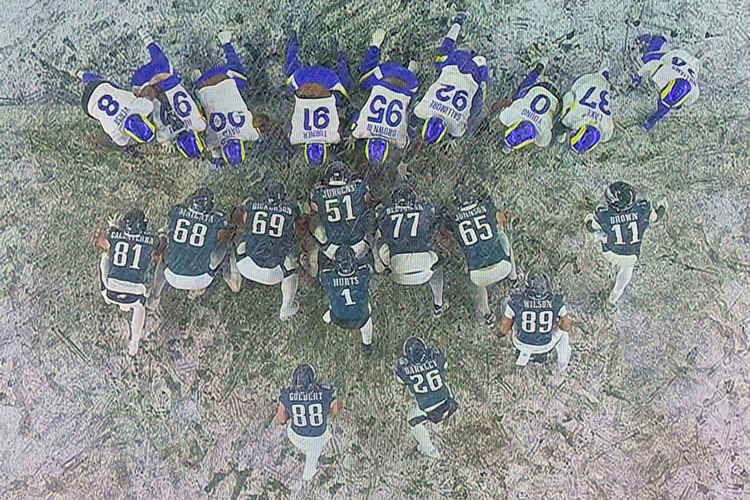
For Philly’s attack, they did rank just outside the top-ten in yards per play (5.6), but that was more so based on design, as they easily led the NFL with a 55.9% run-play rate – only two other teams even ran the ball more than they threw it. And for good reason, as free agency addition Saquon Barkley was on pace to break the league’s single-season rushing record before sitting out week 18 (2005 yards final), being locked into the number two seed already.
In terms of EPA, the Eagles finished eighth on dropbacks (0.165) and first in rushing (0.056). And while they weren’t quite as efficient on third downs (41.7% – tenth), they’re still pretty much automatic with the “Tush Push” on fourth-and-one, and from their week five bye onwards, they didn’t fail to hit 20 points once, averaging bang-on 29 per during that stretch. Once again, Philadelphia was tied with KC for fourth in turnovers committed (14) and only Baltimore finished with more than their 19 total plays of 40+ yards. So they clearly want to overpower teams up front, but not only does Saquon have that break-away potential, but they have a couple of demons on the perimeter who can punish one-on-one coverage deep. We saw that formula get too much for the Commanders, when they slapped 55 points on them the last time out.
Run game:
Considering Saquon went just over 2000 rushing yards before sitting out the regular season finale, facing 8+ defenders in the box on just 20.6% of his carries is fairly low, as you go through the Next Gen Stats database. That’s largely due to the fact that they’re generally an 11-personnel based offense. What allows them to still have as much success compared to some other top-end rushing attacks across the league is a combination of a dominant offensive line and a special talent at running back. While the addition of offensive coordinator Kellen Moore has allowed that group to feel a little less static, the run game designs are still generally in O-line coach Jeff Stoutland‘s field of responsibility. Jalen Hurts being banged up at times this year has forced them primarily operating from the shotgun once again, but there are two major differences – at least those splits aren’t as extreme with 25.4% of their rushing attempts came from under center (even if that number is boosted by the volume of “Tush Push” calls) and having Saquon Barkley handling the rock has allowed them to vary the concepts they use, going away from a nearly 60% inside zone rate. You see a lot more duo, where the back can manipulate second-level defenders and optimize his blocking, they attack the edges with toss plays and thanks to how he can navigate condensed space paired with the explosiveness once that guy gets a seam, they can regularly use power/counter variations. Only Baltimore’s Derrick Henry has averaged more yards “over expectation” per carry than Saquon (1.62) and he’s had seven of the 17 total runs of 60+ yards on the season – which is also an NFL record.
Yet, because of the burst to capture the edge at the RB spot, it’s made Hurts more dangerous playing off that, as you can invert their responsibilities to some degree. Obviously the quarterback sees more space when he keeps the ball on actual option plays, but we saw him score that 44-yard touchdown to open up against the Rams in the Divisional Round, where left tackle Jordan Mailata doesn’t even have anyone to block, when Jalen pulls the ball out of Saquon’s stomach and follows him on the wrap-around when they run GT counter bash – a way to use the backside guard and tackle as pullers away from where the initial handoff is faked towards. The quarterback being a factor allows you to even out the numbers in the box and the attention these receiving option around it require, leads to a set-up where the Eagles are simply going to win mano-e-mano more often than not. Beyond the way surrendering space on the outside can play into their hands, just the angles it creates when you only have one safety playing deep becomes a dangerous proposition, when Saquon has 160 feet horizontally against that man if he breaks through the second level. That’s why we’ve seen opponents during these playoffs opt for split-field looks on early downs, yet when they eventually commit extra resources or someone voids their gap in the second half of games typically, that’s when he burns you. And of course the Eagles have the ultimate weapon in short-yardage situations, when they pack the backfield and create that wave for Jalen to ride over, which makes them nearly impossible to stop when they need to extend drives or cash in at the goal-line. This season, only once did they fail to convert on fourth-and-two yards or less to go.
Pass game:
Building on that previous point, only three teams have faced middle-of-the-field-open structures at a lower rate than Philly (31.3%) because of the resources have to commit to slowing down Saquon Barkley on the ground. Yet, what that does is isolate the guys on outside for Philadelphia with cornerbacks at mercy of A.J. Brown and DeVonta Smith. Jalen Hurts throws one of the best go-balls in the entire league, but then he’s also very comfortable driving the ball to either sideline when those guys snap off curl or comeback routes. In terms of a concept they generally love to run, mesh is a regular option on the menu, often times with tight-end Dallas Goedert running the drag underneath, who they sort of pick for, because of the run-after-catch threat he presents. The other staple for them is double slants with A.J. on the outside, often with a bigger body in the slot next to him, tasked with running through the inside shoulder of the apex defender, who might otherwise cloud the window they intend to hit. For as successful as Philly has been running the ball, they were actually just below-average in their rate of play-action during the regular season (23.9%). That’s interesting considering the difference in splits for Hurts, whether you look at big-time-throw vs. turnover-worthy play rate or even just traditional passer rating (118.8 vs. 75.9 on non-play-action attempts). They don’t move the pocket a whole lot, but rather opt for long-developing concept, often with a post and deep over route incorporated.
In terms of where Jalen wants to go, there are fairly clears in terms of how opponents try to approach him – even though this doesn’t make them a whole lot easier to defend. Number 11 has been an elite option against man-coverage since the Eagles traded for him back in 2022 and if you show a clear isolated matchup pre-snap, that’s where the ball is going to a large degree. DeVonta Smith meanwhile can absolutely win one-on-one, but he’s become a highly reliable zone-beater for them. This season, he’s spent a career-high 54.9% of snaps in the slot and he excels at settling down between bodies or sliding into free space if there’s no window for the ball to arrive initially. Hurts has averaged just 3.4 yards on screen passes for the season, which have totaled slightly over 100. However, he’s averaged an NFL-best 8.2 yards gained on pass attempts of 0-9 yards of depth. A large portion of that is A.J. Brown being borderline uncoverable on slant routes. Yet, I have wanted them to make the running back position a bigger focus in the passing game all year long, since we’ve seen so many times in years past what Saquon can create as a simple check-down option, on screens but also a couple of times going vertical when matched up against a linebacker. A couple of ways where the Eagles differentiate themselves from the rest of the league in terms of offensive play-calling in high-leverage passing situations – they don’t mind taking shots outside the numbers when opponents are playing for the five-yard pass and they regularly run Jalen Hurts on third downs in order to set up fourth-and-short if not pick it up already.
In terms of how opponents have chosen to approach them, Philly was fifth and seventh respectively in pass (36.8%) and run blitz rate against (22.1%) during the regular season. Meanwhile, opponents barely run any stunts or twists against them, largely because those two things don’t coincide but also because of how well-coordinated that under is and the lack of success it’s generally led to. Still, the biggest critique of Jalen Hurts at his worst moments and in two of their three playoff games has been his unwillingness to be aggressive with the football. We saw a few dangerous – partially pre-determined – throws early in 2024 and it’s almost as if the coaching staff told him to not pull the trigger on those. According to PFF, no quarterback has held onto the ball longer, averaging a substantial time to throw of 3.21 seconds. That number has gone up by another 0.9 seconds in the playoffs and he’s taken nine additional sacks across those three contests. Hurts is very good at simply replacing blitzers and ranked just ahead of likely third-time MVP Lamar Jackson with an on-target rate of his passes at 79.1% (tied for seventh). However, you can almost feel the gears turning in his head when defenses change up the look on him, dropping different bodies off the line of scrimmage and make him process new information. He then holds onto the ball and takes sacks, since he never had the greatest pocket presence an has also been limited in his ability to move around. Only three of his 38 sacks taken came on dropbacks of less than 2.5 seconds. So clearly he’s not been pressured early, and just two offensive lines have been responsible for a lower percentage of their quarterbacks’ pressures (74.5%). On the flipside – keeping in mind that Hurts missed nearly three full games due to injury and was rather banged up during this playoff run – he has converted 13 of 17 times he’s scrambled on third and fourth down. Now, that data point doesn’t convey the amount of time he’s trying to escape and particularly when going sideways, getting taken down for sacks, but taking off when a lane presents to him has generally been a pretty big key for this team’s success.
CHIEFS D:
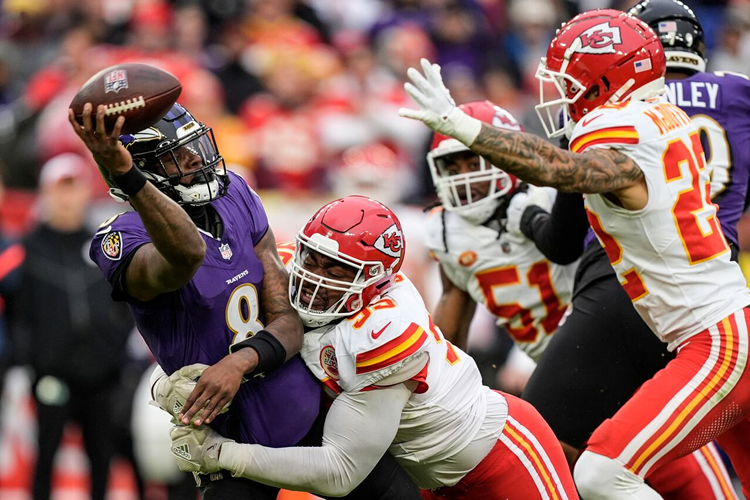
For Kansas City’s defense, it was always going to be tough to match what they did in 2023, when they finished the year second in both total yards and points allowed, along with ranking in the top-five in the majority of other meaningful metrics. They allowed a borderline All-Pro corner in L’Jarius Sneed to walk in free agency, his replacement Jaylen Watson was only available for six regular season games, the same was true for a key rotational D-lineman in Charles Omenihu, and they didn’t really have any notable additions. However, this veteran group under DC Steve Spagnuolo still finished fourth in points per game (19.2 PPG), allowing only more than 20 in four of 16 meaningful contests.
The advanced statistics certainly don’t love them as much this year, especially as you look at schedule-adjusted DVOA (12th). Because they haven’t been able to put opponents behind the sticks regularly, they had an atypically hard time to get them off the field on third downs (43.3% – 26th in the NFL) and didn’t put them in position where they had to put the ball at risk a whole lot. If you take out a catastrophic six-turnover fest by the lowly Browns, they finished with less than a takeaway per week (14 in 16 games). Yet, we saw Spags’ creativity in how he can attacked weaknesses in Houston’s protection schemes, they make opponents kick field goals when they get in scoring range and consistently get it done in high-leverage moments.
Run game:
Steve Spagnuolo-coached defenses have always been rather different to the NFL meta. Last year, they kind of turned back the clock with how much base personnel they were running, using their linebackers as hybrid on-/off-ball players to a certain to alter the blocking surface for opponents. This season they dead-average in their usage of base (23.7%) but also only 30th in nickel (53.7%), as they actually played dime 21.6% of the time (fourth-most). And yet, they were tied for the fourth-lowest yards per carry average in the league (4.1 YPC). That’s heavily connected to the construction of their defensive front, with all four starters being between 260 and 310 pounds, where they typically stay square to their blockers instead of attack up the field, since they can’t always cover every gap. That’s if though they don’t always have a traditional nose-tackle on the field. Derrick Nnadi, who has typically been that guy for them, has played a career-low 13 defensive snaps per game and posted the worst PFF run-defense grade yet at just 40.3. He’s raised his performance a tad during these two postseason appearances, but especially when opponents get into heavier personnel groupings and ask Kansas City to match, he’s not the same kind of space-eating specialist between the guards as he’s been relied upon as in the past. Mike Pennel was an unsung hero in last year’s Super Bowl against the 49ers and he’s been the answer more regularly for the Chiefs when they subbed him in alongside or in place of Tershawn Warton, when facing opponents who require putting heavier personnel onto the field.
While Kansas City hasn’t been in as many three-linebacker sets, they have continued to tap in Leo Chenal’s versatility, where you’ll see him walk down late and create different surfaces that make it tougher for the offensive line and tight-ends of Philadelphia to still communicate how blocking schemes should still be altered. His 183 snaps on the D-line even tops the aforementioned Zack Baun for Philadelphia and it makes up about a third of his playing time on defense. This allows the Chiefs to theoretically be in dime at times but with safeties Justin Reid, Byran Cook and Jaden Hicks combining for 860 snaps in the box, they feel comfortable putting those guys next to Nick Bolton on the second level without being compromised on the ground. In addition to that, we see plenty of 50 fronts, with three D-tackles head up on the three interior linemen on the other side. Having transitioned Chamarri Conner into a full-time nickel role at 205 pounds adds to that flexibility, as you don’t have to worry about him handling contain assignments against condensed formations. Having said all of that, where opposing backs have found success at times is bouncing runs with the defense converging inside, they’ve had their issues handling running threats at the quarterback position at times and Bolton has missed a career-worst 15.1% of attempted tackles, if you include the postseason.
Pass game:
Along with the fact that they typically zag when the rest of the league zigs, the other known commodity about any Spags-coached defense of recent memory in particular is that they’ll be aggressive. Only the Raiders have run cover-zero at a higher rate during the regular season (7.9%) and they’re also tied for first with the Tennessee in terms of how much quarters they call, which in many cases can play out as a version of match across the board in accordance with the route distributions. The veteran play-call has trusted his guys on the back-end to hang with the dudes across from them, which allows them to add extra bodies on their pass-rush. Otherwise, they’ve ranked anywhere from 9th to 17th in terms of percentage at which they deploy cover-one, -two and -six. While only one other team used three-deep less frequently than them (20.8%), since it generally asks players to gain depth at the snap rather than read and drive forward. In the playoffs, they ran a ton of match-quarters combined with blitzes against Houston and then facing Buffalo, they actually used a lot more single-high looks because they felt like they needed that safety patrolling the high post – which we saw that guy get pulled down against a crosser instead of helping out on Mack Hollins zooming right up the numbers on that long touchdown.
No team stunts their defensive line less than the Chiefs overall (9.8%) and on pass plays (14.2%), but they also finished just outside the top-ten in blitz rate (28.4%). If you look at it on a more granular fashion, it’s either second-and-short or third-and-long situations where they bring the heat, finishing sixth (35.7%) and fourth (44.4%) respectively in those categories. Again, unlike some of the defenses that follow the modern meta with a lot of fire-zone calls, where you bring five and play more of a spot drop-combination with your six remaining defenders, they generally lock those guys up with man-/match-assignments. No team has been better over the last two years at dictating terms to their opponents and speeding up the operation for quarterbacks, demanding pin-point accuracy on a lot of occasions despite the timing being thrown off with how they challenge receivers early in the route stem. Where they’ve been vulnerable operating like that has in part been their safeties against speedy tight-ends but especially that second outside corner spot alongside Trent McDuffie. An injury has been the main reason for that however, as Jaylen Watson being back has been a massive upgrade over the question mark that was Nazeeh Johnson. Still, if you want to attack those guys, blocking up the pressure and testing them with deep shots is the way you have to think, if you want to take the pen back and write how this gamescript is being written.
Similarly to Philadelphia, being tied for 18th in sacks (39) for the regular season doesn’t tell the full story for Kansas City’s ability to get after quarterback. Pro Football Focus awarded them the sixth-best pass-rush-productivity league-wide (21.1%). Opponents are regularly forced to release the ball with pressure coming in on them, as you’re not going to find many defenses better at manipulating protection schemes. We saw them rack up eight sacks against the Texans in the Divisional Round, whose plans for designated passing situations were highly questionable, and overall they created 58(!) unblocked pressures throughout the season. While the Bills in the AFC title game did a much better job of keeping their quarterback clean with Spags dialing their blitz rate way down, in the biggest moment on that final fourth down, he sent both the linebacker and corner off the boundary to flush Josh Allen and lead to an incompletion. Truly being a threat to bring any of the 11 defenders on key downs makes this defense a headache to prepare for. In terms of how they align their main rushers, they use plenty of load fronts, where they put three D-linemen to one side of the center, often times with Chris Jones on the outside shoulder of the opposite tackle. That allows them to bring pressure off the slot by slanting the D-line away from it, second-level blitzers are given two-way goes with the guard and it allows for more variety in the games they can run with two free gaps.
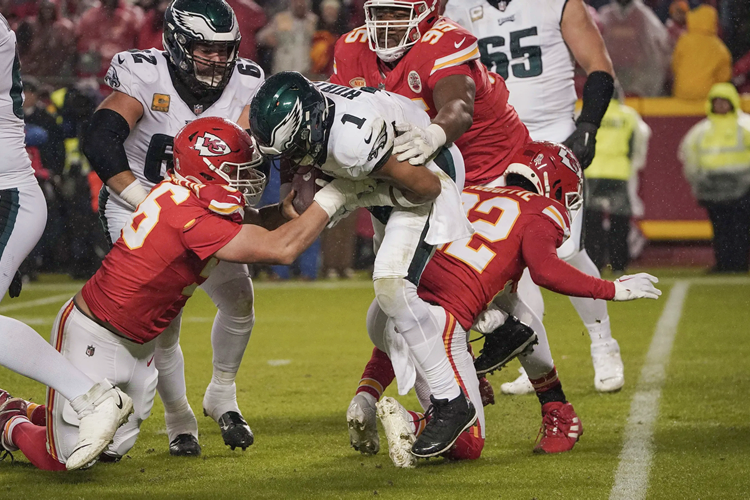
HOW THEY MATCH UP:
When these two sides met in the Super Bowl two years ago, the Eagles saw 21.9% of their rushing attempts stuffed. That would be the second-highest mark of any team this season (behind the Dolphins) if you extrapolated that number. And only six of their 17 running back carries on the day were deemed as “successful” based on down-and-distance. However, on the 15 times Jalen Hurts had the ball in his hands, 11 of those attempts were credited as such and only two of those were actually scrambles. They did run zone read and GT counter with him once each, but where they really hurt Kansas City was when they emptied the backfield and called draw plays (outside of the fumble-turned into-scoop-and-score by Nick Bolton on one of those). Hurts was also credited with five big-time throws compared to zero turnover-worthy plays, as the protection held up mostly, and we saw some big-boy throws on deeper-developing routes though. Twice the Eagles benefitted from the outcome on deep play-action shots to A.J. Brown against the single-high safety looks, where he nodded to the post first before breaking to the corner and then the opposite way. The first resulted in a 45-yard touchdown, while the latter could’ve easily been picked off into true double-coverage. Spags blitzed the Eagles QB on 35.7% of his dropbacks in that showing, but only on one of four third-and-long situations, bailing out of a couple of double-mug looks to force Jalen to hold onto the ball.
The following year when they faced each other again in week 11, Hurts’ EPA per dropback dropped off massively to -0.022, as Spags turned up the heat even more, sending 5+ rushers on 44.8% of pass calls and it actually triggered the Eagles QB to get the ball out a lot quicker. On third downs, that rate actually went up to 60(!)%. And watching it back, it was truly a masterpiece of how to make quarterbacks start seeing ghosts. You saw them involve linebackers in three-man games to one side and drop off someone from the opposite edge. There was a full-house cover-zero call on a random first down, yet then also a strip-sack by an unblocked slot blitzer on a simulated pressure. Routinely, Spags was able to “waste” bodies for the Eagles in protection and force bad plays by Hurts. Nonetheless, Philly did post a 47.8% rushing success rate. And that was with a lot more runs from the shotgun, as only three of 15 attempts on the ground by their running backs coming from under center. In particular, they had success with same-direction runs to where the back was flanked as a tendency breaker, as well as hard cutbacks against the flow on zone concepts from pistol sets.
Something I’ve liked about what the Eagles did against the man-coverage Kansas City wanted to run across both of those matchups was the way they played around with moving receivers in and out of bunches, creating leverage advantages and allowing guys to separate that way. Those blitz-replace throws were largely no problem in the Super Bowl for Hurts, but when those “simple” answers weren’t there the next time they met, results were quite different. I would expect Spags to throw the kitchen sink at him when they get into those obvious passing situations and I’d certainly favor the genius play-caller to spook the guy on the other side. That’s why it’ll be monumental if the Eagles can crank up the run game early on, since that’ll limit the creativity of looks Jalen has to deal with. Being able to make their safeties run and cash in on a couple of explosives off play-action would go a long way, with Dallas Goedert being a pivotal figure since no other defense has allowed more receiving yards to tight-ends (69.6 per game). The Chiefs just held Josh Allen to two-for-five on QB sneaks, but they weren’t able to stop any of the nine “Tush Push” calls in those two most recent meetings combined. Kansas City’s defense will require some big-time outside the numbers throws, and Hurts is certainly capable of those, especially with the two dudes he has out there who can challenge corners vertically, but then also create separation when they snap off routes. If this is an in-between-the-numbers game on that side of the ball, Philly have to be the ones doing it on their terms with the way they move the ball on the ground and the advantage throws off RPOs.
X-factors:
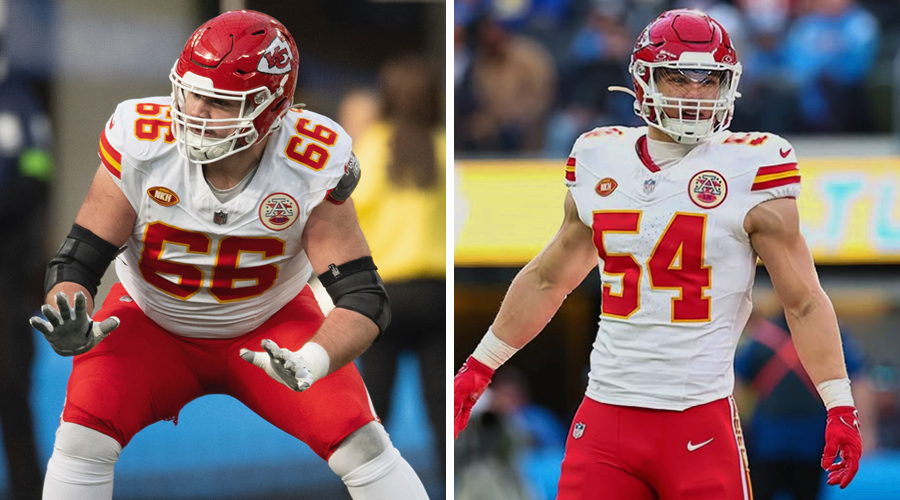
Chiefs – Mike Caliendo & Leo Chenal/Jaylen Watson
As I already mentioned, left tackle has been a turnstile for Kansas City all year long. They tried three different options until finally landing on the solution of moving All-Pro left guard Joe Thuney out there towards around the start of December. During these playoffs, he’s allowed a sack and a couple of QB hits facing that great edge duo for Houston, but kept a clean slate against Buffalo and otherwise only struggled in his first showing at left tackle during the regular season (facing Cleveland’s Myles Garrett on several reps). Still, that required someone taking over the guard spot voided by Thuney and Mike Caliendo has been an issue since being plugged in next to him. Only once in five starts has he received an overall PFF grade above 55.0. Being one-on-one with any of these three defensive tackles on run plays clearly favors Philadelphia. In passing situations, I expect Andy Reid to help him out him schematically to a certain degree, but if Jalen Carter is lined up away from him, can you get away with leaving Caliendo on an island for a handful of dropbacks?
On the other side, I was debating if I should go with Jaylen Watson at the CB2 spot, because if Trent McDuffie travels with A.J. Brown, the spotlight could be put at the other matchup on the perimeter. Yet, because DeVonta Smith lines up in the slot so much more now. So instead, I went with a guy whose role in how KC’s fronts play out will be something I’ll have my eyes on early on. I hinted on the fact that playing with even numbers inside the box favors Philadelphia against pretty much anybody. So changing up the surface and blocking angles, how he handles being the read-man on option run plays but also if they use him more of as an off-ball blitzer could all prove critical in the success Saquon and company might have on the ground. Also, deploying the versatile LB as part of your pressure packages, maybe running some kind of pick-stunt to free up a fellow rusher, will be interesting on third downs.

Eagles – Jahan Dotson & Oren Burks
Since we just referenced what the matchup for the second outside corner spot might look like when Philadelphia has the football, it’s time to bring up Jahan Dotson’s name. Who remembers when this guy was viewed as a fantasy breakout candidate after posting over 500 yards and seven touchdowns in 12 games as a rookie? And then who remembers when questions were asked if the Eagles had the best WR trio in the league once they traded a third-round rookie and a couple of sevens for him at the eve of the ’24 season? Well, Dotson hauled in a total of 19 passes for 216 yards during the regular season, and nearly half of that production came when they were sitting starters in week 18. Him catching the first touchdown in the Wildcard Round against Green Bay served as a nice reminder for the public that he’s still on the team, but he literally hasn’t been targeted since the second quarter of that game. Nonetheless, he has logged at least 55% of offensive snaps in all three of their postseason matchups, often just getting his cardio in as a vertical stretch element. Yet, if KC decides to truly leave him one-on-one for most of the day, I think we could Jalen Hurts take a couple of shots to him down the sideline and/or he faces the easiest matchup in the red-zone.
On defense, I kind of chose the same path as I did with guard Mike Caliendo for the Chiefs, in terms of a player who was inserted into the lineup down the stretch and presents some volatility, projecting what his impact may be in this matchup after Nakobe Dean got injured in the Wildcard Round. Burks is certainly a more proven NFL commodity at this point than what KC is dealing with, having logged well over 3000 total snaps, with 1100 of those coming on defense in a backup capacity largely, but one full season of games started across seven years as a pro. I don’t believe he offers the same kind of play-recognition, aggressiveness in meeting blockers around the line of scrimmage and instincts to flow to the ball quickly the guy he’s replacing. If Philadelphia uses Zack Baun as an on-ball player to a certain extent, you’re putting a lot of responsibility on the one true second-level player, who missed 27% of his attempted tackles in the two-and-a-half games as a starter for the Birds. The space he can command when put in conflict with a run-pass key will be critical and I’m curious to see if they use him more as a pressure-player in this scenario, so Andy Reid and company can’t isolate him in coverage in high-leverage passing situations.
Prediction:

Despite there being some Chiefs fatigue by the NFL fans as a whole and this matchup not being hyped up as much after we already see it on the biggest stage two years ago, I do believe we’ve got the most talented team in Philadelphia against a crew in Kansas City who has consistently raised their level to the highest capacity when they’ve face their toughest challenges. This by no means is matchup that substantially favors one side on paper. How much the Chiefs can slow down this explosive rushing attack for Philly and how Patrick Mahomes and Andy can meticulously chip away against the league’s top passing defense under Vic Fangio will be headliners of course. Yet, after rewatching especially their regular season meeting last year – which the Eagles won 21-17 by the way – what is burnt into my brain are all the different ways Spags was able to rattle the quarterback on the other side with exotic combinations of who was rushing and how they distributed bodies in coverage. Nonetheless, a big throw to DeVonta Smith in the fourth quarter ended up making the difference, and it’ll probably once again require something in that mold on Sunday when an opportunity presents itself downfield.
How both signal-callers are able to deal with compromised circumstances will likely decide the outcome of this game. While Pat has become less aggressive with forcing the issue in those situations – in part because he doesn’t necessarily have the wide receiver options to cash in on such opportunities – during the regular season he did post double the big-time-throw as turnover-worthy-play rate (5.6 vs. 2.9%), while Hurts actually had a negative ratio on those (4.8 vs. 5.3%), according to PFF. Personally, I don’t believe Hurts is significantly worse than he was two years ago, when he was the MVP runner-up. To me, his strengths and weaknesses or more pronounced and we just have a clearer understanding for what he’s being asked to do. The Eagles’ protection plans and how they’re provide clean decisions from the pocket for him should serve as a life line, that protects him from his worst habits of putting his team behind the chains with taking sacks. Ultimately, I don’t believe he’s quite equipped to problem-solve to the level needed to finish the job. In the meantime, looking at the philosophy behind the Fangio-inspired “two-high” defenses around the league, they were a direct response to how Mahomes used to test opponents down the field, yet KC has adjusted to this new meta we saw introduced and they’ve become as good as anyone at picking away with completions underneath that umbrella.
 Kansas City Chiefs 27:23 Philadelphia Eagles


MVP – Patrick Mahomes
It would be incredibly easy to just say that I’m not going to bet against Mahomes when it matters most, because you would’ve lost a lot of money along the way otherwise. However, I do have two coaching angles that I just couldn’t get out of my hand when locking in my pick. First, Nick Sirianni is much more of an emotionally driven coach when it comes to (game management) decisions in high-leverage moments compared to Andy Reid’s routine of dealing with them. And then, when it comes to one play-design on offense in a got-to-have-it situation, I trust the latter one more than Philadelphia OC Kellen Moore – who is generally much better operating from a script – to make the right chess move against one of these defensive masterminds. Although they were always favored against a lesser overall team without an offense that could actually keep pace, Mahomes has never lost to a Vic Fangio-coached defense (8-and-0). While I’ve doubted the heights this version of the Chiefs could reach, they have continued to prove all of the doubters wrong and are masters at finding ways to pull out close wins, especially now with these stakes on the line, to become the first ever three-peat champions.
 Halil's Real Footballtalk