
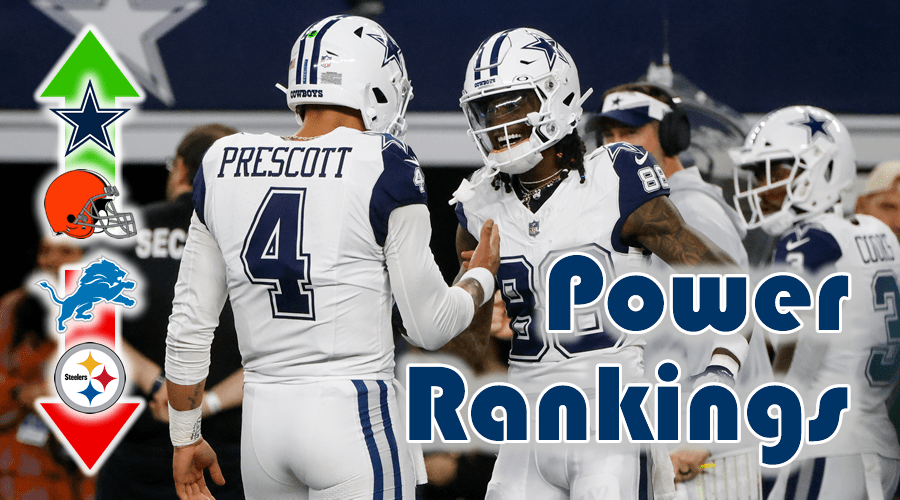
It’s that point of the year again – we enter the figurative fourth quarter of the NFL season. Teams are starting to separate themselves at the top-end and bottom of the league, but there’s still very little clarity in the middle of the pack. So now I’ll try to distinguish between those squads with similar records, as we head down the home stretch, and rank them one through 32.
As always, these are power RANKINGS rather than standings. So I’m well aware that these aren’t fully compliant with how records stack up and that some teams may have beat others, who are listed ahead of them. I base this on what my eyes tell my first of course, but will bring up different metrics, in order to make my points, as well as add context to certain numbers.
Let’s get into it:
1. San Francisco 49ers (10-3) 
I recorded a video last week, in which I broke down in detail how Kyle Shanahan absolutely shredded the Eagles defense and at the end of it, I mentioned that I thought they had separated themselves a little bit from the rest of the NFL. While the Drew Lock-led Seahawks did pull within five points to start the fourth quarter, it felt like they were in clear control throughout the day. This offense is operating on a DIFFERENT level right now. Since their week nine bye, they’re averaging 0.276 EPA per play. For reference that is 1.5 times as high as the number three team, yet they’re also number one in success rate on dropbacks (52.8%) and on run plays (48.5%). What makes them so special is the combination of insane versatility with the looks they can present from the same personnel and a play-caller, who understands how to attack defensive rules better than anybody else in the sport, while Brock Purdy has turned himself into far more than just a distributor. With that being said, their defense has also made a significant jump, allowing an average of 13 points per game and not allowing any of their five opponents to reach 20. The addition of Chase Young has paid major dividends, after Nick Bosa was double-teamed at one of the highest rate among edge rushers prior to his arrival. However, it’s also being more sound on the back-end in terms of playing less true man-coverage and a lot more quarters. If this group can stay largely healthy, they’re the clear favorites at a title to me right now, especially considering they already blew out their two biggest challengers in the Cowboys and Eagles.
2. Baltimore Ravens (10-3) 
While they may be a slight step down from the 49ers on the opposite side of the bracket, considering all the other AFC teams have at least one major question mark, you could contend that the Ravens have more separation to the rest of their conference. Just like San Francisco – where they travel to in week 16 – they control their own destiny, with the Dolphins visiting them the week after that, and now they could even afford to slip once, if they can just take care of Miami. Lamar Jackson’s numbers don’t jump out the same way they did in his MVP season, but he’s been my pick for the award all year long, as new OC Todd Monken has put the game more in his hands, and I think he’s playing the position as well as he ever has, being able to navigate the pocket and deliver the ball to all areas of the field, now that he has legit receivers around him. Plus, they may get Mark Andrews back for their playoff run. And while he leads them in that category, already having gone over 2000 rushing yards on 4.9 yards per carry definitely helps. With that being said, their transformation on defense may have been even more substantial – looking at scheme and overall success. Mike Macdonald has worked wonders with his ability to finding solutions for the staples of their opponents and then fabricating heat on quarterbacks in designated passing situations (lead the NFL with 49 sacks) without real stars up front, thanks to the insane amount of simulated pressure and how they manipulate protection. They allow a league-low 4.3 yards per play and they’re behind only the Browns in terms of EPA per play (-0.122) and DVOA defensively (-19.5%).
3. Dallas Cowboys (10-3) 
When you look at the two most meaningful numbers in football – points scored vs. allowed – nobody has a better differential of the season than these Cowboys (+188). The issue until this past Sunday night was the argument of “who have they beaten”, as all nine of their wins had come against opponents with a below-.500 record. By evening up the season series with the Eagles, and doing so with a assertive 33-13 showcase, with the only Philly touchdown coming on a scoop-and-score, they prove that they can with the “big boys”. Now, we do have to note that they still don’t control their own destiny to an NFC East crown and they’ve been significantly better at home, plus of course until they can overcome the 49ers – who blew them out 42-10 back in week five – none of this truly matters. With that being said, I feel like this is the best all-around Dallas team of my lifetime (which basically spans exactly the amount of time it’s been since their last Super Bowl). Since people were calling out Dak Prescott for his performance at San Francisco, no other quarterback has been better in terms of EPA per play (0.355) or success rate (55.3%). That coincides with Ceedee Lamb being a massive heater (8.6 catches for 112 yards on average), putting on absolute clinic as a route-runner, but the story has been the ancillary weapons stepping up when called upon and the O-line emerging as one the elite units in the NFL again. There’s still some feast-or-famine character to the defense, which has eaten up bad opponents, considering the Seahawks put up 35 points at Dallas the week prior, but they haven’t allowed more than 110 rushing yards since week five and when they’re ahead, their combination of pass-rush and ball-hawking on the back-end is the best in the league.
4. Philadelphia Eagles (10-3) 
It was almost impossible to drop to Eagles any lower than number four, and I still believe they are right up there with anybody – maybe outside of San Francisco – in terms of overall talent on the roster. However, they just got thoroughly dominated by those Niners and Cowboys by a combined score of 75-32, and even before that, they were a misjudgment between the quarterback and receiver from the Bills and a horrible missed pass interference call away from potentially going 0-4 across that stretch. We’ve seen moments of dominance from different areas of the team, but you can argue that they haven’t played a complete game yet all season long. The two biggest areas of concern are Jalen Hurts’ general health and ability to see the field in the dropback game, along with the substantial downgrade we’ve seen from a play-calling perspective on both sides of the ball. The offense is extremely reliant on iso-ball with their top two receivers, without the easy buttons they could spam last year to create YAC opportunities, as the run game hasn’t been nearly as dependable with how simplistic they are and Jalen not being a true threat in that regard right now. Defensively, opponents are consistently able to dictate what coverages they’re in and present answers for how to attack those. The D-line is capable of taking over contests when playing with the lead, but even those front-dynamics can be taken advantage of if you put the pressure on a second level that seems absolutely lost. They’re dead-last in third-down percentage (48.1%) and 30th in red-zone TD rate (70.5%). It’s time to self-scout and find ways to let the talent shine again.
5. Kansas City Chiefs (8-5) 
Numbers one through four were pretty simple for me. This is where I kind of struggled. Because on one hand, trusting Andy Reid and Patrick Mahomes to still figure things out has been a winning strategy for a long time, but at the same time this seems too high considering the only team they’ve defeated over the last month were the Raiders. What led me this way is the idea of “if they were third in scoring offense and 11th on defense, would I question them as much as I do?”. And while I do feel like the handled themselves very poorly at the end of the Bills game, outside of an atypical 24-9 let-down at Denver in week eight, all five of their losses were determined by one play not going in their favor, whether that’s a bad drop, a receiver not checking with the ref if he was aligned correctly or also an egregious missed penalty. It hasn’t been as easy as it’s seemed in the past and the AFC most likely isn’t going through Arrowhead, but really all they need from their receivers is to not to be net-minuses, as they currently lead the league with 31 drops. While he’s regressed a little closer to the median, Mahomes still is at the top of the league in sack rate of his dropbacks (3.6%), he’s been as effective as ever as a runner and they remain as a top-five third-down offense (47.2%). Meanwhile, this is the best KC defense of this current iteration of the team, as they rank fifth in points (17.5 PPG) and tied for fifth in yards per play surrendered (4.9 YPP), while only the Jets have pressured opposing quarterbacks at a higher rate (25.0% of dropbacks). Even with an overall turnover differential of -7, they’ve been right there in the biggest matchups.
6. Buffalo Bills (7-6) 
I know on the surface it seems wild to put a team that only just moved above .500 again this past Sunday at number six here. However, the Bills are also one of only five teams with a point differential of +100 or better, while being a stupid “12-men on defense” penalty plus an all-time great 60-yard kick in the rain being missed away from being the number two seed in the AFC right now. Offensively, are tied for third with 5.8 yards per play and only the Cowboys have picked up more first downs on the year (292). Yet, while they average the fourth-most points per drive (2.41), unfortunately they also turn the ball over at the fifth-highest rate (14.9% of drives). That has been their Achilles heel for certain stretches and a big reason Josh Allen has received criticism in the past. Yet, I’m here to tell you once again that he’s been a superhero for them and you can’t ask anybody to carry the team to that extent without the negative correlations that come with it. While not a ton has changed schematically we’ve seen the OC change to Joe Brady result in a little less weight on the QB’s shoulders. Josh is now right up there with Mahomes when you look at his sack rate per dropback (3.7%) and he’s allowed them to be second in both third-down conversion rate (48.8%) and red-zone percentage (66.7%). The defense has actually been the much bigger concern to me, as they’ve remain fairly predictable with Sean McDermott taking over as the de-facto coordinator, while they’ve lost key pieces in DaQuan Jones, Matt Milano and Tre’Davious White to injury. If you can get those corners isolated, that’s where they become very vulnerable, and Von Miller’s impact has not been felt yet. If they do make it into the tournament, I believe they can be effective enough with specific gameplans, to make a few plays and support what has been a top offense at moving the ball throughout the year.
7. Miami Dolphins (9-4) 
I’m sure most people have seen this by now, but NFL teams were 767-0 when leading by 14+ points with under three minutes left since 2016, until Miami allowed the Titans to erase that deficit in just one minute actually. I’m not 100% sure what to make of it, because it is somewhat fluky in principle, but they also made it look way too easy, in particular defensively, and then Tua and company couldn’t put together a two-minute drill for a game-winning field goal. Fairly similar to the general discourse around the Cowboys prior to this past week, Miami’s overall statistics and record were boosted by what they have done against losing teams, as the only win against an opponent with record of .500 or better came against the Broncos back in week three – which that 70-burger they put on them now feels forever ago. While you do have to go to the third decimal, the Dolphins aren’t number one in yards per play offensively (6.74) since week two. Mike McDaniel, Tua and Tyreek Hill of course deserve major credit for orchestrating one of the most explosive units we’ve ever seen – including the fact they’re cashing in three quarters of their red-zone trips for touchdowns – but the top teams they’ve faced have had solutions for the challenges they present with motion and field spacing, while not nearly having looked the same off-script. Meanwhile, the defense had been emerging since the return of Jalen Ramsey, but the loss of their top pass-rusher Jaelan Phillips is a major factor down the stretch for them and they can’t hold opponents to field goals, allowing opponents to score touchdowns on two thirds of red-zone trips.
8. Cleveland Browns (8-5) 
It’s been a weird season for the Browns. If you just gave someone the facts of the quarterback with the highest guaranteed contract in NFL history, arguably the top running back of the last decade and their starting tackle duo ultimately having played a combined 14 full games, you’d think they’d be dead. Yet, while the Browns offense is still only 29th over the course of the full season in terms of yards per play (4.5 YPP) and they’ve turned the ball over a league-high 27 times, they did just score 30+ points in consecutive weeks for the first time all year and I would argue they have landed on their best quarterback option yet, with Joe Flacco being the fourth one to start multiple contests for them. He’s legitimately played after sitting on his couch three weeks ago still and Kevin Stefanski has served up some explosive-play opportunities on a silver platter for him. Of course, this Cleveland defense has been the real story throughout the year and it remains as an elite unit, still ranking number one in EPA per play (-0.149), success rate (36.2%) and DVOA (-20.9%), despite having to carry an offense that has been anywhere from disappointing to outright disastrous, while starting four different quarterbacks for multiple contests. Watching them on Sunday against the Jaguars, I thought to myself numerous times how I absolutely love the aggressiveness they play with. Jim Schwartz at DC has instilled a mindset of being the aggressors, after they were pretty conservative in terms of how they were structured previously. While they don’t run too much blitz-zero, they call cover-one at an NFL-high 41.7% of snaps, because they have the league’s top corner trio and it allows them to create – and expose – one-on-ones up front. They regularly create negative plays on early downs (lead the NFL with 79 TFLs) and then they’ve held opponents to easily a league-worst 29.0% third-down conversion rate.
9. Detroit Lions (9-4) 
It’s been a tough three weeks for the Lions. First, the Packers come into their house on Thanksgiving and Jordan Love gives them PTSD for all the years Aaron Rodgers tortured them, then they allow the otherwise anemic Derek Carr-led Saints offense to nearly pull off a 21-nothing comeback and then this past Sunday, they travel to Chicago, where the quasi-eliminated home team looks like the more dominant team up front. The offense is still tied for third with 5.8 yards per play, with top-eight success rates in both dropback (48.2%) and rushing success rate (41.7%). Concerns around Jared Goff having to go on the road in the playoffs are very real, but OC Ben Johnson does present a lot of challenges for how broad their menu is from a play-calling perspective and they’ve run the ball effectively all season long. Sadly, their defense has reverted to first-half of 2022 form since their week nine bye. Over those last five games, they rank 31st in both dropback EPA and dropback success rate. Their linebackers have taken a significant step backwards from what they looked like early in the season. You can attack them with misdirection and isolating them in coverage with high-low stretches. So now as opponents have more success throwing the ball on early downs and they don’t push them behind the sticks, you’d need anybody not named Aidan Hutchinson to win up front – and nobody does. Alim McNeill being placed on IR a couple of weeks ago is a major hit in that regard. If you at least held opponents to field goals, they could win that way, but they’re allowing a 68.2% red-zone TD percentage (29th in the NFL). It just doesn’t feel anymore like they’re up there with the “big three” in the NFC.
10. Jacksonville Jaguars (8-5) 
Before we get to anything else – for Trevor Lawrence to even be out there with the high-ankle sprain and then to move the way he did was absolutely insane. Now, he did throw three interceptions, but those weren’t necessarily related to his health, and he did also keep them in the game. Early on in the season, they were turning the ball over at the most inopportune times, their receivers could not get both feet down in the end-zone to save their lives when they got to the red-zone, but it also felt so exhausting with the way they would have to string together long drives in a very horizontal passing attack. However, over the past four weeks, he’s produced 17 of his 42 total completions of 20+ yards. Meanwhile, as explosive as Travis Etienne is when he’s given a lane or he can get around the corner, overall only the Raiders and Bucs average less than Jacksonville’s 3.6 yards per carry. Thankfully, they’ve been equally effective at stop their opponents’ ground, as they rank second in defensive rushing success rate (34.0%). Mike Caldwell has been pretty aggressive with bringing heat and putting their guys on islands on the back-end, which has led to them being tied with the Broncos for a league-high 24 takeaways, but also only the Chargers have given up more yards after the catch (1763) as a unit this season. The edge defender Josh Allen has been a spectacular one-man show for them up front, but they need somebody else to create pressure, so they can keep Tyson Campbell locked up on the backside of the formation, but use their coverage resources more appropriately to flood the field.
11. Denver Broncos (7-6) 
No other team in the NFL has turned around their fortunes more than the Broncos this season. After a highly criticized 1-5 start, they’ve now won six of their last seven games. Across that stretch, they’re averaging a full touchdown more than their opponents and they’re at +11 in terms of turnover differential. Even though I think the turnaround of Russell Wilson has been a little bit exaggerated in terms of the level he’s playing at now, compared to how atrocious this offense was a year around, the fact that Sean Payton has been able to turn him into a robot to some degree and how much more regularly they’re cashing in on vertical shots has been tremendous. Russ is tied for a league-high 6.0% completion percentage over expected – in part thanks to a ridiculous Courtland Sutton touchdown grab on a weekly basis – and he’s produced 31 first downs with his legs. While there are still only two teams allowing a higher yards per play mark (5.9 YPP) than Denver overall, you almost have to differentiate between the unit through the first six and then the latter seven games. We saw a massive change in personnel, getting their young edge rushers onto the field and inserting a quiet superstar in Ja’Quan McMillian at the nickel spot. They skyrocketed from easily dead-last to number three(!) in overall EPA per play. Turnovers have been a major factor in that regard of course, as they’re tied with the Jaguars for a league-high 24 turnovers forced and only the Browns have been better at getting teams off the field on third downs (32.3% conversion rate). The only blemish has been that no other team has gifted their opponents more yards via penalties (838).
12. Los Angeles Rams (6-7) 
That was an incredibly exciting battle, in the rain, at Baltimore, which easily could’ve gone either way. Unfortunately, ten of their prior 12 matchups had gone against teams at .500 or better coming into the weekend and a couple of other similarly tight matchups had ended up with losses against them as well, to put them a game below that mark themselves again. Tie-breakers could make things interesting for that final Wildcard berth, because they do have the head-to-head sweep over Seattle inside their division, but lost to the current number seven seed in the Packers. While I didn’t love what they had on paper coming into the season, particularly with all the unproven commodities on defense, I did have the respect for Sean McVay and Matt Stafford to project them to win six or seven games – and that faith has paid off. Obviously, I didn’t expect Puka Nacua to challenge for the rookie receiving record, but now with Cooper Kupp having his best game of the year, that is deadly duo with the guy slinging the ball to them and the advantages their play-caller can create schematically. The O-line has rebounded thanks to better health and their new guard duo, paving the way for one of my draft crushes Kyren Williams, who runs as hard and is as complete as any back in the league. L.A. is the only team in the top-seven in terms of drives that resulted in points (41.4%) as well as in a turnover (7.9%). You combine that sound defensive philosophies from coordinator Raheem Morris, Aaron Donald still being capable of taking over games and some of their young talent stepping up. Woefully, their special teams rank 32nd in DVOA (-8.3%), in part due to that game-winning punt return TD they gave up this past Sunday in overtime.
13. Houston Texans (7-6) 
Considering the only loss the Texans had suffered among the prior five weeks was a field goal attempt from their backup kicker going off the cross-bar in a back-and-forth contest with the division-leading Jaguars, this past Sunday’s 30-6 beatdown at the hands of the formerly 4-8 Jets had to be a downer. After Tank Dell was moved to injured reserve the week prior, they lost number one receiver Nico Collins early on and the ancillary pass-catcher really struggled to separate or catch the ball reliably. With that being said, the arrival of rookie quarterback C.J. Stroud and offensive coordinator Bobby Slowik has immediately transformed this offense from one of the bottom-feeders to a must-see product on a weekly basis, despite their run game being inefficient and them missing at least 60% of the starting O-line for more than the first month of the season. Another rookie QB in their division – Will Levis – is the only guy to average a higher mark in terms intended air yards per attempt (9.2) than Stroud, but the Texans signal-caller cashes in on them much more regularly and therefore averages 1.1 actual yards more, while being tied for a league-high 61 completions of 20+ yards. Houston has gone without a turnover in an NFL-best six games and Devin Singletary has delivered a spark on the ground. Meanwhile, rheir defense is surrendering just 3.6 yards per carry (tied for the second-lowest mark), but while they’ve shown some positive signs, the second level of their defense can certainly be attacked in the pass game. That’s illustrated by the fact that they’ve allowed the tenth-most air yards as well as yards after the catch – so offenses can hit routes over the middle and turn those into explosive plays. And only the Panthers have missed more tackles on the season (100). At their best, they can get to third-and-long, disguise coverage let the guys off the edge crush the pocket from those wide alignments.
14. Green Bay Packers (6-7) 
Until they lost to the Tommy DeVito-led Giants this past Monday night, the Packers were as hot as just about any team in the league, having won three straight, most recently ruining the Lions’ Thanksgiving and then beating the Chiefs at home in primetime, with both of those being eight-win teams at those points already. Jordan Love looked as indecisive and inaccurate as he looked through the first nine weeks largely, which is disappointing considering he had started to become more decisive along with hitting those trick-shots he’s capable of. Love does currently rank eighth in EPA per play (0.113) and that’s also where the Packers offense finds itself overall, in part due to putting games more in the QB’s hands on early downs with play-action, since they do offer the threat of running downhill, that young receiving corp growing up in front of our eyes and how well they’ve converted third downs (44.0% conversion rate – sixth in the NFL). Defensively, they’ve just been making a lot more big plays. Over the last four weeks, they’ve created seven combined turnovers and Rashan Gary has been a problem off the edge, when their opponents have been forced to catch up. With that being said, their counting stats look better than they should, considering they’ve faced a pretty soft quarterback schedule until recently, which is why they rank 28th in defensive DVOA (6.9%). DC Joe Barry has continued to underwhelm me with how simplistic they are. So I hope once Jaire Alexander returns, they actually let his iso-skills shine and become a little more versatile with how they use the rest of their back-seven assets.
15. Seattle Seahawks (6-7) 
This was one of those teams I put my stamp on before the season and said that they would be a legit contender in the NFC, even going as far to have them beat out the 49ers for the West crown. They laid an egg in the season-opener against the Rams – not uncommon for them in years past either – but then five of their next win games, showcasing a more well-rounded offense and an aggressive defense. Sadly, fortunes have flipped 180 degrees, as they’ve now only win one of their last six – by a field goal against Washington. I like some of the things OC Shane Waldron does generally, but I haven’t felt like there’s a real comprehensive plan to how they structure that unit – whether it’s how much they want to commit to those 11 personnel sets or not always tying the run and pass game together effectively. A healthy Geno Smith can absolutely sling it and they have receivers who can win their matchups, which is how they suddenly put 35 points at Dallas – a house of horrors for most offenses – but it just hasn’t been consistent enough. Meanwhile, the defense has fully reverted to their 2022 form. Following their 5-2 start, only Washington has been worse in terms of EPA per play as a unit – and not by lot – and they’ve surrendered an average of 154.3 rushing yards over that stretch, after that area looked largely fixed early on. Due to that success on the ground, they’ve also allowed their opponents to convert 45.8% of third downs against them (third-highest mark). Jamal Adams has either been yelling at people or getting burnt on the field, Bobby Wagner has become a liability in coverage and as much as I loved fifth overall pick Devon Witherspoon, his impact is somewhat limited, once they moved him back to the outside.
16. Cincinnati Bengals (7-6) 
It’s kind of unbelievable that the Bengals are currently a winning team, when you take into account that they’ve only had their 55-million dollar per year quarterback healthy for about a month and that this has been the worst defense since Joe Burrow’s rookie season. Considering that they were playing with Burrow on one foot for the first month and have now been without him for pretty much the last month, the fact that they’re now in the top-ten in offensive success rate (44.8%) is pretty impressive. They couldn’t really get anything going at Pittsburgh in Jake Browning’s first career start, but after that, they’ve put up 34 points in consecutive weeks. A lot of what they’ve done is set up yards-after-catch opportunities for their skill-position players and emphasized a more downhill run game, where they use their tight-ends on kickouts and traps to create “extra gaps”. Overall, their success has been partially due to only having one multi-turnover game on the season and only the 49ers have a better turnover differential overall (+10). That ability to take the ball away combined with reliable team tackling (only 56 misses – tied for fifth-fewest in the NFL) has been enough to help them pull out these close contests, but some of the things this unit has shown have been unrecognizable. Exchanging their long-time safety duo – which had been key for communication and all their late rotations – has been felt in a major way and they’ve given up way too many explosives. That’s why they’re tied with the lowly Commanders for a league-worst 6.0 yards per play allowed. I’m just concerned about how sustainable this formula is.
17. Indianapolis Colts (7-6) 
Similarly to the Bengals – who I just discussed and beat the Colts this past Sunday – this team has been overperforming all season long. Rookie quarterback Anthony Richardson looked spectacular for the first month of the season until being lost for the year and Jonathan Taylor started to look like his former self after signing that big extension he was hoping for, yet that only lasted for about five games before needing thumb surgery. Yet, they’ve remained as a potent offense all season long, with this past Sunday being just the second time they failed to score at least 20 points. Gardner Minshew has been kind of up-and-down, but the O-line has turned itself into a top-five unit again, Michael Pittman Jr. has quietly been a star receiver, winning at the catch point and with the ball in his hands, Zack Moss has stepped up and Shane Steichen has been one of the top play-callers in the league, consistently bringing new little wrinkles to the tables, in order to give them advantages. Defensively, it’s very much what you’d expect from a Gus Bradley-coordinated unit – they’re basically in nickel personnel the whole time, they’re blitzing on an NFL-low 16.1% of plays and they’re playing cover three at the highest rate league-wide (57.5%). However, what has elevated them has been their defensive line creating more disruption and the speed on the second level to clean things up. Only the Ravens and Browns – objectively the top-two defense by basically any metric – had registered more combined sacks (42) and tackles for loss (74) on the season. They just really need to protect their guys on the perimeter.
18. Minnesota Vikings (7-6) 
This is right around where I expected the Vikings to sit at this stage of the year, but we got here in very different fashion than I expected. Early on, Kirk Cousins was arguably playing as well as ecer, with Kevin O’Connell drawing up opportunities to attack downfield with Justin Jefferson and rookie Jordan Addison, while the defense was very hit-or-miss and got burnt for those big plays on the other end, leading to them coming up short in these more high-scoring affairs. DC Brian Flores got the players to acclimate themselves to the system and was able to turn the dials the right way, where they’re in their own world in terms of the rate they rush six or more players but also use drop-eight as much as any other team in the league. They do blitz on 9.1% more of their plays than any other defense (47.4%), but it’s the illusion of pressure and all the funky looks they present that makes them so tough to figure out for many quarterbacks. And a big reason for how they get there is the way their safeties involve themselves in run fits, to balance out number disadvantages, holding opponents to just 3.7 yards per carry, and despite their aggressive mentality, they’ve only missed 49 tackles on the season (fourth-fewest league-wide). That combined with Josh Dobbs sprinkling his magic on top for a couple of weeks led me to making a video on them. Unfortunately, that has worn off now, as they’ve decided to roll on with Nick Mullens and fully converted to being a defensive team. I mean, they just won a game against the Raiders, where it took 59 minutes for either team to score any points, ultimately winning 3-0. Their defense has quietly ascended to being a number five unit in unit in scoring (18.6 PPG) and EPA per play (-0.088). However, if this what they want to be, they’ll need to take better care of the ball, since only the Browns have turned it over more often this season (24 times).
19. Pittsburgh Steelers (7-6) 
Similarly to the Vikings, I was encouraged to talk about the next two teams and how their re-commitment to the run game could make them pesky competition, with how well their defenses were playing. Then the Steelers come out and lose to two-win teams in consecutive weeks (Cardinals and Patriots) by a combined score of 45-28. We all know about them constantly being outgained yardage-wise during their win streak and their negative point differential of -40. However, they had been able to drag teams in the mud with them and then consistently were the side that would turn games in their favor late with clutch play. Kenny Pickett will be out for at least another week, but with a matchup against the 30th-ranked run defense in the Colts at hand, the key remains featuring Najee Harris and even more so Jaylen Warren, after those two combined for just 19 carries in a catch-up type of game against the Patriots this past Thursday night. What has allowed them typically to stick to the formula is the fact that since week two, Pittsburgh has only turned the ball over seven times across the other 11 games and only the 49ers have a better turnover differential this season (+10). That’s what this defense has been built around – creating those game-changing plays, in particular with T.J. Watt having his hands in a lot of them. Even in schedule-adjusted DVOA, their defense ranks seventh. However, I do not trust any of their corners other than rookie Joey Porter Jr. and in nine of their 13 games, they’ve allowed 105+ rushing yards, in large part due to a slow group of linebackers.
20. Atlanta Falcons (6-7) 
A quick summary of the Falcons this past Sunday:
- 16-play drive – Desmond Ridder misses a wide-open Bijan Robinson and they settle for a field goal
- Next play – bubble screen with numbers advantage, nobody blocks the corner, who picks it off and sets up a touchdown
- Six-play touchdown drive
- 50-yard field goal missed
- Next play – safety as Ridder double-clutches in his own end-zone off heavy play-action and gets stripped
- 52-yard field goal missed
- Four straight punts to start the second half
- Let’s turn it on – touchdown drives of 67 and 75 yards
- Drake London gets stopped at the Bucs’ three-yard line with time running out
No other offense in the league has me pulling my hair out more on a weekly basis than this Falcons. When they make their spectacular rookie running back Bijan Robinson the featured weapon and Ridder can deliver big throws off play-action, they’re an objectively good offense. Yet, after I make another video on them highlighting a 228-yard rushing performance, they throw the ball 73 combined times over the next two weeks. I just don’t get it – and I generally like the principles on which Arthur Smith has built this offense.
Defensively, they’re number eighth in EPA per play (-0.060), but when you look at DVOA instead – which adjusts for schedule – they’re all the way down at 24th (+5.3%). Now, I certainly believe they’re better than that, because they can stop the run at a high rate (second-best rush EPA on the season), they have a premiere play-maker in Jessie Bates at safety and they’ve been an excellent situational unit. For the year, they’ve been the number three third-down defense in the league, allowing opponents to convert on just 33.5% of attempts, and they’re tied for number two in red-zone TD percentage (40.5%).
21. Tampa Bay Buccaneers (6-7) 
I know having a division-leader just outside the top-20 seems somewhat disrespectful, but this is more so a comment on the state of the NFC South. Let’s be real here – the Bucs were 4-7 two weeks ago and since have beat two of their division foes by a combined seven points, and while they certainly deserve credit, I’d argue the Falcons more so beat themselves. Their offense yet again is tied for a league-worst 3.5 yards per rush. Their offensive line has done a solid job in protection (17.7% pressure rate – seventh-lowest), with Tristan Wirfs making the transition from right to left tackle look seamless, but they rarely are able to actually blow open a lane for their backs, while Rachaad White has logged the second-worst rushing yards over expected (-84). What that commitment to that facet does is set opportunities to attack down the field – especially to Mike Evans, with Baker Mayfield being one of the only five passers to throw the ball beyond the sticks on average. Tampa Bay’s defense is interesting, because they are aging in some spots, but then they have some young guys emerging, such as Calijah Kancey and Yaya Diaby up front, along with UDFA Christian Izien at nickel, while Antoine Winfield Jr. has been an absolute game-wrecker for them. There’s a clear way for how to attack this defense however, as they’re once again holding opponents to less than four yards per rush but allowing the third-highest net yards per pass attempt (6.7 yards). While the Vikings pretty much live in their own world when it comes to this, Todd Bowles has stayed true to character as the Bucs are second in terms of blitz rate (38.3%).
22. New Orleans Saints (6-7) 
As you can tell, I have the three NFC South teams not named Carolina in consecutive order, as they’re all 6-7 and have major question marks. However, while the Falcons pumped a lot of money into that defense – which is paying off largely I’d say – and the Bucs are learning that it’s probably time to part with some aging pieces, but at least there are still players among those performing. New Orleans’ approach this past offseason was to keep the band together, but then they also pay Derek Carr 150 million dollars over the next four years (although they can move on after half of that theoretically) to be their franchise quarterback. There have been guys that have played the position at a lower – in part due to the fact that we may still get to a record number of different starter – but I don’t think I’ve enjoyed watching anybody less this season. People were jumping on Carolina’s Bryce Young again when they travelled to the Big Easy this past Sunday, but let’s please note that Carr was 13-of-20 for 37 yards, no touchdowns and a pick through 52 minutes, before they artificially pumped up his stats, probably trying to give him some confidence. Chris Olave leads the NFL with 1093 unrealized air yards this season, because Carr can’t hit him down the field and Alvin Kamara is just getting peppered with checkdowns. The defense has absolutely been carrying the day for them and why they’re not out of this race for the worst division in the league. They’re tied for the fifth-most takeaways defensively (22) and they’re keeping opposing QBs to a league-worst passer rating of just 74.7. With that being said, they’ve now given up an average of 191.3 rushing yards over the last three weeks, when they came off the bye, and nobody has created fewer negative plays, with just 23 sacks and 49 TFLs.
23. Chicago Bears (5-8) 
I almost can’t believe the Bears still have a theoretical chance at making the playoffs and I’m sweating out my Under-7.5-wins ticket right now. And it really starts with the turnaround this defense has gone through. There was a somewhat mysterious departure of former DC Alan Williams early on in the season when they were up there for the worst unit in football. However, since week five, they are the number five defensive in EPA per play (-0.107) and as much as I questioned the decision to trade another early second-round pick for a guy whose rookie contract is about to run out, Montez Sweat has been a difference-maker for them. Since that 0-4 start, they’ve also been holding opponents to just under 70 yards on the ground per game and are now tied for the second-lowest mark in per-carry average (3.6 YPC). It’s not like they’re doing anything crazy – they’ve played a ton of cover-three out of nickel and have just really improved their communication. The one big issue for them has been the red-zone, where they’re allowing offenses to score touchdowns on three quarters of their trips down there (27-of-36). Offensively, we’ve seen OC Luke Getsy understands that they need to heavily feature their best weapon D.J. Moore, while Justin Fields after a horrible start has trusted concepts and guys around him, delivering big throws within structure a lot more regularly, while still being a superweapon when he doesn’t like what he’s seeing and decides to take off, which is how he’s put together his first three-game stretch with a sack rate below 10%. Chicago just snuck inside the top-ten when it comes to percentage of drives that ended in points (38.1%). They’ve also turned the ball over at the fourth-highest rate (15.1%).
24. New York Jets (5-8) 
You’ve got to give it Gang Green here – despite losing their supposed savior Aaron Rodgers just four snaps into 2023, they’ve remained relevant throughout – whether that’s based on early success, Rodgers’ potential return from the torn Achilles or how bad they’ve been recently. The Jets offense is pretty much locked into number 32 overall in EPA per play, success rate and DVOA, barring close to a top-ten finish over the final month of the season. Only the Browns have turned the ball over more than them this season (24 times) and they’re in a league of their own when it comes to third-down conversion rate 24.6% as well as red-zone percentage (34.5%). However, I’m not going to act like all of this on the quarterback, as too often we see their conservative play-calling on early downs set them up with challenging designated passing situations (with an NFL-worst 31.7 rushing success rate), while only having one receiver who can consistently separate. In no way is Zach Wilson without fault here, but considering he’s been dealing with those kinds of circumstances and been pressured at a league-high 29.0% of his dropbacks, seeing him put up 30 points in the rain against the Texans whilst the runaway favorite for Offensive Rookie of the Year on the other side had his worst performance of the season, had to feel good, after getting benched for guys that seemed completely out of place on an NFL field. While the statement of Robert Saleh on “having embarrassed every quarterback they’ve faced” is a bit bold, they’re pressuring opposing passers on a league-best 27.1% of their dropbacks and have held them to the fourth-worst passer rating (76.5). This is certainly influenced by opposing teams being in positive game-script situations and trying to run clock, but only the Ravens defense has allowed a lesser yards-per-play mark (4.5 YPP) and we saw that if the offense is just competent, this is a unit capable of taking over games. It may just be too late for New York to cash in on it, even if Zach can string together some four more good weeks.
25. New York Giants (5-8) 
Is there a more fun character in the NFL right now than “Tommy Cutlets”? And I do purposefully use that term rather than saying something outlandish like “the next great Giants quarterback”, because I’ve learned to appreciate cool storylines instead of trying to project forward on a player’s future. So DeVito winning three of his first four starts and this team having a totally different feel compared to a -14.8 point differential on average through the first ten weeks is fun, especially considering I’ll see them in a couple weeks when I fly to Philly. Even as they’re on a three-game win streak and more than doubling the number on the side of the column that way, the Giants are averaging a league-worst 14.1 points per game, only the Panthers average fewer yards per play (4.3 YPP) and their three QBs have been sacked 11 more times than any other team’s combined (69). With that being said, they have taken better care of the ball after the first month of the season (eight turnovers in nine games), Saquon Barkley is executing run concepts as well as he ever has and DeVito has created some explosives that have pushed them over the edge in tight contest. Some clever play-designs have certainly been part of that. That’s kind of the story with the defense as well, taking the ball away 12(!) times during their three-game win streak and then they’ve gotten teams off the field on third downs, allowing just 35.1% of those to be converted against them (fourth-best in the NFL). It’s against the better teams, where some talent disparity and DC Wink Martindale’s fairly predictable, blitz-heavy approach get taken advantage of.
26. Tennessee Titans (5-8) 
Monday night’s historic comeback win over Miami was a great moment for Titans fans in what has otherwise been a highly disappointing season obviously, starting off 2-2 before losing five of their next six, with some excitement sparked by Will Levis in his first career start before that wore off a little bit again. They can’t run the ball nearly at a consistent enough level to support a rookie, who relies so much on pushing it vertically. Levis leads the NFL with a pretty insane 9.8 intended yards per pass attempt, yet he’s also easily dead-last in what pro-football-reference categorizes as “on-target throws” at 53.7% (only one below 60%). What he shows over this final month will be key in the next step this organization takes, as they decide on how many resources they have invest on a support system of receiving weapons and protections, whilst trying to keep an aging defense glued together – if they believe that’s a viable approach. Only Washington is allowing their opponents to score points on a higher percentage of their drives (42.9%) and while they’ve been average in terms of play-to-play success rate, they rank 30th in EPA per play, due to an excessive amount of explosives responsible for – in particular through the air. They just don’t have the dudes on the back-end to play as much match-coverage as they would like to. Jeffery Simmons has maintained a dominant All-Pro level of play on the interior D-line and what has kept them afloat is their red-zone defense, as they’re the only time to give up touchdowns on less than 40% of trips down there (37.5%).
27. Las Vegas Raiders (5-8) 
We get to our first team that has already fired their coach this season. There was some excitement around the Silver and Black with Antonio Pierce taking on interim duties, as they beat the two New York teams at home, to put them at 5-5, before putting up a valiant fight at Miami and then shockingly going up 14-0 against the Chiefs. However, KC would finish out the day 31-3 and then they just lost 3-0 at home to the Vikings. Their run game started the season slow, then saw a boost with more commitment to Josh Jacobs from that interim staff and has now become very inefficient yet again, as they’re tied for a league-low 3.5 yards per carry and Jacobs actually is dead-last in rushing yards over expected (-86) according to Next Gen Stats. The most encouraging aspect of the offense this season have been those five guys up front in protection, as Aidan O’Connell features a pretty standard pocket time of 2.4 seconds, yet has been pressured at the lowest rate in the league (13.2%). I will say here that AOC has shows signs and is absolutely worth riding out, because nobody wants to see Jimmy G out there any further. The biggest issue has been that they’ve turned the ball at the highest rate of their drives of anybody (17.5%) and they’re tied with the Commanders for the worst turnover differential in the league (-10). The raw numbers for Raiders D have been a lot better since the departure of Josh McDaniels. I appreciate what DC Patrick Graham is doing on the back-end, changing up looks to throw off quarterbacks and making them a respectable unit without many standout players, but at the end of the day, they lack quality corners and ancillary pass-rusher alongside Maxx Crosby, as they have the worst pressure rate defensively in the entire NFL at a measly 16.1%.
28. Los Angeles Chargers (5-8) 
I felt like this was the lowest I could put the Chargers, considering they’ve won two additional games compared to every other team below them, but after the news on Justin Herbert having season-ending surgery on a broken finger and them getting to eight losses, when there’s six teams competing for the final two Wildcard Berths at 7-6, we can finally admit that this is a lost season for them. Somehow the Spanos family hasn’t conceded this, which is why Brandon Staley is still in the building. Really the main reason we couldn’t prematurely write them off was the presence of what I still believe is a fringe-top-five QB, because otherwise there’s just not a lot to hang your hat on. Offensively, only the Jets have put up a lower rushing success rate this season (32.2%) and Keenan Allen has been the only reliable option in the pass game once Mike Williams went to IR. Right tackle has become a massive problem area again and first-round rookie Quentin Johnston’s confidence in his hands is at about zero. Meanwhile, the defense – for which Staley was originally hired, after coordinating the Rams to a number one finish three years ago – has actually been even worse. There have been some interesting one-off designer gameplans in the past, but that complexity generally may have held them back as well, because nobody’s playing fast and freely. One indication for that is the fact that they’ve surrendered an NFL-high 1821 yards after the catch. Being second in the league with 43 sacks is also highly misleading, as they’re 20th in pressure rate overall (20.7%) despite also blitzing at a top-ten rate. The only unit they’ve actually been able to rely upon are special teams, where they rank number one across the NFL (+4.1%)
29. New England Patriots (3-10) 
Compared to the Chargers, at least with New England you can rely on a defense, which has performed at a high level throughout the season, despite very little help. They allow 0.4 yards fewer per rush attempt than any other team in the league (3.2), they rank 11th in third-down percentage (37.0%) and sixth in terms of red-zone TD rate (45.9%). Unless you want to count Kyle Dugger as such, they don’t really have any star players across that unit, but they have so many hybrid bodies in the back-seven, that it allows them to be very flexible and for offenses not to isolate certain matchups, while Christian Barmore has emerged as a disruptive presence on the interior D-line, as I expected when I predicted him to be a breakout candidate for 2023. Unfortunately, their offense has been a model of ineptitude all season long. When they’ve been able to just let Rhamondre Stevenson hammer defenses on the ground, they’ve been able to stay in games, but nobody otherwise scares opponents to any capacity. Their receivers are dead-last collective when you look at separation metrics, with opponents having no issues of calling man-coverage, I question how they string plays together or how they truly challenge defenses and then their guys are making more mental errors than I’ve ever seen. That’s why they’re ahead of only the Jets in offensive EPA per dropback (-0.178). On top of that, only the Commanders and Raiders have a worse turnover differential on the season (-9) and Bill Belichick’s baby – the special teams – currently rank 31st in DVOA, after finishing dead-last a year ago. He’s the greatest coach of my lifetime, but while they did show great fight in that 21-18 win at Pittsburgh last Thursday night, things have probably run its course in Foxborough.
30. Arizona Cardinals (3-10) 
I had a hard time putting the Cardinals any higher than this, considering they rank 26th or worse in both offensive and defensive EPA per play as well as DVOA, along with most of the traditional statistics. Their three wins have come in a shocking no-show by the Cowboys back in week three, Kyler Murray’s tremendous return against a Falcons team that can’t get out of their own way and then a pretty emphatic 24-10 win at Pittsburgh in a game that was delayed twice due to weather conditions, before their bye week. So I’m somewhat intrigued about what they may look like down the stretch and what decisions may come along around Kyler’s future. The offense is currently tied for third with 4.7 yards per rush, in large part due to having had two of the most effective scrambling quarterbacks in the league, but I was very impressed with the way they were able to impose their way in that regard vs. the Steelers in heavy rain their last time out, with the return James Conner to the lineup as well as to his former team. I like some of the wrinkles we’ve seen from OC Drew Petzing this year, but that marriage is still rather untested and it’s been more about hitting big plays and hooking up with breakout tight-end Trey McBride on third downs than consistently picking apart their opponents. Defensively, they’ve really struggled all year long, because Jonathan Gannon relies on simplicity but doesn’t have the dudes to make it work, especially once Kyzir White went down with injury. They’re tied for the second-lowest pressure rate (17.5%) and they’re one of only two units to allow opposing quarterbacks to put up a passer rating above 100 against them on average. Altogether, only the Panthers have worse than their -5.4 yard differential in terms of starting position of drives compared to their opponents (which I labelled the HRF statistic).
31. Washington Commanders (4-9) 
The fact that Ron Rivera likely finishes a fourth season for this Washington organization despite being ten games below .500 is kind of wild, especially considering how bad that defense has been. Defensive coordinator Jack Del Rio was fired after they gave up 45 points to the Cowboys on Thanksgiving. So what did Ron do with ten days of preparation? – He gave up the exact same amount to the Dolphins, where it looked like they were totally shocked about how fast this guy is, whose nickname literally is “The Cheetah”. I know new ownership probably pushed them to sell off parts at the trade deadline, but to allow 4.2 points per game more than any other team in the league is just insane. They’re highly vulnerable in the back-seven and their coaching staff hasn’t done anything to help them out. More optimistically, the offense has at least looked competent for certain stretches and you can tell there’s clear purpose to their play-design, which OC Eric Bienemy deserves some credit for – especially when you also look at the struggles the Chiefs have had to work through since his departure. The Commanders are currently sixth in yards per rush (4.6 YPC) and while people would like to see bigger volume from the bigger names, they do have six players with more than 300 receiving yards on the season. Sam Howell has also gotten better at avoiding sacks, as he’s off that historic pace he was on through the first half of their schedule and now the Giants are actually clearly ahead of them in terms of team sacks taken. So let’s see in which role the people at the top are willing to potentially bring EB back.
32. Carolina Panthers (1-12) 
Number one on this list was pretty obvious, but number 32 was never even in question. That’s easy to say, considering every other team has at least won three games, but this Carolina operation has been an absolute mess. They put together an all-star coaching staff and made the big trade up to first overall in the draft in order to select Bryce Young. However, while there were questions around him, they’ve turned one of the greatest college QBs we’ve ever seen into a laughing stock. Nobody on the O-line can consistently hold up in protection, they don’t have any receivers who can create significant separation, but then pass-game designs are also very elementary and they never seem to have answers for defensive gameplans that are thrown at them. Young is barely ahead of Zach Wilson for the worst mark in EPA per play (-0.193) among quarterbacks and as a unit their offense is dead-last with just 4.0 yards per play. Meanwhile, the defense hasn’t helped out by creating extra possessions either, having forced two fewer turnovers than any other team in the league (nine), while 72.1% of red-zone possessions against them have ended in touchdowns (second-highest rate). You can’t blame them as much as the offense, considering they’ve been without two of their top-three or -four players for the majority of the season, but you can tell that they get tired out there, having missed an NFL-worst 103 tackles on the year. And of course they are at the very bottom of the ranks in the HRF statistic, when it comes to starting position of drives for themselves compared to their opponents at -6.8 yards, as they’re bottom-two in both. Usually at the end of a season like this, you’d at least have that number one draft pick, but they of course gave that up in the Bryce trade. We’ll have to see what David Tepper is willing to throw at a coaching candidate to attempt turning around this lost franchise.
 Halil's Real Footballtalk